Aspects of Geometric Group Theory


—————————————- APPLICATIONS ARE CLOSED ——————————————

Organizing/Scientific Committee: Emmanuel Breuillard (Univ. of Cambridge), Richard Canary (Univ. Michigan), Indira Chatterji (Univ. Nice-Sophia Antipolis), Fanny Kassel (CNRS-IHES)

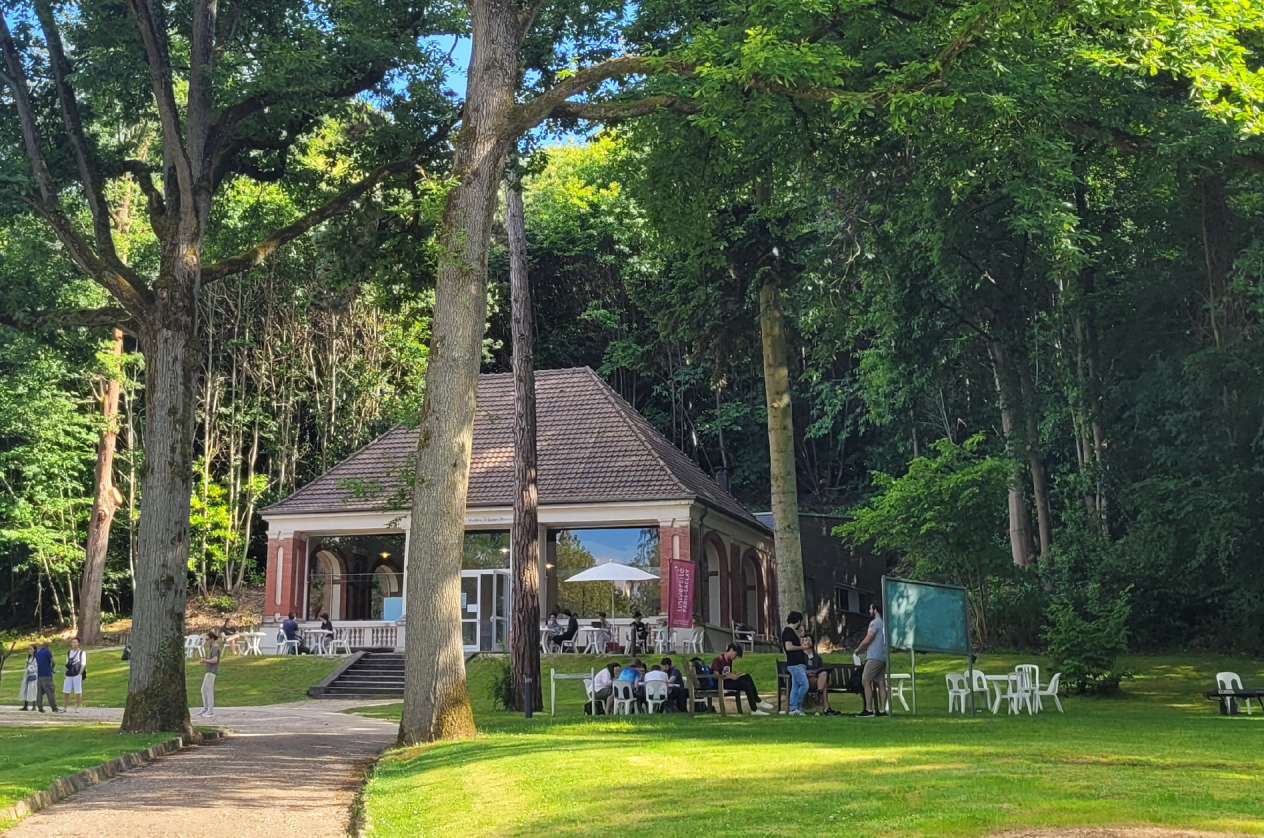
The Summer school on « Aspects of Geometric Group Theory » will be held at the Institut des Hautes Etudes Scientifiques (IHES) from 8 to 19 July 2019. IHES is located in Bures-sur-Yvette, south of Paris (40 minutes by train from Paris).

This school is open to everybody but intended primarily for young participants, including PhD students and postdoctoral fellows.

A group is a mathematical object encoding natural notions of symmetries and transformations. Geometric group theory is an area in mathematics devoted to the study of discrete groups by exploring connections between algebraic properties of such groups and topological and geometric properties of spaces on which these groups act.

As a distinct area, geometric group theory is relatively new, and became an identifiable branch of mathematics in the early 1990s. Geometric group theory closely interacts with low-dimensional topology, hyperbolic geometry, Lie groups and homogeneous spaces, algebraic topology, computational group theory, and differential geometry. There are also substantial connections with complexity theory, mathematical logic, dynamical systems, probability theory, K-theory, and other areas of mathematics.

Nowadays, geometric group theory is a very active and competitive area of research, as shown by the many conferences in the field but also several special programs such as an IHP program in 2014, a jumbo MSRI program in 2016 and a program at the Newton Institute in 2017 to name a few.

We will choose a few important trends in geometric group theory and teach those to graduate students across mathematical fields, so that young people in several areas of mathematics such as algebra, geometry, dynamics, or topology have some basics to either understand a few problems in geometric group theory, or use geometric group theory methods in their respective fields. Geometric group theory is a very broad area, and we will mainly focus on geometric aspects.

INVITED SPEAKERS:

So far the following people have agreed to give a mini-course:

Yves Benoist (CNRS and Université Paris-Sud)
Kai-Uwe Bux (Universität Bielefeld)
Ruth Charney Brandeis University)
François Dahmani (Université Grenoble Alpes)
Anna Erschler (CNRS and ENS)
François Guéritaud (CNRS and Université de Lille)
Kathryn Mann (Brown University)
Yair Minsky (Yale University)
Karen Vogtmann (University of Warwick)
Genevieve Walsh (Tufts University)
Anna Wienhard (Universität Heidelberg)
Daniel T. Wise (McGill University)

This is an IHES Summer School, organized in partnership with the Clay Mathematical Institute, and the support of the Société Générale, the FMJH, the IUF, the ANR GAMME, the project Jeunes Géomètres, the National Science Foundation and the ERC.

 

2015 Summer School on Moduli Problems in Symplectic Geometry

Organized as part of the IHÉS Lectures, this Summer School aims to provide PhD students, post-docs, and young researchers with an overview of recent developments in the theory of moduli spaces of pseudoholomorphic curves in symplectic and contact geometry.

Moduli spaces of pseudoholomorphic curves arise as the zero set of a Fredholm section of a suitable bundle. Provided this section can be appropriately perturbed, these moduli spaces yield powerful contact and symplectic invariants such as Gromov-Witten theory, contact homology, symplectic homology, and Symplectic Field Theory. Constructions and applications of these invariants will be addressed in detail during the workshop. There are two main perturbative techniques, geometric and functional analytic.

The geometric perturbation methods are powerful for applications and practical from a computational point of view but typically require many restrictive assumptions and fail to generalize broadly. We will introduce researchers to the polyfold machinery of Hofer, Wysocki, and Zehnder, a new analytic framework designed to resolve the issue of transversality systematically. As computations are integral in applications of the aforementioned invariants, we will also explore how geometric perturbation schemes can be incorporated into the polyfold package.

We will supplement 7 mini courses with moderated discussions and related talks by senior faculty on current and future directions for the field.

Confirmed speakers:

M. Abouzaid, Columbia University *
P. Biran, ETH Zürich
N. Bottman, Massachusetts Institute of Technology
F. Bourgeois, Université Paris-Sud Orsay
D. Cristofaro-Gardiner, Harvard University
T. Ekholm, Uppsala University *
Y. Eliashberg, Stanford
J. Fish, Institute for Advanced Study *
H. Hofer, Institute for Advanced Study *
M. Hutchings, UC Berkeley *
D. McDuff, Barnard College, Columbia University
J. Nelson, Columbia University and the Institute for Advanced Study
I. Smith, University of Cambridge
J. Solomon, Hebrew University
C. Viterbo, Ecole Normale Supérieure
K. Wehrheim, UC Berkeley *
C. Wendl, University College London *

* Mini course speakers

Organizing Committee

Chair: J. Nelson (Columbia University and the Institute for Advanced Study)
D. Cristofaro-Gardiner (Harvard University)
J. Fish (Institute for Advanced Study and UMass Boston)

Scientific Advisory Committee

H. Hofer (Institute for Advanced Study)
M. Hutchings (UC Berkeley)
D. McDuff (Barnard College, Columbia University)

With the support of La Société Générale


Spectral properties of large random objects

The Summer school on "Spectral properties of large random objects" will be held at the Institut des Hautes Etudes Scientifiques (IHES) from July 17 to July 28, 2017. IHES is located in Bures-sur-Yvette, south of Paris (40 minutes by train from Paris).

The school is open to everybody but intended primarily for young participants, including PhD students and postdoctoral fellows.

Studying spectral properties of large random objects has been a very active playground in probability theory, mathematical physics and computer science during the last decades. 

The motivations are manifold: viewing random matrices as a model for complicated quantum Hamiltonians, studying random Schrödinger operators to understand the Anderson localization phenomenon, viewing eigenvectors of random matrices as models for eigenmodes of quantized chaotic systems, or understanding the geometry of large (random) graphs such as expanders via the spectral properties of their adjacency matrices. In those studies the emphasis is generally put either on the eigenvalues or the eigenvectors of the object.

The goal of the summer school is to present to the selected students (from master students to postdocs) a panoramic view of this rich area, in order to arouse their interest for some old problems which are coming back on stage, as well as the new exciting horizons of the field.

Some funding is available for young participants (more info at the bottom of the page)

Main courses:

• Charles BORDENAVE (Université de Toulouse) 
   Spectrum of random graphs
• Paul BOURGADE (New York University) 
   Universality and quantum unique ergodicity in random matrix theory
• Frédéric KLOPP (Université Pierre et Marie Curie)  
   Large systems of interacting quantum particles in a random field
• Eyal LUBETZKY (New York University) 
   Spectral vs. geometric approaches to random walks on random graphs
• Yuval PERES (Microsoft Research) 
   The cutoff phenomenon and rate of escape for Markov chains
• Christophe SABOT (Université de Lyon 1) 
   Self-interacting processes and random Schrödinger operators
• Balint VIRAG  (University of Toronto) 
  Operator limits of random matrices
• Simone WARZEL  (Technische Universität München)  
   Topics in random operator theory

Talks by:

• Nathanaël ENRIQUEZ (Université Paris X, LPMA)
• Camille MALE (CNRS & Université de Bordeaux)
• Justin SALEZ (Université Paris-Diderot, LPMA)

Organising Committee:

Nicolas CURIEN (Université Paris-Sud) 
Hugo DUMINIL-COPIN (IHES)
Jean-François LE GALL (Université Paris-Sud)
Stéphane NONNENMACHER (Université Paris-Sud)

With the support of


École d’été 2014 Théorie analytique des nombres

Objective

­ ­ Organised as part of the "IHÉS Lectures", this Summer School aims to train PhD students, post-docs and young researchers on recent topics of Analytic Number Theory and to promote exchanges between young researchers of all nationalities.

Analytic number theory began with the first questions concerning the distribution of prime numbers. Since then, the subject has evolved in many directions; it has influenced and interacted with many areas of mathematics, by lending or borrowing ideas going from combinatorics to representation theory, and from modular forms to the deepest reaches of algebraic geometry.

The summer school will cover both classical and emerging topics of analytic number theory, with a focus on the properties of prime numbers:

(1) advanced sieve methods and their refinements, including approaches to gaps between primes and asymptotic sieve for primes;

(2) distribution of arithmetic functions in arithmetic progressions, especially in ranges beyond the direct reach of the Riemann Hypothesis;

(3) exponential sums over finite fields, and their analytic applications, with a focus on the formalism and uses of Frobenius trace functions;

(4) modular forms and associated L-functions, and other analytic aspects of the Langlands program, such as the behavior of torsion homology;

(5) additive combinatorics.


­ ­

Avec le soutien de
la Société Générale


Speakers

Jean BOURGAIN (Princeton, USA)

Valentin BLOMER (Universität Göttingen, Germany)

Etienne FOUVRY (Université Paris-Sud, Orsay)

Andrew GRANVILLE (Université de Montréal, Québec)

Harald HELFGOTT (ENS, Paris)

Henryk IWANIEC (Rutgers University, Piscataway, USA)

Emmanuel KOWALSKI (ETH Zürich, Switzerland)

Philippe MICHEL (EPFL Lausanne, Switzerland)

Peter SARNAK (IAS Princeton, USA)

Kannan SOUNDARARAJAN (Stanford University, USA)

Terence TAO (UCLA, USA)

Akshay VENKATESH (Stanford University, USA)

Autre événement

Workshop on Analytic Number Theory and Geometry
organisé par Farrell Brumley
24-25 juillet, 2014
Université Paris 13

Supersymmetric Localization and Exact Results

Organising Committee Elli Pomoni(DESY)  Bruno Le Floch (Princeton University) and Masahito Yamazaki (Kavli IPMU, University of Tokyo)

Scientific Committee: Vasily Pestun (IHES), Silviu Pufu (Princeton University), Joerg Teschner (DESY)

The Summer school on "Supersymmetric Localization and Exact Results" will be held at the Institut des Hautes Etudes Scientifiques (IHES) from July 16 to July 27, 2018. IHES is located in Bures-sur-Yvette, south of Paris (40 minutes by train from Paris).

This school is open to everybody but intended primarily for young participants, including PhD students and postdoctoral fellows.

Significant progress has been made in the study of gauge theories in the last decade. Thanks to the discovery of novel techniques and especially supersymmetric localization, the field now possesses a plethora of exact results that previously seemed unreachable.

Starting with the work of Nekrasov who computed the instanton partition function for N=2 theories in four dimensions, Pestun computed the exact partition function on a four-sphere for theories with N=2 supersymmetry. Shortly after the partition functions as well as other observables in various spacetime dimensions and compact manifolds were computed.

Our school aims in deepening the understanding of current results and at investigating which of our current methods are transferable to theories with less supersymmetry, as well as trying to increase the list of possible observables that are computable via localization.

Each week will feature three or four speakers giving one lecture per day. During the first week, in addition to these three one hour and a half lectures there will be discussion and homework sessions in the afternoon. During the second week, some of the lectures will be replaced by talks on more advanced topics.

The main lectures will cover the following topics:

Week 1: Introduction to localization, Localization of instantons and Exact results on 4d N=2 theories

Week 2:  Topological strings and matrix models, M5 brane compactifications and Zamolodchikov metric and tt^* equation

Advanced talks week 2: Chiral algebras, N=1 localization, Localization with boundaries, line operators, surface operators, relations to CFT and integrable systems

INVITED SPEAKERS:

Week 1: 1h30 per topic per day
     Francesco Benini(SISSA
     Guido Festuccia (Uppsala)
     Wolfger Peelaers(Rutgers)

Advanced talk in week 1: 2-3 hours
     Seiji Terashima (Kyoto)

Week 2: 1h30 per topic per day
     Zohar Komargodski (Stony Brook)
     Maxim Zabzine (Uppsala)

Advanced talks in the second week: 2-3 hours each
     Nikita Nekrasov (Simons Center)
     Takuya Okuda (Tokyo)
     Balt van Rees (Durham)
 

Some funding is available for young participants (more info at the bottom of the page)

With the support of


Nonlinear Waves 2016: Summer School

Organized as part of the IHÉS Lectures, this 2-weeks Summer School will be the last major scientific event of the special trimester on Non-Linear Waves that will start in the beginning of May 2016 at IHÉS. This school aims at providing an overview of recent developments in the field at this stage of the new cycle started a few years ago and to provide to post-docs and researchers in the early stage of their career working in these domains an opportunity to interact with leading experts on the subject.

Another objective is to gather researchers with different backgrounds whose research is much more converging today than 4 years ago, such as the French schools working on fluid models, on kinetic theory, dynamical systems and partial differential equations in relation to finite-dimensional Hamiltonian models or the microlocal community.

Last but not least, another objective would be the following: the advances have helped to solve classical problems from physics with new and very advanced methods based on analytical intuition thus not always understood or simply not well-known by the physicists. The idea would be to initiate a transfer to physicists interested in non linear waves phenomena and intensify the discussions on more realistic models, whether fluid, kinetic or of high-frequency waves.

We will supplement mini courses (3 hours) in the morning and plenary talks in the afternoon (40-45 minutes) during 2 weeks.

Mini course speakers:

Rupert FRANK (California Institute of Technology)
Carlos KENIG (University of Chicago)
Nader MASMOUDI (Courant Institute of Mathematical Sciences)
Benoît PAUSADER (Brown University)
Michela PROCESI (Universita di Roma 1)
Robert STRAIN (University of Pennsylvania)
Daniel TATARU (University of California at Berkeley)

Plenary talks speakers:

Stefano BIANCHINI (SISSA)
Rémi CARLES (CNRS – IMAG Montpellier)
Stephen GUSTAFSON (University of British Columbia)
Joachim KRIEGER (EPFL)
Hans LINDBLAD  (Johns Hopkins University)
Hiroshi MATANO  (School of Science, University of Tokyo)
Natasa  PAVLOVIC (University of Texas at Austin)
Robert PEGO  (Carnegie Mellon University)
Svetlana ROUDENKO (George Washington University)
Gigliola  STAFFILANI (Massachusetts Institute of Technology)
Tai-Peng TSAI (University of British Columbia)
Nicola VISCIGLIA (Universita di Pisa)
Sijue WU (University of Michigan)

Organising Committee:

Yvan MARTEL (École Polytechnique)
Frank MERLE (Université de Cergy-Pontoise & IHÉS)
Fabrice PLANCHON (Université Nice Sophia-Antipolis)
 

Crédit photographique: © CNRS Photothèque
RAJAU Benoît (UMR7538 – Laboratoire de physique des lasers (LPL), VILLETANEUSE et VRIGNAUD François (UMR6172 – XLIM – LIMOGES)

With the support of