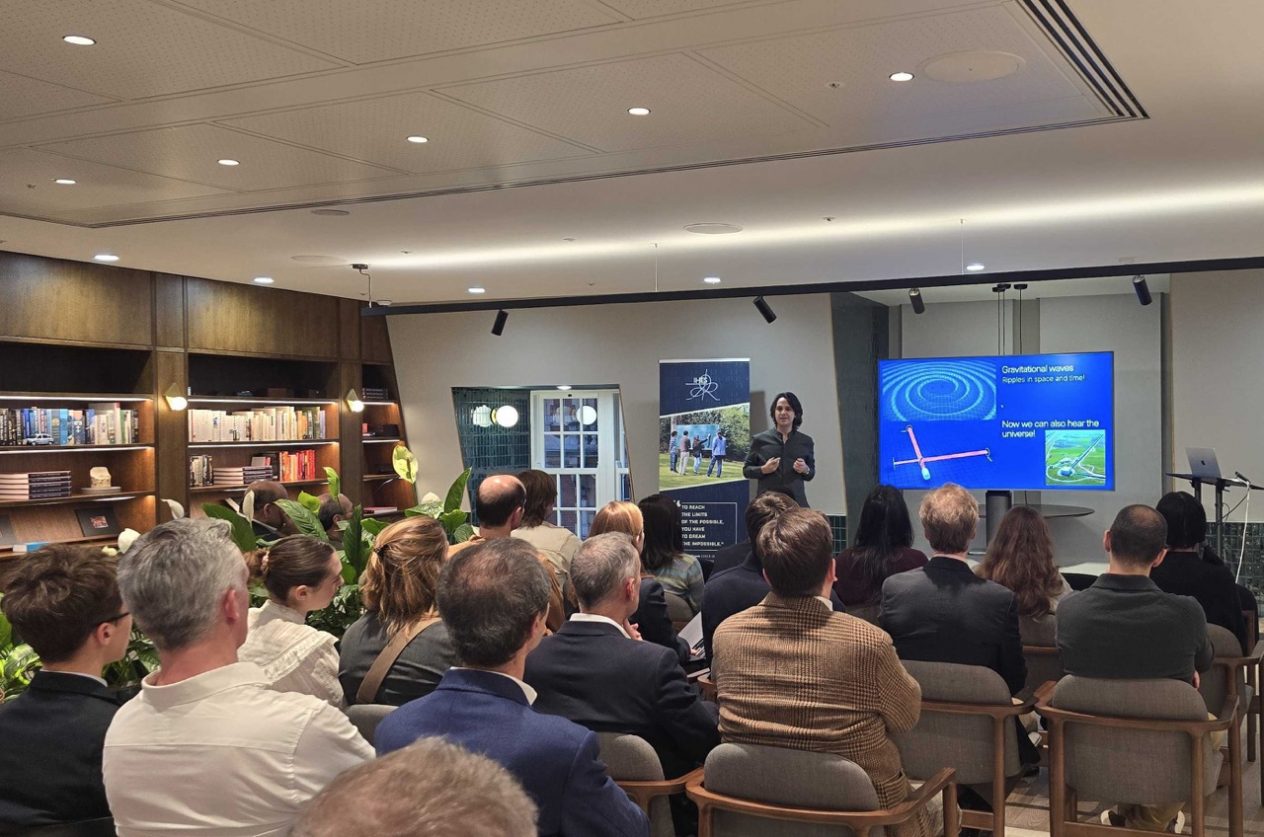
Huawei-IHES Workshop on Mathematical Theories for Information and Communication Technologies

As part of the IHES-Huawei partnership, this one-day workshop is organised by the Huawei's Mathematical and Algorithmic Sciences Lab jointly with IHÉS and aims at creating scientific exchanges around mathematical topics that are essential for the development and innovation of the ICT.


Colloque de clôture du trimestre : le Monde Quantique

Si vous souhaitez vous inscrire pour le repas de midi, veuillez envoyer un mail à Elisabeth Jasserand : jasserand@ihes.fr

Arithmetic and Algebraic Geometry: A conference in honor of Ofer Gabber on the occasion of his 60th birthday

Arithmetic and Algebraic Geometry:

A conference in honor of Ofer Gabber on the occasion of his 60th birthday

List of speakers includes:

     Y. André (CNRS & IMJ-PRG),
     A. Beilinson (University of Chicago),
     B. Bhatt (University of Michigan),
     B. Conrad (Stanford),
     G. Faltings (MPIM),
     D. Gaitsgory (Harvard),
     K. Kato (University of Chicago),
     N. Katz (Princeton),
     M. Kisin (Harvard),
     G. Laumon (Université Paris-Sud),
     G. Lusztig (MIT),
     M. Olsson (UC Berkeley),
     F. Orgogozo (CNRS & École polytechnique),
     L. Ramero (Université de Lille I),
     T. Saito (University of Tokyo),
     P. Scholze (Universität Bonn),
     A. Shiho (University of Tokyo),
     Y. Varshavsky (Hebrew University of Jerusalem),
     A. Vasiu (Binghamton University),
     G. Williamson (University of Sydney),
     W. Zheng (Morningside Center of Mathematics)

Organising Committee:

     A. Abbes (CNRS & IHÉS),
     S. Bloch (University of Chicago),
     L. Illusie (Université Paris-Sud),
     B. Mazur (Harvard)

Organized in partnership with 

Workshop “Hamiltonian methods in strongly coupled Quantum Field Theory”

Many interesting strongly interacting Quantum Field Theories are not amenable to analytical treatment. This workshop will focus on systematic numerical approaches to such theories relying on the quantum Hamiltonian, including Truncated Spectrum Approach, Light Front Quantization, Matrix Product States and Tensor Networks. Such methods provide a viable alternative to Lattice Monte Carlo simulations. Their advantage is the ability to access real-time observables, and to study Renormalization Group flows originating from strongly-interacting fixed points.


Speakers and talks:

Mari Carmen BANULS (MPI Quantum Optics, Garching)
Tensor network applications to (1+1)d gauge theories

Giuseppe CARLEO (ETH Zurich)
Neural-network quantum states

Sophia CHABYSHEVA (University of Minnesota Duluth)
Application of Light-Front methods to model theories   

Philippe CORBOZ (University of Amsterdam)
Simulation of 2D strongly correlated systems with infinite projected entangled-pair states

Joan ELIAS-MIRÓ  (SISSA, Trieste)
Precise calculations with the Renormalized Hamiltonian Truncation approach

Brian HENNING (Yale University)
Free field states and conformal bases

John HILLER (University of Minnesota Duluth)
Nonperturbative light-front methods

Andrew JAMES (University College London)
Truncated spectrum approaches for 2D many-body quantum systems

Andreas LÄUCHLI (University of Innsbruck)
Numerical Hamiltonian truncation approach to the phi^4 theory in 1+1d and beyond

Giuseppe MUSSARDO (SISSA, Trieste) 
Sinh-Gordon model and its duality

Didier POILBLANC (CNRS Toulouse)
Investigation of the chiral antiferromagnetic Heisenberg model using PEPS

Frank POLLMANN (TUM Munich)
Finding purifications with minimal entanglement

Neil ROBINSON (University of Amsterdam)
Rare non-thermal states in the non-integrable Ising field theory

Marco SERONE (SISSA, Trieste)
A look at phi^4_2 using perturbation theory

Gábor TAKÁCS (Budapest University of Technology and Economics)
Applications of TCSA to quenches

Guifré VIDAL (Perimeter Institute, Waterloo)
Conformal data from critical spin chains using periodic MPS and the Koo-Saleur formula

Karel VAN ACOLEYEN (University of Gent)
Tensor networks and the Schwinger model

Matthew WALTERS (CERN) 
Studying RG Flows with Lightcone Conformal Truncation

Program:

 
Mon Jan 8
Tue Jan 9
Wed Jan 10
Thu Jan 11
Fri Jan 12

9:30-11:00
morning coffee and
registration
morning coffee
morning coffee
morning coffee
morning coffee

 
TCSA session 1

MPS for gauge theories

 
lightfront day
TCSA session 2

10:00-11:00
Takacs
Van Acoleyen
Serone
Hiller
James

11:00-11:30
coffee break
coffee break
coffee break
coffee break
coffee break

11:30-12:30
Mussardo
Banuls
Vidal
Chabysheva
Robinson

12:30-14:30
lunch buffet
lunch buffet
lunch buffet
lunch buffet
lunch buffet


(phi^4)_2 session
PEPS session


14:30-15:30
Carleo
Elias-Miro
Corboz
Walters
 

15:30-16:30
coffee break
coffee break
coffee break
coffee break
free afternoon

16:30-17:30
Pollmann
Läuchli
Poilblanc
Henning


17:30 cocktail party


The talks have been recorded and are available at:

 Organisers:

   Ami KATZ (Boston University)
   Robert KONIK (Brookhaven National Laboratory)
   Slava RYCHKOV (IHES and ENS)
   Balt VAN REES (Durham University)

Supported by: the Simons Collaboration on the Non-perturbative Bootstrap http://bootstrapcollaboration.com/

Rencontre autour des Publications Mathématiques de l’IHÉS

Rencontre autour des Publications Mathématiques de l'IHÉS
­Tuesday 22 January 2013­
IHÉS, Marilyn and James Simons Conference Center


­Organised by : ­
­Claire Voisin (CNRS-IMJ, Paris)
­Editor-in-chief of Les Publications Mathématiques de l'IHÉS


­ ­ ­

PROGRAMME­

11:00 – 12:00

­A­nton Zorich (Paris 7)
"Sum of Lyapunov exponents of the Hodge bundle with respect to the Teichmüller geodesic flow" (joint work with A. Eskin and M. Kontsevich)

12:00 – 14:00
Buffet lunch

2:00 – 3:00
Irina Kourkova (UPMC)
"On the functions counting walks with small steps in the quater plane''

3:00 – 3:30
Coffee break

3:40 – 4:40
Emmanuel Breuillard (Paris-Sud)
­ "La structure des groupes approximatifs et le cinquième problème de Hilbert"­

­­ ­ ­ ­

ABSTRACTS

Emmanuel Breuillard (Paris-Sud)
­ "La structure des groupes approximatifs et le cinquième problème de Hilbert"­


Nous montrons un théorème de structure des sous-groupes approximatifs d'un groupe abstrait G, i.e. des grandes parties fin­ies A de G vérifiant une condition de doublement (AA est recouvert par un nombre borné de
translatés de A). En bref les sous-groupes approximatifs sont « presque nilpotents''. Ce théorème s'apparente à la fois au théorème de structure des groupes localement compacts (cinquième problème de Hilbert: Gleason, Yamabe, Montgomery-Zippin) et au théorème de Gromov sur les groupes à croissance polynomiale. Les théoriciens des modèles (Hirschfeld, Goldbring-van-den-Dries) ont jeté un éclairage nouveau sur la preuve du cinquième problème de Hilbert et mis en évidence le lien avec les groupes approximatifs (Hrushovski) rendant possible l'adaptation des techniques de Gleason et Yamabe dans le cadre des groupes approximatifs. Travail en commun avec B. Green et T. Tao. ­

­

Irina Kourkova (UPMC)
"On the functions counting walks with small steps in the quater plane'' ­


On considère le nombre de chemins $q_S((i,j),n)$ dans le quart de plan $({bf Z}_+)^2$ partant du point $(0,0)$, arrivant au point $(i,j)$ en $n$ pas dont les déplacements appartiennent à un sous-ensemble fixé $S subset {-1,0,1}^2/setminus {(0,0)}$. Il existe $2^8$ choix pour $S$ et donc $2^8$ modèles à étudier. Pour tous ces modèles nous explicitons la fonction génératrice $Q_S(x,y,z)=sum_{(i,j)in ({bf Z_+})^2, ngeq 0} q_S((i,j),n)x^iy^jz^n$ de manière unifiée et étudions ensuite sa nature en fonction de l'ensemble $S$: rationnelle, algébrique, holonome ou non-holonome. Le travail est commun avec ­Kilian Raschel. (see the­ pdf)­­ ­

­

A­nton Zorich (Paris 7)
"Sum of Lyapunov exponents of the Hodge bundle with respect to the Teichmüller geodesic flow" (joint work with A. Eskin and M. Kontsevich)

 
Various properties of dynamical systems on Riemann surfaces, of billiards in polygons, of measured foliations can be described in the language of the associated flat metric with conical singularities and with trivial holonomy. Such metric naturally defines a complex structure and a holomorphic 1-form on the Riemann surface. I will try to sho­w how sophisticated geometric properties of the individual flat surface are related to simpler properties of t­he complex Teichmuller geodesic (or, more precisely, of its closure) in the moduli space of Abelian differentials.­ ­

Algebraic Geometry – A conference in honor of Arthur Ogus on the occasion of his 70th birthday

Speakers

A. Beilinson (University of Chicago),
P. Berthelot (Université de Rennes 1),
B. Bhatt (University of Michigan),
S. Bloch (University of Chicago),
F. Charles (Université Paris-Sud),
O. Gabber (CNRS, IHÉS),
K. Kato (University of Chicago),
C. Nakayama (Hitotsubashi University),
M. Olsson (University of California, Berkeley),
M. Temkin (Hebrew University of Jerusalem),
V. Vologodsky (University of Oregon,
X. Zhu (California Institute of Technology)

Journée inaugurale du Laboratoire Alexander Grothendieck – Équipe de Recherche Labellisée CNRS-IHÉS

Orateurs
Spencer Bloch (University of Chicago et IHES)
François Charles (Université Paris-Sud)
Ofer Gabber (CNRS et IHES)
Luc Illusie (Université Paris-Sud)
Vincent Lafforgue (CNRS et Université d'Orléans)

Colloque d’ouverture du trimestre : Le Monde Quantique

Parmi les expériences les plus importantes qui testent les prédictions fondamentales ou les aspects troublants de la mécanique quantique, nombreuses sont celles qui ont été menées par des groupes de recherche en France, en particulier ceux qui travaillent dans la région parisienne. En outre, le travail théorique sur les fondements de la mécanique quantique a une tradition de longue date en France qui s’est poursuivie jusqu'à ce jour. Enfin, les problèmes concernant l'unification de la théorie quantique avec la théorie de la gravitation sont activement étudiés par des chercheurs de la région parisienne, notamment à l'IHES. Pour ces raisons, il semble naturel et hautement souhaitable de faire le point sur l'état de l'art dans ce domaine et de rendre compte des grands progrès récemment accomplis.

C’est exactement le but du programme trimestriel de séminaires et colloques décrit ci-dessous qui aura lieu à l’IHES de janvier à avril 2015. Ce programme devrait, nous l’espérons, être utile pour, et intéresser, la communauté scientifique locale.

Le programme, qui réunira des physiciens expérimentateurs et des théoriciens spécialisés en sciences quantiques, se déroulera sur 11 semaines avec un colloque d'ouverture le 29  janvier puis un séminaire hebdomadaire avec des exposés et discussions autour d'un thème précis du 4 février au 1er avril, et, pour finir, un colloque de clôture qui aura lieu les 9 et 10 avril.­ 

Cellular and Molecular Biotechnology

Synthetic Biology is heralded as a novel approach to the engineering of biosystems that will set the scene for a flourishing knowledge-based bio-economy. Benefits for the fundamental understanding of biological phenomena are also claimed, as rational construction of a system based on hypothesized design principles can be used to test assumptions. The keywords of synthetic biology are rational design, decoupling of conception and fabrication, standardization and component re-use, modularity and hierarchy, orthogonality and context-insensitivity. However, each keyword raises questions of desirability and feasibility. These questions remain ongoing areas of inquiry for the field and require multi-faceted approaches. Beyond the current hype surrounding it, what is the value of synthetic biology for the progress in understanding of biological systems and for the establishment of new biotechnological production platforms?

Scientific committee

Steven BENNER, Ffame, Gainesville, USA
Victor DE LORENZO, CNB, CSIC, Madrid, ES
Tim GARDNER, Riffyn, Oakland, CA, USA
Misha GROMOV, IHÉS, Bures-sur-Yvette, FR, Chair
Jutta HEIM, Evolva, Reinach, CH
Patrick JOHNSON, Dassault Systèmes, Vélizy, FR
François KÉPÈS, Genopole, CNRS, Evry, FR, Chair
Richard KITNEY, Imperial College London, UK
Udo REICHL, Max Planck Institute for Dynamics of Complex Technical Systems, Magdeburg, DE
Susan ROSSER, Edinburgh University, UK
Reshma SHETTY, Ginkgo Bioworks, Boston, Mass, USA
Minus VAN BAALEN, ENS Paris, FR


Speakers

Nitin BALIGA, Institute for Systems Biology, Seattle, USA
David BIKARD, Institut Pasteur, Paris, FR
Jef BOEKE, Langone Medical Center, NY Univ., USA
Nico CALLEWAERT, Dpt of Medical Protein Research, Univ.Gent, BE
Yvonne CHEN, Chemical and Biomolecular Engr, UCLA, USA
Tom ELLIS, Dpt of Bioengineering, Imperial College, London, UK
Luis Angel FERNANDEZ, Centro Nacional de Biotecnología, Madrid, ES
Paul FREEMONT, Dpt of Medicine, Imperial College, London, UK
Martin FUSSENEGGER, Dpt of Biosystems Science & Engr, ETH, Zurich, CH
Ming HAMMOND, Depts of Chemistry and MCB, UC Berkeley, USA
Jim HASELOFF, Dpt of Plant Sciences, Univ. of Cambridge, UK
Piet HERDEWIJN, KU Leuven, BE & iSSB-CNRS, Genopole, FR
Ichiro HIRAO, Institute of Bioengineering and Nanotechnology (IBN), The Nanos, SG
Philipp HOLLIGER, Lab. of Molecular Biology, Cambridge, UK
Farren ISAACS, The Sackler Institute, Yale Univ., New Have, USA
Kirsten JUNG, LMU Division of Microbiology, Münich, DE
Sébastien LEMIRE / Timothy K. LU, Research Laboratory of Electronics (RLE) at MIT, Cambridge, USA
Maria LLUCH SENAR / Luis SERRANO, Center for Genomic Regulation (CRG), Barcelona, ES
Philippe MARLIERE, Global Bioenergies, Evry, FR
Goksel MISIRLI / Anil WIPAT, School of Computing Science, Univ. of Newcastle, UK
Pablo I. NIKEL, Centro Nacional de Biotecnología, Madrid, ES
Anne OSBOURN, John Innes Centre, Norfolk, UK
Sven PANKE, Bioprocess Laboratory, ETH Zürich, CH
Floyd ROMESBERG, The Scripps Research Institute, La Jolla, USA
Eriko TAKANO, Faculty of Life Sciences, Univ. of Manchester, UK
Danielle TULLMAN-ERCEK, Dpt of Chemical and Biomolecular Engr, UC Berkeley, USA

Discussants

Daniel BENNEQUIN University Paris 7, FR
Rui DILÃO Instituto Superior Técnico, PT
Dmitry GRIGORIEV CNRS & MPI, Bonn, DE
Alexander GORBAN University of Leicester, UK
Willy JÄGER University of Heidelberg, DE
Olivier MARTIN CNRS-INRA, Gif-sur-Yvette, FR
Robert PENNER Caltech, USA & IHÉS, FR
Christophe SOULÉ CNRS-IHÉS, FR
Alain TROUVÉ ENS-Cachan, FR
Vitaly VOLPERT Université de Lyon1, FR
Andrei ZINOVYEV Institut Curie, FR
​Pasha ZUSMANOVICH University of Ostrava, CR

Organizing Committee : François KÉPÈS, Mikhail GROMOV, Nadya MOROZOVA,

 

Huawei-IHÉS Workshop on Mathematical Sciences

As part of the IHES-Huawei partnership, this one-day workshop is organised by the Huawei's Mathematical and Algorithmic Sciences Lab jointly with IHÉS and aims at creating scientific exchanges around mathematical topics that are essential for the development and innovation of the ICT.

Journée Statistique / Apprentissage à Paris Saclay

The aim of this workshop is to bring together mathematicians and computer scientists around some talks on recent results in statistics and machine learning. Various theoretical topics in machine learning, optimization, deep learning, statistics and probability theory will be presented as well as applications to astrophysics and biology.

Registration is free and open from November 8, 2018 to January 20, 2019.

Organised by : Pierre Alquier (ENSAE) et Alexandre Gramfort (INRIA)

Invited speakers :

Jérôme BOBIN (CEA LCS)
Robert GOWER (Telecom ParisTech)
Flora JAY (CNRS, LRI)
Edouard OYALLON (CentraleSupélec / INRIA)
Thanh Mai PHAM NGOC (LMO – Université Paris Sud)
Erwan SCORNET (CMAP, École Polytechnique)


Nonlinear Waves 2016: May Conference

List of speakers includes:

     Massimiliano BERTI (SISSA)
     Lydia BIERI (University of Michigan)
     Piotr BIZON (Jagellonian University, Krakow)
     Walter CRAIG (McMaster University)
     Pietro D'ANCONA (Universita di Roma 1)
     Manuel DEL PINO (Universidad de Chile)
     Jean-Marc DELORT (Université Paris 13)
     Erwann FAOU (Université de Rennes 1)
     Gadi FIBICH (Tel Aviv University)
     Mahir HADZIC (King's College London)
     Oana IVANOVICI (Université de Nice-Sophia Antipolis)
     Sergiu KLAINERMAN (Princeton University)
     Herbert KOCH (Universität Bonn)
     Tetsu MIZUMACHI (Kyushu University)
     Kenji NAKANISHI (Osaka University)
     Sung-Jin OH (University of California, Berkeley)
     Gustavo PONCE (University of California at Santa Barbara)
     Didier SMETS (Université Pierre et Marie Curie)
     Laurent THOMANN (Université de Lorraine)
     Peter TOPPING (Warwick University)
     Luis VEGA (Universidad del Pais Vasco)
     Monica VISAN (University of California at Los Angeles)

Organising Committee:

     Frank MERLE (Université de Cergy-Pontoise & IHÉS)
     Pierre RAPHAËL (Université Nice Sophia-Antipolis)
     Nikolay TZVETKOV (Université de Cergy-Pontoise)

Crédit photographique: © CNRS Photothèque
RAJAU Benoît (UMR7538 – Laboratoire de physique des lasers (LPL), VILLETANEUSE et VRIGNAUD François (UMR6172 – XLIM – LIMOGES)

With the support of