
Modified Scattering for the Three Dimensional Maxwell-Dirac System
Séminaire Laurent Schwartz — EDP et applications
Séminaire Laurent Schwartz — EDP et applications
Séminaire Laurent Schwartz — EDP et applications
Séminaire Laurent Schwartz — EDP et applications
A category of motives is an axiomatic framework in which several cohomology theories, which typically appear in algebraic geometry, are represented. While Voevodsky’s classical framework of motivic homotopy theory focused on $mathbb{A}^1$-invariant cohomology theories, such as $ell$-adic étale cohomology, the more recent developments in integral $p$-adic Hodge theory have motivated lots of progress towards a more general theory of non-$mathbb{A}^1$-motives in which $p$-adic cohomology theories, such as crystalline or prismatic cohomology, are also represented. In this talk, I want to explain how the Beilinson–Lichtenbaum phenomenon in non-$mathbb{A}^1$-invariant motivic cohomology can be used to shed some light on the proof of Fontaine’s crystalline conjecture in $p$-adic Hodge theory. This is based on a joint work with Arnab Kundu, where we develop a version in families of Gabber’s presentation lemma to prove such a Beilinson–Lichtenbaum phenomenon over general valuation rings.
========
Pour être informé des prochains séminaires vous pouvez vous abonner à la liste de diffusion en écrivant un mail à sympa@listes.math.cnrs.fr avec comme sujet: « subscribe seminaire_mathematique PRENOM NOM »(indiquez vos propres prénom et nom) et laissez le corps du message vide.
Running Seminar
========
Pour être informé des prochains séminaires vous pouvez vous abonner à la liste de diffusion en écrivant un mail à sympa@listes.math.cnrs.fr avec comme sujet: « subscribe seminaire_mathematique PRENOM NOM »(indiquez vos propres prénom et nom) et laissez le corps du message vide.
In this talk, I will discuss various aspects of the Distance Conjecture in AdS/CFT. First, I will briefly introduce the Distance Conjecture and how to naturally translate it to the CFT side, as encoded in the CFT Distance Conjecture. In the second part, I will sketch a proof of the first statement in this conjecture, namely that higher-spin symmetry always lies at infinite distance in the conformal manifold of any local CFT in more than two dimensions. For the third part, we will change gears from model-independent proofs to asking more refined questions in well-known models. Specifically, we will focus on a mini-landscape of supersymmetric CFTs in four dimensions which feature three distinct infinite distance limits distinguished by the CFT Distance Conjecture parameter. Borrowing insights from the Swampland program, I will argue that these three limits correspond to three different strings becoming tensionless in AdS. To support this claim, I will discuss how some properties of these CFTs, such as their large N Hagedorn temperature, are determined solely by the CFT Distance Conjecture parameter. I will also discuss how one of these limits nicely fits with the Type IIB string, while another corresponds to a non-critical string theory in AdS.
Pour être informé des prochains séminaires vous pouvez vous abonner à la liste de diffusion en écrivant un mail à sympa@listes.math.cnrs.fr avec comme sujet: « subscribe seminaire_physique PRENOM NOM »(indiquez vos propres prénom et nom) et laissez le corps du message vide.
Séminaire Amplitudes et Gravitation sur l’Yvette (IHES/IPhT)
Reconstructing the metric of a perturbed black hole due to the presence of a companion, including both the stationary and radiative contributions, is a highly non-trivial problem. In this talk, we address this to linear order in perturbation theory through the characteristic initial value formulation, prescribing data on two intersecting null hypersurfaces, one of which is a perturbed isolated horizon. By including the possibility of small amounts of infalling radiation at the horizon, we show that the ringdown modes arise naturally in this formalism when there is no incoming radiation from null infinity. This therefore establishes analytically strong correlations between the usual quasi-normal modes observed in the outgoing radiation with the horizon geometry and the infalling radiation at the horizon. This can be viewed as a demonstration of black hole tomography in a perturbative setting, where we are able to determine the detailed dynamics of the horizon geometry based on observations of gravitational waves from the late stage of a binary black hole merger.
Pour être informé des prochains séminaires vous pouvez vous abonner à la liste de diffusion en écrivant un mail à sympa@listes.math.cnrs.fr avec comme sujet: « subscribe seminaire_physique PRENOM NOM »(indiquez vos propres prénom et nom) et laissez le corps du message vide.
Running Seminar
========
Pour être informé des prochains séminaires vous pouvez vous abonner à la liste de diffusion en écrivant un mail à sympa@listes.math.cnrs.fr avec comme sujet: « subscribe seminaire_mathematique PRENOM NOM »(indiquez vos propres prénom et nom) et laissez le corps du message vide.
Probability and analysis informal seminar
The $phi^4$ model is a real-valued spin system with quartic potential. This model has deep connections with the classical Ising model, and both are expected to belong to the same universality class. We construct a random cluster representation for $phi^4$, analogous to that of the Ising model. For this percolation model, we prove that local uniqueness of macroscopic cluster holds throughout the supercritical phase. The corresponding result for the Ising model was proved by Bodineau (2005) and serves as the crucial ingredient in renormalization arguments used to study fine properties of the supercritical behaviour, such as surface order large deviations, the Wulff construction and exponential decay of truncated correlations. The unboundedness of spins in the $phi^4$ model imposes considerable difficulties when compared with the Ising model. This is particularly the case when handling boundary conditions, which we do by relying on the recently constructed random current representation of the model.Joint work with Trishen Gunaratnam, Christoforos Panagiotis and Romain Panis.
========
Pour être informé des prochains séminaires vous pouvez vous abonner à la liste de diffusion en écrivant un mail à sympa@listes.math.cnrs.fr avec comme sujet: « subscribe seminaire_mathematique PRENOM NOM »(indiquez vos propres prénom et nom) et laissez le corps du message vide.
Although there are several ways to »choose a compact hyperbolic surface at random », putting the Weil-Petersson probability measure on the moduli space of hyperbolic surfaces of a given topology is certainly the most natural.
The work of M. Mirzakhani has made possible the study of this probabilistic model: it is one of the only models of »random Riemannian manifolds » where some explicit calculations are actually possible. One may thus ask questions about of the geometry and the spectral statistics of the Laplacian of a randomly chosen surface — in analogy with what is usually asked for models of random graphs.
I will be interested in the spectral gap of the Laplacian for a random compact hyperbolic surface, in the limit of large genus (joint work with Laura Monk).
Branched manifolds were introduced by Bob Williams in his study of dynamical systems, and generalize the notion of train tracks. Let G be one of the eight Thurston geometries. There is a branched 3-manifold W(G) with a finite triangulation such that a closed 3-manifold M immerses into W(G) if and only if M admits a G-structure. Equivalently, there is a combinatorial characterization of those manifolds that admit a G-structure. This is joint with Priyam Patel and Leslie Mavrakis.
Running Seminar
The analogues of mapping tori in arithmetic are curves over finite fields; flat connections on 3-manifolds are similar to unramified Galois representations. In order to find flat connections on a mapping torus defined by a diffeomorphism F we used the automorphism of the character surface induced by F. I will state a counterpart of this problem (finding Galois representations explicitly) in the world of p-adic differential equations, and will try to explain how to turn it into an effective computation following some ideas of F. Beukers.
========
Pour être informé des prochains séminaires vous pouvez vous abonner à la liste de diffusion en écrivant un mail à sympa@listes.math.cnrs.fr avec comme sujet: « subscribe seminaire_mathematique PRENOM NOM »(indiquez vos propres prénom et nom) et laissez le corps du message vide.
Et aussi
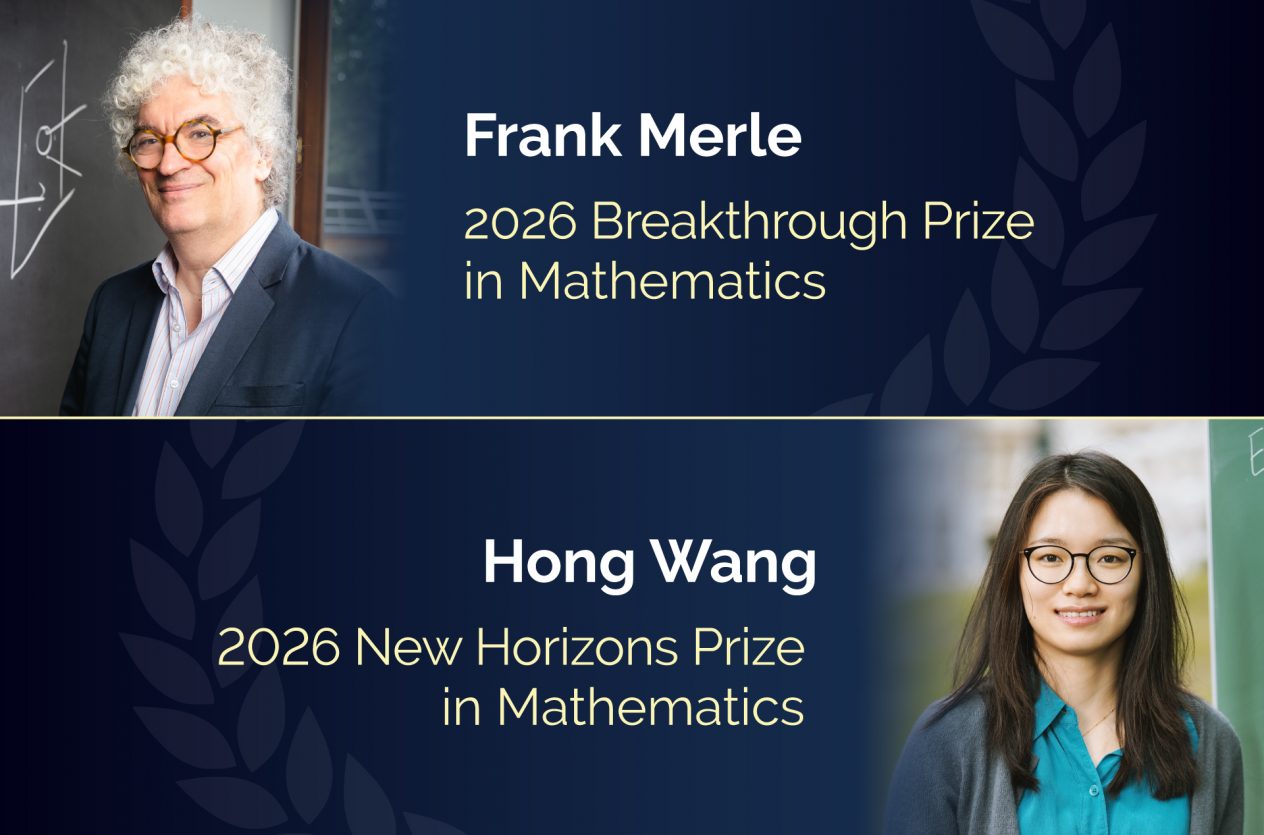
La 12e cérémonie des Breakthrough Prize s'est tenue samedi 18 avril, et l’IHES est fier d’annoncer que deux de ses scientifiques figurent parmi les lauréats de cette année.
En savoir plus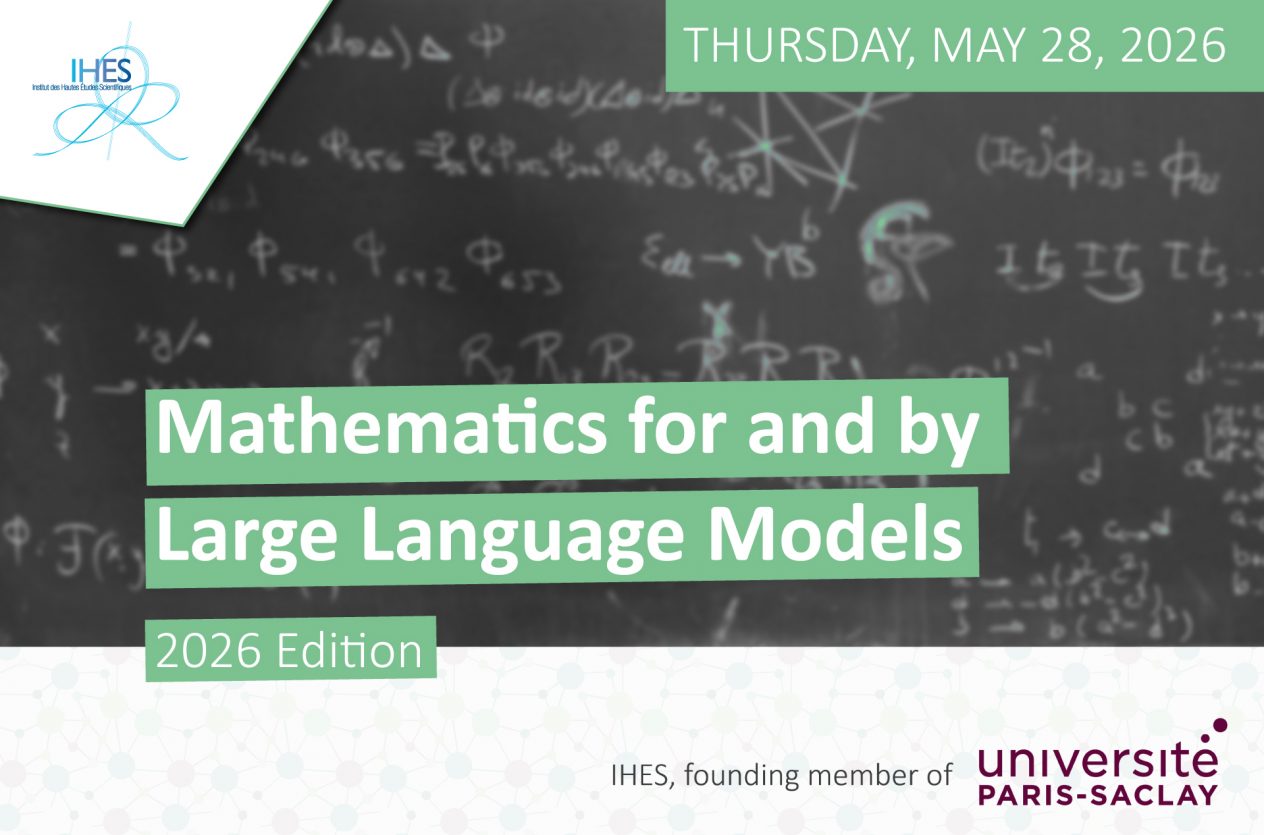
Le 28 mai prochain, François Charton, Michael Douglas, Amaury Hayat et Yiannis Vlassopoulos organisent à l'IHES une conférence d'une journée sur les mathématiques et les grands modèles de langage.
En savoir plus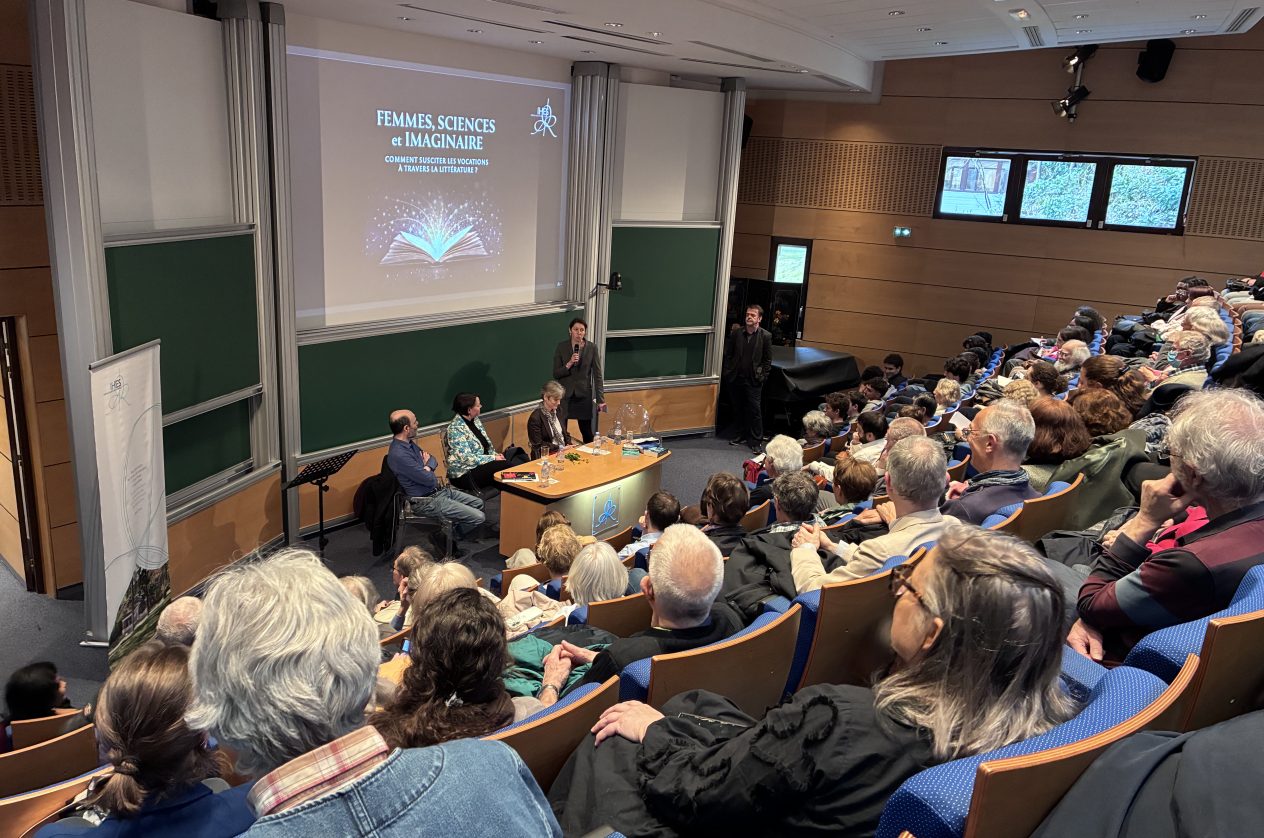
Le 2 avril dernier, l’IHES a eu le plaisir d’accueillir près de 130 participants, dont une quarantaine de lycéens et lycéennes du lycée Rosa Parks de Montgeron, pour une table ronde grand public, suivie d’un cocktail dînatoire, d’une vente de livres organisée par la Librairie Liragif et d’une séance de dédicaces.
En savoir plus