
Analysis of Epistasis Networks in Cancer
The different types of genes mutations in cancer genomes, the selection of driver mutations and the possibility of epistasis networks in cancer will be discussed.
The different types of genes mutations in cancer genomes, the selection of driver mutations and the possibility of epistasis networks in cancer will be discussed.
We construct for the first time hairy black holes within a well-established theoretical framework: the electroweak theory minimally coupled to Einstein’s General Relativity. These black holes support an axially symmetric electroweak condensate — the hair — made of massive W, Z, and Higgs fields. In the extremal limit, they are surrounded in addition by a symmetric phase where the Higgs field vanishes, and their size can be macroscopic. We analyze their properties and establish connections with known flat-space results in the electroweak theory.
Pour être informé des prochains séminaires vous pouvez vous abonner à la liste de diffusion en écrivant un mail à sympa@listes.math.cnrs.fr avec comme sujet: « subscribe seminaire_physique PRENOM NOM »(indiquez vos propres prénom et nom) et laissez le corps du message vide.
Probability and analysis informal seminar
The Elastic Manifold is a model of an elastic interface in a disordered medium, introduced in the 80’s in order to understand the competition between the effects of disorder and those of elasticity. This model gave us a very vast literature in statistical physics, from Daniel Fisher to Marc Mezard and Giorgio Parisi, and many more works inspired by the progress of the Parisi school on Spin Glasses, up to the more mathematical recent works by Yan Fyodorov and Pierre Le Doussal.
I will cover here recent progress, first on the topological complexity of the energy landscape for the Elastic Manifold, obtained with Paul Bourgade (Courant) and Benjamin McKenna (Georgia Tech), and then on the Parisi formula for the quenched free energy, and the nature of the glass transition at low temperature, more recently proved in a series of works, with Pax Kivimae (Courant).
========
Pour être informé des prochains séminaires vous pouvez vous abonner à la liste de diffusion en écrivant un mail à sympa@listes.math.cnrs.fr avec comme sujet: « subscribe seminaire_mathematique PRENOM NOM »(indiquez vos propres prénom et nom) et laissez le corps du message vide.
Séminaire Amplitudes et Gravitation sur l’Yvette (IHES/IPhT)
Accurate and efficient modeling of binary black holes (BBHs) is crucial for detecting gravitational waves (GWs) they emit. Closed-form solutions to these systems in their initial inspiral state are highly sought after and have been worked out by many groups in the past few decades. Most of these solutions are valid only in certain limits (small eccentricity, zero spins, equal mass binary, etc). In this talk, we will discuss our solution for the most general post-Newtonian (PN) BBH system (with arbitrary masses, eccentricity, and spins). Two newly discovered constants of motion, along with the action-angle variables of these BBHs will also be presented. Throughout, we will confine ourselves to 1.5PN and 2PN orders.
Pour être informé des prochains séminaires vous pouvez vous abonner à la liste de diffusion en écrivant un mail à sympa@listes.math.cnrs.fr avec comme sujet: « subscribe seminaire_physique PRENOM NOM »(indiquez vos propres prénom et nom) et laissez le corps du message vide.
In a dynamical system that incorporates an exponentially growing number of degrees of freedom, can information sent at early time be retrieved at late time? This “inflationary inference problem” arises in several contexts: statistical inference, error correction, measurement-altered quantum criticality, quantum Darwinism, and cosmology. In this talk, we will introduce the problem, and propose a general criterion for inference, extending the Kesten-Stigum threshold. Implications in some of the aforementioned contexts will be discussed. In particular, we will revisit the question of “classicalisation” during inflation.
Pour être informé des prochains séminaires vous pouvez vous abonner à la liste de diffusion en écrivant un mail à sympa@listes.math.cnrs.fr avec comme sujet: « subscribe seminaire_physique PRENOM NOM »(indiquez vos propres prénom et nom) et laissez le corps du message vide.
Thurston defined a mapping class group-equivariant spine for Teichmüller space: the « Thurston spine ». This spine is a CW complex, consisting of the points in Teichmüller space at which the set of shortest geodesics — the systoles — cut the surface into polygons. The systole function is a map from Teichmüller space to R+ whose value at any point is given by the length of the systoles. It is known that the systole function is a topological Morse function on Teichmüller space, whose critical points are contained in the Thurston spine. This talk surveys what the systole function tells us about the Thurston spine.
Any closed, flat Riemannian manifold is finitely covered by the torus, by Bieberbach’s classical theorem. Similar classifications have been pursued for closed, Riemannian conformally flat manifolds, as well as for closed, flat Lorentzian manifolds. I will present the classification of closed, Lorentzian conformally flat manifolds with unipotent holonomy. This is joint work with Rachel Lee.
Probability and analysis informal seminar
In this talk, we will briefly review the main ideas for solving singular SPDEs with the use of Regularity Structures. After presenting the main symmetries known, we will focus on some recent progress concerning the chain rule symmetry in the full subcritical regime. These symmetries allow us to restrict the space of solutions.
========
Pour être informé des prochains séminaires vous pouvez vous abonner à la liste de diffusion en écrivant un mail à sympa@listes.math.cnrs.fr avec comme sujet: « subscribe seminaire_mathematique PRENOM NOM »(indiquez vos propres prénom et nom) et laissez le corps du message vide.
Séminaire Amplitudes et Gravitation sur l’Yvette (IHES/IPhT)
In this talk, it will be shown that the Kerr metric describes a pair of self-dual and anti-self-dual Taub-NUT instantons, like the N and S poles of a bar magnet. The implications of this fact will be discussed. Firstly, it derives the Newman-Janis algorithm without an ambiguity: a mathematical procedure that generates spinning black hole solutions from non-spinning ones by means of a complex transformation, previously believed as merely a formal construct. Secondly, it uniquely determines the effective point-particle Lagrangian of Kerr black hole in post-Minkowskian gravity, based on the topological nature of the gravitational Dirac string (Misner string) associated with the NUT charges. This off-shell construction resolves the longstanding struggle that the gravitational dynamics of Kerr black holes at the second post-Minkowskian order is not uniquely, or easily, determinable from the scattering amplitudes methods. The gravitational Compton amplitude for Kerr black hole will be presented, which achieves correct factorizations without spurious poles in a simple manner. Finally, a new chapter of relativity will be proposed, in which spin is intrinsically unified into spacetime: « spinspacetime”.
Pour être informé des prochains séminaires vous pouvez vous abonner à la liste de diffusion en écrivant un mail à sympa@listes.math.cnrs.fr avec comme sujet: « subscribe seminaire_physique PRENOM NOM »(indiquez vos propres prénom et nom) et laissez le corps du message vide.
Kadanoff’s block idea pioneers the renormalization group (RG) theory and clarifies the scaling hypothesis in critical phenomena. Nevertheless, it has difficulty as a quantitatively reliable RG method due to uncontrolled approximations when formulated in the spin language. Reformulated in a modern tensor-network language, the block idea is equipped with a natural measure of RG errors. In 2D, the RG errors are typically smaller than 1% and decrease systematically when more coupling constants are retained in the RG map. The relative error of the estimated free energy of the 2D Ising model can easily go down to about 10-9 using a personal computer.
In 3D, due to the linear growth of entanglement entropy, the RG errors are too large for the block-tensor map to be reliable. For the 3D Ising model, the RG errors grow to more than 10% just after one RG step, and then keep growing to more than 30% near the critical fixed point. Even worse, the estimated scaling dimensions fail to converge with respect to the RG step. We propose an entanglement filtering (EF) scheme to cleanse the redundant entanglement. Enhanced by the proposed EF, the RG errors near the critical fixed point goes down to 6%; they decrease slowly to 2% when more couplings are retained. The estimated scaling dimensions become stable respect to the RG step. The relative errors of the first two relevant fields are 0.4% and 0.1% in the best case. The proposed RG is promising as a systematically-improvable real space RG method in 3D.
Pour être informé des prochains séminaires vous pouvez vous abonner à la liste de diffusion en écrivant un mail à sympa@listes.math.cnrs.fr avec comme sujet: « subscribe seminaire_physique PRENOM NOM »(indiquez vos propres prénom et nom) et laissez le corps du message vide.
I will explain how convex projective geometry over non-Archimedean ordered fields may be used to study large scale properties of individual real Hilbert geometries and degenerations of convex projective actions, using a projective geometry version of ultralimits. Non-Archimedean convex subsets have a naturally associated quotient Hilbert metric space. In the case of ultralimits, we show that it is the ultralimit of the real Hilbert metric spaces under a natural non-degeneracy condition. I will present some examples and give a full description of the Hilbert metric space for non-Archimedean polytopes defined over R, which correspond to the asymptotic cones of a fixed real polytope. This is joint work with Xenia Flamm.
Khintchine’s theorem is a key result in Diophantine approximation. Given a positive non-increasing function f defined over the integers, it states that the set of real numbers that are f-approximable has zero or full Lebesgue measure depending on whether the series of terms (f(n))n converges or diverges. I will present a recent work in collaboration with Weikun He and Han Zhang in which we extend Khintchine’s theorem to any self-similar probability measure on the real line. The argument involves the quantitative equidistribution of upper triangular random walks on SL(2,R)/SL(2,Z).
Et aussi

La 12e cérémonie des Breakthrough Prize s'est tenue samedi 18 avril, et l’IHES est fier d’annoncer que deux de ses scientifiques figurent parmi les lauréats de cette année.
En savoir plus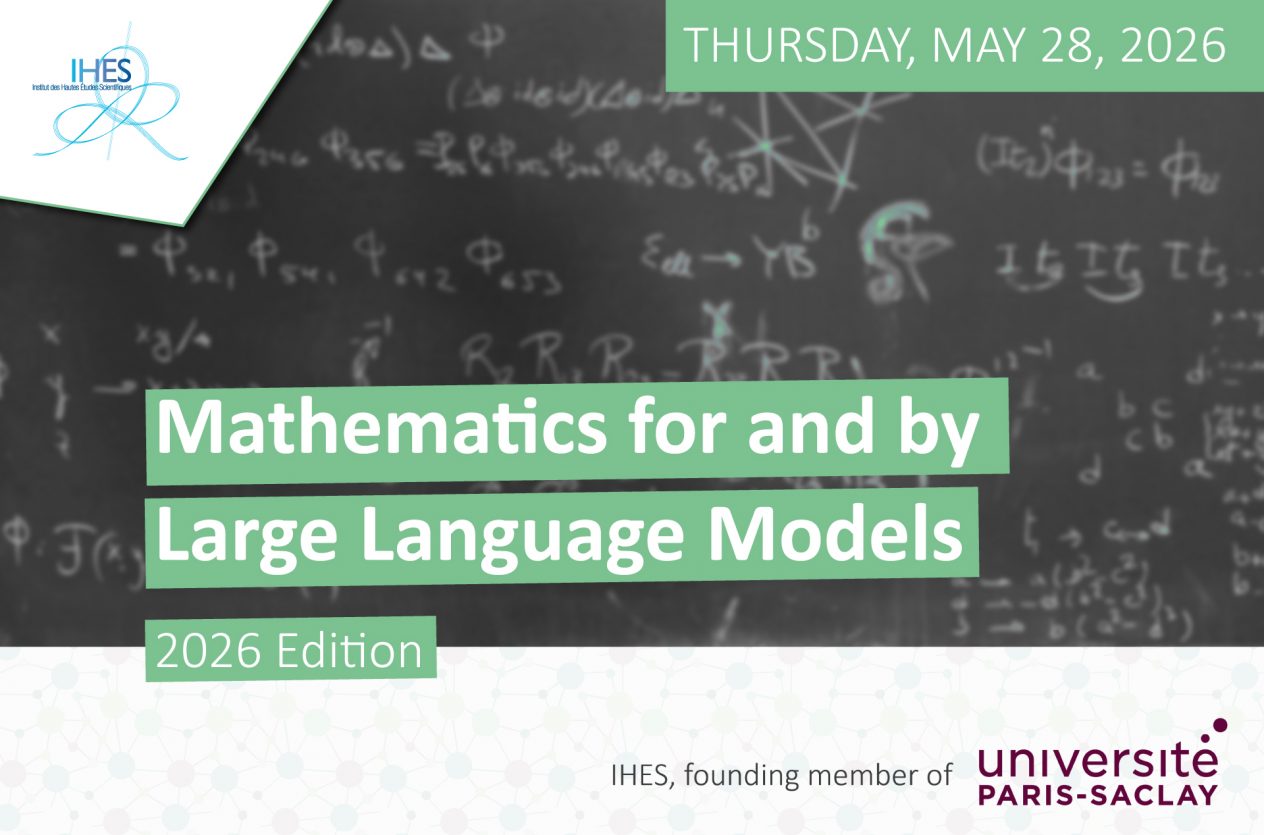
Le 28 mai prochain, François Charton, Michael Douglas, Amaury Hayat et Yiannis Vlassopoulos organisent à l'IHES une conférence d'une journée sur les mathématiques et les grands modèles de langage.
En savoir plus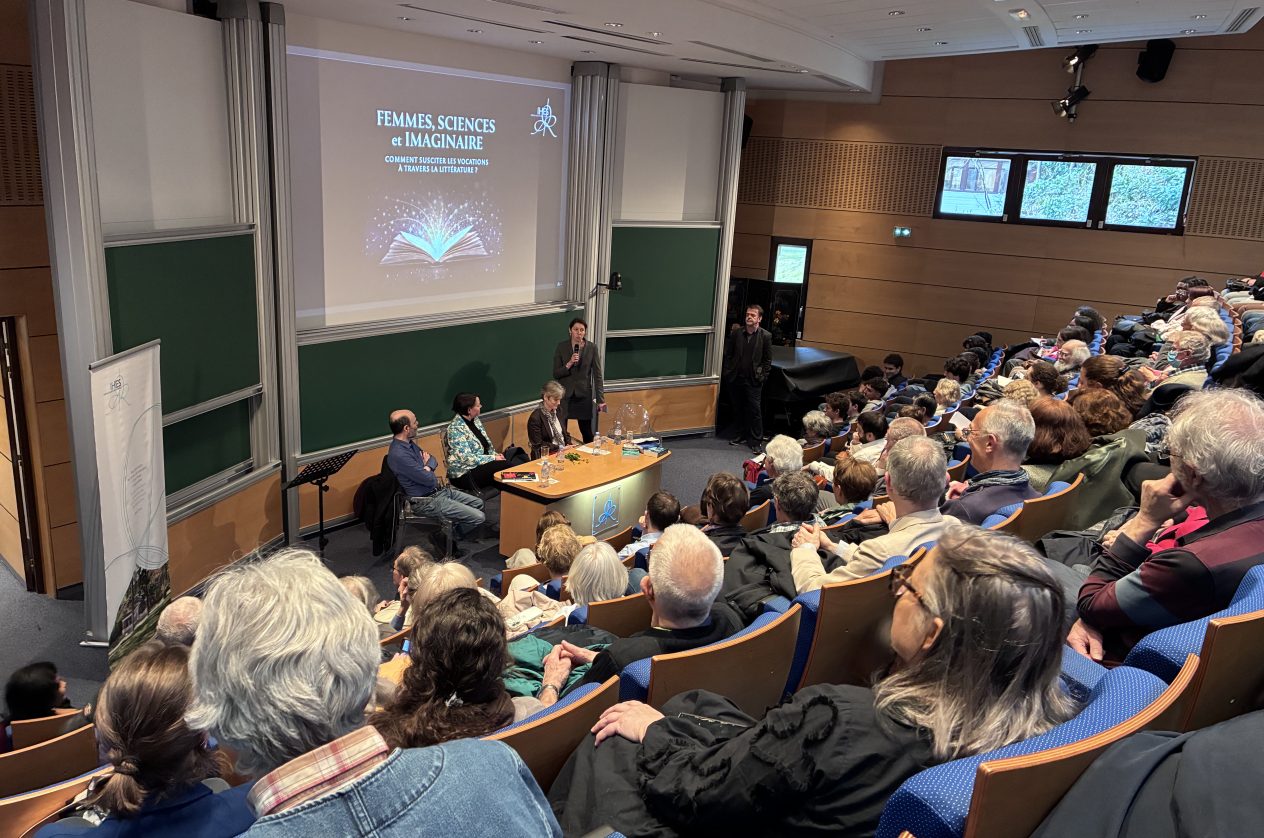
Le 2 avril dernier, l’IHES a eu le plaisir d’accueillir près de 130 participants, dont une quarantaine de lycéens et lycéennes du lycée Rosa Parks de Montgeron, pour une table ronde grand public, suivie d’un cocktail dînatoire, d’une vente de livres organisée par la Librairie Liragif et d’une séance de dédicaces.
En savoir plus