
Stability of Rayleigh-Jeans Equilibria in the Kinetic FPUT Equation
Séminaire Laurent Schwartz — EDP et applications
Séminaire Laurent Schwartz — EDP et applications
Séminaire Laurent Schwartz — EDP et applications
Séminaire Laurent Schwartz — EDP et applications
The work discussed is joint with André Belotto da Silva, Michael Temkin and Jaroslaw Wlodarczyk.
Given a subvariety X of a nonsingular complex variety Y carrying a monomial foliation F, we construct an embedded resolution of singularities of X that is aligned with the foliation F, solving a problem of Belotto da Silva. This in particular implies resolution of singularities of singular integrable foliations.
========
Pour être informé des prochains séminaires vous pouvez vous abonner à la liste de diffusion en écrivant un mail à sympa@listes.math.cnrs.fr avec comme sujet: « subscribe seminaire_mathematique PRENOM NOM »(indiquez vos propres prénom et nom) et laissez le corps du message vide.
Probability and analysis informal seminar
The cutoff phenomenon is an abrupt transition from out of equilibrium to equilibrium undergoned by certain Markov processes in the limit where the number of states tends to infinity. Discovered forty years ago in the context of card shuffling, it has since then been established in a variety of contexts, including random walks on graphs and groups, high-temperature spin systems, or interacting particles. Nevertheless, a general theory is still missing, and identifying the general mechanisms underlying this mysterious phenomenon remains one of the most fundamental problems in the area of mixing times. In this talk, I will give a self-contained introduction to this fascinating question, and then describe a new approach based on entropy and curvature.
========
Pour être informé des prochains séminaires vous pouvez vous abonner à la liste de diffusion en écrivant un mail à sympa@listes.math.cnrs.fr avec comme sujet: « subscribe seminaire_mathematique PRENOM NOM »(indiquez vos propres prénom et nom) et laissez le corps du message vide.
A Teichmüller curve V in Mg is an isometrically immersed algebraic curve in the moduli space of Riemann surfaces. These rare, extremal objects lie at the nexus of algebraic geometry, number theory, complex analysis and surface topology. We will discuss some ideas behind the known constructions of Teichmüller curves that have been discovered over the past 30 years, and a selection of open problems.
I will give several definitions of entropy at infinity for a dynamical system on a noncompact topological space. In the case of geodesic flows in negative curvature, in joint work with S. Gouëzel and S. Tapie, we showed that these definitions coincide. When the entropy at infinity is strictly smaller than the topological entropy, we obtained numerous interesting applications in the past few years. In a more recent work with A. Florio and A. Vaugon, we are able to prove that some of these properties still hold in the generality of hyperbolic flows on noncompact manifolds. I will try to give the flavour of these works.
Balzan Lectures on 50 Years of Binary Pulsars
The first pulsar in a binary system (PSR B1913+16) was discovered in the summer of 1974 by Russell Hulse and Joseph Taylor. In the fifty years since this pioneering discovery, many more binary pulsars were discovered, including remarkable systems such as the double binary pulsar PSR J0737−3039A/B (with two active radio pulsars detectable from the Earth), and the triple system PSR J0337+1715. Binary pulsars have triggered many research works in theoretical gravity, and have opened up new experimental windows on relativistic gravity. The comparison between binary-pulsar timing data and theoretical predictions has notably provided the first direct observational proof that gravity propagates at the velocity of light, and the first accurate tests of the strong-field regime of relativistic gravity.
To celebrate 50 years of binary-pulsar physics, two complementary Balzan lectures will present reviews of: (1) the theoretical works triggered by the discovery of binary pulsars; and (2) the state-of-the-art of binary pulsar observations and of their scientific content.
Supported by the « 2021 Balzan Prize for Gravitation: Physical and Astrophysical Aspects », awarded to Thibault Damour
Balzan Lectures on 50 Years of Binary Pulsars
The first pulsar in a binary system (PSR B1913+16) was discovered in the summer of 1974 by Russell Hulse and Joseph Taylor. In the fifty years since this pioneering discovery, many more binary pulsars were discovered, including remarkable systems such as the double binary pulsar PSR J0737−3039A/B (with two active radio pulsars detectable from the Earth), and the triple system PSR J0337+1715. Binary pulsars have triggered many research works in theoretical gravity, and have opened up new experimental windows on relativistic gravity. The comparison between binary-pulsar timing data and theoretical predictions has notably provided the first direct observational proof that gravity propagates at the velocity of light, and the first accurate tests of the strong-field regime of relativistic gravity.
To celebrate 50 years of binary-pulsar physics, two complementary Balzan lectures will present reviews of: (1) the theoretical works triggered by the discovery of binary pulsars; and (2) the state-of-the-art of binary pulsar observations and of their scientific content.
Supported by the « 2021 Balzan Prize for Gravitation: Physical and Astrophysical Aspects », awarded to Thibault Damour
Probability and analysis informal seminar
Tensor networks are a recent cool addition to physicist’s toolkit used to study renormalization of lattice models. However the mathematical theory of tensor network renormalization group (TNRG) is still in its infancy. I will aim to transmit my excitement about the tensor networks. Rough plan:1. Wilson’s conjecture about renormalization group fixed points describing criticality – can we prove it?2. Why are tensor networks better than other approaches to renormalization (e.g. spin blocking).3. Numerical algorithms for TNRG – what do people see numerically?4. Discrete scaling operator 5. A few mathematically rigorous results about TNRG6. Open problems
========
Pour être informé des prochains séminaires vous pouvez vous abonner à la liste de diffusion en écrivant un mail à sympa@listes.math.cnrs.fr avec comme sujet: « subscribe seminaire_mathematique PRENOM NOM »(indiquez vos propres prénom et nom) et laissez le corps du message vide.
Séminaire de géométrie arithmétique
The notion of micro support in mixed characteristic is formulated using the Frobenius–Witt cotangent bundle but the existence of the singular support is not yet known. We introduce a relative notion of micro support over a fixed regular scheme S and prove the existence of a saturation of the relative singular support on smooth schemes over S. The proof is a variation of that by Beilinson using the Radon transform.
========
Pour être informé des prochains séminaires vous pouvez vous abonner à la liste de diffusion en écrivant un mail à sympa@listes.math.cnrs.fr avec comme sujet: « subscribe seminaire_mathematique PRENOM NOM »(indiquez vos propres prénom et nom) et laissez le corps du message vide.
I will discuss how M2-M5 intersections in the twisted M-theory background yield R-matrices of quantum toroidal algebra of gl(1). These intersections are also identified as Miura operators, providing the Miura transformation for the q-deformed W- and Y-algebras. Consequently, the intertwining relation of the q-deformed Maulik-Okounkov R-matrix is illuminated as a Yang-Baxter equation, in particular. Also, I will explain the M2-M5 intersection (equivalently the Miura operator) gives rise to the qq-characters of the 5d N=1 gauge theory, illuminating an algebraic meaning of the latter.
========
Pour être informé des prochains séminaires vous pouvez vous abonner à la liste de diffusion en écrivant un mail à sympa@listes.math.cnrs.fr avec comme sujet: « subscribe seminaire_mathematique PRENOM NOM »(indiquez vos propres prénom et nom) et laissez le corps du message vide.
Et aussi

La 12e cérémonie des Breakthrough Prize s'est tenue samedi 18 avril, et l’IHES est fier d’annoncer que deux de ses scientifiques figurent parmi les lauréats de cette année.
En savoir plus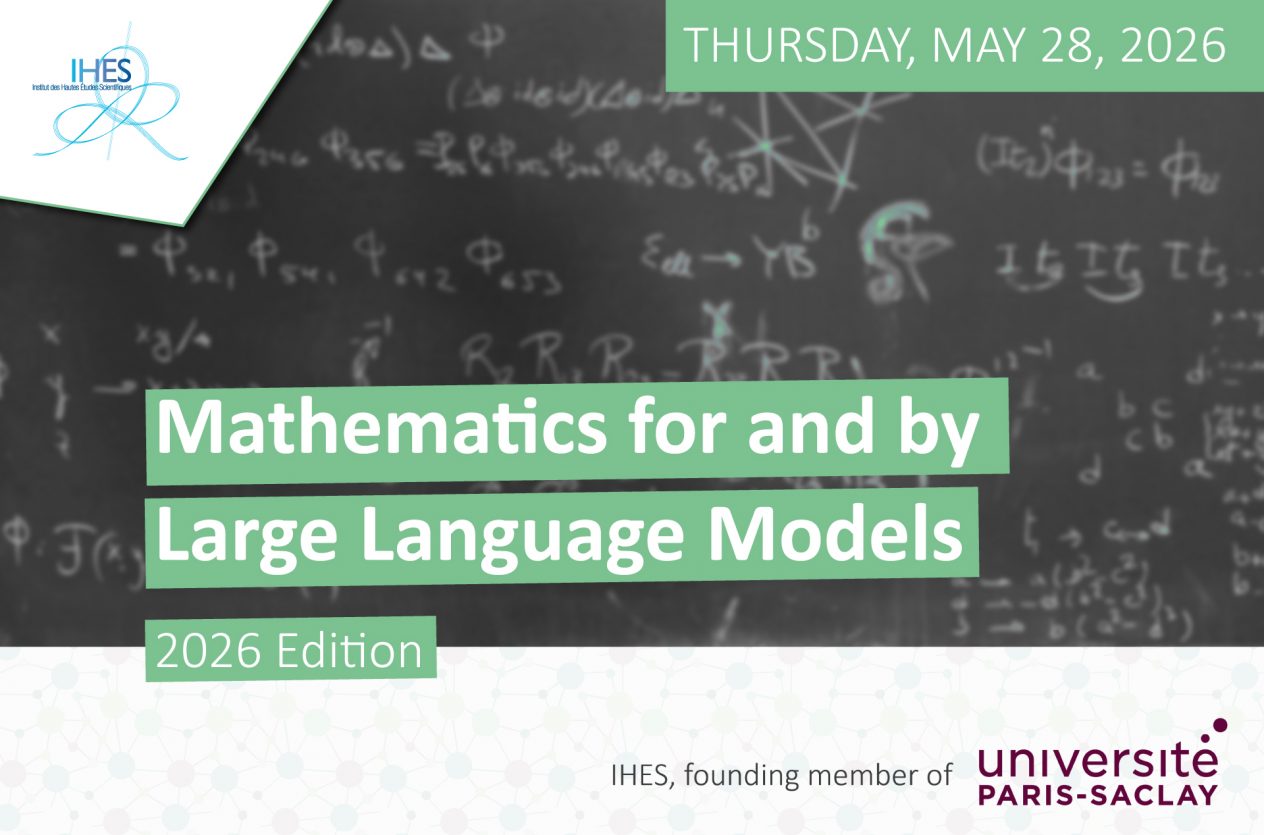
Le 28 mai prochain, François Charton, Michael Douglas, Amaury Hayat et Yiannis Vlassopoulos organisent à l'IHES une conférence d'une journée sur les mathématiques et les grands modèles de langage.
En savoir plus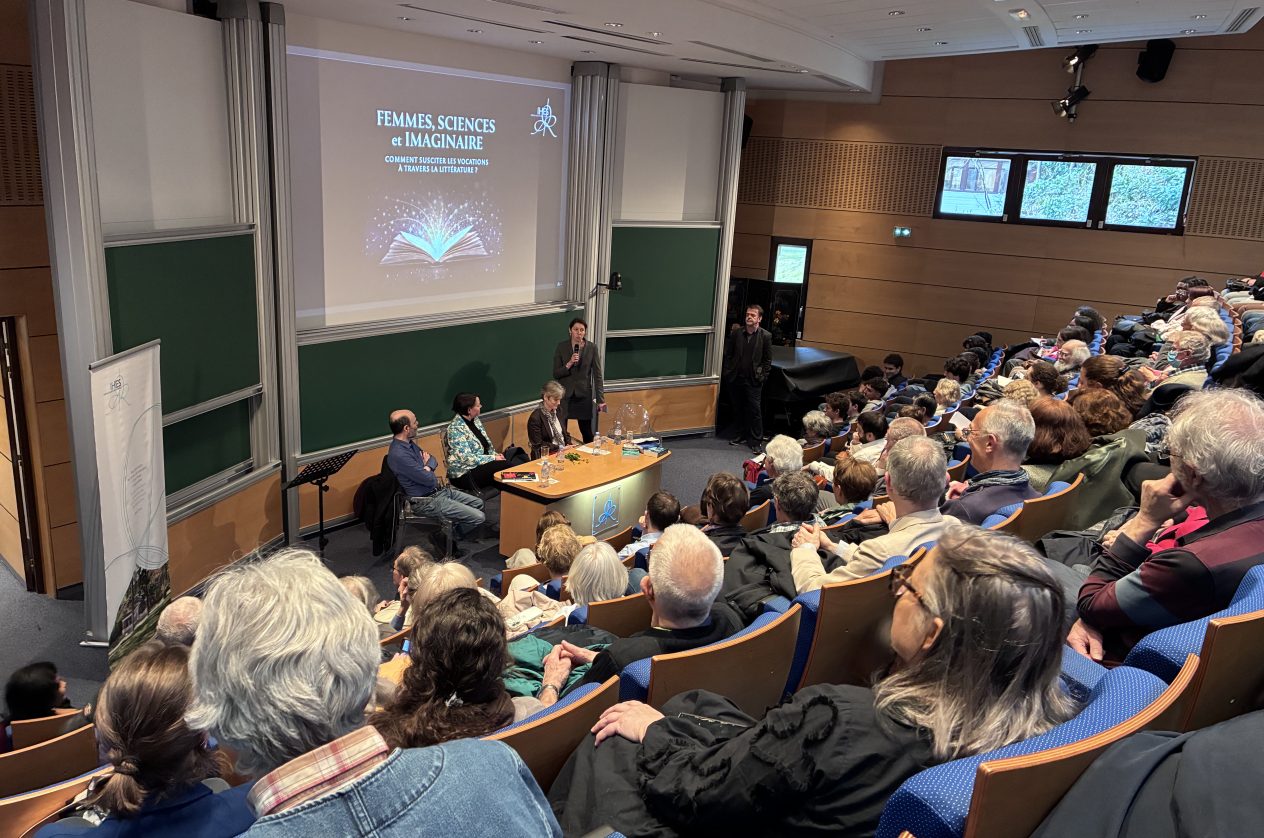
Le 2 avril dernier, l’IHES a eu le plaisir d’accueillir près de 130 participants, dont une quarantaine de lycéens et lycéennes du lycée Rosa Parks de Montgeron, pour une table ronde grand public, suivie d’un cocktail dînatoire, d’une vente de livres organisée par la Librairie Liragif et d’une séance de dédicaces.
En savoir plus