
Entropie, hyperbolicité et classification en dynamique
Séminaire Laurent Schwartz — EDP et applications
Séminaire Laurent Schwartz — EDP et applications
This will be a discussion about large language models such as OpenAI’s GPT series, oriented towards physicists and mathematicians. After a brief survey of the state of the art, we describe transformer models in detail, and discuss current ideas on how they work and how models trained to predict the next word in a text are able to perform other tasks displaying intelligence. ========Pour être informé des prochains séminaires vous pouvez vous abonner à la liste de diffusion en écrivant un mail à sympa@listes.math.cnrs.fr avec comme sujet: « subscribe seminaire_mathematique PRENOM NOM »(indiquez vos propres prénom et nom) et laissez le corps du message vide.
Pour être informé des prochains séminaires vous pouvez vous abonner à la liste de diffusion en écrivant un mail à sympa@listes.math.cnrs.fr avec comme sujet: « subscribe seminaire_physique PRENOM NOM »(indiquez vos propres prénom et nom) et laissez le corps du message vide.
I’ll explain how the quantization of Hitchin integrable system can be formulated in the N=2 supersymmetric gauge theory with the help of half-BPS surface defects. I’ll first review the universal oper for the Gaudin model constructed from a current algebra, and relate it to the constraints for the coinvariants of the affine Kac-Moody algebra with the twisted vacuum module. In the N=2 gauge theory side, we consider two types of surface defects, the « canonical » surface defect and the « regular monodromy » surface defect, inserted on top of each other. The correlation function of the surface defects is shown to give a basis of coinvariants with the twisted vacuum module. The insertion of twisted vacuum module is known to give the action of Hecke modification on the coinvariants. I’ll define the Hecke operator as an integral of the image of Hecke modifications, which is shown to factorize due to the cluster decomposition of the two surface defects. The factorization explains why the action of the Hecke operator is diagonal. Using this factorization property and the relation with the universal oper, I show the sections of the Hecke eigensheaf give common eigenfunctions of the quantum Hitchin Hamiltonians (with the eigenvalues parametrizing the space of opers), explaining the statement of Beilinson and Drinfeld in the N=2 gauge theory framework. ========Pour être informé des prochains séminaires vous pouvez vous abonner à la liste de diffusion en écrivant un mail à sympa@listes.math.cnrs.fr avec comme sujet: « subscribe seminaire_mathematique PRENOM NOM »(indiquez vos propres prénom et nom) et laissez le corps du message vide.
Discrete subgroups of semisimple Lie groups arise in a variety of contexts, sometimes « in nature » as monodromy groups of families of algebraic manifolds, and other times in relation to geometric structures and associated dynamical systems. I will explain a method to establish that monodromy groups of certain variations of Hodge structure give Anosov representations, thus relating algebraic and dynamical situations. Among many consequences of these interactions, I will explain some uniformization results for domains of discontinuity of the associated discrete groups, Torelli theorems for certain families of Calabi-Yau manifolds (including the mirror quintic), and also a proof of a conjecture of Eskin, Kontsevich, Möller, and Zorich on Lyapunov exponents. The discrete groups of interest live inside the real linear symplectic group, and the domains of discontinuity are inside Lagrangian Grassmanians and other associated flag manifolds. The necessary context and background will be explained.
The horocycle flow on hyperbolic surfaces has attracted considerable attention in the last century. In the ’30s, Hedlund proved that all horocycle orbits are dense in closed hyperbolic surfaces, and the classification problem for horocycle orbit closures has been solved for geometrically finite surfaces. We are interested in the topology and dynamics of horocycle orbits in the geometrically infinite setting, where our understanding is much more limited.In this talk, I will discuss joint work with Or Landesberg and Yair Minsky: we give the first complete classification of orbit closures for a class of Z-covers of closed surfaces. Our analysis is rooted in a seemingly unrelated geometric optimization problem: finding a best Lipschitz map to the circle. We then relate the topology of horocycle orbit closures with the dynamics of the minimizing lamination of maximal stretch, as studied by Guéritaud-Kassel and Daskalopoulos-Uhlenbeck.
Transposable elements (TEs), one type of mobile genetic elements, often represent a large part of eukaryotic genomes and were long regarded only as selfish genomic parasites. We are now coming to understanding of the complex relationships between TEs and their host organisms — not only in the germline but in the soma too.The repetitive nature of TE has prevented to fully grasp the level of their activity with molecular biology and sequencing techniques so far. This is particularly true of somatic transposition in the healthy tissues on the whole-genome scale, as these events represent rare variants difficult to accurately detect with bulk short-read sequencing approaches.I will give a brief overview of the field and present our ongoing study of transposable elements mobility in D. melanogaster with long-read sequencing techniques. We were able to identify an endogenous LTR retroelement rover that is somatically active in the healthy gut tissues by tracing back sequence variants of the inserted sequences to the fixed rover copies. We dissected the transcriptional landscape as well as the local sequence and chromatin environment of the fixed copies and hypothesize that its activity may be determined by the upstream locus-specific chromatin features.
Probability and analysis informal seminarIn this talk, we will consider a classical model of random interfaces known as the grad phi (or Ginzburg-Landau) model. The model first received rigorous consideration in the work of Brascamp-Lieb-Lebowitz in 1975. Since then, it has been extensively studied by the mathematical community and various aspects of the model have been investigated regarding for instance the localization and delocalization of the interface, the hydrodynamical limit, the scaling limit, large deviations etc. Most of these results were originally established under the assumption that the potential encoding the definition of the model is uniformly convex, and it has been an active line of research to extend these results beyond the assumption of uniform convexity. In this talk, we will introduce the model, some of its main properties, and discuss a result of localization and delocalization for a class of convex (but not uniformly convex) potentials. ========Pour être informé des prochains séminaires vous pouvez vous abonner à la liste de diffusion en écrivant un mail à sympa@listes.math.cnrs.fr avec comme sujet: « subscribe seminaire_mathematique PRENOM NOM »(indiquez vos propres prénom et nom) et laissez le corps du message vide.
Probability and analysis informal seminarPotts gauge theories were introduced in the ’80s by Kogut, Pearson, Shigemitsu, and Sinclair. They are toy examples of lattice gauge theories that exhibit a confinement-deconfinement phase transition of Wilson loop observables. In 3d, they arise as dual models to 3d Ising and Potts models. In 4d, they exhibit self-duality. In this talk, I will give a gentle introduction to these models and their stochastic geometric representations. I will also discuss how modern percolation theory techniques seems to be useful in analysing these models in 4d (at least, making some modest progress). This is based on ongoing work with Sky Cao. ========Pour être informé des prochains séminaires vous pouvez vous abonner à la liste de diffusion en écrivant un mail à sympa@listes.math.cnrs.fr avec comme sujet: « subscribe seminaire_mathematique PRENOM NOM »(indiquez vos propres prénom et nom) et laissez le corps du message vide.
Probability and analysis informal seminarA dimer tiling of Zd is a collection of edges such that every vertex is covered exactly once. In 2000, Cohn, Kenyon, and Propp showed that 2D dimer tilings satisfy a large deviations principle. In joint work with Nishant Chandgotia and Scott Sheffield, we prove an analogous large deviations principle for dimers in 3D. A lot of the results for dimers in two dimensions use tools and exact formulas (e.g. the height function representation of a tiling or the Kasteleyn determinant formula) that are specific to dimension 2. In this talk, I will explain how to formulate the large deviations principle in 3D, show simulations, and explain some of the ways that we use a smaller set of tools (e.g. Hall’s matching theorem or a double dimer swapping operation) in our arguments. I will also describe some results and problems that illustrate some of the ways that three dimensions is qualitatively different from two. ========Pour être informé des prochains séminaires vous pouvez vous abonner à la liste de diffusion en écrivant un mail à sympa@listes.math.cnrs.fr avec comme sujet: « subscribe seminaire_mathematique PRENOM NOM »(indiquez vos propres prénom et nom) et laissez le corps du message vide.
Probability and analysis informal seminarA Liouville quantum gravity (LQG) surface is a random two-dimensional « Riemannian manifold » that is conjectured to be the scaling limit of a wide variety of random planar graph models. LQG was formulated initially as a random measure space and, more recently, as a random metric space. In this talk, I will explain how the LQG measure can be recovered as the Minkowski content measure for the LQG metric, thereby providing a direct connection between the two formulations for the first time. Our primary tool is the mating-of-trees theory of Duplantier, Miller, and Sheffield, which says that an LQG surface explored by an independent space-filling Schramm–Loewner evolution (SLE) curve is an infinitely divisible metric measure space when. This is joint work with Ewain Gwynne (University of Chicago). ========Pour être informé des prochains séminaires vous pouvez vous abonner à la liste de diffusion en écrivant un mail à sympa@listes.math.cnrs.fr avec comme sujet: « subscribe seminaire_mathematique PRENOM NOM »(indiquez vos propres prénom et nom) et laissez le corps du message vide.
Pour être informé des prochains séminaires vous pouvez vous abonner à la liste de diffusion en écrivant un mail à sympa@listes.math.cnrs.fr avec comme sujet: « subscribe seminaire_physique PRENOM NOM »(indiquez vos propres prénom et nom) et laissez le corps du message vide.
Et aussi
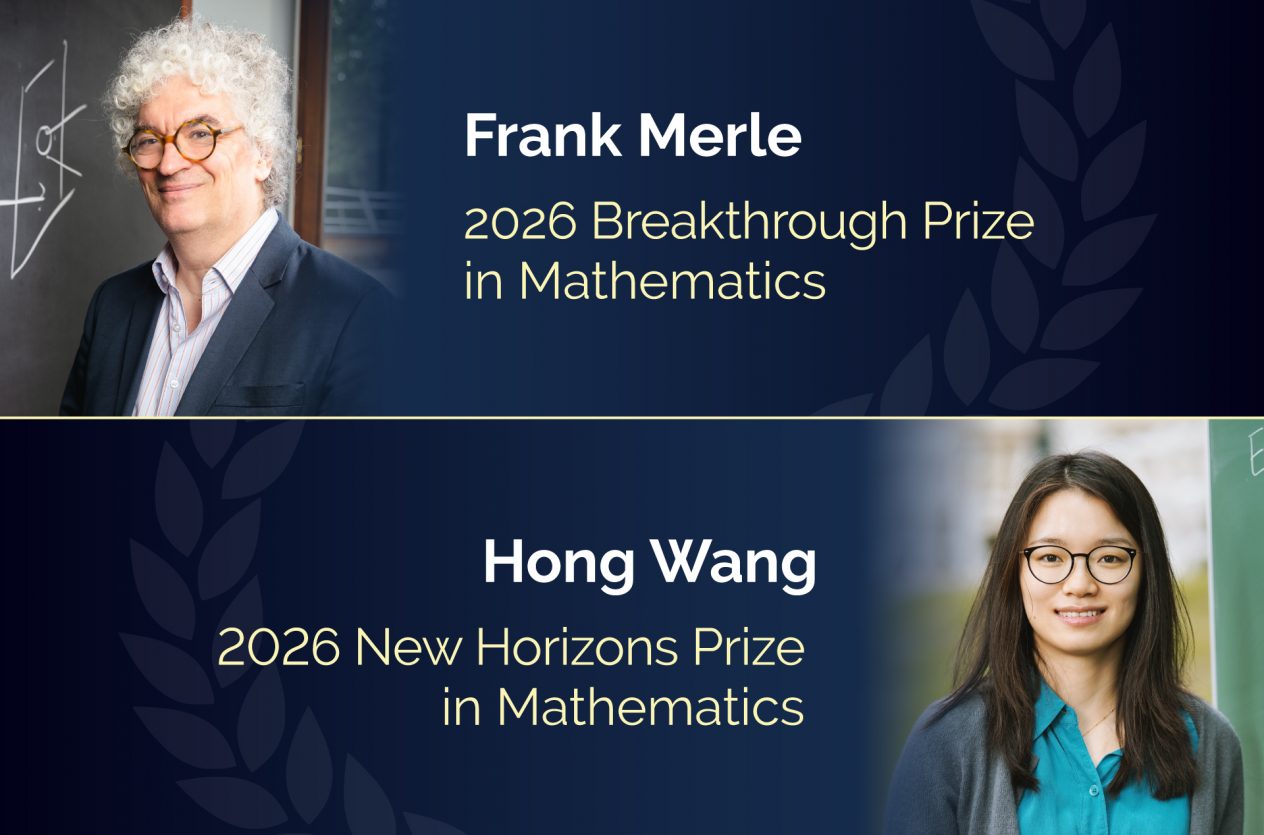
La 12e cérémonie des Breakthrough Prize s'est tenue samedi 18 avril, et l’IHES est fier d’annoncer que deux de ses scientifiques figurent parmi les lauréats de cette année.
En savoir plus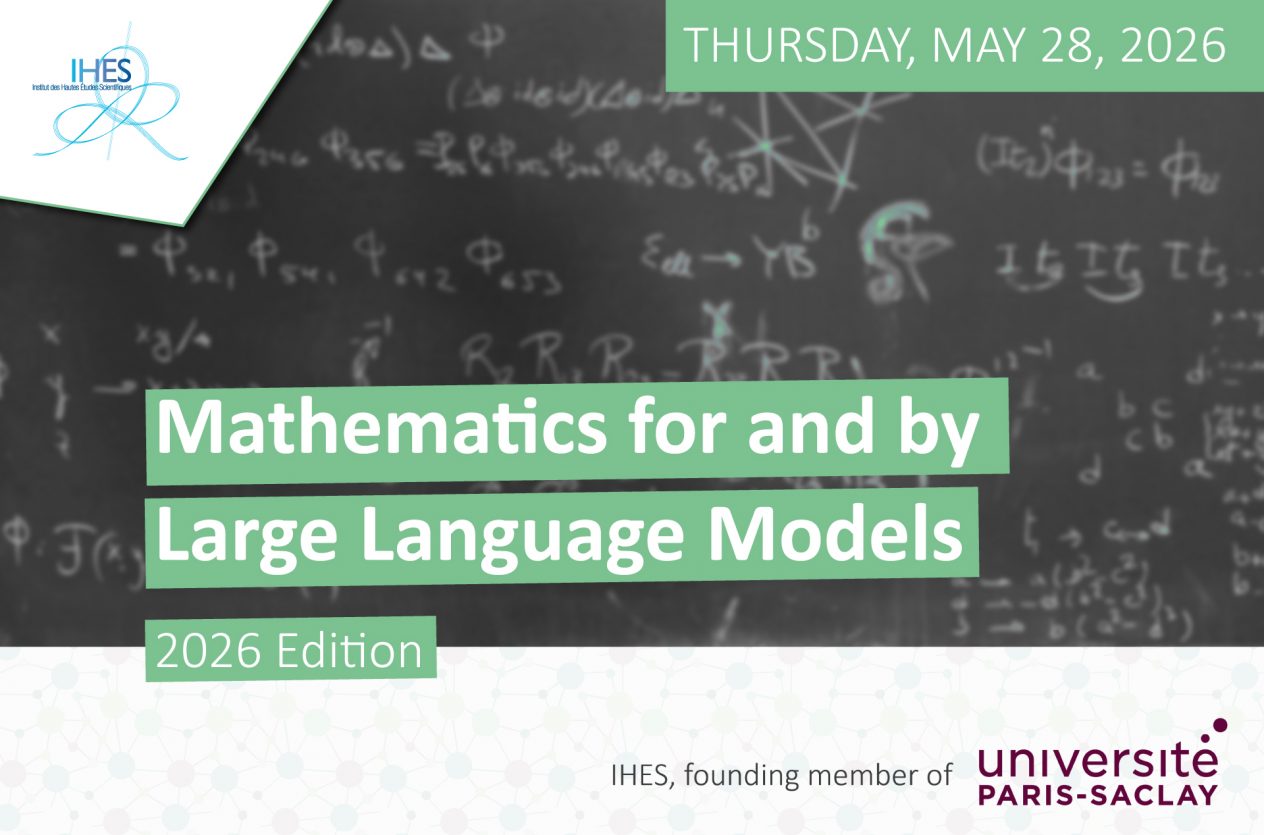
Le 28 mai prochain, François Charton, Michael Douglas, Amaury Hayat et Yiannis Vlassopoulos organisent à l'IHES une conférence d'une journée sur les mathématiques et les grands modèles de langage.
En savoir plus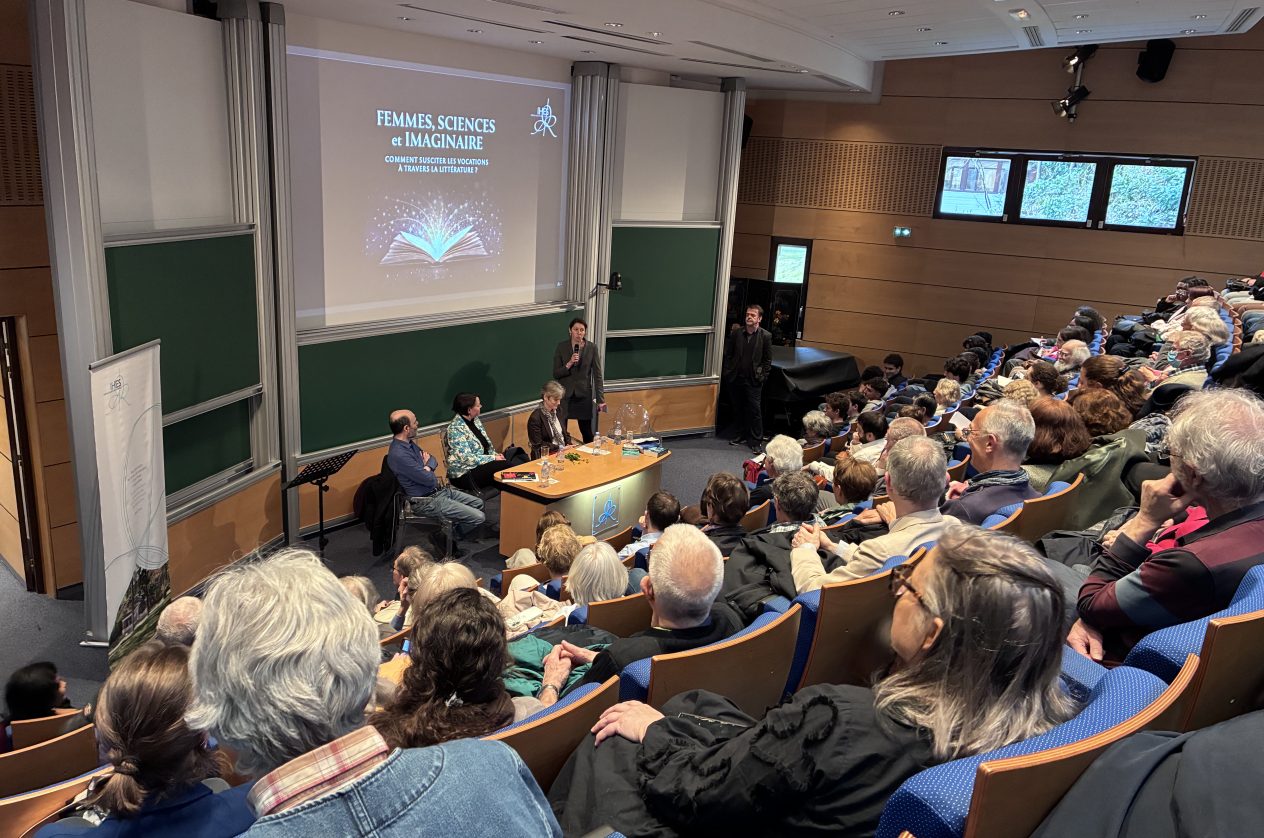
Le 2 avril dernier, l’IHES a eu le plaisir d’accueillir près de 130 participants, dont une quarantaine de lycéens et lycéennes du lycée Rosa Parks de Montgeron, pour une table ronde grand public, suivie d’un cocktail dînatoire, d’une vente de livres organisée par la Librairie Liragif et d’une séance de dédicaces.
En savoir plus