
Distributions invariantes en dynamique parabolique
Séminaire Laurent Schwartz — EDP et applications
Séminaire Laurent Schwartz — EDP et applications
Séminaire Laurent Schwartz — EDP et applications
The presence of nearby conformal field theories (CFTs) hidden in the complex plane of the tuning parameter was recently proposed as an elegant explanation for the ubiquity of « weakly first-order » transitions in condensed matter and high-energy systems. In this work, we perform an exact microscopic study of such a complex CFT (CCFT) in the two-dimensional O(n) loop model. The well-known absence of symmetry-breaking of the O(n>2) model is understood as arising from the displacement of the non-trivial fixed points into the complex temperature plane. Thanks to a numerical finite-size study of the transfer matrix, we confirm the presence of a CCFT in the complex plane and extract the real and imaginary parts of the central charge and scaling dimensions. By comparing those with the analytic continuation of predictions from Coulomb gas techniques, we determine the range of validity of the analytic continuation to extend up to ng≈12.34, beyond which the CCFT gives way to a gapped state. Finally, we propose a beta function which reproduces the main features of the phase diagram and which suggests an interpretation of the CCFT as a liquid-gas critical point at the end of a first-order transition line. Participer à la réunion Zoomhttps://us02web.zoom.us/j/85766610072?pwd=VFl2UUpPOURpMUk5SGJpMmsxMFpmQT09ID de réunion : 857 6661 0072Code secret : 966618==================================================================Pour être informé des prochains séminaires vous pouvez vous abonner à la liste de diffusion en écrivant un mail à sympa@listes.math.cnrs.fr avec comme sujet: « subscribe quantum_encounters_seminar PRENOM NOM »(indiquez vos propres prénom et nom) et laissez le corps du message vide.
Probability and analysis informal seminarRandom walks on groups are nice examples of Markov chains which arise quite naturally in many situations. Their key feature is that one can use the algebraic properties of the group to gain a fine understanding of the asymptotic behaviour. For instance, it has been observed that some random walks exhibit a very sharp phase transition called the cut-off phenomenon. I will first explain this phenomenon on a concrete example, introducing all the necessary material. Then, I will give some ideas on how the setting may be enlarged to encompass more general stochastic processes (called non-commutative Markov chains) by using a strange algebraic structure called a quantum group. ========Pour être informé des prochains séminaires vous pouvez vous abonner à la liste de diffusion en écrivant un mail à sympa@listes.math.cnrs.fr avec comme sujet: « subscribe seminaire_mathematique PRENOM NOM »(indiquez vos propres prénom et nom) et laissez le corps du message vide.
Probability and analysis informal seminarWe consider one-dimensional chains and multi-dimensional networks of harmonic oscillators coupled to two Langevin heat reservoirs at different temperatures. Each particle interacts with its nearest neighbours by harmonic potentials and all individual particles are confined by harmonic potentials, too. In previous works we investigated the sharp N-particle dependence of the spectral gap of the associated generator in different physical scenarios and for different spatial dimensions. In this talk I will present new results on the behaviour of the spectral gap when considering longer-range interactions in the same model. In particular, depending on the strength of the longer-range interaction, there are different regimes appearing where the gap drastically changes behaviour but even the hypoellipticity of the operator breaks down. This is a joint work with Simon Becker (ETH). ========Pour être informé des prochains séminaires vous pouvez vous abonner à la liste de diffusion en écrivant un mail à sympa@listes.math.cnrs.fr avec comme sujet: « subscribe seminaire_mathematique PRENOM NOM »(indiquez vos propres prénom et nom) et laissez le corps du message vide.
Probability and analysis informal seminarIn this talk I will present recent results obtained in joint work with Trishen Gunaratnam, Christoforos Panagiotis and Franco Severo concerning the study of Gibbs measures of the lattice $phi^4_d$ model on $Z^d$. We prove that the set of translation invariant Gibbs measures for the $phi^4_d$ model on $Z^d$ has at most two extremal measures at all temperature. We also give a sufficient condition to ensure that the set of all Gibbs measures is a singleton. As an application, we show that the spontaneous magnetisation of the nearest-neighbour $phi^4_d$ model on $$Z^d$ vanishes at criticality for d>=3. The analogous results were established for the Ising model in the seminal works of Aizenman, Duminil-Copin, and Sidoravicius (Comm. Math. Phys., 2015), and Raoufi (Ann. Prob., 2020) using the so-called random current representation introduced by Aizenman (Comm. Math. Phys., 1982). Our proof relies on a new corresponding stochastic geometric representation for the $phi^4_d$ model called the random tangled current representation. ========Pour être informé des prochains séminaires vous pouvez vous abonner à la liste de diffusion en écrivant un mail à sympa@listes.math.cnrs.fr avec comme sujet: « subscribe seminaire_mathematique PRENOM NOM »(indiquez vos propres prénom et nom) et laissez le corps du message vide.
In the presence of a (quantum or classical) statistical ensemble of metrics one can consider averages of distances between points/events, as long as a prescription is assigned for identifying such points. These average distances, in general, are not geodesic distances of any metric because they are not additive, in a sense that I will specify. Deviations from additivity can be measured by a quantity that, in any coordinate expansion, starts only at forth order. In Euclidean signature average distances are always subadditive. In Lorentzian signature it proves convenient to identify the events by anchoring them to a set of free falling observers. This prescription, by no means unique, naturally conveys the point of view of these observers, whose causal relations are inevitably affected by the fluctuations of the metric field. Average Lorentzian distances portray an interesting « average causal structure” that has no classical analogue. Pour être informé des prochains séminaires vous pouvez vous abonner à la liste de diffusion en écrivant un mail à sympa@listes.math.cnrs.fr avec comme sujet: « subscribe seminaire_physique PRENOM NOM »(indiquez vos propres prénom et nom) et laissez le corps du message vide.
Lecture 1: Twistors for Linear and Self Dual GravityThis lecture will review how linear gravity can be obtained from integral formulae from twistor space and how the fully nonlinear self dual sector of 4d gravity can be built using complex analysis. It will focus on global problems in split signature where the self-dual sector can be generated from a Hamiltonian deformation of the real slice of twistor space. The space-time is reconstructed from holomorphic discs in twistor space with boundary on the deformed real slice. Supported by the « 2021 Balzan Prize for Gravitation: Physical and Astrophysical Aspects », awarded to Thibault Damour
Lecture 2: A Twistor Formula for the Tree-Level Gravity S-MatrixThis lecture will obtain a compact twistor formula for the full tree-level gravitational S-matrix beyond the self-dual sector. It uses an extension of the complex geometry of twistor space of the previous lecture. In the final formula, all integrations are saturated against delta functions yielding a sum of residues. These depend on the n momenta and polarization vectors of associated gravity linear waves.Supported by the « 2021 Balzan Prize for Gravitation: Physical and Astrophysical Aspects », awarded to Thibault Damour
Atttention : La première Leçon aura lieu à l’Institut Mathématique d’Orsay, Amphi Yoccoz, le 15 mai à 14hRetrouvez toutes ces informations sur le site de la Fondation Mathématique Jacques Hadamard :https://fondation-hadamard.fr/en/articles/2023/01/20/hadamard-lectures-2023/Abstract:Since Weil, mathematicians have understood that there is a deep analogy between the ordinary integers and polynomials in one variable over a finite field, as well as between number fields and the fields of functions on algebraic curves over finite fields. Using this, we can take classical problems in number theory and consider their analogues involving polynomials over finite fields, to which new geometric techniques can be applied that aren’t available in the classical setting. In this course, I will survey recent progress on such problems.Specifically, I will try to highlight how the geometric perspective produces connections to other areas of mathematics, including how the circle method for counting solutions to Diophantine equations can be used to study the topology of moduli spaces of curves in varieties, how geometric approaches to the Cohen-Lenstra heuristics and their generalizations motivate new results of a purely probabilistic nature, and how the analytic theory of automorphic forms over function fields is connected to geometric Langlands theory.
Atttention : La première Leçon aura lieu à l’Institut Mathématique d’Orsay, Amphi Yoccoz, le 15 mai à 14hRetrouvez toutes ces informations sur le site de la Fondation Mathématique Jacques Hadamard :https://fondation-hadamard.fr/en/articles/2023/01/20/hadamard-lectures-2023/Abstract:Since Weil, mathematicians have understood that there is a deep analogy between the ordinary integers and polynomials in one variable over a finite field, as well as between number fields and the fields of functions on algebraic curves over finite fields. Using this, we can take classical problems in number theory and consider their analogues involving polynomials over finite fields, to which new geometric techniques can be applied that aren’t available in the classical setting. In this course, I will survey recent progress on such problems.Specifically, I will try to highlight how the geometric perspective produces connections to other areas of mathematics, including how the circle method for counting solutions to Diophantine equations can be used to study the topology of moduli spaces of curves in varieties, how geometric approaches to the Cohen-Lenstra heuristics and their generalizations motivate new results of a purely probabilistic nature, and how the analytic theory of automorphic forms over function fields is connected to geometric Langlands theory.
Atttention : La première Leçon aura lieu à l’Institut Mathématique d’Orsay, Amphi Yoccoz, le 15 mai à 14hRetrouvez toutes ces informations sur le site de la Fondation Mathématique Jacques Hadamard :https://fondation-hadamard.fr/en/articles/2023/01/20/hadamard-lectures-2023/Abstract:Since Weil, mathematicians have understood that there is a deep analogy between the ordinary integers and polynomials in one variable over a finite field, as well as between number fields and the fields of functions on algebraic curves over finite fields. Using this, we can take classical problems in number theory and consider their analogues involving polynomials over finite fields, to which new geometric techniques can be applied that aren’t available in the classical setting. In this course, I will survey recent progress on such problems.Specifically, I will try to highlight how the geometric perspective produces connections to other areas of mathematics, including how the circle method for counting solutions to Diophantine equations can be used to study the topology of moduli spaces of curves in varieties, how geometric approaches to the Cohen-Lenstra heuristics and their generalizations motivate new results of a purely probabilistic nature, and how the analytic theory of automorphic forms over function fields is connected to geometric Langlands theory.
Et aussi
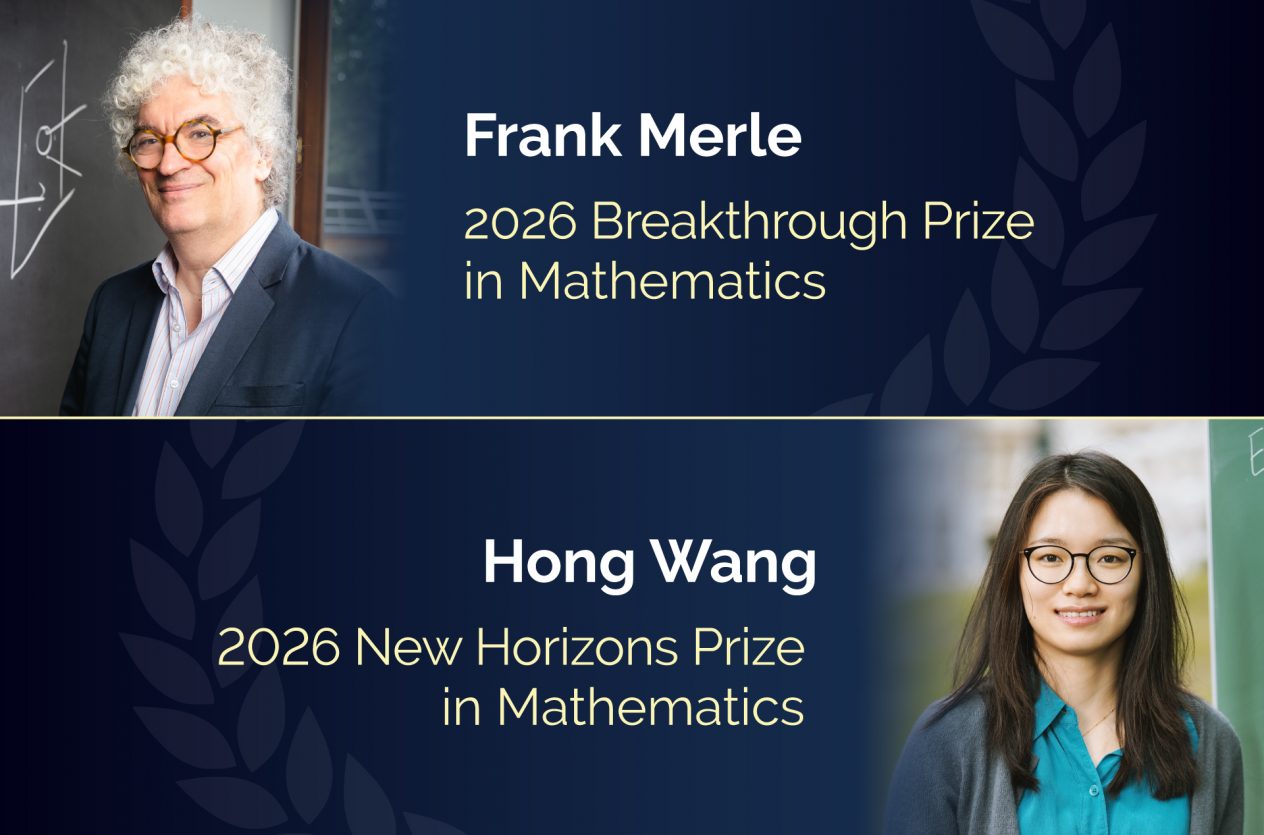
La 12e cérémonie des Breakthrough Prize s'est tenue samedi 18 avril, et l’IHES est fier d’annoncer que deux de ses scientifiques figurent parmi les lauréats de cette année.
En savoir plus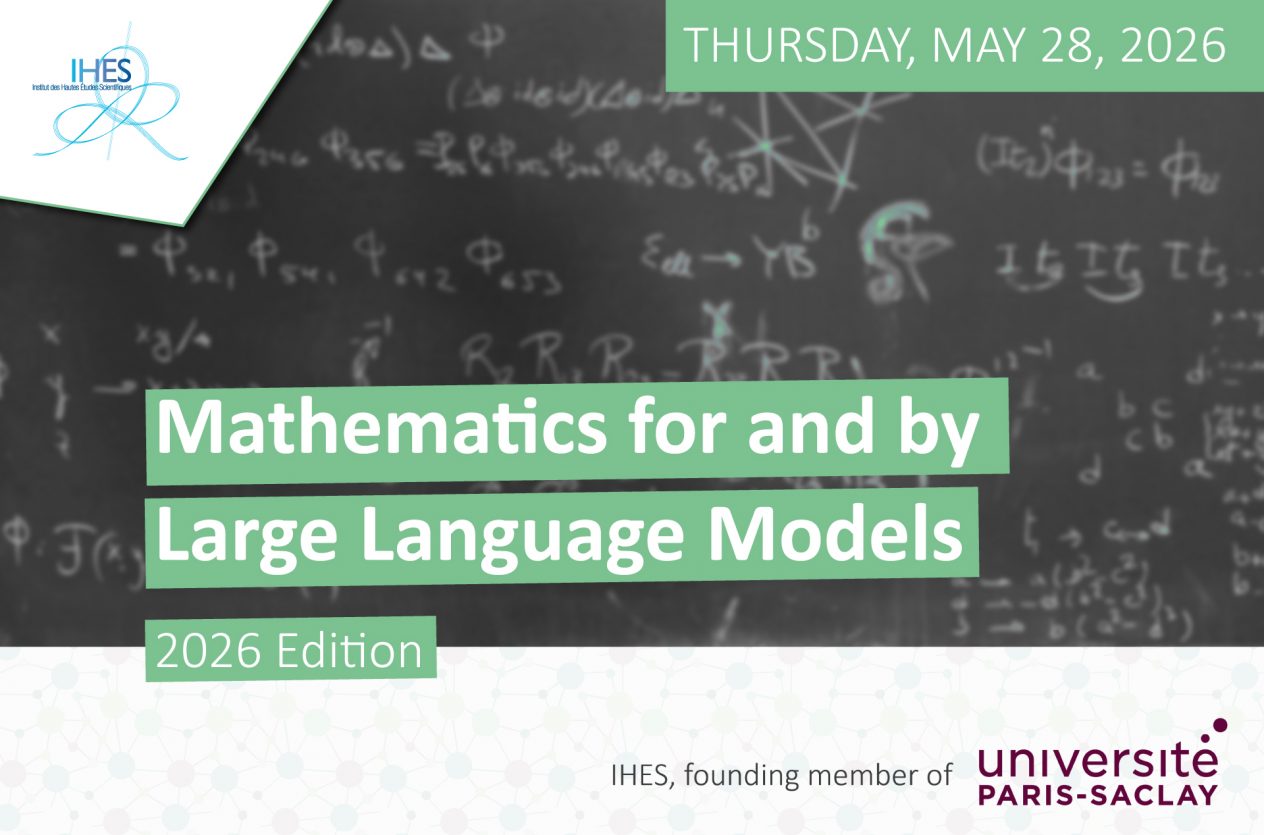
Le 28 mai prochain, François Charton, Michael Douglas, Amaury Hayat et Yiannis Vlassopoulos organisent à l'IHES une conférence d'une journée sur les mathématiques et les grands modèles de langage.
En savoir plus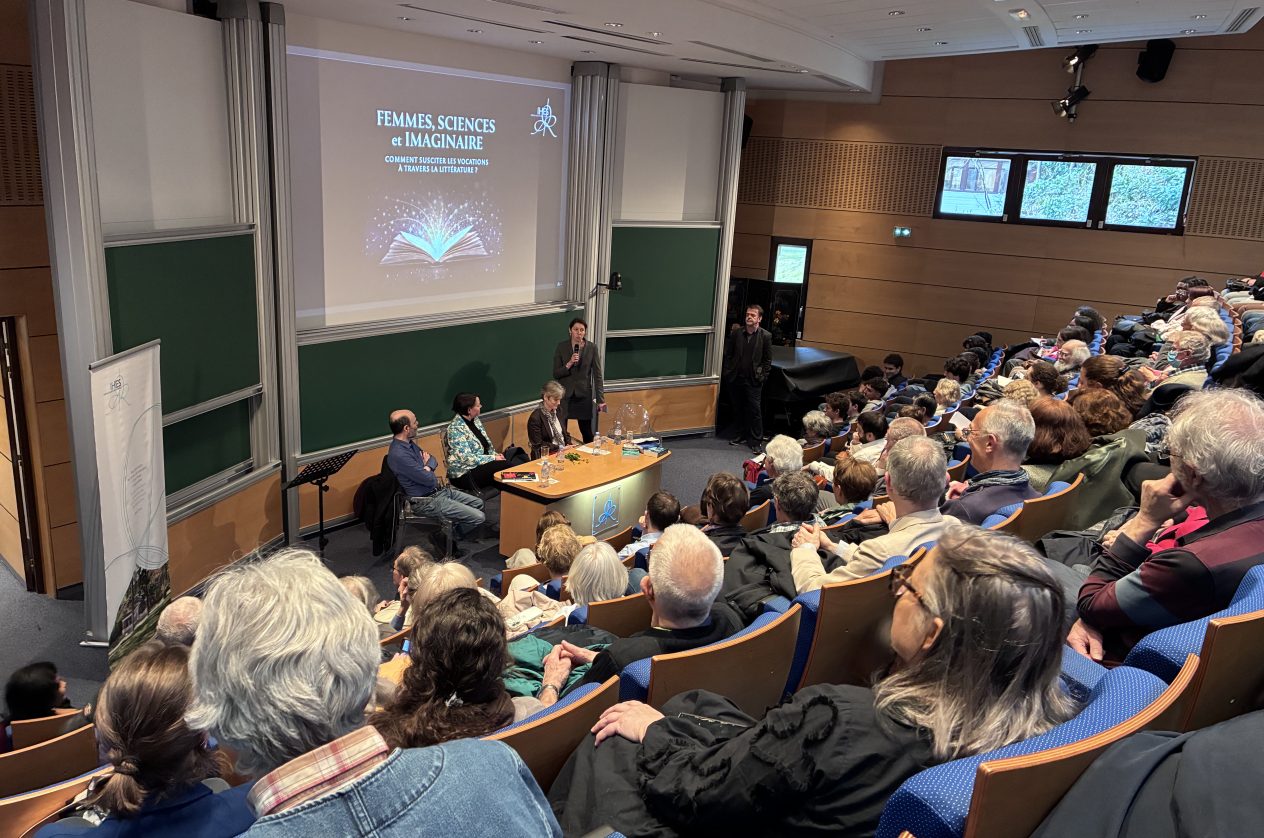
Le 2 avril dernier, l’IHES a eu le plaisir d’accueillir près de 130 participants, dont une quarantaine de lycéens et lycéennes du lycée Rosa Parks de Montgeron, pour une table ronde grand public, suivie d’un cocktail dînatoire, d’une vente de livres organisée par la Librairie Liragif et d’une séance de dédicaces.
En savoir plus