
Croissance des normes Sobolev pour l’équation de Szegö cubique
Séminaire Laurent Schwartz — EDP et applications
Séminaire Laurent Schwartz — EDP et applications
Séminaire Laurent Schwartz — EDP et applications
Une carte cFK de taille $n$ est une carte aléatoire tirée parmi toutes les cartes planaires enracinées à $n$ arêtes avec une probabilité proportionnelle à la fonction de partition de la FK-percolation critique (auto-dual) sur la carte. C'est une famille de cartes aléatoire dépendant d'un paramètre $q>0$, dont le cas $q=1$ correspond à la carte planaire uniforme. En 2013 Sheffield a trouvé une bijection, dite de Hamburger-Cheeseburger, entre une carte cFK et un modèle de mot aléatoire. Dans cet exposé, nous donnons une nouvelle présentation de cette bijection. Nous construisons ensuite la limite locale de la carte cFK pour tout $q$, et étudions quelques propriétés de la limite.
Travail de mémoire de master dirigé par Jérémie Bouttier et Nicolas Curien.
We will review modified gravity theories and in particular scalar tensor theories, where we have an additional scalar field coupling to the metric tensor. By means of a theorem given by Horndeski back in 1974 we will briefly discuss the most general of these theories. We will examine a particular sub-class of Horndeski theory which has interesting properties with respect to the cosmological constant problem. We will then find black hole solutions of this subclass which in some cases will be identical to GR solutions. The novel ingredient will be the presence of a time and space dependent scalar field. As we will see time dependence and higher order Galileon terms will bifurcate no hair theorems and provide scalar tensor black holes with a non trivial scalar field.
A large amount of work in perturbative superstring theory is associated to certain limits of string amplitudes with massless (or very low mass) asymptotic states, in simple string backgrounds where computations are feasible. In this talk I will focus on a much less explored regime, that of amplitudes with `highly excited' asymptotic string states, and will give an overview of a formalism (based on covariant coherent state vertex operators) which is particularly efficient for explicit computations involving highly excited strings. I will discuss generic features of `all' 2-point 1-loop amplitudes, eventually focusing on a simple explicit example to illustrate the effectiveness of this new approach, while also making contact with low energy effective field theory results.
Je montrerai comment calculer la fonction à trois points dépendant des distances pour la famille des cartes planaires générales, c'est à dire la fonction génératrice de ces cartes avec poids par arête et poids par face, avec trois sommets marqués à distances mutuelles prescrites. Je discuterai aussi du cas de la famille des cartes biparties et de quelques cas limites. Ceci est un travail en commun avec Éric Fusy.
Many cellular and developmental processes are tightly controlled by regulatory logic that is similar across different species. Is this similarity the result of common ancestry or is it due to convergent evolution?
We address this question using in silico modeling of genetic networks controlling organ development in flowers. First, we determine the number of networks implementing a given logic and point to an open mathematical problem. Second, we take a computational approach based on Markov Chain Monte Carlo and sample uniformity that highly constrained space of networks. The production of a large number of samples in that ensemble reveals how structural features of genetic networks are shaped by the imposed regulatory logic. Thus, network structural features are expected to be shared across different species through convergent evolution.
Et aussi
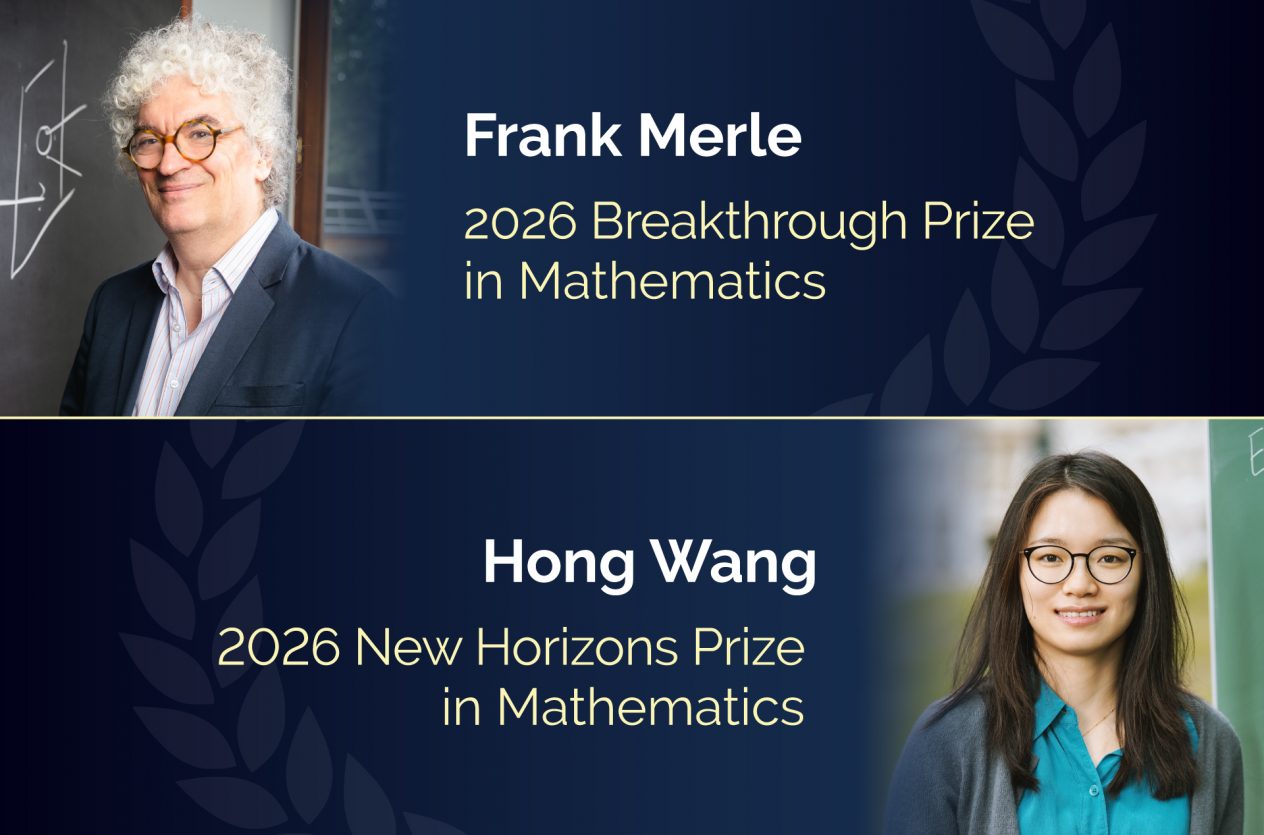
La 12e cérémonie des Breakthrough Prize s'est tenue samedi 18 avril, et l’IHES est fier d’annoncer que deux de ses scientifiques figurent parmi les lauréats de cette année.
En savoir plus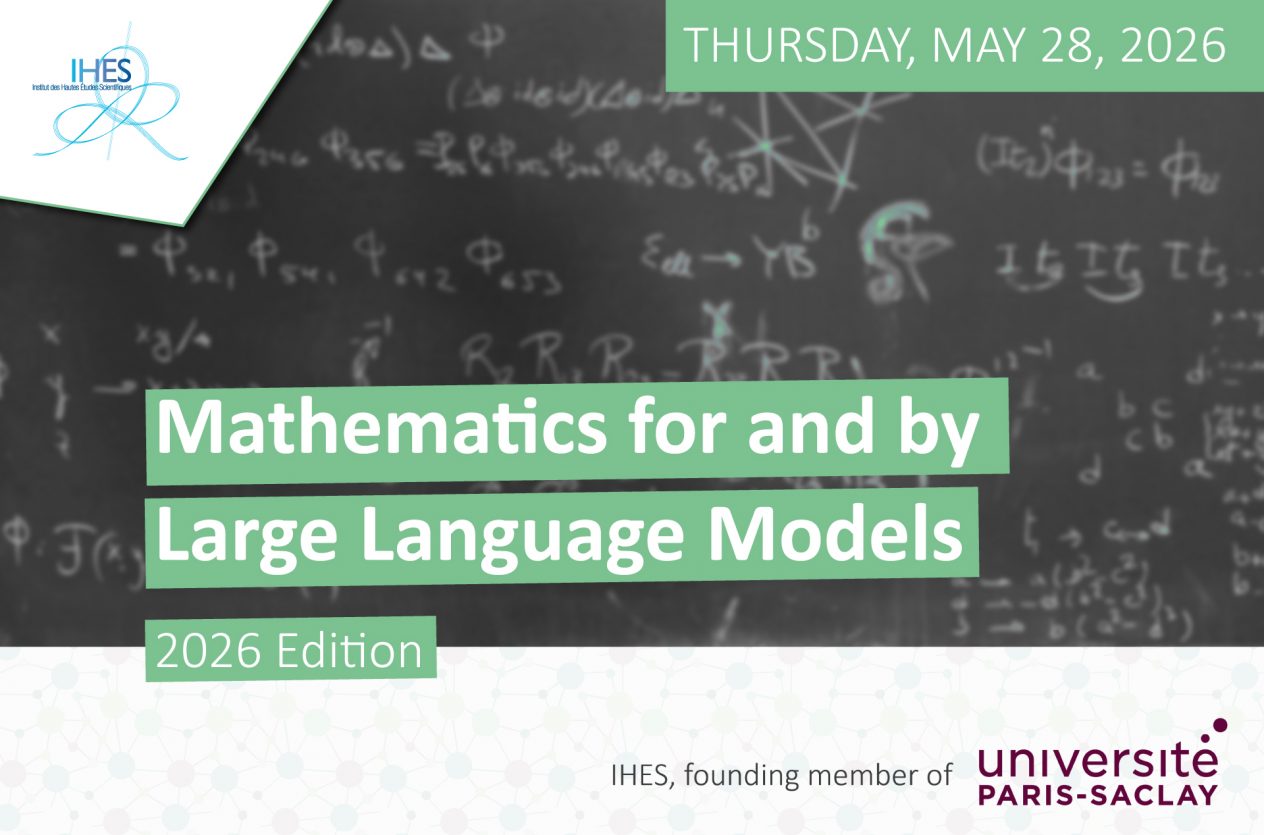
Le 28 mai prochain, François Charton, Michael Douglas, Amaury Hayat et Yiannis Vlassopoulos organisent à l'IHES une conférence d'une journée sur les mathématiques et les grands modèles de langage.
En savoir plus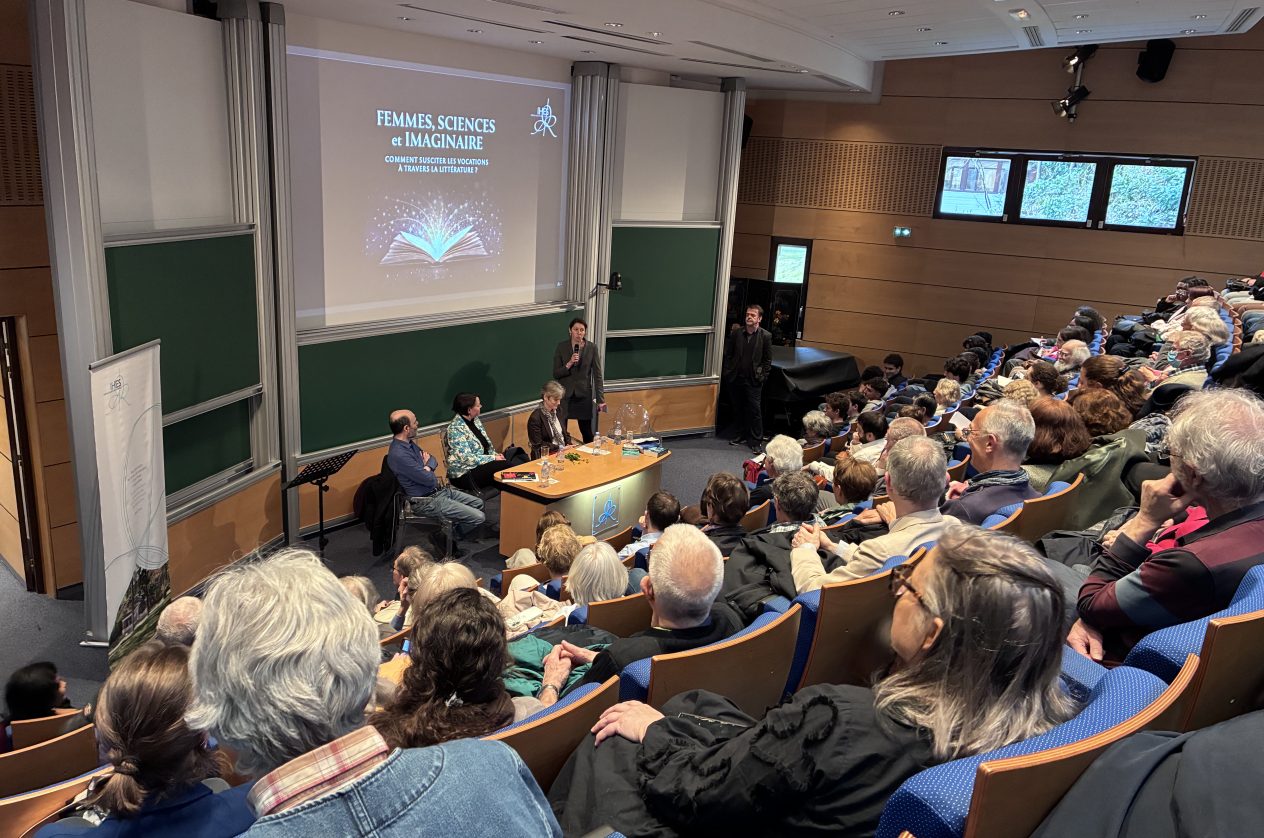
Le 2 avril dernier, l’IHES a eu le plaisir d’accueillir près de 130 participants, dont une quarantaine de lycéens et lycéennes du lycée Rosa Parks de Montgeron, pour une table ronde grand public, suivie d’un cocktail dînatoire, d’une vente de livres organisée par la Librairie Liragif et d’une séance de dédicaces.
En savoir plus