
Knotty problems with DNA
I will introduce you to topological questions that arise when considering the DNA of three different unicellular organisms: bacteria, ciliates and trypanosomes.
I will introduce you to topological questions that arise when considering the DNA of three different unicellular organisms: bacteria, ciliates and trypanosomes.
A classical result of Kronecker and Weber states that the value of the elliptic j-function at a point of complex multiplication (i.e. a point lying in the intersection of the upper half-plain and some imaginary quadratic field) is algebraic. B. Gross and D. Zagier have conjectured that a similar phenomenon also holds for certain modular eigenfunctions of the hyperbolic Laplace operator. Namely, the higher Green's functions are real-valued functions of two variables on the upper half-plane which are bi-invariant under the action of SL2(Z), have a logarithmic singularity along the diagonal and are eigenfunctions of the hyperbolic Laplace operator with eigenvalue k(1-k) for some positive integer k. The conjecture formulated in "Heegner points and derivatives of L-series'' (1986) predicts when the value of a higher Green's function at a pair of points of complex multiplication is equal to the logarithm of an algebraic number. In this talk I would like to present a proof of this conjecture for a pair of points both lying in the same imaginary quadratic field.
All necessary biological knowledge for understanding the hot biological problem(s) underlying the modeling will be provided.
A quantum curve is a magical object. It conjecturally captures information of quantum topological invariants in a concise manner. In this talk we will discuss a method of constructing quantum curves by quantizing the spectral curves of Hitchin systems in terms of the WKB method. The quantization is performed by applying the Eynard-Orantin theory, which is a generalization of the topological recursion formalism developed by Eynard and Orantin in 2007. The talk is based on my joint work with Olivia Dumitrescu.
We study two classes of n-generated quadratic algebras over a field K. The first is the class Cn of all n-generated PBW algebras with polynomial growth and finite global dimension. We show that a PBW algebra A is in Cn iff its Hilbert series is HA(z) = 1/(1-z)n. Furthermore each class Cn contains a unique (up to isomorphism) monomial algebra A = K ‹ x1, … , xn › / (xj xi | 1 ≤£ i < j £ n). The second is the class of n-generated quantum binomial algebras A, where the defining relations are nondegenerate square-free binomials xy – cxy zt, with nonzero coefficients cxy. Our main result shows that the following conditions are equivalent: (i) A is a Yang-Baxter algebra, that is the set of quadratic relations R defines canonically a solution of the Yang-Baxter equation. (ii) A is an Artin-Schelter regular PBW algebra. (iii) A is a PBW algebra with polynomial growth. (iv) A is a binomial skew polynomial ring. (v) The Koszul dual A! is a quantum Grassmann algebra.
Let B be a quaternionic algebra over a totally real field F, and p be a prime at least 3 unramified in F. We consider a Shimura variety X associated to B* of level prime to p. A generalization of Deligne-Carayol's "modèle étrange" allows us to define an integral model for X. We will then define a Goren-Oort stratification on the characteristic p fiber of X, and show that each closed Goren-Oort stratum is an iterated P1-fibration over another quaternionic Shimura variety in characteristic p. Now suppose that [F:Q] is even and that p is inert in F. An iteration of this construction gives rise to many algebraic cycles of middle codimension on the characteristic p fibre of Hilbert modular varieties of prime-to-p level. We show that the cohomological classes of these cycles generate a large subspace of the Tate cycles, which, in some special cases, coincides with the prediction of the Tate conjecture for the Hilbert modular variety over finite fields. This is a joint work with Liang Xiao.
Page web du séminaire
Given an F-crystal C over a scheme S of positive characteristic p, one can associate many reduced locally closed subschemes T of S defined by the property that a suitable invariant of F-crystals is constant on the fibres of C over points of S. A basic problem is to study different properties of such locally closed subschemes T. In this talk, we present a survey of purity results for locally closed subschemes T of S, including some of them which were obtained by us and by the graduate student Jinghao Li.
A technical ingredient in Faltings’ original approach to p-adic comparison theorems involves the construction of K(π, 1)-neighborhoods for a smooth scheme X over a mixed characteristic dvr with a perfect residue field: every point x ∈ X has an open neighborhood U whose general fiber is a K(π, 1) scheme (a notion analogous to having a contractible universal cover). I will show how to extend this result to the logarithmically smooth case, which might help to simplify some proofs in p-adic Hodge theory.
In the context of Loop Quantum Gravity, Black Holes are closely related to Chern-Simons theory on a punctured 2-sphere with SU(2) gauge group. Using this link, one can describe precisely the space of microstates for the Black Holes and compute the corresponding statistical entropy. However, it turns out that the entropy depends on the unphysical Immirzi parameter γ. But, using a suitable analytic continuation of γ to complex values, we show that the entropy reproduces the expected Bekenstein-Hawking expression when γ = ± i at the semi-classical limit. This remarkable result has a nice and clear geometric interpretation and many very interesting physical consequences. In particular, we show that, at the semi-classical limit, the Black Hole microstates (at the vicinity of the horizon) are particles in equilibrium at the Unruh temperature.
We study N=(0,2) deformed (2,2) two-dimensional sigma models. Such heterotic models were discovered previously on the world sheet of non-Abelian strings supported by certain four-dimensional N=1 theories. We study geometric aspects and holomorphic properties of these models, and derive a number of exact expressions for the beta functions in terms of the anomalous dimensions analogous to the NSVZ beta function in four-dimensional Yang-Mills. Instanton calculus provides a straightforward method for the derivation.
We prove that despite the chiral nature of the model anomalies in the isometry currents do not appear for CP(N-1) at any N. This is in contradistinction with the minimal heterotic model (with no right-moving fermions) which is anomaly-free only for N=2, i.e. in CP(1). We also consider the N=(0,2) supercurrent supermultiplet (the so-called hypercurrent) and its anomalies, as well as the « Konishi anomaly. » This gives us another method for finding exact β functions.
A clear–cut parallel between N=1 4D Yang-Mills and N=(0,2) 2D sigma models is revealed.
Et aussi
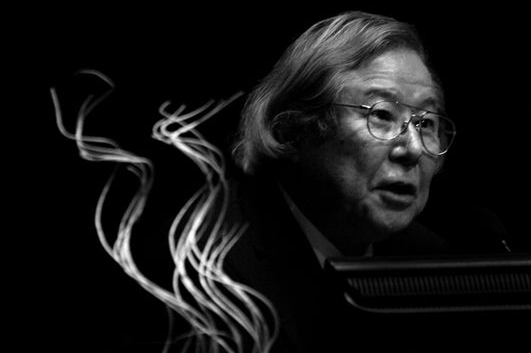
L’IHES a appris avec une profonde tristesse le décès de Heisuke Hironaka, figure majeure des mathématiques contemporaines et lauréat de la médaille Fields en 1970 pour ses contributions fondamentales à la géométrie algébrique.
En savoir plus
Découvrez l'entretien avec Heisuke Hironaka par Stéphane Deligeorges réalisé à l'occasion des 40 ans de l'IHES en 1998.
En savoir plus
Découvrez le discours prononcé par Heisuke Hironaka à l'occasion de la remise de la Légion d'honneur à l'Ambassade de France à Tokyo le 21 janvier 2004.
En savoir plus