
Extremizers for Hardy-Littlewood-Sobolev inequalities on groups of Heisenberg-type
Séminaire Laurent Schwartz — EDP et applications
Séminaire Laurent Schwartz — EDP et applications
Séminaire Laurent Schwartz — EDP et applications
Avec le soutien de :
ERC Advanced Grant : AAMOT (Arithmetic of Automorphic Motives)
PI : Michael HARRIS
The moduli of (possibly irregular) formal connections in one variable (up to gauge transformations) is an infinite-dimensional space that "feels finite-dimensional," e.g., it has finite-dimensional tangent spaces. However, it is not so clear how this perception is actually reflected in the global geometry of this space.
Previous works have focused on explicit parametrization of this space. As we will recall during the talk, this approach has significant limitations, and is insufficient to say anything about the global geometry. But we will instead find that this space appears much kinder through the lens of homological (or more poetically, noncommutative) geometry, exhibiting better features than all its close relatives. In particular, we will give a first sense in which it appears globally finite-dimensional.
Finally, we will discuss how these results lend credence to the existence of a de Rham Langlands program incorporating arbitrary singularities (the usual story is unramified, or at worst has Iwahori ramification). Time permitting, we will be formulate a precise conjecture that is a first approximation to a local geometric Langlands conjecture.
Avec le soutien de :
ERC Advanced Grant : AAMOT (Arithmetic of Automorphic Motives)
PI : Michael HARRIS
The smooth representation theory of a p-adic reductive group G with characteristic zero coefficients is very closely connected to the module theory of its (pro-p) Iwahori-Hecke algebra H = H(G). In the modular case,where the coefficients have characteristic p, this connection breaks down to a large extent. In this talk I will first survey joint work with R. Ollivier in this modular case.
We determine completely the homological properties of H, and we introduce a certain torsion theory in the module category Mod(H) such that the torsion free modules embed fully faithfully into the category of smooth G-representations. In the case of the group SL_2 we are able to explicitly compute this torsion theory. Secondly I will describe a derived picture of the whole situation in which one recovers an equivalence between the module theory of a derived version of H and the derived representation theory of G. In both approaches the cohomology of the pro-p Iwahori subgroup of G in a certain universal module plays a crucial role.
The logarithmic Hodge-Witt sheaves of Illusie, Milne, Kato, et al. of a smooth variety in characteristic p provide a concrete realisation of its p-adic motivic cohomology, thanks to results of Geisser-Levine and Bloch-Kato-Gabber which link them to algebraic K-theory. I will explain an analogous theory for formal schemes, as well as applications to algebraic cycles, such as a weak Lefschetz theorem for formal Chow groups.
Avec le soutien de :
ERC Advanced Grant : AAMOT (Arithmetic of Automorphic Motives)
PI : Michael HARRIS
This is joint work with Zhiwei Yun. We prove a generalization of Gross-Zagier formula in the function field setting. Our formula relates self-intersection of certain cycles on the moduli of Shtukas for GL(2) to higher derivatives of L-functions.
The local p-adic Simpson correspondence by Faltings asserts that there is a natural equivalence of categories between small generalized representations and small Higgs modules for an affine semi-stable scheme over a complete discrete valuation ring of mixed characteristic with algebraically closed residue field. However, in the case of rational coefficients, the construction of the functor from the former to the latter, reducing to the theory for integral coefficients, does not seem to work as it is written, as pointed out by Ahmed Abbes. In this talk, I give an alternative argument based on a generalized Sen's theory for the semi-stable scheme and complete the local theory for rational coefficients.
Avec le soutien de :
ERC Advanced Grant : AAMOT (Arithmetic of Automorphic Motives)
PI : Michael HARRIS
Let G be a split reductive group over a finite field F_q and let K be a global field with constant field F_q. By fundamental work of Vincent Lafforgue any cuspidal automorphic representation of G(A_K) gives rise to a compatible system of Galois representation of Gal(K^sep/K) valued in the dual group hat G of G. In joint work with M. Harris, C. Khare and J. Thorne, we investigate the question of when a hat G-valued continuous l-adic representation of Gal(K^sep/K) is potentially automorphic, i.e. arises potentially from V. Lafforgue’s construction. After an introduction and the statement of a first potential modularity result, I will focus on the aspect of compatible systems and the use of a result of Moret-Bailly in the present context.
On expose les résultats récents sur la conjecture de Langlands locale pour les groupes classiques en caractéristique p, et les techniques de théorie des représentations utilisées. Nous commençons avec le cas d'une représentation générique. On discute les fonctions L et les facteurs locaux sur un corps local non archimédien. Nous présentons les résultats de Ganapathy-Varma sur le transfert de la caractéristique zéro à la caractéristique p pour les groupes classiques deployés. Nous donnons aussi une autre approche du global au local en collaboration avec Gan pour les groupes classiques quasi-deployés. Nous faisons une conjecture dans le cas général, mais le cas générique est complet. Nous donnons des détails pour l'étude des fonctions L avec la méthode de Langlands-Shahidi.
Avec le soutien de :
ERC Advanced Grant : AAMOT (Arithmetic of Automorphic Motives)
PI : Michael HARRIS
Je vais tenter d'expliquer quelques propriétés de ma conjecture concernant la géométrisation de la correspondance de Langlands locale. Je me concentrerai en particulier sur les propriétés de faisceau caractère, la compatibilité local/global et le fait que la conjecture implique la conjecture de Kottwitz décrivant la contribution des paquets supercuspidaux à la cohomologie des espaces de Rapoport-Zink. Je supposerai que l'auditeur est quelque peu familier avec la prépublication "Geometrization of the local Langlands correspondence: an overview".
Si on devait choisir un seul adjectif pour définir le domaine des exoplanètes, cet adjectif serait «révolutionnaire». Au cours des dernières années, presque 2000 planètes ont été trouvées autour de tous les types d’étoiles, y compris les étoiles pulsantes et binaires. Les estimations statistiques actuelles indiquent que, en moyenne, chaque étoile dans notre galaxie hébergerait au moins un compagnon planétaire, c’est à dire que notre Voie lactée est bondée de cent milliards de planètes.
L’aspect le plus révolutionnaire de ce jeune domaine est la découverte que le Système solaire ne semble pas être le paradigme dans notre Galaxie, mais plutôt l’une des nombreuses configurations possibles. Aujourd’hui l’accent doit donc passer de la découverte à la compréhension : c’est à dire comprendre la nature des planètes et leur histoire.
Le moyen d’observation clé pour comprendre les planètes est la composition chimique et l’état de leur atmosphère. Connaître de quoi les atmosphères sont faites est essentiel pour clarifier, par exemple, si une planète est née dans l’orbite actuelle où elle est observée ou si elle a suivi une migration longues ; il est également important de comprendre le rôle du rayonnement stellaire sur les processus d’échappement, l’évolution chimique et la circulation atmosphérique. À ce jour, deux méthodes peuvent être utilisées pour sonder les atmosphères exoplanétaires : la spectroscopie en transit et en éclipse, et la spectroscopie en imagerie directe. Ces sont des méthodes très complémentaires et nous devrions poursuivre les deux pour obtenir une connaissance cohérente des planètes en dehors de notre système solaire.
Et aussi
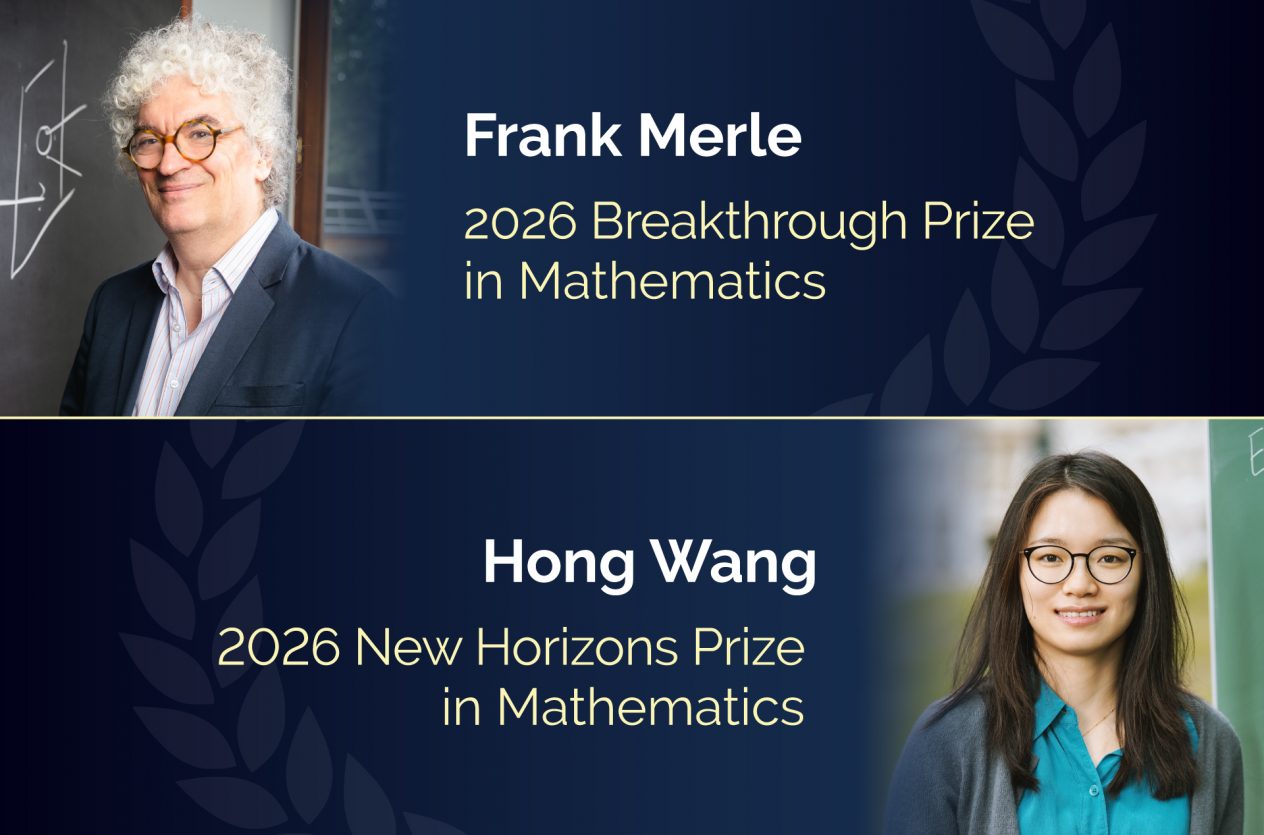
La 12e cérémonie des Breakthrough Prize s'est tenue samedi 18 avril, et l’IHES est fier d’annoncer que deux de ses scientifiques figurent parmi les lauréats de cette année.
En savoir plus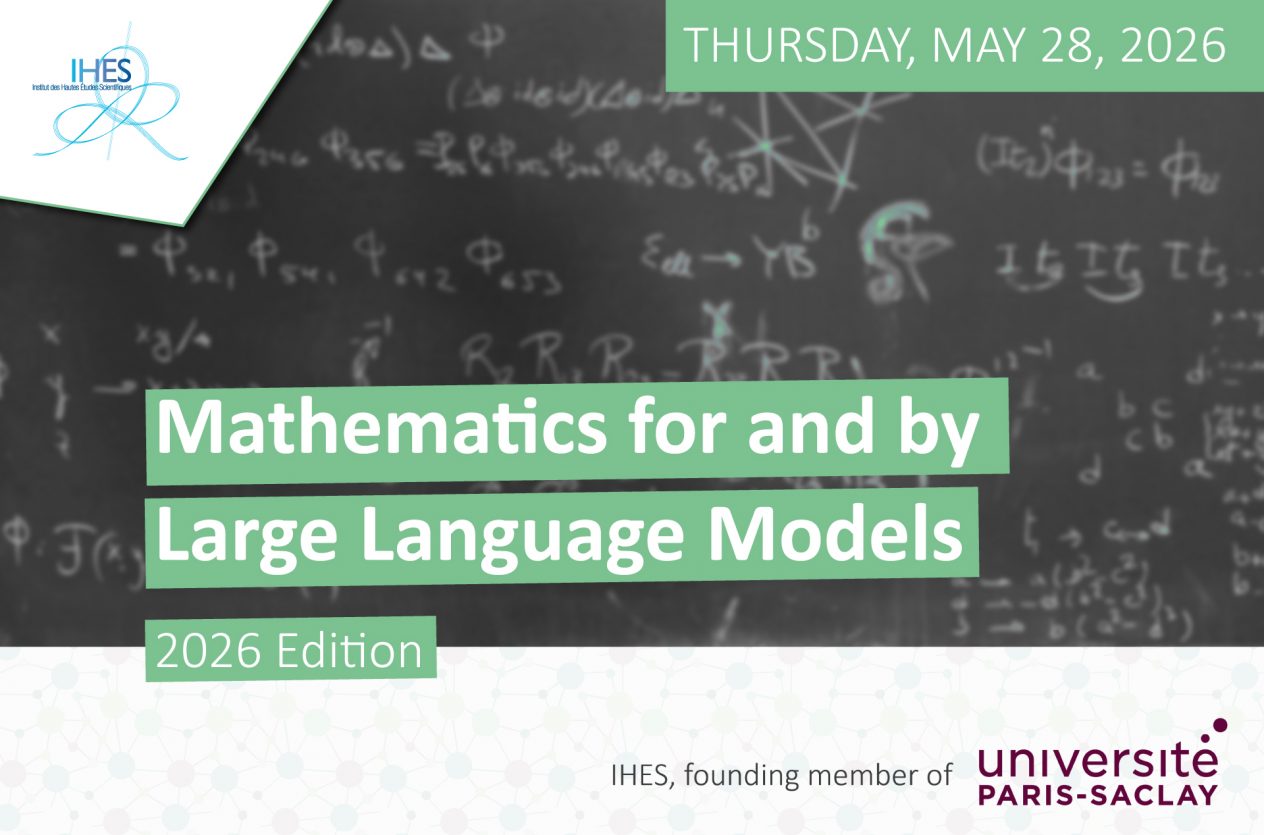
Le 28 mai prochain, François Charton, Michael Douglas, Amaury Hayat et Yiannis Vlassopoulos organisent à l'IHES une conférence d'une journée sur les mathématiques et les grands modèles de langage.
En savoir plus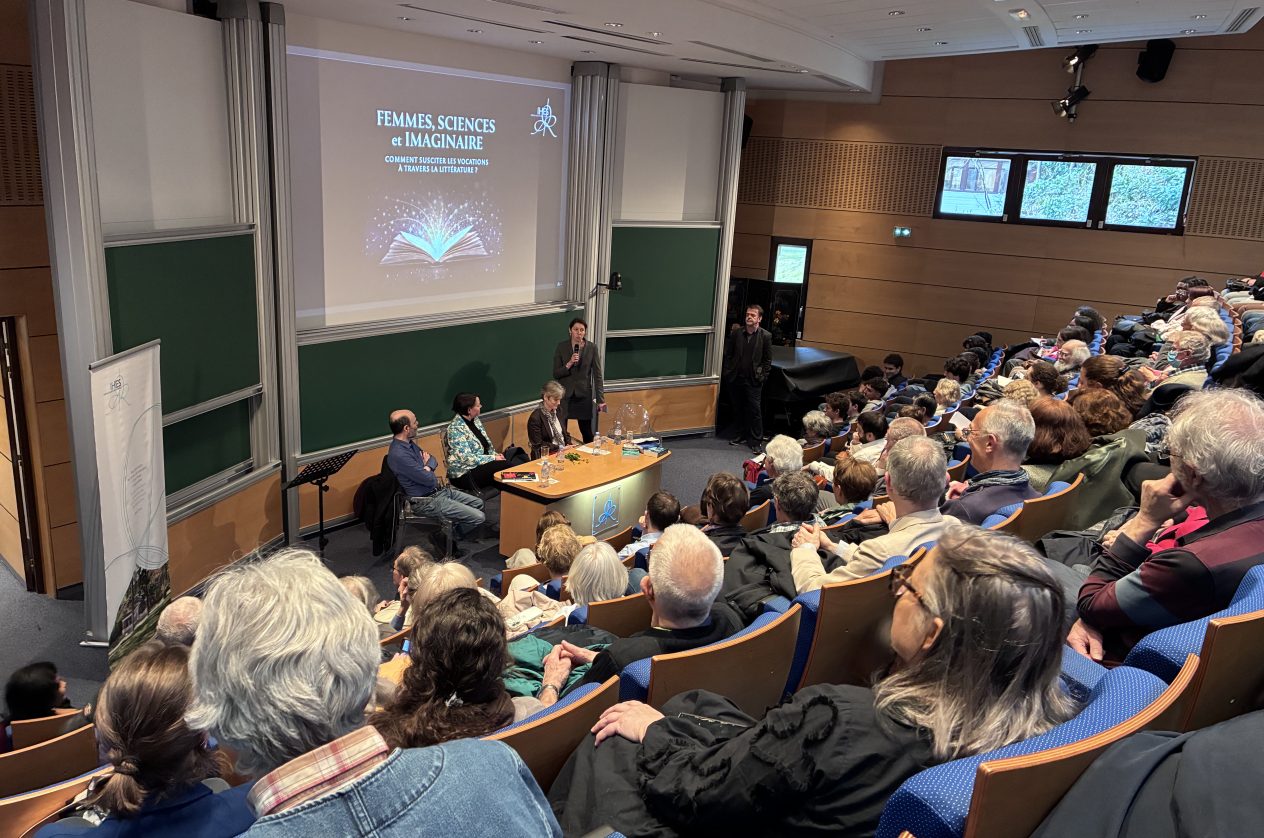
Le 2 avril dernier, l’IHES a eu le plaisir d’accueillir près de 130 participants, dont une quarantaine de lycéens et lycéennes du lycée Rosa Parks de Montgeron, pour une table ronde grand public, suivie d’un cocktail dînatoire, d’une vente de livres organisée par la Librairie Liragif et d’une séance de dédicaces.
En savoir plus