
On the Nonlinear Stability of Black Holes
Let $G$ be a Lie group, $H$ a closed subgroup of $G$ and $Gamma$ a discontinuous group for the homogeneous space $mathscr{X}=G/H$, which means that $Gamma$ is a discrete subgroup of $G$ acting properly discontinuously and fixed point freely on $mathscr{X}$. The subject of the talk is to to deal with some questions related to the geometry of the parameter and the deformation spaces of the action of $Gamma$ on $mathscr{X}$, when the group $G$ is solvable. The local rigidity conjecture in the nilpotent case and the analogue of the Selberg-Weil-Kobayashi rigidity Theorem in such non-Riemannian setting is also discussed.
An important conjecture in quantum mechanics is that non-interacting, disordered 3d quantum systems should exhibit a localization-delocalization transition as a function of the disorder strength. From a mathematical viewpoint, a lot is known about the localized phase for strong disorder, much less about the delocalized phase at weak disorder. In this talk I will present results for a hierarchical supersymmetric model for a class of 3d quantum systems, called Weyl semimetals. We use rigorous renormalization group methods to compute the correlation functions of the system. In particular, I will report a result about the algebraic decay of the averaged two-point correlation function, compatible with delocalization. Our method is based on a rigorous implementation of RG, reminiscent of the Gawedzki-Kupiainen block spin transformations; the main technical novelty is the multiscale analysis of Gaussian measures with purely imaginary covariances.
Joint work with Luca Fresta and Marcello Porta.
Séminaire Laurent Schwartz — EDP et applications
In 1996 Rinat Kashaev introduced a new way to write the star-triangle move (or Yang-Baxter equations) of the Ising model as a single polynomial relation. In 2013 Richard Kenyon and Robin Pemantle understood that this relation could be seen as a kind of spatial recurrence. I will show how the iteration of Kashaev’s recurrence can be related the combinatorics of a loop model with two colors, that was introduced for different reasons by Ole Warnaar and Bernard Nienhuis in 1993. It is also possible to couple this loop model with known relatives of the Ising model: a dimer model and a six-vertex model. Finally I will show a few limit shape phenomena.
Mapping class groups of infinite type surfaces, also called « big » mapping class groups, arise naturally in several dynamical contexts, such as two-dimensional dynamics, one-dimensional complex dynamics, « Artinization » of Thompson groups, etc.
In this talk, I will present recent objects and phenomena related to big mapping class groups. In particular, I will define two faithful actions of some big mapping class groups. The first is an action by isometries on a Gromov-hyperbolic graph. The second is an action by homeomorphisms on a circle in which the vertices of the graph naturally embed. I will describe some properties of the objects involved, and give some fruitful relations between the dynamics of the two actions. For example, we will see that loxodromic elements (for the first action) necessarily have rational rotation number (for the second action). If time allows, I will explain how to use these simultaneous actions to construct nontrivial quasimorphisms on subgroups of big mapping class groups.
This is joint work with Alden Walker.
I will show that for any integer N, there are only finitely many cuspidal algebraic automorphic representations of GL_m over Q whose Artin conductor is N and whose « weights » are in the interval {0,…,23} (with m varying). Via the conjectural yoga between geometric Galois representations (or motives) and algebraic automorphic forms, this statement may be viewed as a generalization of the classical Hermite-Minkowski theorem in algebraic number theory. I will also discuss variants of these results when the base field Q is replaced by an arbitrary number field.
Séminaire Laurent Schwartz — EDP et applications
We describe dynamical systems arising from the classification of locally homogeneous geometric structures on manifolds. Their classification mimics the classification of Riemann surfaces by the Riemann moduli space – the quotient of Teichmüller space by the properly discontinuous action of the mapping class group. However, this action is misleading: mapping class groups generally act chaotically on character varieties. For fundamental examples, these varieties appear as affine cubics, and we relate the projective geometry of cubic surfaces to dynamical properties of the action.
Séminaire Laurent Schwartz — EDP et applications
Let Γ be a group acting by isometries on a proper metric space (X,d). The critical exponent δΓ(X) is a number which measures the complexity of this action. The critical exponent of a subgroup Γ'<Γ is hence smaller than the critical exponent of Γ. When does equality occur? It was shown in the 1980s by Brooks that if X is the real hyperbolic space, Γ’ is a normal subgroup of Γ and Γ is convex-cocompact, then equality occurs if and only if Γ/Γ’ is amenable. At the same time, Cohen and Grigorchuk proved an analogous result when Γ is a free group acting on its Cayley graph.
When the action of Γ on X is not cocompact, showing that the equality of critical exponents is equivalent to the amenability of Γ/Γ’ requires an additional assumption: a « growth gap at infinity ». I will explain how, under this (optimal) assumption, we can generalize the result of Brooks to all groups Γ with a proper action on a Gromov hyperbolic space.
Joint work with R. Coulon, R. Dougall and B. Schapira.
In this talk I will argue that after certain timescale (which scales with the system size as L^{d+2}) dynamics of a local observable becomes universal and it can be described by a random matrix.
This talks is based on https://arxiv.org/abs/1804.08626 and other recent works.
Et aussi
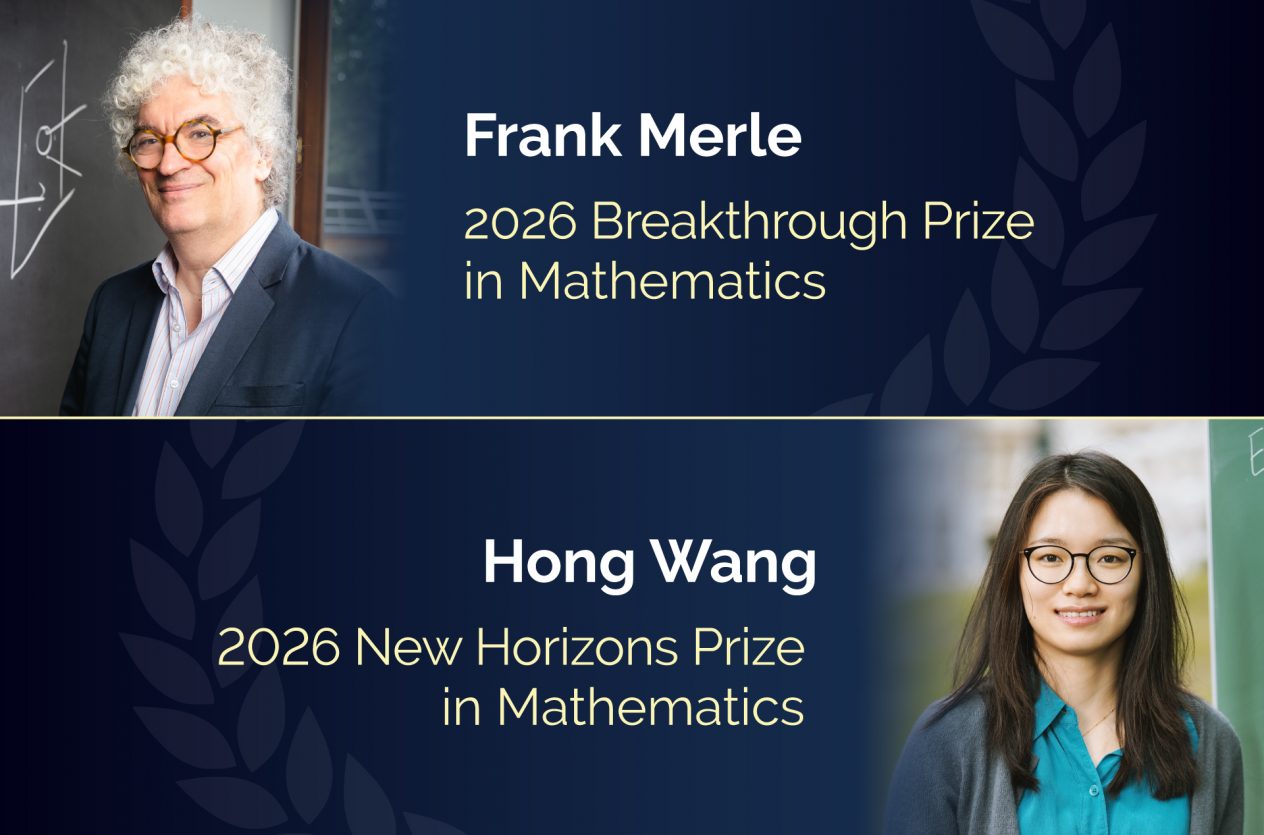
La 12e cérémonie des Breakthrough Prize s'est tenue samedi 18 avril, et l’IHES est fier d’annoncer que deux de ses scientifiques figurent parmi les lauréats de cette année.
En savoir plus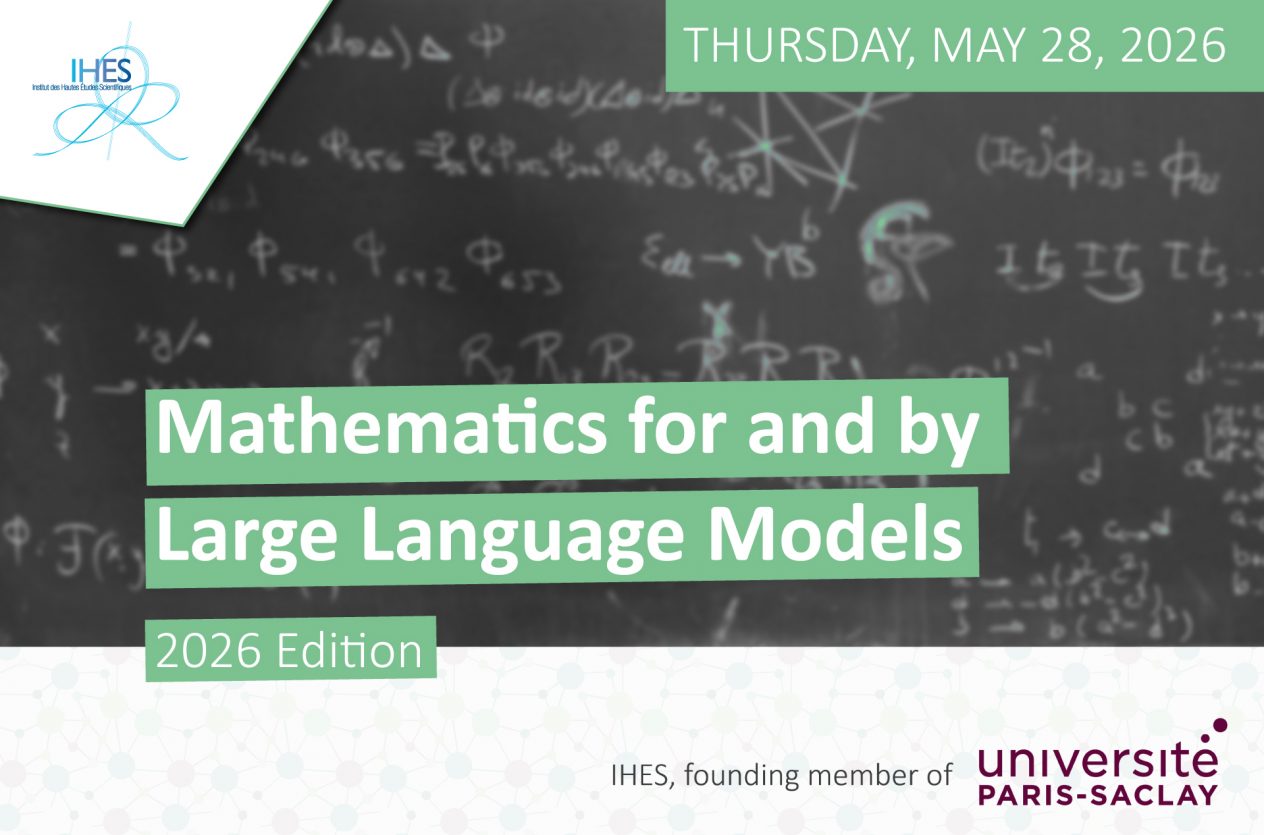
Le 28 mai prochain, François Charton, Michael Douglas, Amaury Hayat et Yiannis Vlassopoulos organisent à l'IHES une conférence d'une journée sur les mathématiques et les grands modèles de langage.
En savoir plus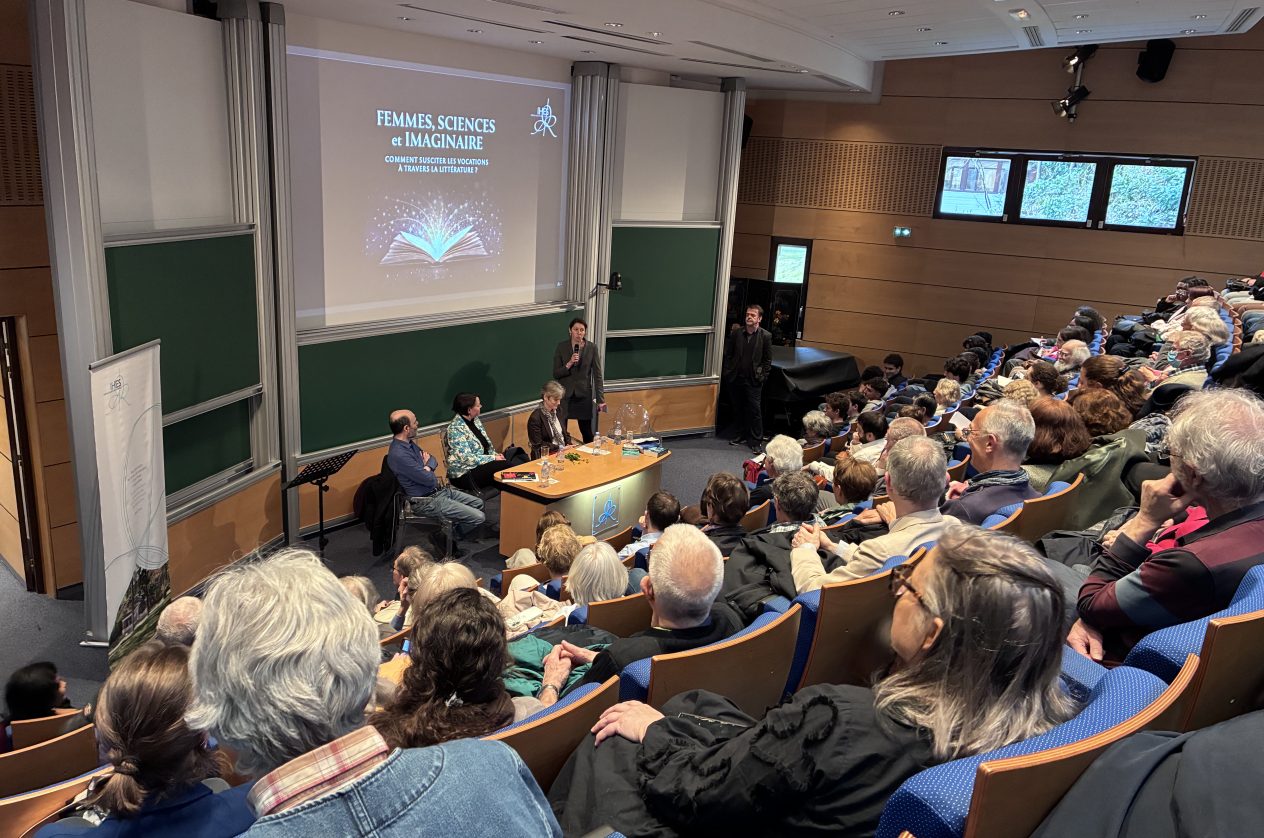
Le 2 avril dernier, l’IHES a eu le plaisir d’accueillir près de 130 participants, dont une quarantaine de lycéens et lycéennes du lycée Rosa Parks de Montgeron, pour une table ronde grand public, suivie d’un cocktail dînatoire, d’une vente de livres organisée par la Librairie Liragif et d’une séance de dédicaces.
En savoir plus