
Extremizers for Hardy-Littlewood-Sobolev inequalities on groups of Heisenberg-type
Séminaire Laurent Schwartz — EDP et applications
Events from Indico
Séminaire Laurent Schwartz — EDP et applications
Séminaire Laurent Schwartz — EDP et applications
Avec le soutien de :
ERC Advanced Grant : AAMOT (Arithmetic of Automorphic Motives)
PI : Michael HARRIS
The moduli of (possibly irregular) formal connections in one variable (up to gauge transformations) is an infinite-dimensional space that "feels finite-dimensional," e.g., it has finite-dimensional tangent spaces. However, it is not so clear how this perception is actually reflected in the global geometry of this space.
Previous works have focused on explicit parametrization of this space. As we will recall during the talk, this approach has significant limitations, and is insufficient to say anything about the global geometry. But we will instead find that this space appears much kinder through the lens of homological (or more poetically, noncommutative) geometry, exhibiting better features than all its close relatives. In particular, we will give a first sense in which it appears globally finite-dimensional.
Finally, we will discuss how these results lend credence to the existence of a de Rham Langlands program incorporating arbitrary singularities (the usual story is unramified, or at worst has Iwahori ramification). Time permitting, we will be formulate a precise conjecture that is a first approximation to a local geometric Langlands conjecture.
Avec le soutien de :
ERC Advanced Grant : AAMOT (Arithmetic of Automorphic Motives)
PI : Michael HARRIS
The smooth representation theory of a p-adic reductive group G with characteristic zero coefficients is very closely connected to the module theory of its (pro-p) Iwahori-Hecke algebra H = H(G). In the modular case,where the coefficients have characteristic p, this connection breaks down to a large extent. In this talk I will first survey joint work with R. Ollivier in this modular case.
We determine completely the homological properties of H, and we introduce a certain torsion theory in the module category Mod(H) such that the torsion free modules embed fully faithfully into the category of smooth G-representations. In the case of the group SL_2 we are able to explicitly compute this torsion theory. Secondly I will describe a derived picture of the whole situation in which one recovers an equivalence between the module theory of a derived version of H and the derived representation theory of G. In both approaches the cohomology of the pro-p Iwahori subgroup of G in a certain universal module plays a crucial role.
Avec le soutien de :
ERC Advanced Grant : AAMOT (Arithmetic of Automorphic Motives)
PI : Michael HARRIS
This is joint work with Zhiwei Yun. We prove a generalization of Gross-Zagier formula in the function field setting. Our formula relates self-intersection of certain cycles on the moduli of Shtukas for GL(2) to higher derivatives of L-functions.
Avec le soutien de :
ERC Advanced Grant : AAMOT (Arithmetic of Automorphic Motives)
PI : Michael HARRIS
Let G be a split reductive group over a finite field F_q and let K be a global field with constant field F_q. By fundamental work of Vincent Lafforgue any cuspidal automorphic representation of G(A_K) gives rise to a compatible system of Galois representation of Gal(K^sep/K) valued in the dual group hat G of G. In joint work with M. Harris, C. Khare and J. Thorne, we investigate the question of when a hat G-valued continuous l-adic representation of Gal(K^sep/K) is potentially automorphic, i.e. arises potentially from V. Lafforgue’s construction. After an introduction and the statement of a first potential modularity result, I will focus on the aspect of compatible systems and the use of a result of Moret-Bailly in the present context.
Avec le soutien de :
ERC Advanced Grant : AAMOT (Arithmetic of Automorphic Motives)
PI : Michael HARRIS
Je vais tenter d'expliquer quelques propriétés de ma conjecture concernant la géométrisation de la correspondance de Langlands locale. Je me concentrerai en particulier sur les propriétés de faisceau caractère, la compatibilité local/global et le fait que la conjecture implique la conjecture de Kottwitz décrivant la contribution des paquets supercuspidaux à la cohomologie des espaces de Rapoport-Zink. Je supposerai que l'auditeur est quelque peu familier avec la prépublication "Geometrization of the local Langlands correspondence: an overview".
Si on devait choisir un seul adjectif pour définir le domaine des exoplanètes, cet adjectif serait «révolutionnaire». Au cours des dernières années, presque 2000 planètes ont été trouvées autour de tous les types d’étoiles, y compris les étoiles pulsantes et binaires. Les estimations statistiques actuelles indiquent que, en moyenne, chaque étoile dans notre galaxie hébergerait au moins un compagnon planétaire, c’est à dire que notre Voie lactée est bondée de cent milliards de planètes.
L’aspect le plus révolutionnaire de ce jeune domaine est la découverte que le Système solaire ne semble pas être le paradigme dans notre Galaxie, mais plutôt l’une des nombreuses configurations possibles. Aujourd’hui l’accent doit donc passer de la découverte à la compréhension : c’est à dire comprendre la nature des planètes et leur histoire.
Le moyen d’observation clé pour comprendre les planètes est la composition chimique et l’état de leur atmosphère. Connaître de quoi les atmosphères sont faites est essentiel pour clarifier, par exemple, si une planète est née dans l’orbite actuelle où elle est observée ou si elle a suivi une migration longues ; il est également important de comprendre le rôle du rayonnement stellaire sur les processus d’échappement, l’évolution chimique et la circulation atmosphérique. À ce jour, deux méthodes peuvent être utilisées pour sonder les atmosphères exoplanétaires : la spectroscopie en transit et en éclipse, et la spectroscopie en imagerie directe. Ces sont des méthodes très complémentaires et nous devrions poursuivre les deux pour obtenir une connaissance cohérente des planètes en dehors de notre système solaire.
After a series of partial results, Ilya Kapovich proved in 2009 that if G is a non-elementary geometrically finite Kleinian group acting on a finitely-dimensional unit ball by hyperbolic isometries, then either the Hausdorff dimension of the limit set L(G ) of G is strictly larger than its topological dimension k , or else, L(G ) is a geometric k -sphere.
Using the methods, different than Kapovich's ones, stemming from the theory of conformal iterated function systems and geometric measure theory (recifiability), we shall formulate and discuss the proof of an extension of Kapovich result to the case, where geometric finiteness is replaced by the weaker requirement that the Hausdorff dimension of the limit points that are not radial, is smaller than the Hausdorff dimension of the set of radial points.
A counterpart of this theorem for rational functions of the Riemann sphere will be also discussed.
Finally, the case of Kleinian groups acting on the unit ball of infinitely dimensional separable Hilbert space will be considered.
Let K be a function field over an algebraically closed field of characteritic p geq 0, X a proper smooth K-scheme, and l a prime distinct from p. Deligne proved that the Q_l-coefficient étale cohomology groups of the geometric fiber of X–> K are always semisimple as G_K-modules. In this talk, we consider a similar problem for the F_l-coefficient étale cohomology groups. Among other things, we show that if p=0 (resp. in general), they are semisimple for all but finitely many l's (resp. for all l's in a set of density 1).
Séminaire de Relativité Générale Mathématique
The hidden symmetry of the Kerr spacetime, encoded in its pair of conformal Killing-Yano tensors, implies hidden symmetries for various test fields on such a background. Starting from certain natural operator identities we derive two such symmetries of the linearized Einstein operator. The first one is of differential order four and the relation to the classical theory of Debye potentials as well as to the Chandrasekhar transformation will be explained. The second one is of differential order six and related to the separability of an integrability condition to the linearized Einstein equations — the Teukolsky equation. Advanced symbolic computer algebra tools for xAct were developed for this purpose and if time permits, I will give an overview on the current status.
I will talk about a method of constructing virtual fundamental cycles on moduli spaces of J-holomorphic maps. The construction uses quite a bit of homological algebra, in particular homotopy colimits and homotopy sheaves, and most of the action happens "at the chain level". I will also mention some applications to existing and conjectural enumerative invariants in symplectic and contact geometry.
Et aussi
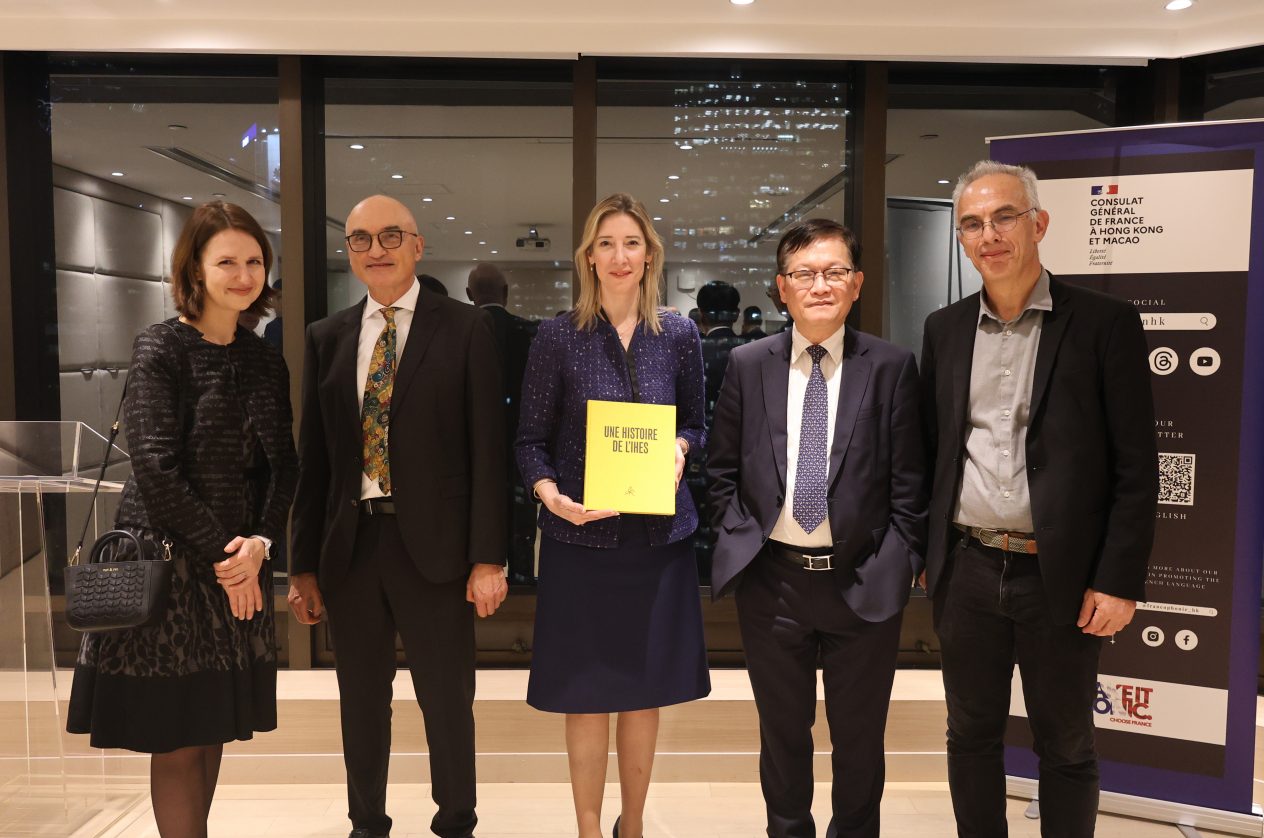
Début février, l’IHES a organisé une série d’événements à Hong Kong, soulignant son rayonnement international ainsi que son engagement en faveur des échanges scientifiques.
En savoir plus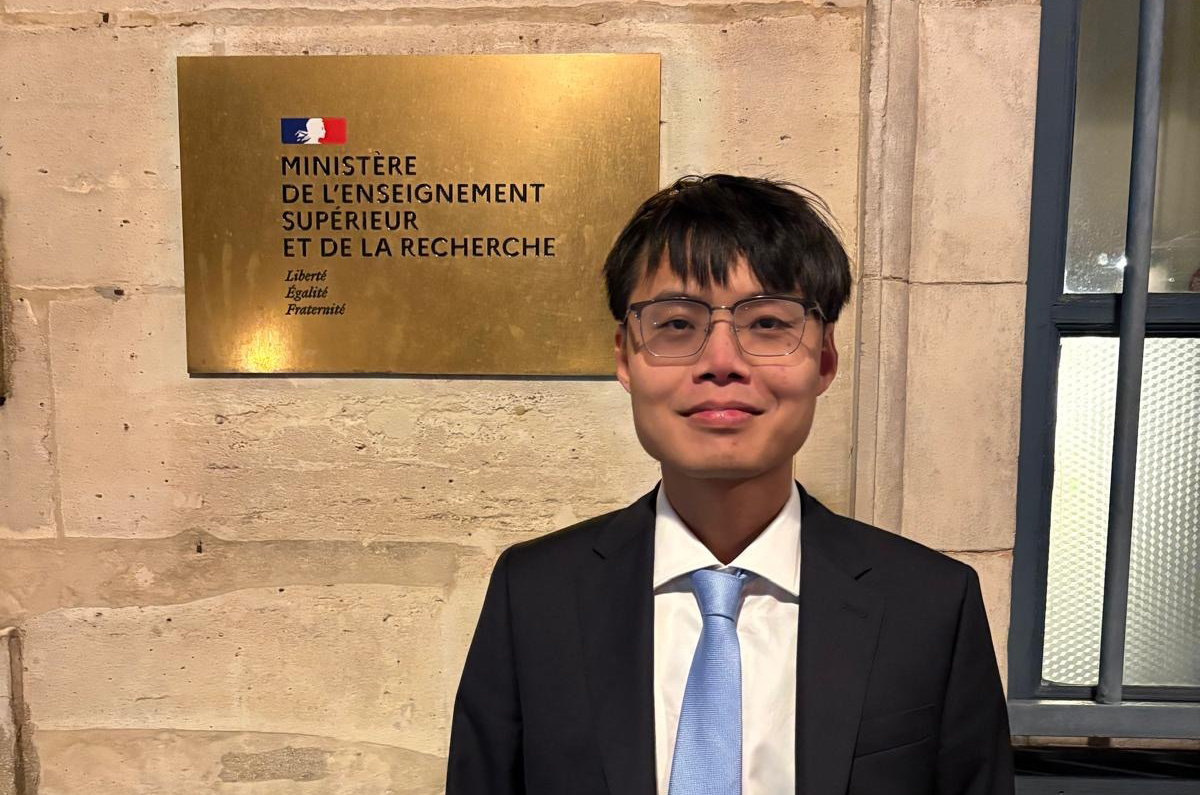
Zhongkai Tao, professeur junior à l’IHES, fait partie des premiers lauréats du programme Choose France for Science.
En savoir plus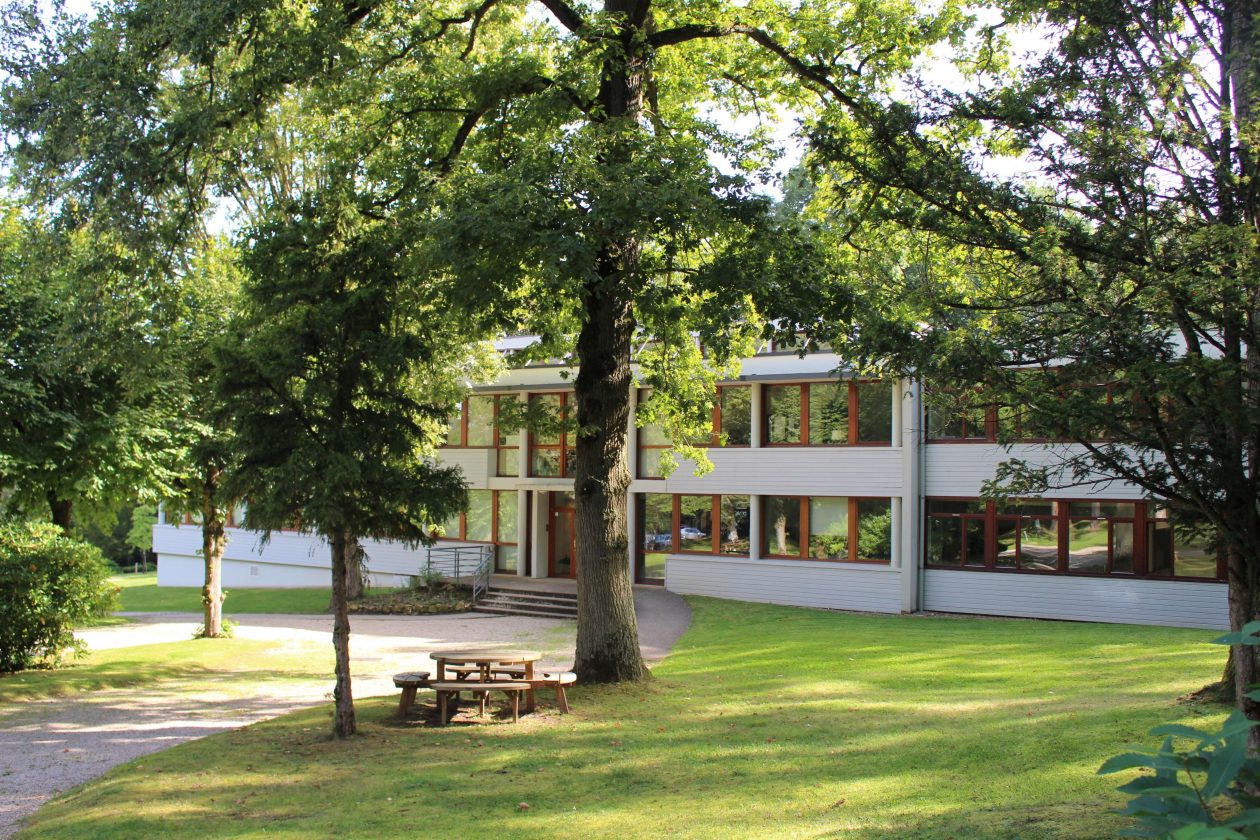
L’IHES a le plaisir d’annoncer la nomination de Thierry Bodineau au poste de directeur du Laboratoire Alexander Grothendieck (LAG).
En savoir plus