
Equation de Keller-Segel fractionnaire
Séminaire Laurent Schwartz — EDP et applications
Events from Indico
Séminaire Laurent Schwartz — EDP et applications
In this talk I will argue that after certain timescale (which scales with the system size as L^{d+2}) dynamics of a local observable becomes universal and it can be described by a random matrix.
This talks is based on https://arxiv.org/abs/1804.08626 and other recent works.
Mathematicians have long understood periodic trajectories on the square billiard table, which occur when the slope of the trajectory is rational. In this talk, I will explain my joint work with Samuel Lelièvre on periodic trajectories on the regular pentagon, describing their geometry, symbolic dynamics, and group structure. The periodic trajectories are very beautiful, and some of them exhibit a surprising « dense but not equidistributed » behavior.
In my talk, I will report on my ongoing collaborating project together with Yifeng Liu, Liang Xiao, Wei Zhang, and Xinwen Zhu, which concerns the rank 0 case of the Beilinson-Bloch-Kato conjecture on the relation between L-functions and Selmer groups for certain Rankin–Selberg motives for GL(n) x GL(n+1). I will state the main results with some examples coming from elliptic curves, sketch the strategy of the proof, and then focus on the key geometric ingredients, namely the semi-stable reduction of unitary Shimura varieties of type U(1,n) at non-quasi-split places.
In order to analyze mathematical and physical systems it is often necessary to assume some form of order, e.g. perfect symmetry or complete randomness. Fortunately, nature seems to be biased towards such forms of order as well. During the second half of the 20th century, a new paradigm of « aperiodic order » was suggested. Instances of aperiodic order were discovered in different areas of mathematics, such as harmonic analysis and diophantine approximation (Meyer), tiling theory (Wang, Penrose) and additive combinatorics (Freiman, Erdös-Szemeredi); after some initial resistance is has now been accepted that aperiodic order also exists in nature in the form of quasicrystals.
Together with Michael Björklund we have proposed a general mathematical framework for the study of aperiodic structures in metric spaces, based on the notion of an « approximate lattices ». Roughly speaking, approximate lattices generalize lattices in the same way that approximate subgroups (in the sense of Tao) generalize subgroups. Approximate lattices in Euclidean space are essentially the « harmonious sets » of Meyer (a.k.a. mathematical quasi-crystals), but there are interesting examples in other geometries, such as symmetric spaces, Bruhat-Tits buildings or nilpotent Lie groups. It turns out that with every approximate lattice one can associate a dynamical system, which replaces the homogeneous space associated with a lattice – thus the study of approximate lattices can be considered as « geometric group theory enriched over dynamical systems ».
In this talk I will (1) give an overview over the basic framework of approximate lattices and geometric approximate group theory; (2) illustrate the framework by formulating Meyer’s theory of harmonious sets in this language; (3) time permitting, discuss some recent structure theory of approximate lattices in nilpotent Lie groups and applications to Bragg peaks in the Schrödinger spectrum of magnetic quasicrystals.
Based on joint works with Michael Björklund (Chalmers), Matthew Cordes (ETH), Felix Pogorzelski (Leipzig) and Vera Tonić (Rijeka).
I will consider the asymptotic behavior of eigenfunctions of the Laplacian on a compact locally symmetric manifold M « in the level aspect », that is as the volume of M tends to infinity. I will formulate a precise conjecture of « Berry type », and describe partial results obtained in a joint work with Miklos Abert and Étienne Le Masson.
A classification will be given of all separable minimal hypersurfaces in ${mathbb R}^{n geq 3}$.
An important conjecture in quantum mechanics is that non-interacting, disordered 3d quantum systems should exhibit a localization-delocalization transition as a function of the disorder strength. From a mathematical viewpoint, a lot is known about the localized phase for strong disorder, much less about the delocalized phase at weak disorder. In this talk I will present results for a hierarchical supersymmetric model for a class of 3d quantum systems, called Weyl semimetals. We use rigorous renormalization group methods to compute the correlation functions of the system. In particular, I will report a result about the algebraic decay of the averaged two-point correlation function, compatible with delocalization. Our method is based on a rigorous implementation of RG, reminiscent of the Gawedzki-Kupiainen block spin transformations; the main technical novelty is the multiscale analysis of Gaussian measures with purely imaginary covariances.
Joint work with Luca Fresta and Marcello Porta.
In 1996 Rinat Kashaev introduced a new way to write the star-triangle move (or Yang-Baxter equations) of the Ising model as a single polynomial relation. In 2013 Richard Kenyon and Robin Pemantle understood that this relation could be seen as a kind of spatial recurrence. I will show how the iteration of Kashaev’s recurrence can be related the combinatorics of a loop model with two colors, that was introduced for different reasons by Ole Warnaar and Bernard Nienhuis in 1993. It is also possible to couple this loop model with known relatives of the Ising model: a dimer model and a six-vertex model. Finally I will show a few limit shape phenomena.
I will show that for any integer N, there are only finitely many cuspidal algebraic automorphic representations of GL_m over Q whose Artin conductor is N and whose « weights » are in the interval {0,…,23} (with m varying). Via the conjectural yoga between geometric Galois representations (or motives) and algebraic automorphic forms, this statement may be viewed as a generalization of the classical Hermite-Minkowski theorem in algebraic number theory. I will also discuss variants of these results when the base field Q is replaced by an arbitrary number field.
We describe dynamical systems arising from the classification of locally homogeneous geometric structures on manifolds. Their classification mimics the classification of Riemann surfaces by the Riemann moduli space – the quotient of Teichmüller space by the properly discontinuous action of the mapping class group. However, this action is misleading: mapping class groups generally act chaotically on character varieties. For fundamental examples, these varieties appear as affine cubics, and we relate the projective geometry of cubic surfaces to dynamical properties of the action.
Let Γ be a group acting by isometries on a proper metric space (X,d). The critical exponent δΓ(X) is a number which measures the complexity of this action. The critical exponent of a subgroup Γ'<Γ is hence smaller than the critical exponent of Γ. When does equality occur? It was shown in the 1980s by Brooks that if X is the real hyperbolic space, Γ’ is a normal subgroup of Γ and Γ is convex-cocompact, then equality occurs if and only if Γ/Γ’ is amenable. At the same time, Cohen and Grigorchuk proved an analogous result when Γ is a free group acting on its Cayley graph.
When the action of Γ on X is not cocompact, showing that the equality of critical exponents is equivalent to the amenability of Γ/Γ’ requires an additional assumption: a « growth gap at infinity ». I will explain how, under this (optimal) assumption, we can generalize the result of Brooks to all groups Γ with a proper action on a Gromov hyperbolic space.
Joint work with R. Coulon, R. Dougall and B. Schapira.
Et aussi
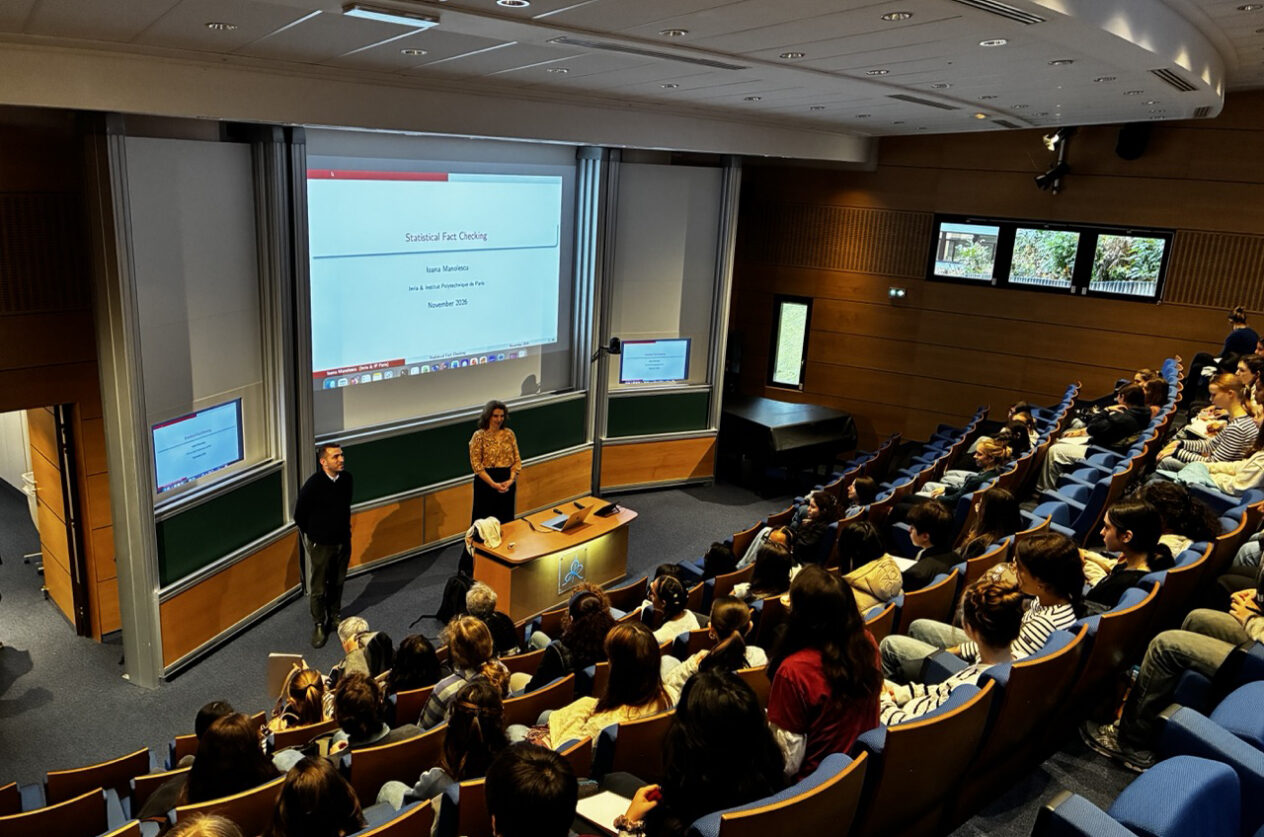
Le 18 novembre dernier, l’IHES a organisé une journée « Filles, maths et informatique, une équation lumineuse », projet coordonné par l'Association Femmes et Mathématiques, et a ainsi accueilli environ 70 lycéennes pour une journée consacrée aux mathématiques et à l’informatique, et surtout aux femmes qui en font leur métier.
En savoir plus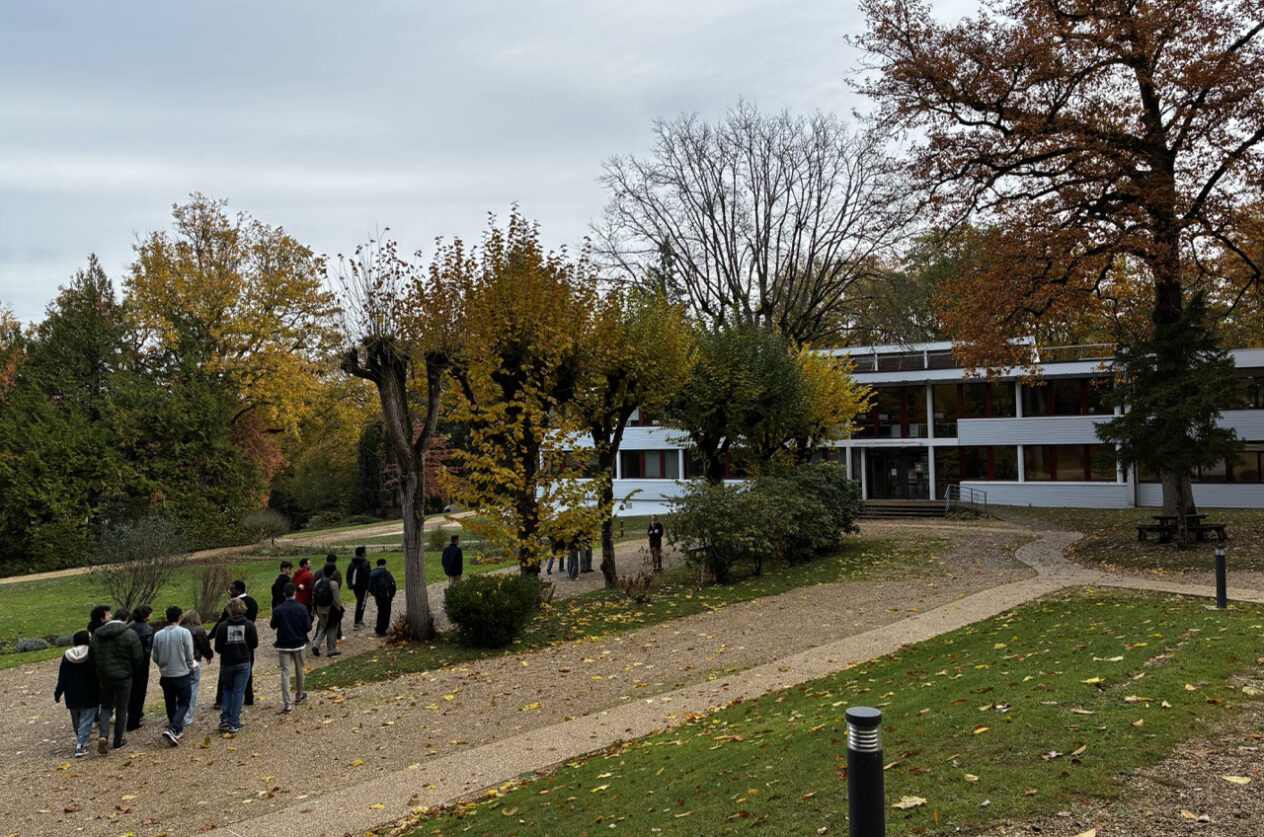
Le lundi 16 novembre, l’IHES a accueilli des élèves de l’École polytechnique pour une matinée de découverte.
En savoir plus
Soutenu par le Xuemin Institute of Advanced Studies (Xuemin IAS) de l’université Fudan à Shanghai, ce programme permet à l’IHES d’accueillir de jeunes scientifiques remarquables en postdoctorat, qui peuvent ainsi travailler en étroite collaboration avec les chercheurs déjà présents à l’Institut.
En savoir plus