
Statistique spectrale des opérateurs non-auto-adjoints aléatoires
Séminaire Laurent Schwartz — EDP et applications
Events from Indico
Séminaire Laurent Schwartz — EDP et applications
Nous montrerons que, pour de telles représentations ρ : π1Σ → G, l'adhérence de Zariski de ρ(Γ) contient le SL2 principal sauf lorsque Γ est un sous-groupe monogène de π1Σ, auquel cas cette adhérence de Zariski est un sous-groupe abélien régulier connexe. Ceci entraîne la classification des adhérences de Zariski possibles puisque la classification des groupes algébriques contenant le SL2 principal est connue. Enfin dans le cas où Γ = π1Σ (ou un sous-groupe d'indice fini) les paramètres de Hitchin déterminent l'adhérence de ρ(Γ).
We investigate the degree to which the geometry of a compact real projective manifold with boundary is reflected in the associated holonomy representation, a representation of the fundamental group in the projective general linear group PGL(n,R) which in general need not have any nice properties.
We show that if the projective manifold is strictly convex, then its holonomy representation is projective Anosov, a condition which generalizes the dynamical properties of convex cocompact representations in rank one (e.g. hyperbolic) geometry. Conversely, a strictly convex projective manifold may be constructed from a projective Anosov representation that preserves a properly convex set in projective space. Applications include new examples of both convex projective manifolds and Anosov representations. Joint work with François Guéritaud and Fanny Kassel.
In this talk I will survey some recent work on coarse geometry of transformation groups, specifically, groups of homeomorphisms and diffeomorphisms of manifolds. Following a framework developed by C. Rosendal, many of these groups have a well defined quasi-isometry type (despite not being locally compact or compactly generated). This provides the right context to discuss geometric questions such as boundedness and subgroup distortion — questions which have already been studied in the context of actions of finitely generated groups on manifolds.
At present, the mod $p$ (and $p$-adic) local Langlands correspondence is only well understood for the group $mathrm{GL}_2(mathbb{Q}_p)$. One of the main difficulties is that little is known about supersingular representations besides this case, and we do know that there is no simple one-to-one correspondence between representations of $mathrm{GL}_2(K)$ with two-dimensional representations of $mathrm{Gal}(overline{K}/K)$, at least when $K/mathbb{mathbb{Q}}_p$ is (non-trivial) finite unramified.
However, the Buzzard-Diamond-Jarvis conjecture and the mod $p$ local-global compatibility for $mathrm{GL}_2/mathbb{Q}$ suggest that this hypothetical correspondence may be realized in the cohomology of Shimura curves with characteristic $p$ coefficients (cut out by some modular residual global representation $bar{r}$). Moreover, the work of Gee, Breuil and Emerton-Gee-Savitt show that, to get information about the $mathrm{GL}_2(K)$-action on the cohomology, one could instead study the geometry of certain Galois deformation rings of the $p$-component of $bar{r}$.
In a work in progress with Haoran Wang, we push forward their analysis of the structure of potentially Barsotti-Tate deformation rings and, as an application, we prove a multiplicity one result of the cohomology at full congruence level when $bar{r}$ is reducible generic emph{non-split} at $p$. (The semi-simple case was previously proved by Le-Morra-Schraen and by ourselves.)
Séminaire de Relativité Générale Mathématique
The maximal analytic Schwarzschild spacetime is manifestly inextendible as a Lorentzian manifold with a twice continuously differentiable metric. In this talk I will describe how one proves the stronger statement that the maximal analytic Schwarzschild spacetime is inextendible as a Lorentzian manifold with a continuous metric. The investigation of low-regularity inextendibility criteria is motivated by the strong cosmic censorship conjecture in general relativity.
Séminaire de Relativité Générale Mathématique
We will discuss dynamical properties of the Schwarzschild interior, backwards and forwards (in time) with respect to the initial value problem for the Einstein vacuum equations.
We study the role of the Ding-Iohara-Miki (DIM) algebra, which is the simplest example of quantum toroidal algebra, in gauge theories, matrix models, q-deformed CFT and refined topological strings. We use DIM algebra to write down the Ward identities for the matrix models and show how it is connected to quiver W-algebras of the A-series. We describe the integrable structure of refined topological strings arising from DIM algebra: the R-matrix, T-operators and RTT relations. Finally, we write down the q-KZ equation for the DIM algebra intertwiners and interpret its solutions as refined topological string amplitudes.
In the first part of the talk, I will discuss a joint project with Chris Elliott on realizing the geometric Langlands correspondence as an instance of S-duality by careful analysis of Kapustin and Witten’s work using derived algebraic geometry. In the second part of the talk, I will report on work in progress to produce new instances of Langlands duality in geometric representation theory through the lens of quantum field theory.
Une variété affine (au sens de la géométrie différentielle) est une variété admettant un atlas de cartes à valeur dans un espace affine V et à changements de cartes localement constants dans le groupe affine Aff(V). A la fin des années 50, Chern a conjecturé que la caractéristique d’Euler de toute variété affine compacte s’annule. Je discuterai cette conjecture, et sa preuve dans le cas où X est spéciale affine (i.e. X est affine et admet une forme volume parallèle).
The space of projective measured foliations is (one of) the boundaries of Teichmüller space. One can consider a special subclass of this set that define Teichmüller geodesics whose projection to moduli space is contained in a compact set. These can be thought of as analogous to badly approximable rotations. The main result of the talk is that this set is path connected in high enough genus. This is joint work with Sebastian Hensel.
The geometric Langlands correspondence was introduced by Beilinson and Drinfeld as a tool to solve quantum Hitchin systems such as the Gaudin model. The correspondence can be understood following Kapustin and Witten as arising from S-duality in a topologically twisted 4-dimensional super Yang-Mills theory. In this talk I will describe a multiplicative deformation of the Hitchin system and explain a conjectural statement of the corresponding q-deformed correspondence. I will also give some motivations for the statement from the theory of higher deformation quantization and a deformed setup of Kapustin and Witten.
Et aussi
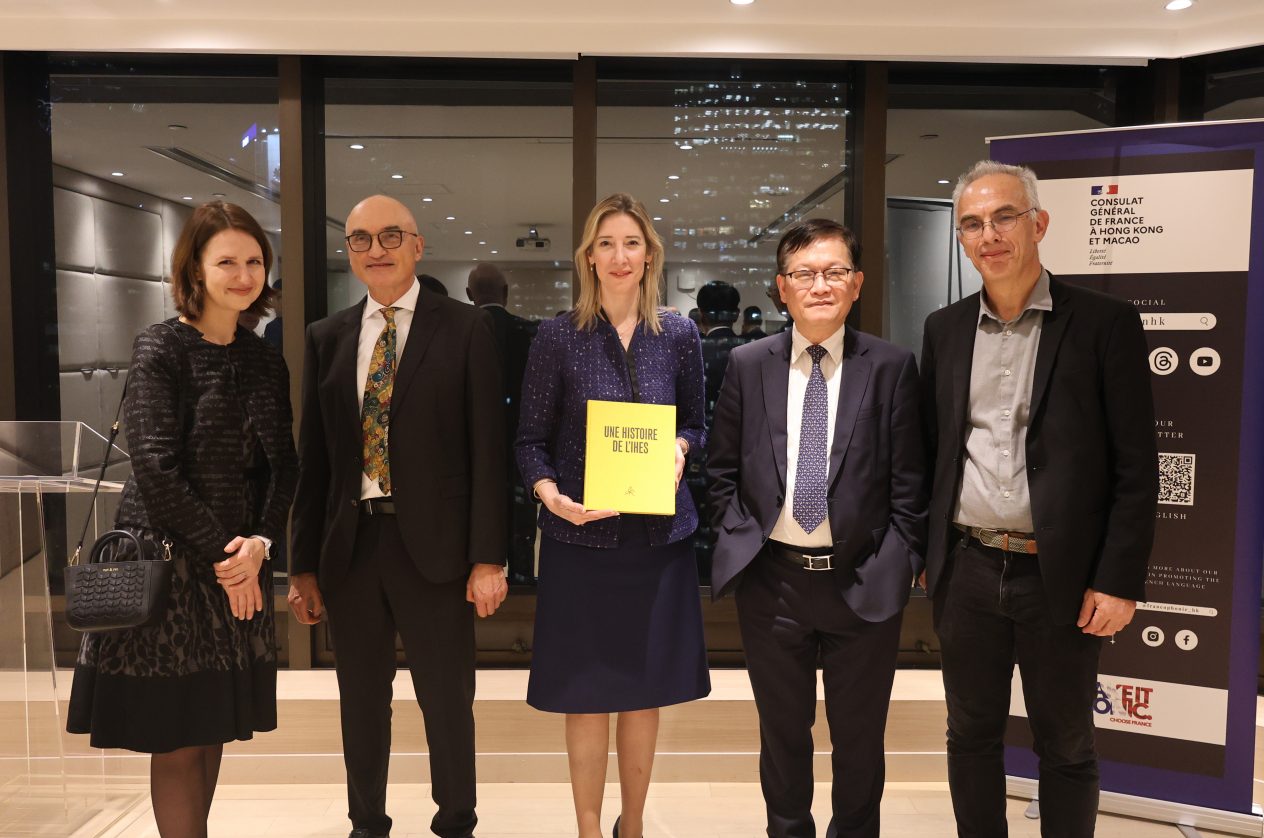
Début février, l’IHES a organisé une série d’événements à Hong Kong, soulignant son rayonnement international ainsi que son engagement en faveur des échanges scientifiques.
En savoir plus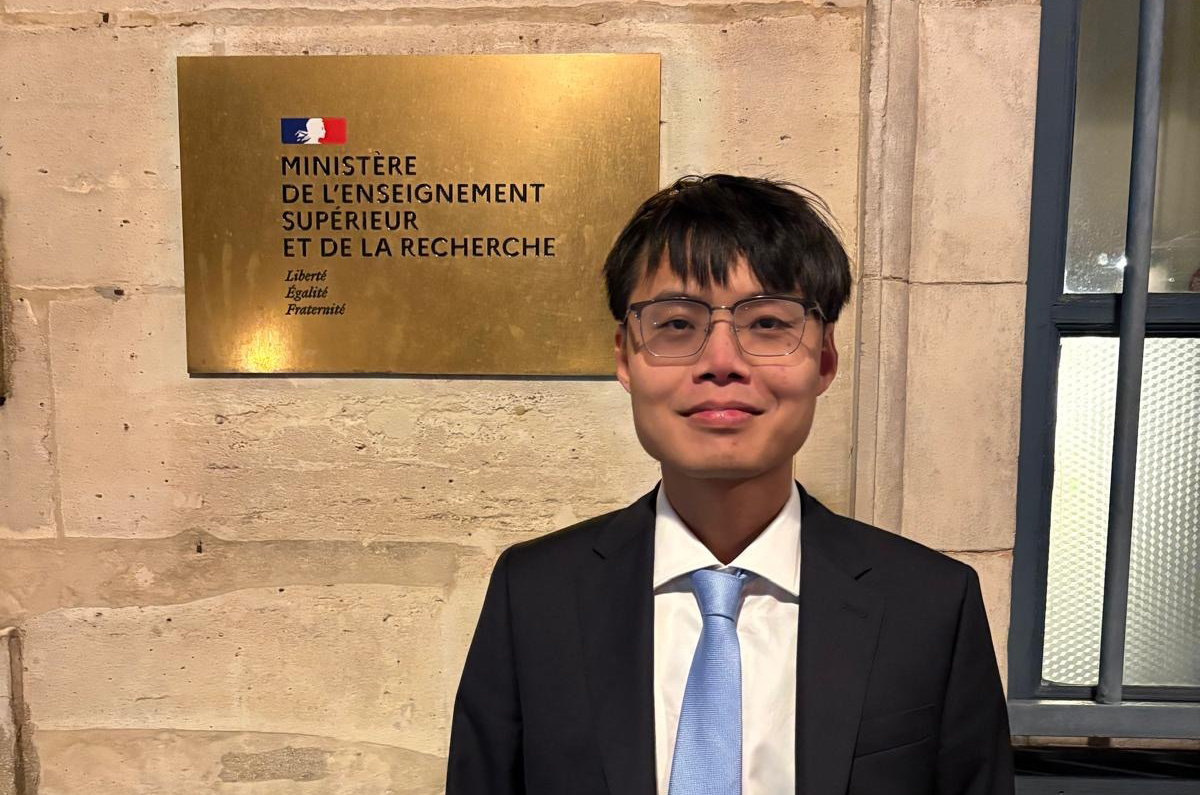
Zhongkai Tao, professeur junior à l’IHES, fait partie des premiers lauréats du programme Choose France for Science.
En savoir plus