
Charge Fluctuations in 2d Coulomb (and related) Systems
Séminaire Laurent Schwartz — EDP et applications
Séminaire Laurent Schwartz — EDP et applications
Séminaire Laurent Schwartz — EDP et applications
The well-known collar or Margulis lemma describes the structure of negatively curved manifolds at mesoscopic scale, in particular it allows to describe these manifolds globally through the « thick-thin decomposition ». This is not sufficient, however, to completely understand the homotopy type of the manifold, even roughly. In this talk I will describe an « arithmetic Margulis lemma » (essentially a consequence of work of E. Breuillard) which allows to describe thin parts at a macroscopic scale in certain circumstances, and how to use it to obtain sharp bounds on the volume of thin parts of arithmetic locally symmetric spaces. This is joint work with M. Frączyk and S. Hurtado.
If a finite set S densely generates a compact, semisimple Lie group G, then how well does the set of words of length ℓ in S (and S-1) approximate G? We could ask for them words to be an ε-net of G; or, beyond an ε-net, we could ask for the words to be evenly distributed down to a scale of ε; or we could ask for an efficient algorithm to produce a word that lies within ε of any given g in G. An optimal statistical result, with ℓ = O(log 1/ε), was first established by Lubotzky, Phillips, and Sarnak when G = SU(2) for special choices of S; and later generalized by others, but still with some restrictions on S. Not long afterwards, in the context of quantum computing, Solovay and Kitaev independently established an algorithm to find a word with ℓ = O((log 1/ε)a) for any S and (initially) also G = SU(2). I will discuss the current status of different versions of this question, including versions when G might not be compact or S-1 might not be used. I will also discuss my own result, in which I improve the exponent in the (algorithmic) Solovay-Kitaev theorem from the previous best value of a = 3+δ to a = (logφ 2) + 1 + δ < 2.4405.
Pour être informé des prochains séminaires vous pouvez vous abonner à la liste de diffusion en écrivant un mail à sympa@listes.math.cnrs.fr avec comme sujet: « subscribe seminaire_physique PRENOM NOM »(indiquez vos propres prénom et nom) et laissez le corps du message vide.
Brylynski defined and studied the topological analogue of the Radon transform on Grassmannians over Complex numbers. Using techniques from the theory of D-modules he characterized the image of these Radon transforms in terms of their singular supports. In this talk, we shall discuss a characteristic p > 0 analogues of Brylynski’s work on the characterization of the image of the Radon transform and obtain a precise description in terms of Beilinson-Saito’s theory of singular support. This is joint work with Deepam Patel. Pour être informé des prochains séminaires vous pouvez vous abonner à la liste de diffusion en écrivant un mail à sympa@listes.math.cnrs.fr avec comme sujet: « subscribe seminaire_mathematique PRENOM NOM »(indiquez vos propres prénom et nom) et laissez le corps du message vide.
In characteristic $p neq 0$, it was observed by Katz that locally constant constructible (l.c.c.) étale sheaves of abelian p-groups can be alternatively described, using a mild extension of Artin-Schreier-Witt theory, in terms of $phi$-modules over the ring of Witt vectors. I will discuss the case of l.c.c. étale sheaves of possibly non-abelian $p$-groups, with applications to explicit description of Gabber-Katz extensions and to non-abelian analogs of local class field theory symbols. Pour être informé des prochains séminaires vous pouvez vous abonner à la liste de diffusion en écrivant un mail à sympa@listes.math.cnrs.fr avec comme sujet: « subscribe seminaire_mathematique PRENOM NOM »(indiquez vos propres prénom et nom) et laissez le corps du message vide.
In the study of resurgent structures underlying quantum invariants of knots, Garoufalidis-Gu-Marino conjectured that the state integrals of Andersen-Kashaev should give the Borel re-summation of some associated perturbative series. I will explain this conjecture and its extension to other examples relating to finite type invariants and closed 3-manifolds, along with relations to recently proposed q-series invariants. Pour être informé des prochains séminaires vous pouvez vous abonner à la liste de diffusion en écrivant un mail à sympa@listes.math.cnrs.fr avec comme sujet: « subscribe seminaire_mathematique PRENOM NOM »(indiquez vos propres prénom et nom) et laissez le corps du message vide.
The link between the hyperbolic geometry of 3-manifolds and the conformal metrics on their boundary has been explored extensively in the context of hyperbolic geometry and is also motivated by the AdS3/CFT2 correspondence. An elementary observation is that the group of Möbius transformations on the Riemann sphere coincides with the isometries of the hyperbolic 3-space H3. The Loewner energy is a Möbius-invariant quantity that measures the roundness of Jordan curves. It arises from large deviations of SLE0+ and is a Kähler potential on the universal Teichmüller space endowed with the Weil-Petersson metric. We show that the Loewner energy of a Jordan curve in the Riemann sphere equals the renormalized volume of a submanifold of H3 constructed using the Epstein surfaces associated with the hyperbolic metric on both sides of the curve. This is work in progress with Martin Bridgeman (Boston College), Ken Bromberg (Utah), and Franco Vargas-Pallete (Yale).
The fine curve graph is a Gromov hyperbolic graph on which the homeomorphism group of a surface acts. It allows to apply tools from geometric group theory and the theory of mapping class groups in this setting.In this talk, we will describe the first entries in a dictionary linking dynamical properties of homeomorphisms acting on the surface to the geometry of the action on the fine curve graph. Furthermore, we will discuss phenomena not encountered in the setting of « classical » curve graphs — namely, homeomorphisms acting as parabolic isometries. This is joint work with Jonathan Bowden, Katie Mann, Emmanuel Militon and Richard Webb.Time permitting, I will describe ongoing work with Jonathan Bowden and Richard Webb concerning the Gromov boundary of the fine curve graph.
Classical ramification theory deals with complete discrete valuation fields k((X)) with perfect residue fields k. Invariants such as the Swan conductor capture important information about extensions of these fields. Many fascinating complications arise when we allow non-discrete valuations and imperfect residue fields k. Particularly in positive residue characteristic, we encounter the mysterious phenomenon of the defect (or ramification deficiency). The occurrence of a non-trivial defect is one of the main obstacles to long-standing problems, such as obtaining resolution of singularities in positive characteristic. Degree p extensions of valuation fields are building blocks of the general case. In this talk, we will present a generalization of ramification invariants for such extensions and discuss how this leads to a better understanding of the defect. If time permits, we will briefly discuss their connection with some recent work (joint with K. Kato) on upper ramification groups. Pour être informé des prochains séminaires vous pouvez vous abonner à la liste de diffusion en écrivant un mail à sympa@listes.math.cnrs.fr avec comme sujet: « subscribe seminaire_mathematique PRENOM NOM »(indiquez vos propres prénom et nom) et laissez le corps du message vide.
I will give a definition of a certain category of « log quasicoherent » sheaves on a logarithmic variety which uses Falting’s « almost mathematics » and which has the property that log differential forms and log polyvector fields are the Hochshild homology (appropriately understood) and Hochschild cohomology, respectively, of this category. This implies a certain « noncommutative Hodge theory » associated to a log variety in mixed characteristic. I will also explain (if there is time left over) a relationship of the proof of the main results to mirror symmetry. Pour être informé des prochains séminaires vous pouvez vous abonner à la liste de diffusion en écrivant un mail à sympa@listes.math.cnrs.fr avec comme sujet: « subscribe seminaire_mathematique PRENOM NOM »(indiquez vos propres prénom et nom) et laissez le corps du message vide.
Et aussi

La 12e cérémonie des Breakthrough Prize s'est tenue samedi 18 avril, et l’IHES est fier d’annoncer que deux de ses scientifiques figurent parmi les lauréats de cette année.
En savoir plus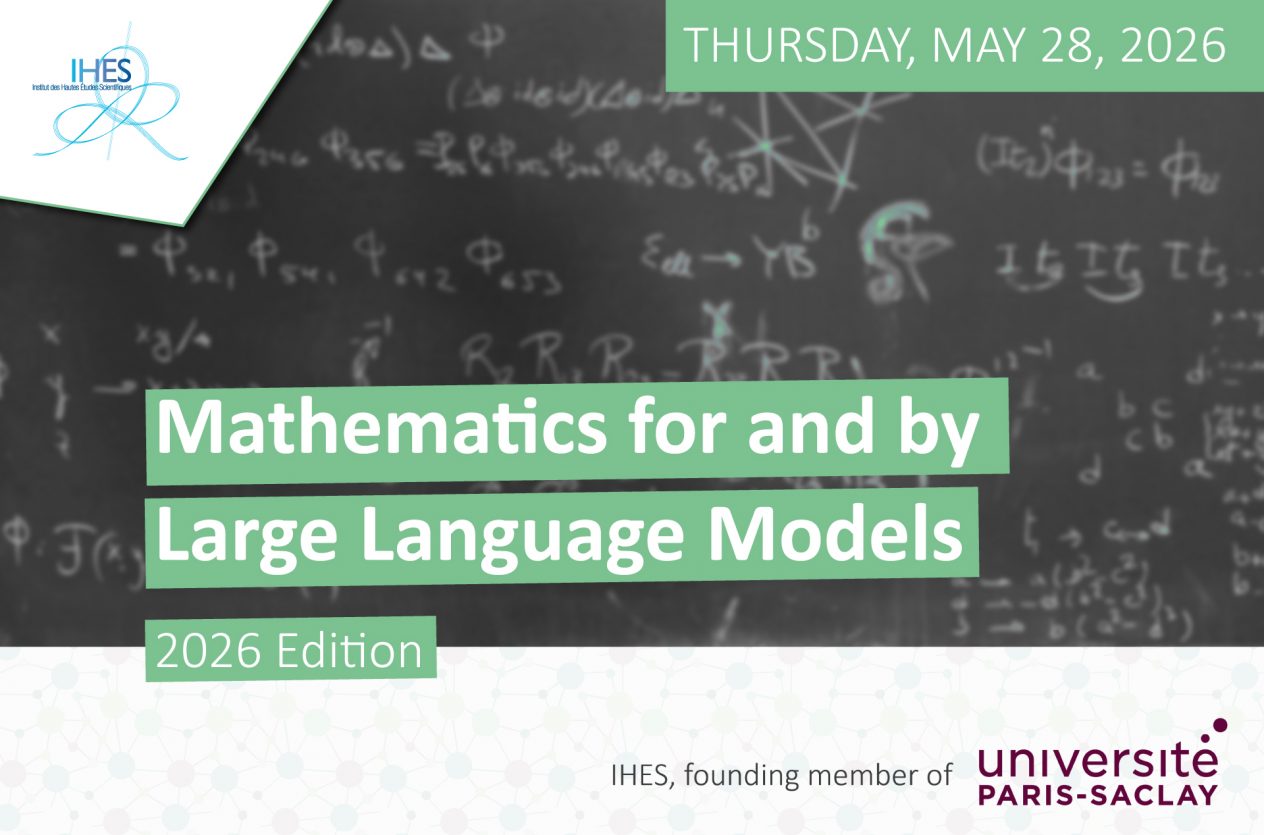
Le 28 mai prochain, François Charton, Michael Douglas, Amaury Hayat et Yiannis Vlassopoulos organisent à l'IHES une conférence d'une journée sur les mathématiques et les grands modèles de langage.
En savoir plus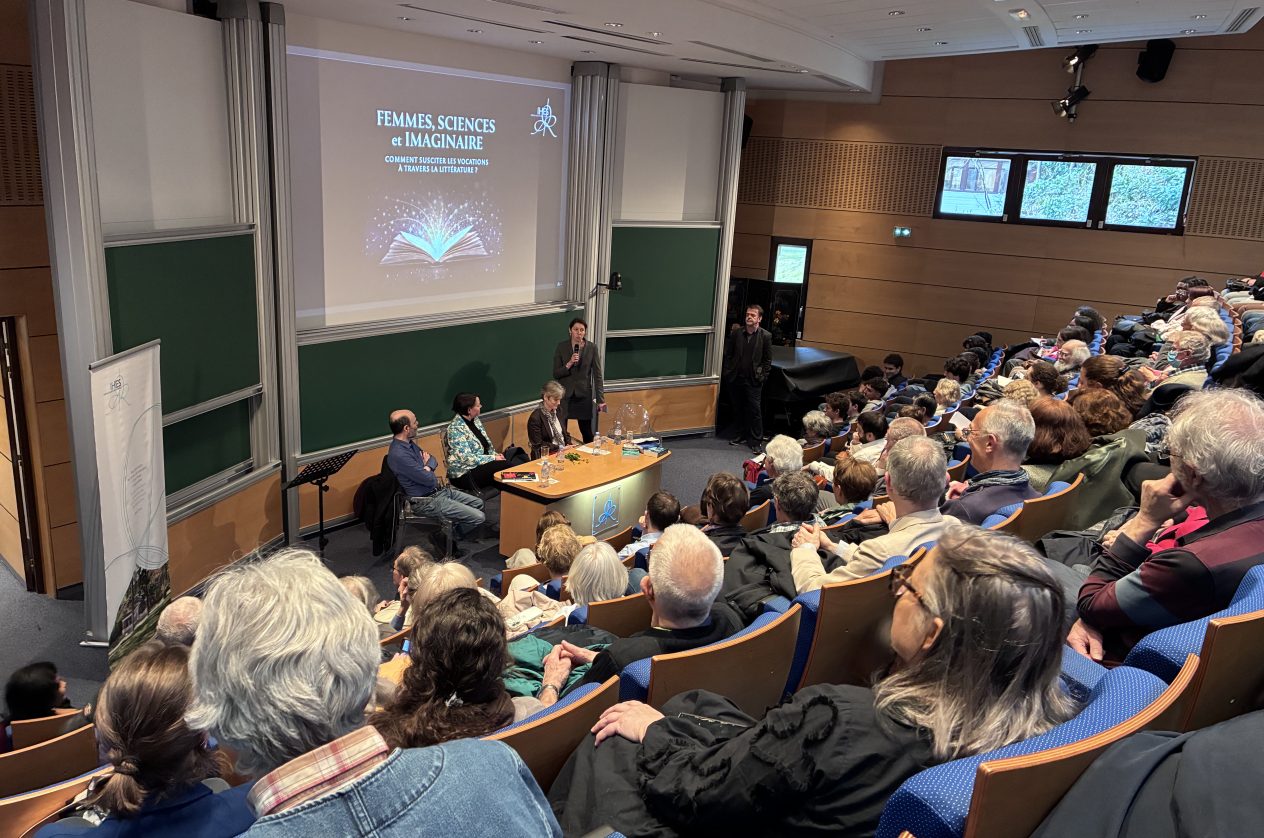
Le 2 avril dernier, l’IHES a eu le plaisir d’accueillir près de 130 participants, dont une quarantaine de lycéens et lycéennes du lycée Rosa Parks de Montgeron, pour une table ronde grand public, suivie d’un cocktail dînatoire, d’une vente de livres organisée par la Librairie Liragif et d’une séance de dédicaces.
En savoir plus