
Dispersion Estimates for the Wave Equation outside a General Strictly Convex Obstacle in Dimension 3
Séminaire Laurent Schwartz — EDP et applications
Séminaire Laurent Schwartz — EDP et applications
Séminaire Laurent Schwartz — EDP et applications
Séminaire Laurent Schwartz — EDP et applications
Any finite-dimensional p-adic representation of the absolute Galois group of a p-adic local field with imperfect residue field is characterized by its arithmetic and geometric Sen operators defined by Sen and Brinon. We generalize their construction to the fundamental group of a p-adic affine variety with a semi-stable chart, and prove that the module of Sen operators is canonically defined, independently of the choice of the chart. Our construction relies on a descent theorem in the p-adic Simpson correspondence developed by Tsuji. When the representation comes from a Qp-representation of a p-adic analytic group quotient of the fundamental group, we describe its Lie algebra action in terms of the Sen operators, which is a generalization of a result of Sen and Ohkubo. These Sen operators can be extended continuously to certain infinite-dimensional representations. As an application, we prove that the geometric Sen operators annihilate locally analytic vectors, generalizing a result of Pan. Pour être informé des prochains séminaires vous pouvez vous abonner à la liste de diffusion en écrivant un mail à sympa@listes.math.cnrs.fr avec comme sujet: « subscribe seminaire_mathematique PRENOM NOM »(indiquez vos propres prénom et nom) et laissez le corps du message vide.
For $ell$-adic cohomology, the weight monodromy conjecture for complete intersections was proved by Scholze in his celebrated paper. Using his theory of perfectoid spaces, he reduced it to the equal characteristic case, which was already proved by Deligne. Considering that the equal characteristic case of the p-adic weight monodromy conjecture has been also formulated and proved (by Crew and Lazda–Pal), it is natural to try to reduce the p-adic weight monodromy conjecture to the equal characteristic case using Scholze’s technique. In this talk, I will discuss how to realize it (joint work with Federico Binda and Alberto Vezzani). Pour être informé des prochains séminaires vous pouvez vous abonner à la liste de diffusion en écrivant un mail à sympa@listes.math.cnrs.fr avec comme sujet: « subscribe seminaire_mathematique PRENOM NOM »(indiquez vos propres prénom et nom) et laissez le corps du message vide.
I will talk about a series of works with Artem Prikhodko where we develop a version of p-adic Hodge theory in the setting of Artin stacks. One of the main motivations for our project was a conjecture by Totaro: namely, based on his concrete computations, he suggested that the dimension of mod p de Rham cohomology of the classifying stack BG for G reductive might always be bounded from below by the dimension of the Fp-singular cohomology on the classifying space BG(C) of the Lie group G(C) of complex points of G. For smooth and proper schemes such an inequality is a consequence of integral p-adic Hodge theory in the form proved by Bhatt-Morrow-Scholze; however, their results can not be applied here directly since BG is not proper.To prove Totaro’s conjecture, using the theory of prismatic cohomology, we develop integral p-adic Hodge theory in a more general setting of Hodge-proper stacks: these are stacks that only look proper from the point of view of its Hodge cohomology. However, one problem then still remains: namely, the étale comparison we get is with the étale cohomology of the Raynaud generic fiber, which a priori agrees with the algebraic generic fiber (and then complex points) only in the smooth proper setting. Nevertheless, we prove that the two étale cohomology theories still agree at least for quotient stacks [X/G] with X smooth and proper and G reductive. This then implies Totaro’s conjecture by plugging X=pt. In further work we also show that after inverting p the two étale cohomology agree for any Hodge-proper stack, which sets up rational p-adic Hodge theory (with the crystalline and de Rham comparisons, and Hodge-Tate decomposition) in this setting. If time permits, I will also tell about some explicit computations of cohomology of reductive groups in characteristic p that one can perform using the above comparison in the case of BG (this is a series of joint works with Federico Scavia and Anlong Chua). Pour être informé des prochains séminaires vous pouvez vous abonner à la liste de diffusion en écrivant un mail à sympa@listes.math.cnrs.fr avec comme sujet: « subscribe seminaire_mathematique PRENOM NOM »(indiquez vos propres prénom et nom) et laissez le corps du message vide.
I will talk about a series of works with Artem Prikhodko where we develop a version of p-adic Hodge theory in the setting of Artin stacks. One of the main motivations for our project was a conjecture by Totaro: namely, based on his concrete computations, he suggested that the dimension of mod p de Rham cohomology of the classifying stack BG for G reductive might always be bounded from below by the dimension of the Fp-singular cohomology on the classifying space BG(C) of the Lie group G(C) of complex points of G. For smooth and proper schemes such an inequality is a consequence of integral p-adic Hodge theory in the form proved by Bhatt-Morrow-Scholze; however, their results can not be applied here directly since BG is not proper.To prove Totaro’s conjecture, using the theory of prismatic cohomology, we develop integral p-adic Hodge theory in a more general setting of Hodge-proper stacks: these are stacks that only look proper from the point of view of its Hodge cohomology. However, one problem then still remains: namely, the étale comparison we get is with the étale cohomology of the Raynaud generic fiber, which a priori agrees with the algebraic generic fiber (and then complex points) only in the smooth proper setting. Nevertheless, we prove that the two étale cohomology theories still agree at least for quotient stacks [X/G] with X smooth and proper and G reductive. This then implies Totaro’s conjecture by plugging X=pt. In further work we also show that after inverting p the two étale cohomology agree for any Hodge-proper stack, which sets up rational p-adic Hodge theory (with the crystalline and de Rham comparisons, and Hodge-Tate decomposition) in this setting. If time permits, I will also tell about some explicit computations of cohomology of reductive groups in characteristic p that one can perform using the above comparison in the case of BG (this is a series of joint works with Federico Scavia and Anlong Chua). Pour être informé des prochains séminaires vous pouvez vous abonner à la liste de diffusion en écrivant un mail à sympa@listes.math.cnrs.fr avec comme sujet: « subscribe seminaire_mathematique PRENOM NOM »(indiquez vos propres prénom et nom) et laissez le corps du message vide.
Let G be a finitely generated group acting faithfully by linear transformations on a finite-dimensional complex vector space. The theorems of Malcev, Selberg, or Tits provide important properties satisfied by G. To what extent do these properties continue to hold when G is acting by polynomial (instead of linear) transformations? In order to address this question, I shall describe a few results that illustrate how one can use p-adic or finite fields for problems which are initially phrased in terms of complex numbers.
Let Xk,d denote the space of rank-k lattices in Rd. Topological and statistical properties of the dynamics of discrete subgroups of G=SL(d,R) on Xd,d were described in the seminal works of Benoist-Quint. A key step/result in this study is the classification of stationary measures on Xd,d. Later, Sargent-Shapira initiated the study of dynamics on the spaces Xk,d. When k ≠ d, the space Xk,d is of a different nature and a clear description of dynamics on these spaces is far from being established. Given a probability measure μ which is Zariski-dense in a copy of SL(2,R) in G, we give a classification of μ-stationary measures on Xk,d and prove corresponding equidistribution results. In contrast to the results of Benoist-Quint, the type of stationary measures that μ admits depends strongly on the position of SL(2,R) relative to parabolic subgroups of G. I will start by reviewing preceding major works and ideas. The talk will be accessible to a broad audience. Joint work with Alexander Gorodnik and Jialun Li.
We approximate boundaries of convex polytopes by smooth hypersurfaces with positive mean curvatures and, by using basic geometric relations between the scalar curvatures of Riemannian manifolds and the mean curvatures of their boundaries, establish lower bound on the dihedral angles of these polytopes.
Port du masque obligatoire / Mask mandatory
Institut Des Hautes Etudes Scientifiques vous invite à une réunion Zoom planifiée.
Sujet : Séminaire de mathématique : M. Gromov
Heure : 27 juin 2022 02:00 PM Paris
Participer à la réunion Zoom
https://us02web.zoom.us/j/87455718639?pwd=oDF-dSYQd8Sevw2yEd1AVx4-HzxrBF.1
ID de réunion : 874 5571 8639
Code secret : 052856
Pour être informé des prochains séminaires vous pouvez vous abonner à la liste de diffusion en écrivant un mail à sympa@listes.math.cnrs.fr avec comme sujet: « subscribe seminaire_mathematique PRENOM NOM »
(indiquez vos propres prénom et nom) et laissez le corps du message vide.
The common knowledge is that mutations in genomes are caused by the mistakes of the Polymerase, the enzyme responsible for copying DNA (or RNA). However, errors of polymerase must be symmetrical with respect to the change of the DNA or RNA strand. Surprisingly, mutations in the Human DNA Genome and in the RNA genome of the notorious SARS Cov2 virus are drastically asymmetric. We will discuss how this asymmetry of mutations helps to pinpoint the real cause of mutations in these genomes – chemical damage of DNA or RNA, and mechanisms whereby this damage actually causes mutations.
Connection to codes has emerged recently as a new tool to construct and study Narain CFTs with special properties. In the talk I will review this connection and argue that optimal theories, i.e. those maximizing the value of spectral gap for the given central charge, are code CFTs – meaning they can be constructed using codes. This applies to known optimal theories with c<=8 as well as to asymptotically large c. I will also discuss spinoff results, in particular construction of fake torus partition function Z(tau, bar tau), which satisfies all properties of the 2d CFT torus partition function (modular invariance, discreteness and positive-definiteness of spectrum), yet can be shown not to be a partition function of any 2d theory.
Pour être informé des prochains séminaires vous pouvez vous abonner à la liste de diffusion en écrivant un mail à sympa@listes.math.cnrs.fr avec comme sujet: « subscribe seminaire_physique PRENOM NOM »
(indiquez vos propres prénom et nom) et laissez le corps du message vide.
Et aussi

La 12e cérémonie des Breakthrough Prize s'est tenue samedi 18 avril, et l’IHES est fier d’annoncer que deux de ses scientifiques figurent parmi les lauréats de cette année.
En savoir plus
Le 28 mai prochain, François Charton, Michael Douglas, Amaury Hayat et Yiannis Vlassopoulos organisent à l'IHES une conférence d'une journée sur les mathématiques et les grands modèles de langage.
En savoir plus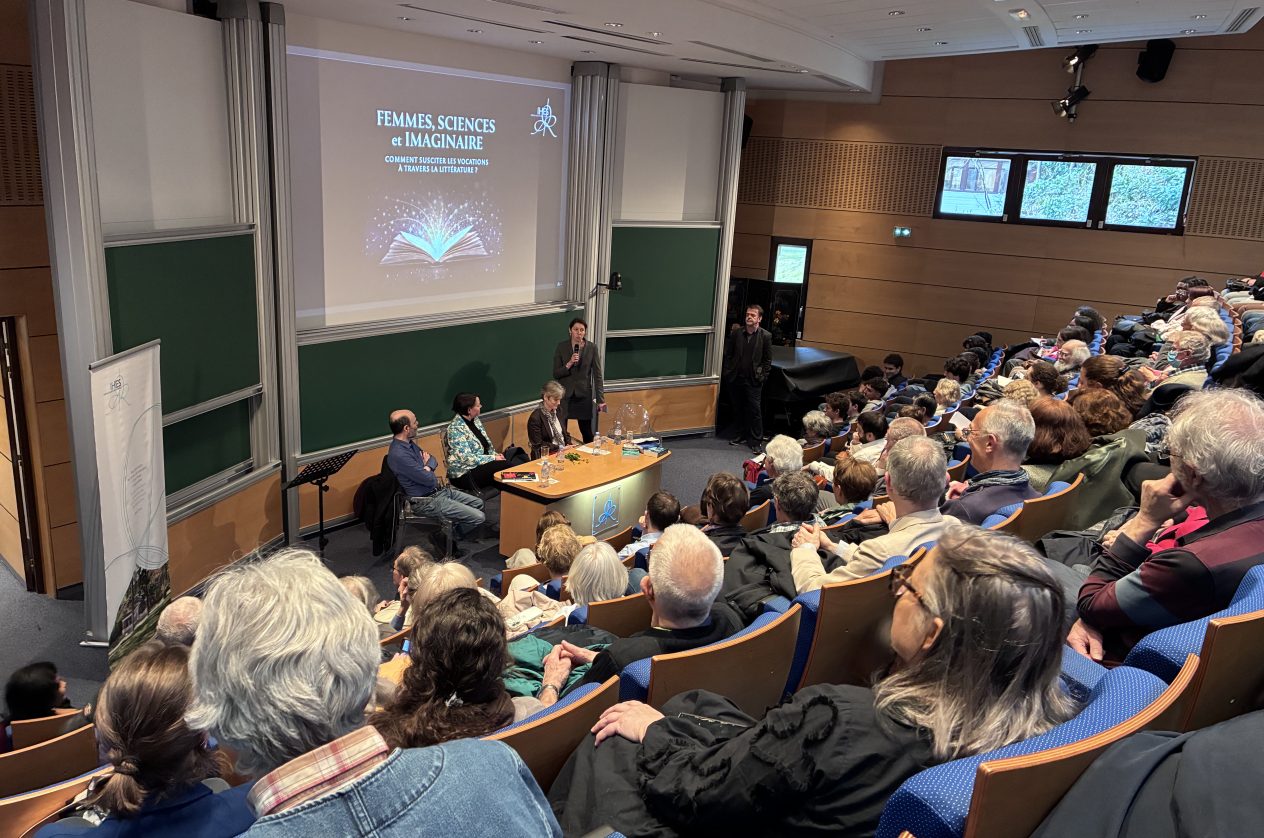
Le 2 avril dernier, l’IHES a eu le plaisir d’accueillir près de 130 participants, dont une quarantaine de lycéens et lycéennes du lycée Rosa Parks de Montgeron, pour une table ronde grand public, suivie d’un cocktail dînatoire, d’une vente de livres organisée par la Librairie Liragif et d’une séance de dédicaces.
En savoir plus