
Stabilité spectrale des colonnes de tourbillons pour Euler 3D
Séminaire Laurent Schwartz — EDP et applications
Events from Indico
Séminaire Laurent Schwartz — EDP et applications
The Teichmüller space parametrizes Riemann surfaces of
fixed topological type and is fundamental in various contexts of mathematics
and physics. It can be defined as a component of the moduli space of flat G=PSL(2,R)
connections on the surface. Higher Teichmüller space extends these notions
to appropriate higher rank classical Lie groups G, and N=1 super Teichmüller
space likewise studies the extension to the super Lie group G=OSp(1|2).
In this talk, which reports on joint work with Yi Huang, Ivan Ip and Robert Penner,
I will discuss our solution to the long-standing problem of giving Penner-type
coordinates on super-Teichmüller space and its higher analogues and will
also talk about several applications of this theory including our recent
generalization of the McShane identity to the super case.
Let G be a real reductive Lie group and H a closed subgroup of G. According to the Benoist-Kobayashi criterion, the properness of an action on G/H is controlled by the Cartan projection of H. In this talk, we give some examples of closed subgroups that are not reductive in G but whose Cartan projection is computable (one example is an abelian horospherical subgroup of G). Applying these nonreductive subgroups, we show that some homogeneous spaces of reductive type do not have compact Clifford-Klein forms.
I will discuss results of recent numerical bootstrap work performed for systems with cubic symmetry. Under certain assumptions, we find an isolated region in parameter space, which given prior intuition with the numerical bootstrap, indicates the existence of a CFT in this region. We find critical exponents for the conjectured CFT which are in discrepancy with the epsilon expansion (but in good agreement with experiments for structural phase transitions). The disagreement of critical exponents for structural phase transitions calculated in the epsilon expansion with those measured in experiments is something that was noticed since the 70s. I will briefly discuss some resolutions proposed at the time.
We explore in detail the properties of two melonic quantum mechanical theories which can be formulated either as fermionic matrix quantum mechanics in the new large D limit, or as disordered models. Both models have a mass parameter m and the transition from the perturbative large m region to the strongly coupled « black-hole » small m region is associated with several interesting phenomena. One model, with U(n)^2 symmetry and equivalent to complex SYK, has a line of first-order phase transitions terminating, for a strictly positive temperature, at a critical point having non-trivial, non-mean-field critical exponents for standard thermodynamical quantities. Quasi-normal frequencies, as well as Lyapunov exponents associated with out-of-time-ordered four-point functions, are also singular at the critical point, leading to interesting new critical exponents. The other model, with reduced U(n) symmetry, has a quantum critical point at strictly zero temperature and positive critical mass m*. For 0<m<m*, it flows to a new gapless IR fixed point, for which the standard scale invariance is spontaneously broken by the appearance of distinct scaling dimensions Δ+ and Δ- for the Euclidean two-point function when t→ +∞ and t→ -∞
Séminaire Laurent Schwartz — EDP et applications
Séminaire Laurent Schwartz — EDP et applications
${mathbb A}^1$-localisation is a universal construction which produces « cohomology theories » for which the affine line ${mathbb A}^1$ is contractible. It plays a central role in the theory of motives à la Morel-Voevodsky. In this talk, I’ll discuss the analogous construction where the affine line is replaced by the projective line ${mathbb P}^1$. This is the ${mathbb P}^1$-localisation which is arguably an unnatural construction since it produces « cohomology theories » for which the projective line ${mathbb P}^1$ is contractible. Nevertheless, I’ll explain a few positive results and some computations around this construction which naturally lead to a definition of Kodaira-Spencer classes of arithmetic nature. (Unfortunately, it is yet unclear if these classes are really interesting and nontrivial.)
Whereas the exponential map from a Lie algebra to a Lie group can be viewed as the monodromy of a singular connection A dz/z on a disk, the wild character varieties are the receptacles for the monodromy data for arbitrary meromorphic connections on Riemann surfaces. This suggests one should think of the wild character varieties (or the full nonabelian Hodge triple of spaces, bringing in the meromorphic Higgs bundle moduli spaces too) as global analogues of Lie groups, and try to classify them. As a step in this direction I’ll explain some recent joint work with D. Yamakawa that defines a diagram for any algebraic connection on a vector bundle on the affine line. This generalises the definition made by the speaker in the untwisted case in 2008 in arXiv:0806.1050 Apx. C, related to the « quiver modularity theorem », that a large class of Nakajima quiver varieties arise as moduli spaces of meromorphic connections on a trivial vector bundle the Riemann sphere, proved in the simply-laced case and conjectured in general in op.cit. (published in Pub. Math. IHES 2012), and proved in general by Hiroe-Yamakawa (Adv. Math. 2014). In particular this construction of diagrams yields all the affine Dynkin diagrams of the Okamoto symmetries of the Painlevé equations, and recovers their special solutions upon removing one node. The case of Painlevé 3 caused the most difficulties.
I will show that Intersection Theory (for twisted de Rham cohomology) rules the algebra of Feynman integrals. In particular I will address the problem of the direct decomposition of Feynman integrals into a basis of master integrals, showing that it can by achieved by projection, using intersection numbers for differential forms. After introducing a few basic concepts of intersection theory, I will show the application of this novel method, first, to special mathematical functions, and, later, to Feynman integrals on the maximal cuts, also explaining how differential equations and dimensional recurrence relations for master Feynman integrals can be directly built by means of intersection numbers. The presented method exposes the geometric structure beneath Feynman integrals, and offers the computational advantage of bypassing the system-solving strategy characterizing the standard reduction algorithms, which are based on integration-by-parts identities. Examples of applications to multi-loop graphs contributing to multiparticle scattering, involving both massless and massive particles are presented.
Et aussi

Une conférence grand public par Marie-Cécile Bruwier, organisée par les Amis de l’IHES aura lieu le mardi 2 juin 2026 à 17H30 dans le Centre de conférences Marilyn et James Simons et sur Zoom.
En savoir plus
Slava Rychkov, professeur permanent en physique à l’IHES, a été distingué par le prestigieux prix Humboldt pour la recherche, attribué par la Fondation Alexander von Humboldt.
En savoir plus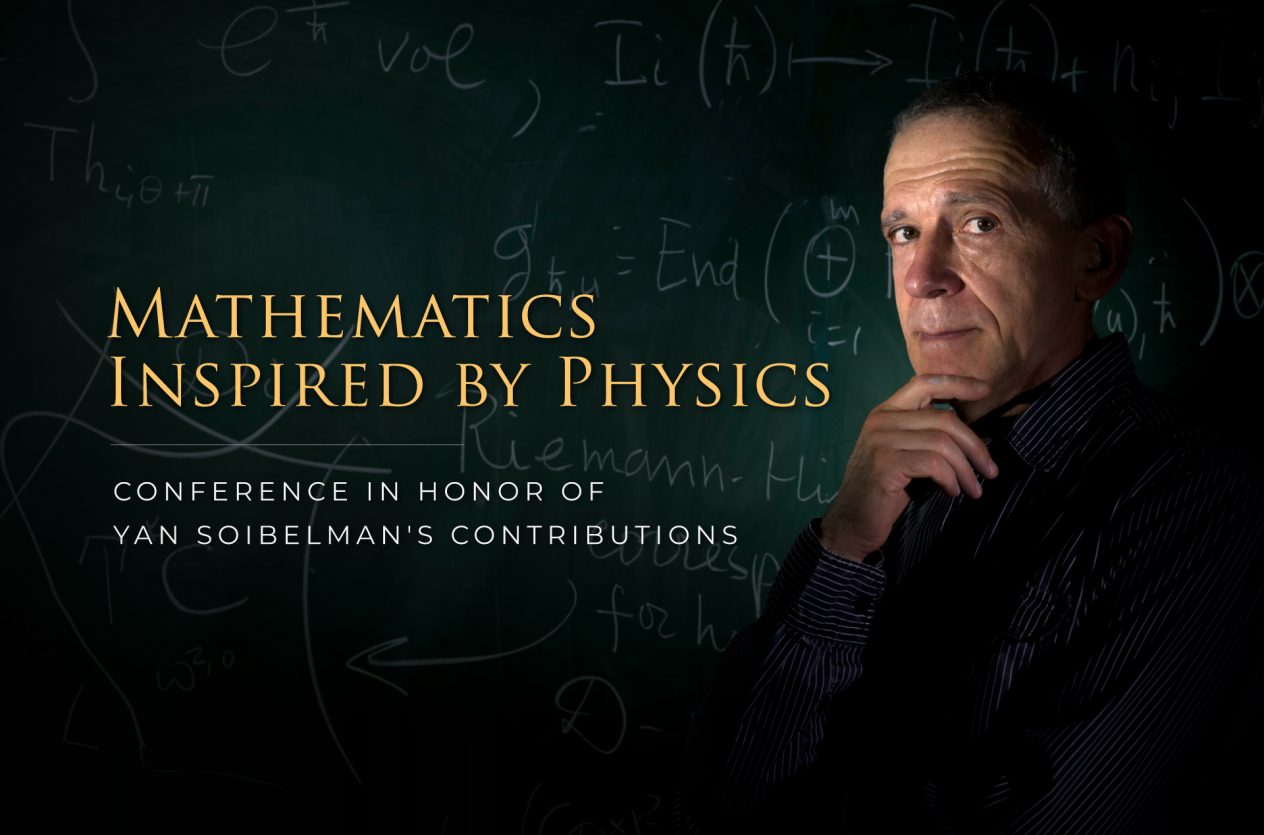
Les 1 et 2 juin se tiendra une conférence célébrant la carrière de Yan Soibelman, professeur à la Kansas State University et visiteur régulier à l'IHES.
En savoir plus