End-to-end construction of the maximal solution of the Liouville equation
Séminaire Laurent Schwartz — EDP et applications
Events from Indico
Séminaire Laurent Schwartz — EDP et applications
Different forms of the matrix Cayley-Hamilton identity in some quantum algebras will be presented. In particular, I plan consider the so-called braided Yangian — some generalization of Drinfeld Yangian — recently introduced in my joint work with D.Gurevich. A quantum counterpart of the Drinfeld-Sokolov reduction based on the Cayley-Hamilton identity will be discussed as well.
This is an informal, yet hopefully entertaining talk by a non-expert. After a short (and undoubtedly
incomplete) discussion of some basic puzzles confronting present-day cosmology, I recall the Friedmann Equations for the evolution of a homogeneous, isotropic universe and then proceed to describe the quantum-mechanical state of the universe shortly after inflation. This leads me to speculate about a possible mechanism, based on the chiral magnetic effect, for the growth of intergalactic magnetic fields in the early universe. This mechanism is a fourdimensional cousin of the quantum Hall effect. I then discuss ideas how to unify models of Dark Matter and Dark Energy into a single theory, which, in addition, might shed light on the origin of the matter-antimatter asymmetry of the universe.
Periods, numerical as algebraic integrals, and abstract, associated to de Rham comparison isomorphism, are fundamental in Physics and Mathematics. … Why are they so much related!?
Various considerations regarding their geometric and dynamic interpretation will be provided, together with thoughts requiring further readings and study.
Hadamard Lectures 2018
Retrouvez toutes les informations sur le site de la Fondation Mathématique Jacques Hadamard :
https://www.fondation-hadamard.fr/fr/financements-accueil-206-cours-avances/accueil-lecons-hadamard
We find a canonical decomposition of a geodesic current on a surface of finite type arising from a topological decomposition of the surface along special geodesics. We show that each component either is associated to a measured lamination or has positive systole. For a current with positive systole, we show that the intersection function on the set of closed curves is bilipschitz equivalent to the length function with respect to a hyperbolic metric. We show that the subset of currents with positive systole is open and that the mapping class group acts properly discontinuously on it. As an application, we obtain in the case of compact surfaces a structure theorem on the length functions appearing in the length spectrum compactification both of the Hitchin and of the maximal character varieties and determine therein an open set of discontinuity for the action of the mapping class group. This is joint work with Alessandra Iozzi, Anne Parreau, and Beatrice Pozzetti.
An Anosov representation of a word hyperbolic group Γ into a semisimple Lie group G is a dynamically defined strengthening of a quasi-isometric embedding of Γ into G, which serves as a flexible higher rank analogue of the notion of convex-cocompactness. In particular, Anosov representations yield interesting discrete subgroups of G. Guichard-Wienhard and Kapovich-Leeb-Porti constructed co-compact domains of proper discontinuity for these discrete subgroups lying in generalized flag manifolds G/P where P<G is a parabolic subgroup. Distinct domains of discontinuity are indexed by certain special subsets (ideals) in the Weyl group of G with respect to the Bruhat order. In this talk, we discuss the calculation of the homology groups of the quotient manifolds in the case when Γ is a closed surface group, and G is a complex simple Lie group. The formulas express the Betti numbers explicitly in terms of the combinatorial properties of the corresponding subset of the Weyl group of G. This yields a sufficient condition to distinguish the homotopy type of two quotient manifolds obtained from different ideals in the Weyl group. Time permitting, we will present some interesting special cases where the Poincaré polynomial can be expressed as a particularly simple rational function with the degree of the numerator and denominator depending on the genus of the surface.
Hadamard Lectures 2018
Retrouvez toutes les informations sur le site de la Fondation Mathématique Jacques Hadamard :
https://www.fondation-hadamard.fr/fr/financements-accueil-206-cours-avances/accueil-lecons-hadamard
Hadamard Lectures 2018
Retrouvez toutes les informations sur le site de la Fondation Mathématique Jacques Hadamard :
https://www.fondation-hadamard.fr/fr/financements-accueil-206-cours-avances/accueil-lecons-hadamard
The central problem of Noncommutative Geometry is constructing differential calculus on a given noncommutative algebra. Some known approaches to this problem will be mentioned in my talk.
Also, I shall exhibit a new approach to constructing such a calculus on the enveloping algebras of Lie algebras gl(n) and their super-analogs. This approach is based on a new form of the Leibniz rule. As a result, the corresponding differential algebra can be treated as a quantization (deformation) of its commutative counterpart, namely, the differential algebra on the symmetric algebra of a given Lie algebra gl(n).
The role of braided algebras (i.e., those related to the corresponding quantum groups) in constructing this calculus will be exhibited. Applications to quantization of some dynamical models by means of so-called « quantum spherical coordinates » will be also exhibited.
The Chow group of zero-cycles of a smooth and projective variety defined over a field k is an invariant of an arithmetic and geometric nature which is well understood only when k is a finite field (by higher-dimensional class field theory). In this talk, we will discuss the case of local and strictly local fields. We prove in particular the injectivity of the cycle class map to integral l-adic cohomology for a large class of surfaces with positive geometric genus over p-adic fields. The same statement holds for semistable K3 surfaces over C((t)), but does not hold in general for surfaces over C((t)) or over the maximal unramified extension of a p-adic field. This is a joint work with Hélène Esnault.
Page web du séminaire
Et aussi
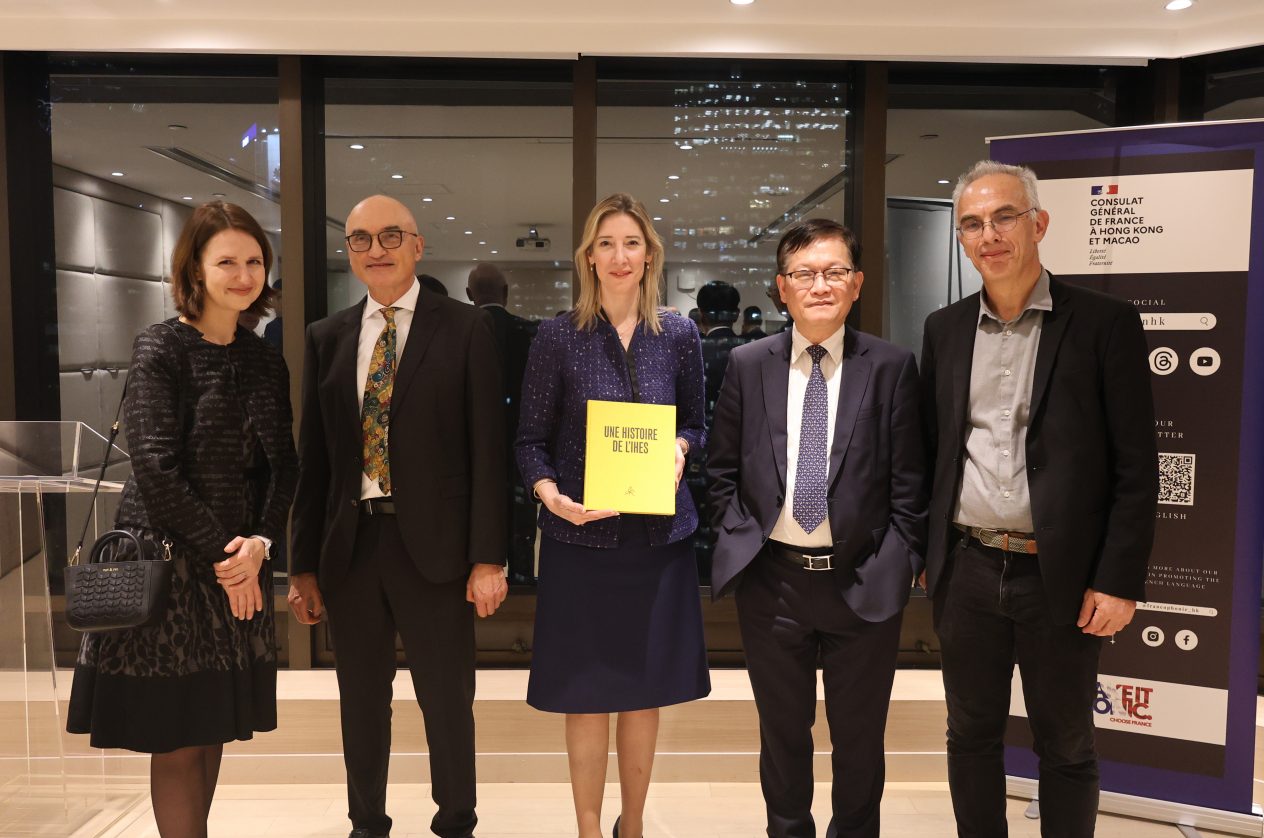
Début février, l’IHES a organisé une série d’événements à Hong Kong, soulignant son rayonnement international ainsi que son engagement en faveur des échanges scientifiques.
En savoir plus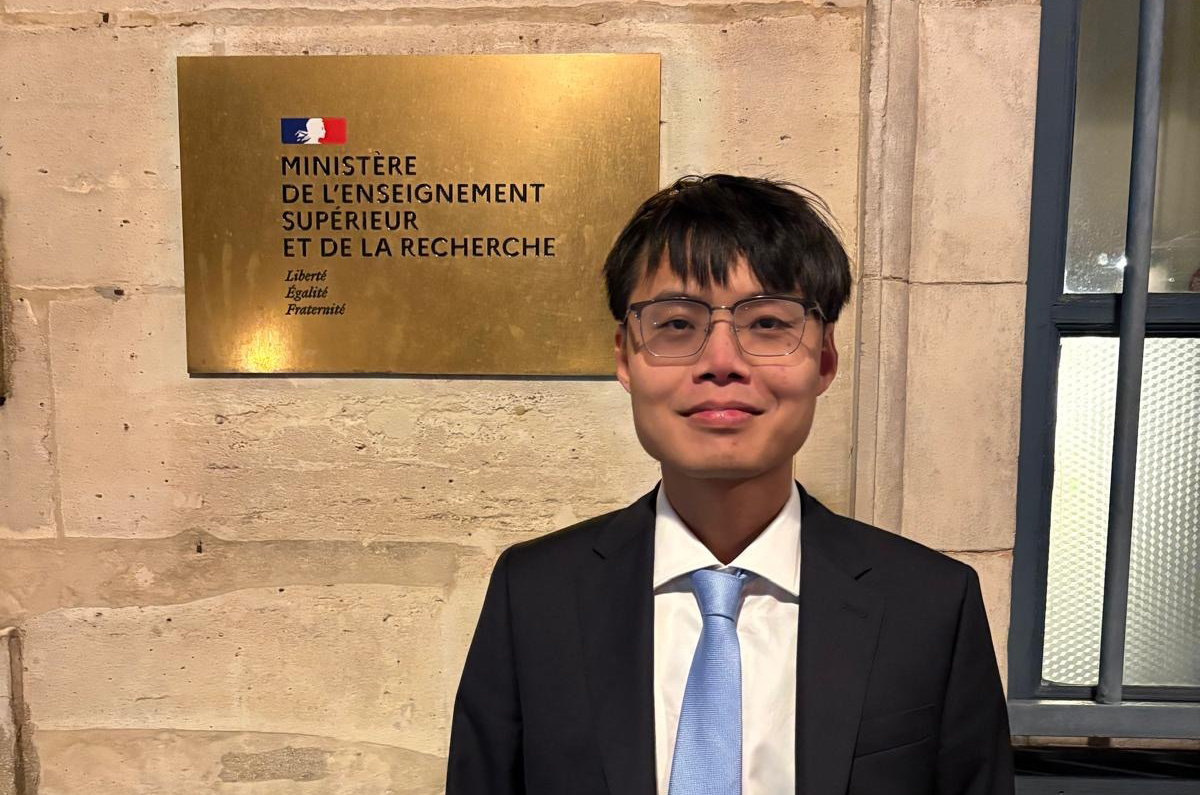
Zhongkai Tao, professeur junior à l’IHES, fait partie des premiers lauréats du programme Choose France for Science.
En savoir plus