
Eigenvalues of Laplacian on Riemannian manifolds of nonnegative Ricci curvature
I will explain some universal inequalities among eigenvalues of Laplacian and how to derive it from the point of view of the theory of concentration of measure.
Events from Indico
I will explain some universal inequalities among eigenvalues of Laplacian and how to derive it from the point of view of the theory of concentration of measure.
A toric arrangement is given by a family A of level sets of characters of a complex torus T. The focus of this talk will be on the topology of the complement M:=T A, and in particular on the extent to which M is determined by the combinatorial data of the arrangement A, a line of research recently revived by work of De Concini and Procesi.
I will first present some basics about toric arrangements, and then hint at how a theoretical framework can be developed in parallel to the theory of hyperplane arrangements. In particular, I will describe combinatorial models for the homotopy type of M and explain the methods we use in our proof of minimality, and thus of torsion-freeness, of M.
This is mostly joint work with Giacomo d'Antonio.
In my talk I will discuss the possible hypothetical generalization of the Langlands correspondence for two-dimensional local fields and two-dimensional arithmetic schemes. A two-dimensional local field appear naturally from a point and a formal stalk of irreducible curve on a surface such that this curve contains the point. An example of two-dimensional local field on an algebraic surface is the field of iterated Laurent series.
Neutron star and black hole magnetospheres, converting rotational energy to Poynting flux, are often modeled using force-free electrodynamics, since the energy of the field dominates that of the charged matter. In this peculiar scheme, the requirement that the 4-force on the current vanish plays the role of a non-linear field equation, with the current defined by the field via Maxwell’s equations. This talk will show how the theory becomes remarkably simple and elegant when treated relativistically with the help of differential forms, and some applications and new exact solutions will be discussed.
Journée autour des formes modulaires et amplitudes en théorie des cordes.
Journée autour des formes modulaires et amplitudes en théorie des cordes.
By Hodge symmetry, the Betti numbers of a complex projective smooth variety in odd degrees are even. When the base field has characteristic p, Deligne proved the hard Lefschetz theorem in étale cohomology, and the parity result follows from this. Suh has generalized this to proper smooth varieties in characteristic p, using crystalline cohomology. The purity of intersection cohomology group of proper varieties suggests that the same parity property should hold for these groups in characteristic p. We proved this by investigating the symmetry in the categorical level. In particular, we reproved Suh's result, using merely étale cohomology. Some related results will be discussed. This is joint work with Weizhe Zheng.
Page web du séminaire
(ATTENTION CHANGEMENT DE DATE)
We will explain a generalisation of the construction of the local factors of Godement-Jacquet's L-functions, based on Vinberg's monoid.
Page web du séminaire
Nous organisons un petit groupe de travail pour essayer de mieux comprendre les liens entre la méthode de BKW complexe, la correspondance de Hodge nonabélienne sauvage et la récursion toplogique d'Eynard-Orantin.
The basic aim is to try to better understand the relation between exact WKB, wild nonabelian Hodge theory and the topological recursion of Eynard-Orantin, as well as links to the (nonlinear) Stokes phenomenon.
In order to control locally a space-time which satisfies the Einstein equations, what are the minimal assumptions one should make on its curvature tensor? The bounded L2 curvature conjecture roughly asserts that one should only need L2 bound on the curvature tensor on a given space-like hypersuface. I will present the proof of this conjecture, which sheds light on the specific nonlinear structure of the Einstein equations. This is joint work with S. Klainerman and I. Rodnianski.
Et aussi
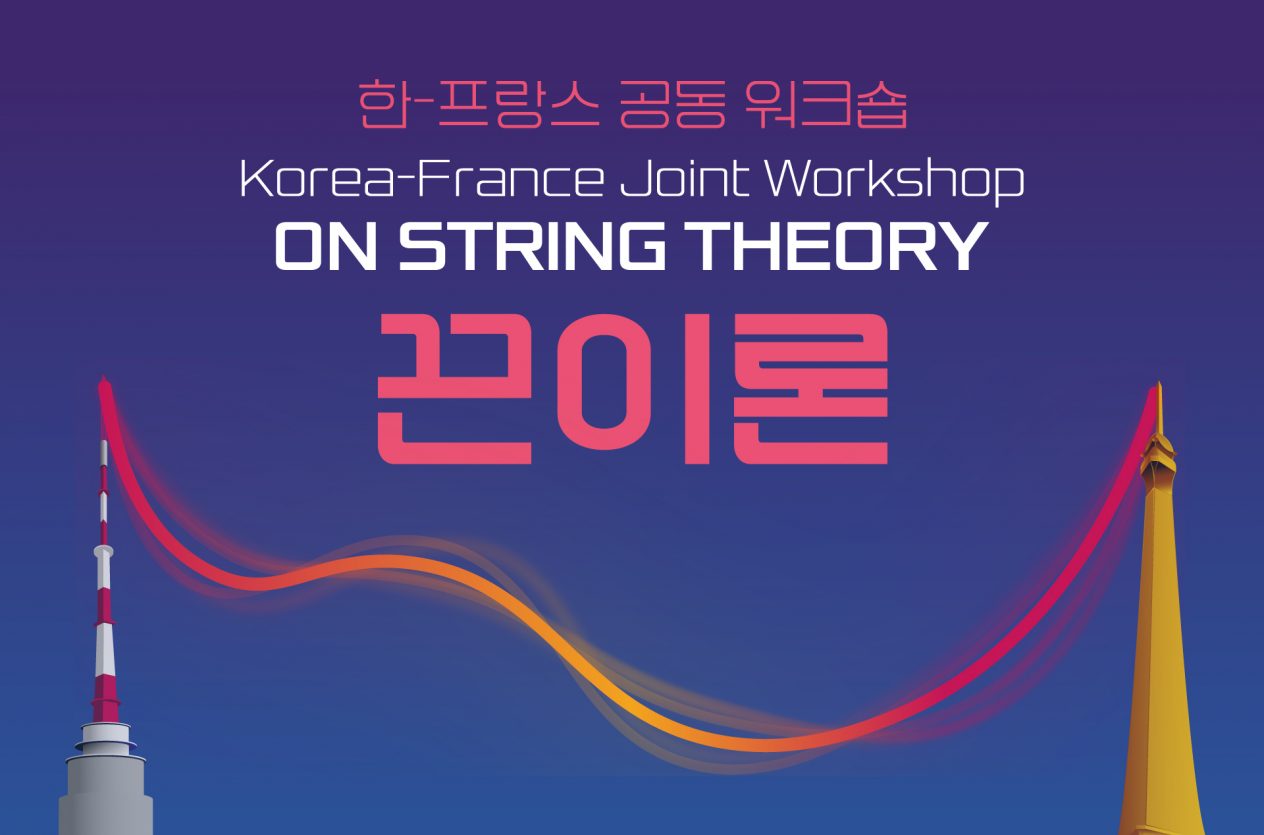
Du 15 au 18 septembre prochain, Piljin Yi (KIAS), Sangmin Lee (KIAS), Sungjay Lee (KIAS), Ruben Minasian (IPhT, CEA Saclay), Julio Parra Martinez (IHES) et Eric Perlmutter (IPhT, CEA Saclay) organiseront un workshop franco-coréen axé autour de la théorie des cordes.
En savoir plus
LSC, pour Life, Structure, and Cognition (Vie, Structure et Cognition), a pour objectif de s’informer sur les avancées entre la biologie et l’intelligence artificielle. Rendez-vous du 22 au 25 juin pour la quatrième édition LSC 2026.
En savoir plus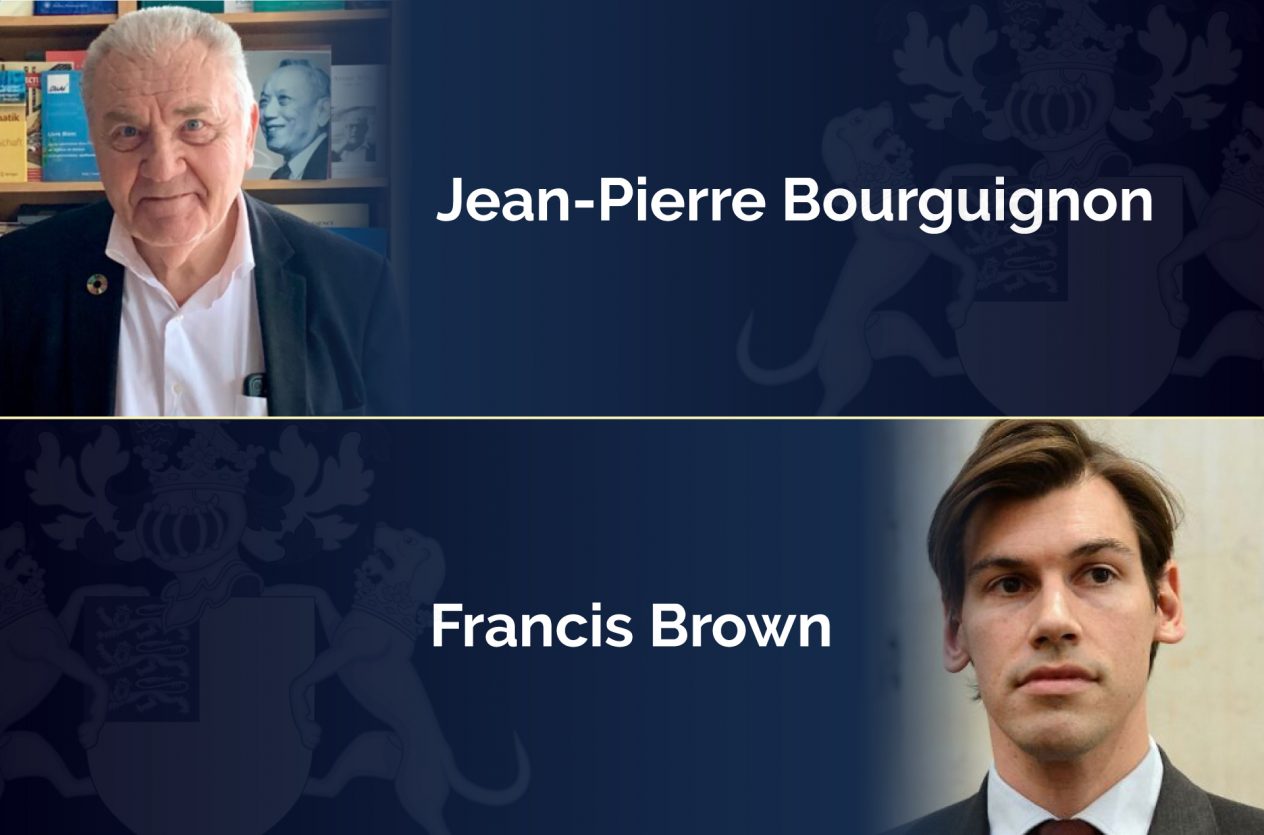
L'IHES est fier d'annoncer que Jean-Pierre Bourguignon, ancien directeur de l'IHES, et Francis Brown, ancien chercheur CNRS à l'IHES, ont été élus Fellows de la Royal Society.
En savoir plus