
Scattering and Linear Landau Damping (for Non-homogeneous States)
Séminaire Laurent Schwartz — EDP et applications
Events from Indico
Séminaire Laurent Schwartz — EDP et applications
In this talk I will describe the geometrical four-point functions (cluster connectivities) of 2d critical Q-state Potts model and its relation to minimal models four-point functions. By studying on the RSOS lattice of the ADE type, we provide a geometrical formulation of minimal models four-point functions of operators related to the Potts model and they involve the same types of cluster/loop expansions as that of the Potts model albeit with different weights. I will discuss how our results can be used to extract useful information about the Potts model from minimal models.
Séminaire Laurent Schwartz — EDP et applications
Séminaire Laurent Schwartz — EDP et applications
A classical principle in deformation theory asserts that any formal deformation problem over a field of characteristic zero is classified by a differential graded Lie algebra. Using the Koszul duality between Lie algebras and commutative algebras, Lurie and Pridham have given a more precise description of this principle: they establish an equivalence of categories between dg-Lie algebras and formal moduli problems indexed by Artin commutative dg-algebras. I will describe a variant of this result for deformation problems around schemes over a field of characteristic zero. In this case, there is an equivalence between the homotopy categories of dg-Lie algebroids and formal moduli problems on a derived scheme. This can be viewed as a derived version of the relation between Lie algebroids and formal groupoids.
The talk is dedicated to flag manifold sigma-models, which are theories of generalized harmonic maps from a Riemann surface to a manifold of flags in $C^N$. These theories feature interesting geometric properties and are in certain cases examples of the so-called ‘integrable’ models. I will review some of these facts.
Séminaire Laurent Schwartz — EDP et applications
Dans le cas de coefficients indépendants du temps, le propagateur de Feynman peut être défini comme une valeur au
bord de la résolvante de l’opérateur d’onde (interprété comme un opérateur auto-adjoint). Un résultat célèbre de Duistermaat et
Hörmander en donne une caractérisation microlocale ainsi qu’une paramétrix qui se généralisent bien au cas des opérateurs de
type principal réel. Toutefois, la question d’existence d’un inverse canonique est longtemps restée ouverte. Le but de cet exposé
sera de présenter quelques résultats récents sur l’inversibilité de l’opérateur de Klein-Gordon sur des espaces-temps asymptotiquement
plats et d’expliquer comment interpréter l’inverse en termes de conditions aux limites globales à l’infini ainsi que dans un
langage plus « spectral». Quelques applications en théorie quantique des champs seront présentées. (travaux en collaboration avec
Christian Gérard et András Vasy)
Séminaire Laurent Schwartz — EDP et applications
Je discuterai d’un résultat récent obtenu avec Joackim Bernier et Benoît Grébert concernant la stabilité de petites solutions
régulières à l’équation de Schrödinger non linéaire (NLS) en dimension 1 sur un tore. Il s’agira de montrer un résultat du
type: « le plus souvent, les solutions de NLS sont stables sur des temps très longs » en précisant l’énoncé et les techniques utilisées.
Celles ci sont basées sur un nouveau type de formes normales dites rationnelles qui permettent de conjuguer le flot de NLS à
une dynamique intégrable sur des ensembles dont on mesure la taille par calculs probabilistes. La possible existence de contre
exemples et l’extension à d’autres situations, seront aussi évoquées et discutées.
Weight structures give certain filtrations of triangulated categories; the definition is a certain cousin of that of t-structures. Particular cases of weight decompositions give stupid filtrations of complexes and cellular towers for spectra. I will also mention interesting motivic and Hodge-theoretic examples of weight structures along with methods for constructing them. Weight structures yield weight filtrations and spectral sequences for cohomology as well as certain weight complex functors. In particular, there exists an exact conservative functor from (relative) constructible Voevodsky motives into complexes of Chow motives, whereas the corresponding weight spectral sequences vastly generalize Deligne’s ones. Lastly, the relations between weight structures and t-structures yield new methods for constructing t-structures and proving their properties.
In this course, we will discuss the use of convex integration to construct wild weak solutions in the context of the Euler and Navier-Stokes equations. In particular, we will outline the resolution of Onsager’s conjecture as well as the recent proof of non-uniqueness of weak solutions to the Navier-Stokes equations.
Onsager’s conjecture states that weak solutions to the Euler equation belonging to Hölder spaces with Hölder exponent greater than 1/3 conserve energy, and conversely, there exit weak solutionslying in any Hölder space with exponent less than 1/3 which dissipate energy. The conjecture itself is linked to the anomalous disspoation of energy in turbulent flows, which has been called the zeroth law of turbulence.
For initial datum of finite kinetic energy, Leray has proven that there exists at least one global in time finite energy weak solution of the 3D Navier-Stokes equations. We prove that weak solutions of the 3D Navier-Stokes equations are not unique, within a class of weak solutions with finite kinetic energy. The non-uniqueness of Leray-Hopf solutions is the subset of a famous conjecture of Ladyzenskaja in ’69, and to date, this conjecture remains open.
Séminaire Laurent Schwartz — EDP et applications
Dans un premier temps, je présenterai des résultats qui quantifient le prolongement unique pour des équations de type
onde. Typiquement, est-ce que la petitesse d’une solution sur une portion définie de l’espace-temps implique la petitesse de la
solution globale? Dans un second temps, je présenterai des applications de ces méthodes à des opérateurs hypoelliptiques de type
« sommes de carrés de champs de vecteurs ». Il s’agit de travaux en collaboration avec Matthieu Léautaud.
In low dimension, it is expected that topological properties determine a natural geometry. In this spirit, several characterizations are conjectured for Kleinian groups, i.e. discrete subgroups of PSL(2,C). We will survey different methods that lead to their topological and dynamical characterizations, and point out their limits and the difficulties encountered in obtaining a complete answer.
Et aussi
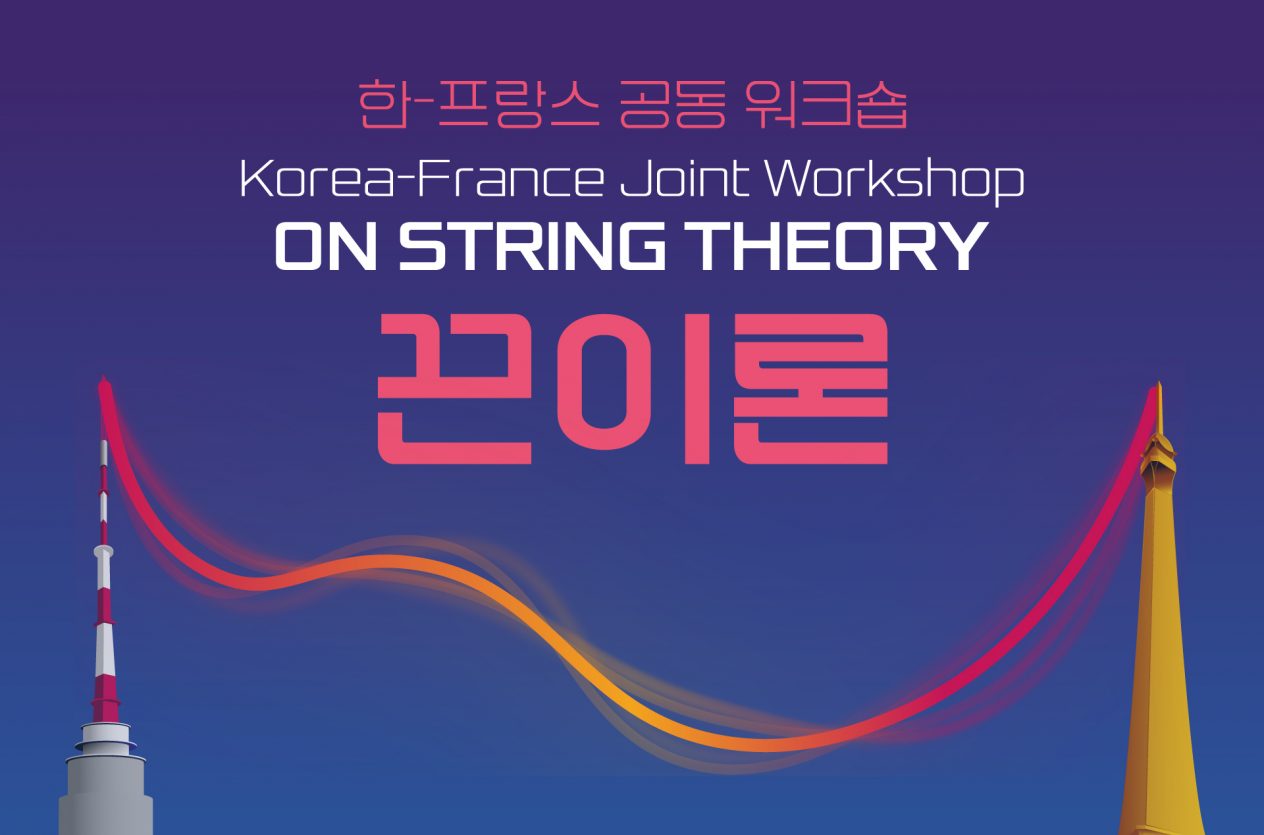
Du 15 au 18 septembre prochain, Piljin Yi (KIAS), Sangmin Lee (KIAS), Sungjay Lee (KIAS), Ruben Minasian (IPhT, CEA Saclay), Julio Parra Martinez (IHES) et Eric Perlmutter (IPhT, CEA Saclay) organiseront un workshop franco-coréen axé autour de la théorie des cordes.
En savoir plus
LSC, pour Life, Structure, and Cognition (Vie, Structure et Cognition), a pour objectif de s’informer sur les avancées entre la biologie et l’intelligence artificielle. Rendez-vous du 22 au 25 juin pour la quatrième édition LSC 2026.
En savoir plus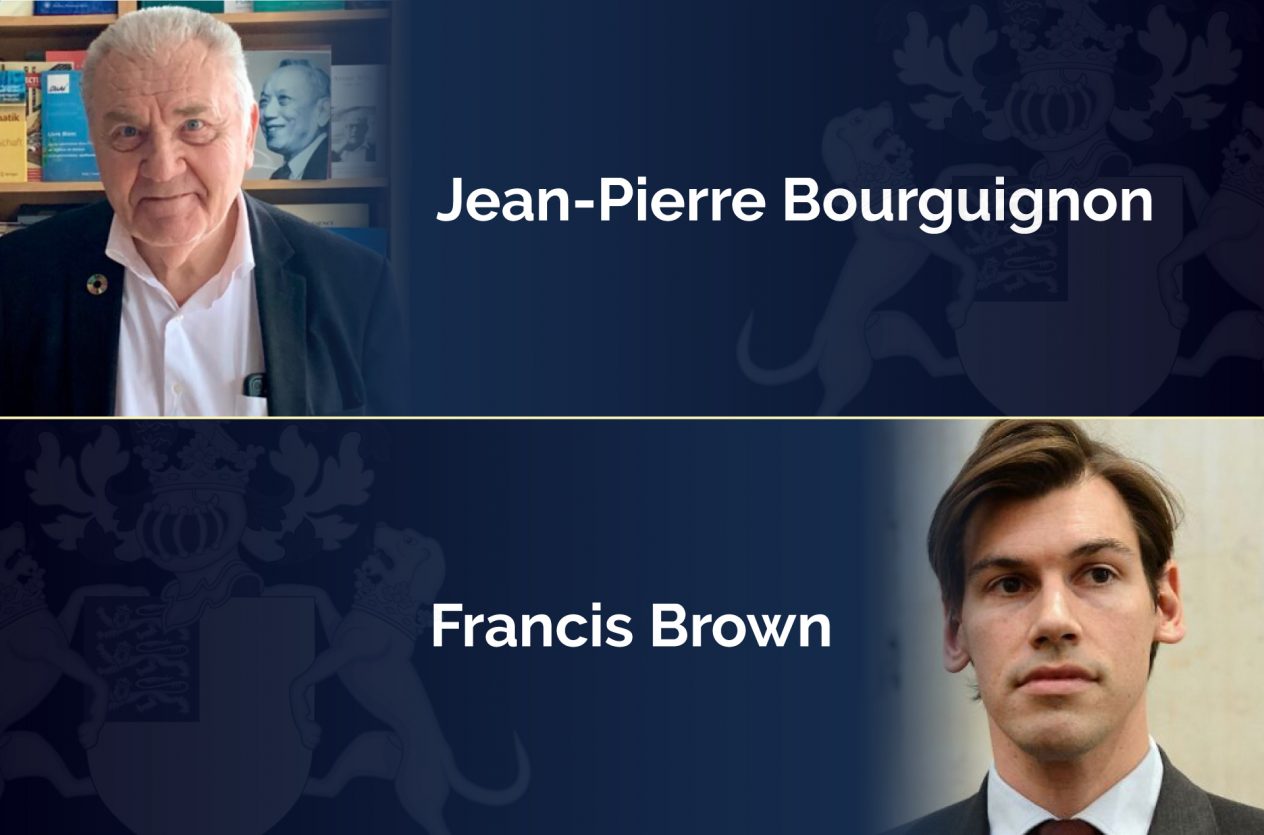
L'IHES est fier d'annoncer que Jean-Pierre Bourguignon, ancien directeur de l'IHES, et Francis Brown, ancien chercheur CNRS à l'IHES, ont été élus Fellows de la Royal Society.
En savoir plus