Signature and Toledo Invariants for Flat Unitary Bundles over Surfaces with Boundary
We consider representations of the fundamental groups of compact surfaces with boundary into classical simple Lie groups of Hermitian type. We relate work on the signature of the associated local systems, due to Meyer and Atiyah, to Burger-Iozzi-Wienhard’s Toledo invariant. To measure the difference, we extend Atiyah-Patodi-Singer’s rho invariant, initially defined on U(p), to discontinuous class functions, first on U(p,q), and then on other classical groups via embeddings into U(p,q). As an application, we obtain a Milnor-Wood type inequality which slightly differs from, and sometimes improves upon Burger-Iozzi-Wienhard’s version. This is joint work with P. Pansu and X. Wan.
Confined Subgroups of Semisimple Lie Groups
Let G be a semisimple Lie group, e.g. G = SL(n,R). A subgroup Γ of G is called confined if there is a bounded neighborhood of the identity that contains a non-trivial element of every conjugate of Γ. For example, any normal subgroup of a co-compact lattice is confined. In joint work with Tsachik Gelander, we proved that when G has higher rank (e.g. G = SL(n,R) with n>2), a discrete subgroup of G is confined if and only if it is a lattice, which can be seen as an extension of Margulis’ Normal Subgroup Theorem. The proof consists of two independent steps that I hope to explain in my talk: 1) the passage from discrete subgroups to stationary random subgroups and 2) the classification of discrete stationary random subgroups in higher rank. If time permits, I will also discuss some open questions related to this work.
Motivic Cohomology of Mixed Characteristic Schemes
I will present a new theory of motivic cohomology for general (qcqs) schemes. It is related to non-connective algebraic K-theory via an Atiyah-Hirzebruch spectral sequence. In particular, it is non-A1-invariant in general, but it recovers classical motivic cohomology on smooth schemes over a Dedekind domain after A1-localisation. The construction relies on the syntomic cohomology of Bhatt-Morrow-Scholze and the cdh-local motivic cohomology of Bachmann-Elmanto-Morrow, and generalises the construction of Elmanto-Morrow in the case of schemes over a field. Pour être informé des prochains séminaires vous pouvez vous abonner à la liste de diffusion en écrivant un mail à sympa@listes.math.cnrs.fr avec comme sujet: « subscribe seminaire_mathematique PRENOM NOM »(indiquez vos propres prénom et nom) et laissez le corps du message vide.
Ornstein-Zernike Theory for the 2D Near-critical Random Cluster Model
Probability and analysis informal seminarIn this talk, we will discuss the classical Ornstein-Zernike theory for the random-cluster models (also known as FK percolation). In its modern form, it is a very robust theory, which most celebrated output is the computation of the asymptotically polynomial corrections to the pure exponential decay of the two-points correlation function of the random-cluster model in the subcritical regime. We will present an ongoing project that extends this theory to the near-critical regime of the two-dimensional random-cluster model, thus providing a precise understanding of the Ornstein-Zernike asymptotics when p approaches the critical parameter $p_c$. The output of this work is a formula encompassing both the critical behaviour of the system when looked at a scale negligible with respect to its correlation length, and its subcritical behaviour when looked at a scale way larger than its correlation length. Based on a joint work with Ioan Manolescu.========Pour être informé des prochains séminaires vous pouvez vous abonner à la liste de diffusion en écrivant un mail à sympa@listes.math.cnrs.fr avec comme sujet: « subscribe seminaire_mathematique PRENOM NOM »(indiquez vos propres prénom et nom) et laissez le corps du message vide.
From O(3) to Cubic CFT: Conformal Perturbation and the Large Charge Sector
The Cubic CFT can be understood as the O(3) invariant CFT perturbed by a slightly relevant operator. In this paper, we use conformal perturbation theory together with the conformal data of the O(3) vector model to compute the anomalous dimension of scalar bilinear operators of the Cubic CFT. When the Z2 symmetry that flips the signs of φi is gauged, the Cubic model describes a certain phase transition of a quantum dimer model. The scalar bilinear operators are the order parameters of this phase transition. Based on the conformal data of the O(3) CFT, we determine the correction to the critical exponent as η_Cubic-η_O(3)≈ -0.0215(49). The O(3) data is obtained using the numerical conformal bootstrap method to study all four-point correlators involving the four operators: v=φ_i, s=∑_i φ_iφ_i and the leading scalar operators with O(3) isospin j=2 and 4. According to large charge effective theory, the leading operator with charge Q has scaling dimension Δ_Q=c_3/2 * Q^3/2+c_1/2 * Q1^/2. We find a good match with this prediction up to isospin j=6 for spin 0 and 2 and measured the coefficients c_3/2 and c_1/2. Pour être informé des prochains séminaires vous pouvez vous abonner à la liste de diffusion en écrivant un mail à sympa@listes.math.cnrs.fr avec comme sujet: « subscribe seminaire_physique PRENOM NOM »(indiquez vos propres prénom et nom) et laissez le corps du message vide.
10e séminaire ITZYKSON – Valeurs zêta multiples et fonctions modulaires de graphes en théorie des cordes
10e séminaire ITZYKSON :Valeurs zêta multiples et fonctions modulaires de graphes en théorie des cordes Le 10e séminaire Itzykson est organisé par Maxim Kontsevich (IHES), Stéphane Nonnenmacher (IMO, Univ. Paris-Saclay), Sylvain Ribault (IPhT Saclay) et Pierre Vanhove (IPhT Saclay). Dans leur développement à basse énergie, les amplitudes de diffusion en théorie des champs et en théorie des cordes ont des propriétés remarquables liées à la théorie des nombres, notamment en ce qui concerne l’invariance modulaire. Ainsi, certaines amplitudes sont déterminées par une classe de valeurs zêta multiples univaluées découvertes par Francis Brown. L’analyse des amplitudes de diffusion a conduit à la découverte de formes modulaires nouvelles généralisant au cas elliptique ces valeurs zêta multiples univaluées. Durant cette journée seront présentés divers aspects de la relation entre les propriétés physiques des amplitudes, des développements récents en théorie des nombres, et de nouvelles formes modulaires. Le cours présentera les notions fondamentales qui seront ensuite développées dans deux séminaires.Trois cours auront lieu dans la journée, présentés par : Pierre Vanhove, IPhT SaclayFederico Zerbini, OxfordEric Perlmutter, IPhT SaclayL’inscription est gratuite mais nécessaire et sera possible jusqu’au 10 novembre 2022. Un buffet-déjeuner sera offert aux participants qui s’y seront inscrits. Le séminaire sera filmé et diffusé en différé sur la chaîne YouTube de l’IHES.
Day in Honor of Yvonne Choquet-Bruhat’s 100th Birthday
December 2023 marks Yvonne Choquet-Bruhat’s 100th birthday. For this special occasion, IHES organizes a day in her honor on December 8, 2023.Registration is free but mandatory.Yvonne Choquet-Bruhat’s work has had a long-lasting impact on the field of mathematical relativity starting with her seminal 1952 paper on the local well-posedness of Einstein equations. Her numerous contributions, both to constraint equations and to the evolution problem in general relativity, have deeply influenced several generations of researchers. This special day in her honor will be the occasion to present some of the latest developments in the field.Invited Speakers:Thibault Damour, IHES Michael Eichmair, University of Vienna Cécile Huneau, École polytechniqueSergiu Klainerman, Princeton University Organizers: Laure Saint-Raymond (IHES) & Jérémie Szeftel (Laboratoire Jacques-Louis Lions)
Colloque pour honorer la mémoire de Jacques TITS
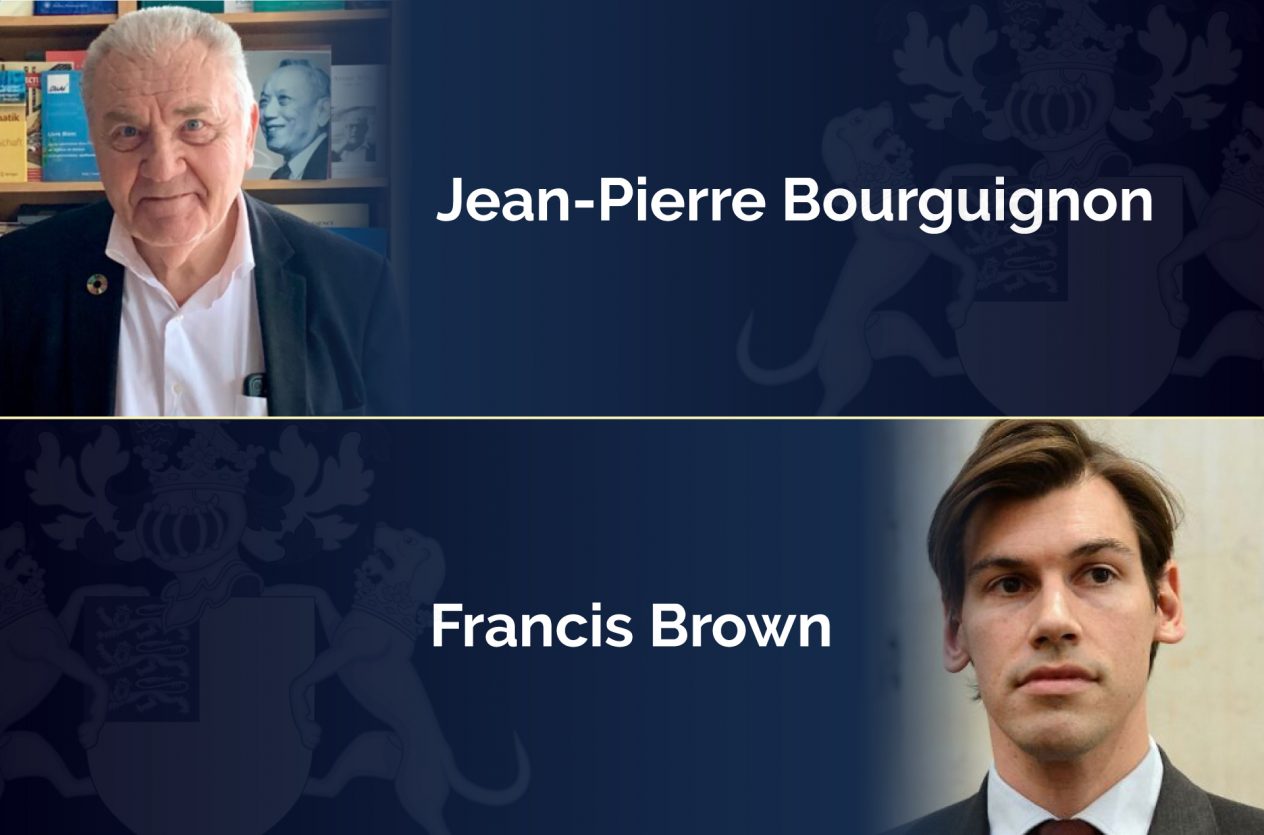
En l’honneur du mathématicien Jacques Tits, un colloque de quatre demi-journées sur trois jours est organisé au Collège de France du 11 au 13 décembre 2023, organisé par Jean-Pierre Bourguignon, Michel Broué, Philippe Gille et Guy Rousseau. L’inscription au colloque est gratuite.Conférenciers invités :Michael BATEEmmanuel BREUILLARDPierre-Emmanuel CAPRACEJessica FINTZENAnne LONJOUTom DE MEDTSBernhard MÜHLHERRAnne QUÉGUINER-MATHIEUAnne PARREAUZev ROSENGARTENJean-Pierre SERREGernot STROTH Conseil scientifique :Michel BRIONNGÔ Bão ChâuAlain VALETTERichard WEISS
Combinatorics and Arithmetic for Physics: Special Days
Combinatorics and Arithmetic for Physics: special daysTenth Anniversary EditionThe meeting focuses on questions of discrete mathematics and number theory, emphasizing computability. Problems are drawn mainly from theoretical physics: renormalization, combinatorial physics, geometry, evolution equations (commutative and noncommutative), or related to its models, but not only. Computations, based on combinatorial structures (graphs, trees, words, automata, semirings, bases), or classical structures (operators, Hopf algebras, evolution equations, special functions, categories) are good candidates for computer-based implementation and experimentation.Organized by: Gérard H. E. DUCHAMP, Maxim KONTSEVICH, Gleb KOSHEVOY, Sergei NECHAEV, and Karol A. PENSON.Speakers:Marek Bozejko (Institute of Mathematics Wroclaw University)Ricardo Buring (INRIA)Philippe Di Francesco (UIUC)Gérard H. E. Duchamp (LIPN, Université Paris Nord) Harold Erbin (CTP, MIT, USA)Stéphane Gaubert (INRIA, CMAP, École polytechnique)Volker Genz (IBS CGP)Darij Grinberg (Drexel University) Dimitry Gurevich (IITP, Moscou) Yuki Kanabuko (MPIM, Bonn)Rinat Kedem (UIUC)Maxim Kontsevich (IHES)Gleb Koshevoy (IITP, Moscow & IHES)Thomas Krajewski (CPT, Marseille)Marek Kus (Center for Theoretical Physics)Hiroaki Nakamura (Osaka University) Toshiki Nakashima (Sophia University Tokyo) Hadrien Notarantonio (Inria Saclay)Karol A. Penson (LPTMC, Sorbonne Université) Eric Pichon-Pharabod (Université Paris-Saclay)Sanjaye Ramgoolam (Queen Mary University of London)Travis Scrimshaw (Hokkaido University) Andrea Sportiello (LIPN, Université Paris Nord)Adrian Tanasa (Université de Bordeaux)Vasily Sazonov (CEA)Jean-Bernard Zuber (LPTHE, Sorbonne Université)Karol Życzkowski (Jagiellonian University)Sponsors: IHES – Math-STIC – LIPN (UMR-7030) – LPTMC (Univ-Paris 6) – INRIA – GDR EFI – CEAScientific Committee:Joseph Ben Geloun (LIPN-Paris XIII), Alin Bostan (INRIA), Marek Bozejko (Wroclaw University), Vincent Rivasseau (Orsay-CEA)
Existence and density of (typical) Hodge loci
Séminaire informel sur les intersections atypiquesI will recall how understanding the geometry of jumping loci for algebraic cycles in families of smooth projective complex varieties can be reinterpreted as an unlikely intersection problem. I will then present joint work with David Urbanik using this point of view to give sufficient conditions for the analytic density of these loci in the base of the family. ========Pour être informé des prochains séminaires vous pouvez vous abonner à la liste de diffusion en écrivant un mail à sympa@listes.math.cnrs.fr avec comme sujet: « subscribe seminaire_mathematique PRENOM NOM »(indiquez vos propres prénom et nom) et laissez le corps du message vide.
Non-archimedean periods for log Calabi-Yau surfaces
Period integrals are a fundamental concept in algebraic geometry and number theory. In this talk, we will study the notion of non-archimedean periods as introduced by Kontsevich and Soibelman. We will give an overview of the non-archimedean SYZ program, which is a close analogue of the classical SYZ conjecture in mirror symmetry. Using the non-archimedean SYZ fibration, we will prove that non-archimedean periods recover the analytic periods for log Calabi-Yau surfaces, verifying a conjecture of Kontsevich and Soibelman. This is joint work with Jonathan Lai. Pour être informé des prochains séminaires vous pouvez vous abonner à la liste de diffusion en écrivant un mail à sympa@listes.math.cnrs.fr avec comme sujet: « subscribe seminaire_mathematique PRENOM NOM »(indiquez vos propres prénom et nom) et laissez le corps du message vide.
Effective Geometric Unlikely Intersections and Applications 1/2
Séminaire informel sur les intersections atypiquesThis is part one of a two part lecture, the second of which will be given by Greg Baldi. In the first part we introduce a unified framework for studying « geometric » unlikely intersection problems, which in particular includes all such problems arising from (mixed) Hodge theory, and prove a general geometric Zilber-Pink theorem in this context, subsuming previous results of this nature. The proofs are also effective, in the sense that they give explicit algorithms to compute the relevant atypical loci. In the second part we will explain how this common framework also applies to characterise geometric unlikely intersection phenomena beyond the Hodge-theoretic setting, and in particular to orbit closures in strata of abelian differentials. ========Pour être informé des prochains séminaires vous pouvez vous abonner à la liste de diffusion en écrivant un mail à sympa@listes.math.cnrs.fr avec comme sujet: « subscribe seminaire_mathematique PRENOM NOM »(indiquez vos propres prénom et nom) et laissez le corps du message vide.