
Le problème de Cauchy pour l’équation elliptique de Hele-Shaw
Séminaire Laurent Schwartz — EDP et applications
Events from Indico
Séminaire Laurent Schwartz — EDP et applications
Séminaire Laurent Schwartz — EDP et applications
Séminaire Laurent Schwartz — EDP et applications
Séminaire Laurent Schwartz — EDP et applications
We are interested in a system of particles in singular mean-field interaction and wish to prove that, as the number of particles goes to infinity, two given particles within that system become « more and more » independent, a phenomenon known as propagation of chaos. The interaction we will focus on comes from the Biot-Savart kernel, for which the nonlinear limit of the particle system satisfies the vorticity equation, arising from the 2D incompressible Navier-Stokes system. We build upon a recent work of P.-E. Jabin and Z. Wang to obtain a uniform in time convergence. The approach consists in computing the time evolution of the relative entropy of the joint law of the particle system with respect to the nonlinear limit. We prove time-uniform bounds on the limit, as well as a logarithmic Sobolev inequality. From the latter, the Fisher information appearing in the entropy dissipation yields a control on the relative entropy itself, inducing the time uniformity. This is joint work with A. Guillin and P. Monmarché.
We are going present a multi-scale analysis to derive log-Sobolev inequalities for interacting particle systems. This leads to a generalised Bakry-Emery criterion which can be applied to non-convex potentials. The approach relies on a Hamilton-Jacobi equation know as Polchinski equation. If time allows, we will explain how this multi-scale criterion allows to build Lipschitz transport maps. This talk is based on the survey arXiv:2307.07619 in collaboration with R. Bauerschmidt and B. Dagallier.
In this talk I will present some general strategies for proving (possibly constructive) rate of convergence in the longtime asymptotic for solutions to linear evolution equations. I will next explain how to implement these strategy in the case of the kinetic Fokker-Planck equation for several geometries (torus, whole space with confinement force, bounded domain with reflection condition).
In recent works it has been demonstrated that using an appropriate rescaling, linear kinetic equations with heavy tailed equilibria give rise to a scalar fractional diffusion equation. In this talk an extension of this is presented, where the linear kinetic equations under consideration, not only conserves mass, but also momentum and energy. In the limit, fractional diffusion equations are obtained for the energy and the mass, while the equation for the momentum is trivial. The methods of proof presented rely on spectral analysis combined with energy estimates. It is constructive and provides explicit convergence rates. This is work in progress together with É. Bouin and C. Mouhot.
I will adress the Burnett conjecture for the Einstein vacuum equations in general relativity. It states that small scale inhomogeneities in a vacuum spacetime can be described by a density of particle. I will give the state of the art and present perspectives.
In this talk we review some classical and recent results relating the uncertainty principles for the Laplacian with the controllability and stabilisation of some linear PDEs. The uncertainty principles for the Fourier transforms state that a square integrable function cannot be both localised in frequency and space without being zero, and this can be further quantified resulting in unique continuation inequalities in the phase spaces. Applying these ideas to the spectrum of the Laplacian on a compact Riemannian manifold, Lebeau and Robbiano obtained their celebrated result on the exact controllability of the heat equation in arbitrarily small time. The relevant quantitative uncertainty principles known as spectral inequalities in the literature can be adapted to a number of different operators, including the Laplace-Beltami operator associated to $C^1$ metrics or some Schödinger operators with long-range potentials, as we have shown in recent results in collaboration with Gilles Lebeau (Nice) and Nicolas Burq (Orsay), with a significant relaxation on the localisation in space. As a consequence, we obtain a number of corollaries on the decay rate of damped waves with rough dampings, the simultaneous controllability of heat equations with different boundary conditions and the controllability of the heat equation with rough controls.
This talk will start with a few basic notions about the classical theory of optimal transport between two probability measures (Monge and Wasserstein distances, Kantorovich duality, Brenier’s theorem). Recent results about extensions of these notions to the case of density operators in the content of quantum mechanics will be presented, with applications to the derivation of kinetic equations from quantum N-body systems. Finally, we shall propose a notion of optimal transport from a phase-space (classical0 probability density to a quantum density operator.
I discuss improved lattice models in three dimensions. Improved means that either one or two parameters of the model are tuned such that the leading or the leading and the next to leading correction to scaling have, at least approximately, a vanishing amplitude. This is achieved by using a finite size scaling analysis of dimensionless quantities. Based on these results, accurate estimates of universal quantities such as critical exponents are obtained. I summarize results that have been obtained for the Ising, the XY, the Heisenberg and the cubic universality classes and compare them with those obtained by other methods, in particular precise estimates obtained recently by using the conformal bootstrap method. Pour être informé des prochains séminaires vous pouvez vous abonner à la liste de diffusion en écrivant un mail à sympa@listes.math.cnrs.fr avec comme sujet: « subscribe seminaire_physique PRENOM NOM »(indiquez vos propres prénom et nom) et laissez le corps du message vide.
Et aussi
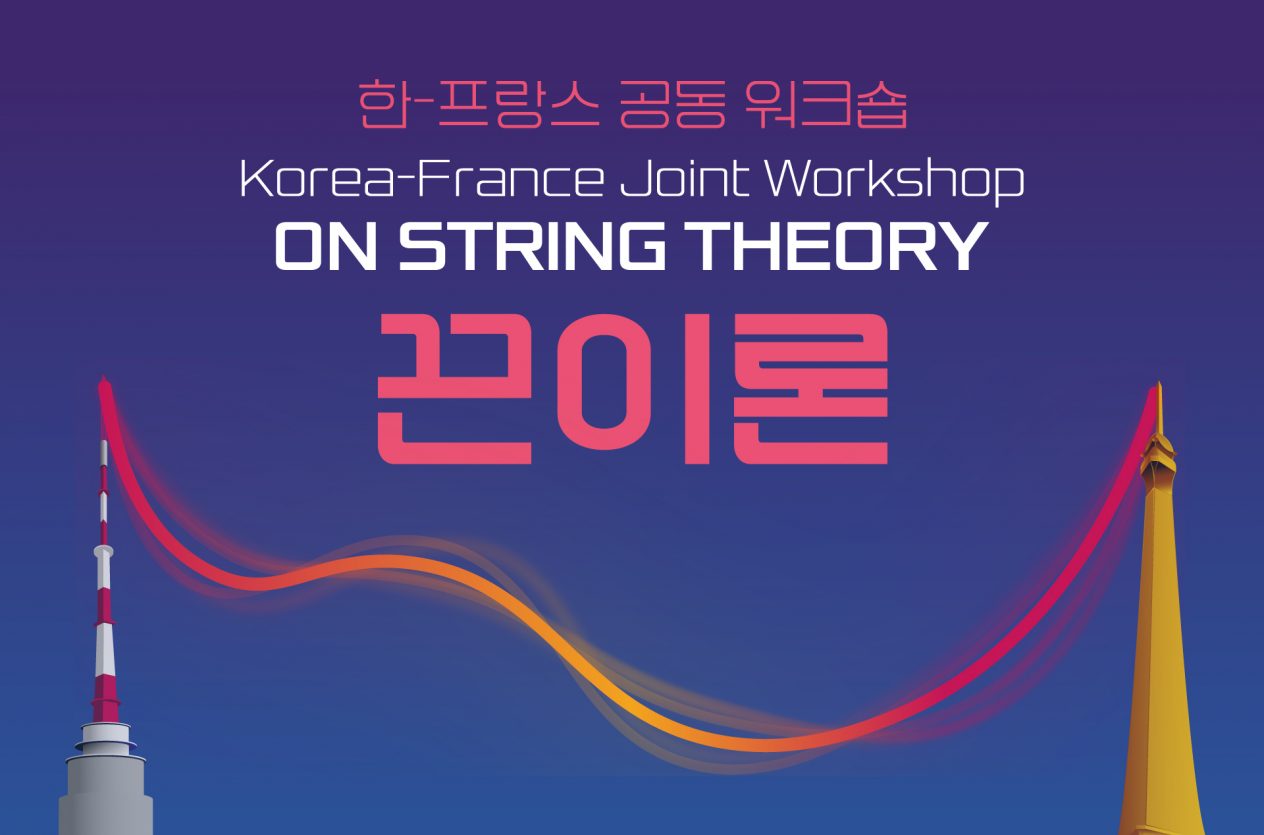
Du 15 au 18 septembre prochain, Piljin Yi (KIAS), Sangmin Lee (KIAS), Sungjay Lee (KIAS), Ruben Minasian (IPhT, CEA Saclay), Julio Parra Martinez (IHES) et Eric Perlmutter (IPhT, CEA Saclay) organiseront un workshop franco-coréen axé autour de la théorie des cordes.
En savoir plus
LSC, pour Life, Structure, and Cognition (Vie, Structure et Cognition), a pour objectif de s’informer sur les avancées entre la biologie et l’intelligence artificielle. Rendez-vous du 22 au 25 juin pour la quatrième édition LSC 2026.
En savoir plus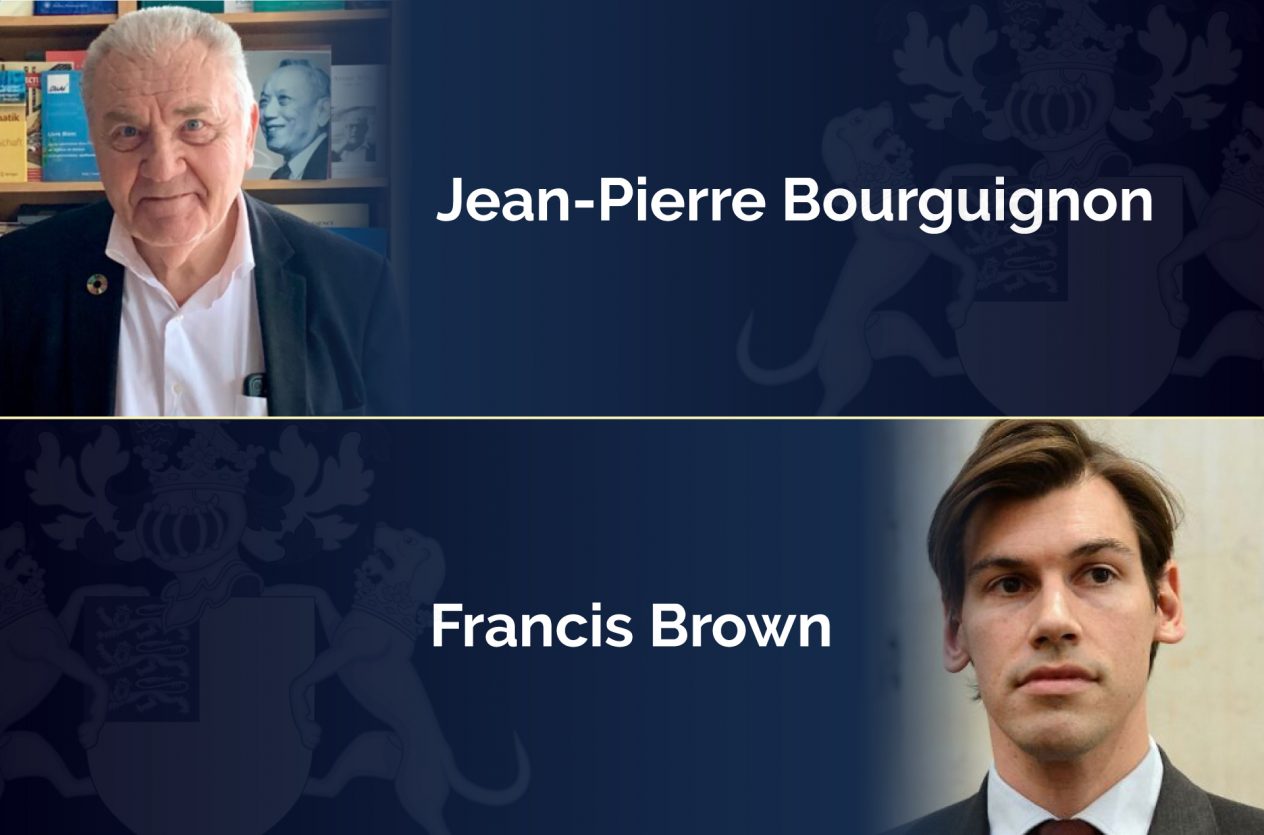
L'IHES est fier d'annoncer que Jean-Pierre Bourguignon, ancien directeur de l'IHES, et Francis Brown, ancien chercheur CNRS à l'IHES, ont été élus Fellows de la Royal Society.
En savoir plus