Rencontre autour des Publications Mathématiques de l’IHÉS

Rencontre autour des Publications Mathématiques de l'IHÉS
­Tuesday 22 January 2013­
IHÉS, Marilyn and James Simons Conference Center


­Organised by : ­
­Claire Voisin (CNRS-IMJ, Paris)
­Editor-in-chief of Les Publications Mathématiques de l'IHÉS


­ ­ ­

PROGRAMME­

11:00 – 12:00

­A­nton Zorich (Paris 7)
"Sum of Lyapunov exponents of the Hodge bundle with respect to the Teichmüller geodesic flow" (joint work with A. Eskin and M. Kontsevich)

12:00 – 14:00
Buffet lunch

2:00 – 3:00
Irina Kourkova (UPMC)
"On the functions counting walks with small steps in the quater plane''

3:00 – 3:30
Coffee break

3:40 – 4:40
Emmanuel Breuillard (Paris-Sud)
­ "La structure des groupes approximatifs et le cinquième problème de Hilbert"­

­­ ­ ­ ­

ABSTRACTS

Emmanuel Breuillard (Paris-Sud)
­ "La structure des groupes approximatifs et le cinquième problème de Hilbert"­


Nous montrons un théorème de structure des sous-groupes approximatifs d'un groupe abstrait G, i.e. des grandes parties fin­ies A de G vérifiant une condition de doublement (AA est recouvert par un nombre borné de
translatés de A). En bref les sous-groupes approximatifs sont « presque nilpotents''. Ce théorème s'apparente à la fois au théorème de structure des groupes localement compacts (cinquième problème de Hilbert: Gleason, Yamabe, Montgomery-Zippin) et au théorème de Gromov sur les groupes à croissance polynomiale. Les théoriciens des modèles (Hirschfeld, Goldbring-van-den-Dries) ont jeté un éclairage nouveau sur la preuve du cinquième problème de Hilbert et mis en évidence le lien avec les groupes approximatifs (Hrushovski) rendant possible l'adaptation des techniques de Gleason et Yamabe dans le cadre des groupes approximatifs. Travail en commun avec B. Green et T. Tao. ­

­

Irina Kourkova (UPMC)
"On the functions counting walks with small steps in the quater plane'' ­


On considère le nombre de chemins $q_S((i,j),n)$ dans le quart de plan $({bf Z}_+)^2$ partant du point $(0,0)$, arrivant au point $(i,j)$ en $n$ pas dont les déplacements appartiennent à un sous-ensemble fixé $S subset {-1,0,1}^2/setminus {(0,0)}$. Il existe $2^8$ choix pour $S$ et donc $2^8$ modèles à étudier. Pour tous ces modèles nous explicitons la fonction génératrice $Q_S(x,y,z)=sum_{(i,j)in ({bf Z_+})^2, ngeq 0} q_S((i,j),n)x^iy^jz^n$ de manière unifiée et étudions ensuite sa nature en fonction de l'ensemble $S$: rationnelle, algébrique, holonome ou non-holonome. Le travail est commun avec ­Kilian Raschel. (see the­ pdf)­­ ­

­

A­nton Zorich (Paris 7)
"Sum of Lyapunov exponents of the Hodge bundle with respect to the Teichmüller geodesic flow" (joint work with A. Eskin and M. Kontsevich)

 
Various properties of dynamical systems on Riemann surfaces, of billiards in polygons, of measured foliations can be described in the language of the associated flat metric with conical singularities and with trivial holonomy. Such metric naturally defines a complex structure and a holomorphic 1-form on the Riemann surface. I will try to sho­w how sophisticated geometric properties of the individual flat surface are related to simpler properties of t­he complex Teichmuller geodesic (or, more precisely, of its closure) in the moduli space of Abelian differentials.­ ­

Interdisciplinary Workshop on Stem Cells and Regeneration

Fête Parisienne in Computation, Inference and Optimization: ­­A Young Researchers’ Forum­

Moduli Spaces and Macromolecule­ss­

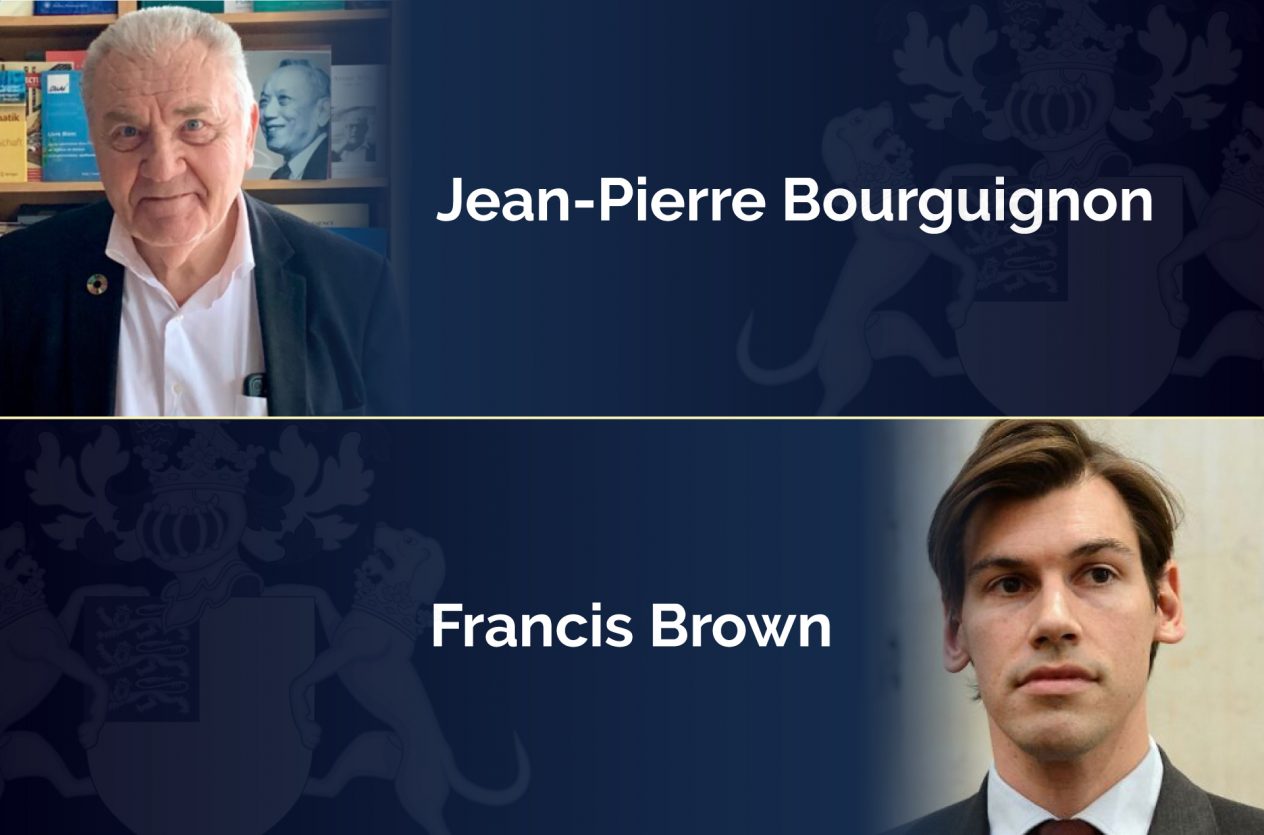
Conference in honor of Jean-Pierre Bourguignon

Dialogues autour de l’algèbre, la géométrie et les fonctions multizêtas

The aim of this workshop is to bring together mathematicians and computer scientists around some talks on recent results in statistics and machine learning. Various topics will be presented, among which network reconstruction, natural language processing, extreme events, topological data analysis, non parametric estimation for random walks in random environment and online learning.

Organised by : Sylvain ARLOT and Guillaume CHARPIAT

Invited speakers :

Alexandre Allauzen (Université Paris-Sud, LIMSI)
Frédéric Chazal (INRIA Saclay)
Isabelle Guyon (Université Paris-Sud, LRI)
Matthieu Lerasle (CNRS, LMO)
Vianney Perchet (CMLA)
Anne Sabourin (Télécom ParisTech)


Algebraic Analysis in honor of Masaki Kashiwara’s 70th birthday

MASAKI KASHIWARA and ALGEBRAIC ANALYSIS

The story starts in the sixties, when Mikio Sato introduces hyperfunctions by algebraic methods with the dream to treat classical problems of analysis with the tools of algebraic geometry, homological algebra and sheaves, what he called "Algebraic Analysis".

Read more on Giuseppe Dito's web page


List of speakers:

    Anton ALEKSEEV (Université de Genève)
    Philip BOALCH (Université Paris-Sud)
    Anna CADORET (Ecole Polytechnique)
    Giovanni FELDER (ETH Zürich)
    Julien GRIVAUX (Aix-Marseille Université, IHES)
    Stéphane GUILLERMOU (Université Grenoble Alpes)
    Mikhail KAPRANOV (IPMU, The University of Tokyo)
    Masaki KASHIWARA (RIMS, Kyoto University)
    Maxim KONTSEVICH (IHES)
    François LOESER (Université Paris 6)
    Takuro MOCHIZUKI (RIMS, Kyoto University)
    Motohico MULASE (UC Davis)
    Hiraku NAKAJIMA (RIMS, Kyoto University)
    Marco ROBALO (Université Paris 6)
    Raphaël ROUQUIER (UCLA)
    Takeshi SAITO (The University of Tokyo)
    David TREUMANN (Boston College)
    Michèle VERGNE (Université Paris 7)
    Gabriele VEZZOSI (Università di Firenze)
    Tony Yue YU (Université Paris-Sud)

Organising Committee:

     Giuseppe Dito  (Université de Bourgogne)
     Maxim Kontsevich  (IHES)
     Pierre Schapira  (Université Paris 6)


Algebra, Geometry and Physics: a conference in honour of Maxim Kontsevich

Holder of the AXA-IHÉS Chair of Mathematics

Certainly, geometry in the 21st century with physical application, will involve the study of new kinds of objects with categorical structures playing a primordial role.
Maxim Kontsevich has been a force of nature in creating these new categorical structures in the last 20 years.
The goal of this conference is to celebrate his contributions to Mathematics and Physics.
This meeting­ will contribute to disseminate results on­ a variety of subjects and will ­serve a perfect opportunity for young scientists to get involved in top research. ­

Invited speakers

Mohammed ABOUZAID (Columbia Univ., New York USA)
Denis AUROUX (U.C. Berkeley, USA)
Tom BRIDGELAND (Univ. of Sheffield, UK)
Alain CONNES (IHÉS-Collège de France, Paris, France)
Kevin COSTELLO (Northwestern Univ., Evanston, USA)
Emanuel DIACONESCU (Univ. of Alberta, Canada)
Simon DONALDSON (Simons Center for Geometry and Physics, Stony Brook, USA)
Alexander EFIMOV (Steklov Mathematical Institute, RAS, Moscow, Russia)
Yakov ELIASHBERG (Stanford Univ., USA)
Kenji FUKAYA (Simons Center for Geometry and Physics, Stony Brook, USA)
Alexander GONCHAROV (Yale Univ., New Haven, USA)
Sergei GUKOV (Caltech, Pasadena, USA)
Mikhail KAPRANOV (Kavli Institute for the Physics and Mathematics of the Universe (WPI), Tokyo)
Anton KAPUSTIN­  (Caltech, Pasadena, USA)
François LOESER (Univ. Pierre-et-Marie-Curie and IHÉS, France)
Yuri MANIN (MPIM ­Bonn, Germany)
Nikita NEKRASOV (Simons Center for Geometry and Physics, Stony Brook, USA)
Tony PANTEV (Univ. of Pennsylvania, Philadelphia, USA)
Graeme SEGAL (Univ. of Oxford, UK)
Paul SEIDEL  (MIT, Cambridge, USA)
Carlos SIMPSON (CNRS-Univ. de Nice, France)
Yan SOIBELMAN (Kansas State Univ., Manhattan, USA)
Richard THOMAS (Imperial College London, UK)
Bertrand TOËN (CNRS-Univ. de Montpellier 2, France)
Yuri TSCHINKEL (Courant Institute & Simons Foundation, New York, ­USA)
Claire VOISIN (CNRS-École Polytechnique, Palaiseau, France)
Thomas WILLWACHER (ETH Zürich, Switzerland)
Shing-Tung YAU (Chinese Univ. of  Hong Kong,  China and Harvard Univ., USA)
Don ZAGIER (Collège de France, Paris and MPIM Bonn, Germany)
Anton ZORICH (Univ. Paris-Diderot, France)


With the support of the Clay Mathematics Institute and the FMJH


Black Holes, Quantum Information, Entanglement and All That

Organisers: Thibault Damour (IHES), Vasily Pestun (IHES), Eliezer Rabinovici (IHES &  Hebrew Univ. of Jerusalem)

The special properties of Black Holes have intrigued researchers for decades. They do signal their existence in nature in several ways including by emitting gravitational waves while merging. Their way of handling information is more elusive. In this workshop we plan to discuss mostly several aspects of this information handling with some emphasis on possible relations it has to the theory of chaos, thermalization and quantum information.

Invited speakers:

     BARBON José (IFT-CSIC, Univ. Autonoma de Madrid)
     BENA Iosif (CEA Saclay)
     CRAPS Ben (Vrije Univ. Brussel)
     DE BOER Jan  (Univ. of Amsterdam)
     FERRARI Frank (Univ. Libre de Bruxelles)
     GIBBONS Gary  (DAMTP, Cambridge Univ.)
     GURAU Razvan (CPHT, Ecole polytechnique)
     KURCHAN Jorge (ENS, Paris)
     MALDACENA Juan (IAS, Princeton)
     PAGE Don N. (Univ. of Alberta, Canada)
     PAPADODIMAS Kyriakos (CERN, Genève)
     RIVASSEAU Vincent (Univ. Paris-Sud, Orsay)
     ROSENHAUS Vladimir (UC Santa Barbara)
     SHEPELYANSKY Dima  (Univ. Paul Sabatier, Toulouse)
     SOLODUKHIN Sergey (Univ. de Tours)
     VENEZIANO Gabriele (CERN, Genève)


Colloque de clôture du trimestre : le Monde Quantique

Si vous souhaitez vous inscrire pour le repas de midi, veuillez envoyer un mail à Elisabeth Jasserand : jasserand@ihes.fr

Workshop “Hamiltonian methods in strongly coupled Quantum Field Theory”

Many interesting strongly interacting Quantum Field Theories are not amenable to analytical treatment. This workshop will focus on systematic numerical approaches to such theories relying on the quantum Hamiltonian, including Truncated Spectrum Approach, Light Front Quantization, Matrix Product States and Tensor Networks. Such methods provide a viable alternative to Lattice Monte Carlo simulations. Their advantage is the ability to access real-time observables, and to study Renormalization Group flows originating from strongly-interacting fixed points.


Speakers and talks:

Mari Carmen BANULS (MPI Quantum Optics, Garching)
Tensor network applications to (1+1)d gauge theories

Giuseppe CARLEO (ETH Zurich)
Neural-network quantum states

Sophia CHABYSHEVA (University of Minnesota Duluth)
Application of Light-Front methods to model theories   

Philippe CORBOZ (University of Amsterdam)
Simulation of 2D strongly correlated systems with infinite projected entangled-pair states

Joan ELIAS-MIRÓ  (SISSA, Trieste)
Precise calculations with the Renormalized Hamiltonian Truncation approach

Brian HENNING (Yale University)
Free field states and conformal bases

John HILLER (University of Minnesota Duluth)
Nonperturbative light-front methods

Andrew JAMES (University College London)
Truncated spectrum approaches for 2D many-body quantum systems

Andreas LÄUCHLI (University of Innsbruck)
Numerical Hamiltonian truncation approach to the phi^4 theory in 1+1d and beyond

Giuseppe MUSSARDO (SISSA, Trieste) 
Sinh-Gordon model and its duality

Didier POILBLANC (CNRS Toulouse)
Investigation of the chiral antiferromagnetic Heisenberg model using PEPS

Frank POLLMANN (TUM Munich)
Finding purifications with minimal entanglement

Neil ROBINSON (University of Amsterdam)
Rare non-thermal states in the non-integrable Ising field theory

Marco SERONE (SISSA, Trieste)
A look at phi^4_2 using perturbation theory

Gábor TAKÁCS (Budapest University of Technology and Economics)
Applications of TCSA to quenches

Guifré VIDAL (Perimeter Institute, Waterloo)
Conformal data from critical spin chains using periodic MPS and the Koo-Saleur formula

Karel VAN ACOLEYEN (University of Gent)
Tensor networks and the Schwinger model

Matthew WALTERS (CERN) 
Studying RG Flows with Lightcone Conformal Truncation

Program:

 
Mon Jan 8
Tue Jan 9
Wed Jan 10
Thu Jan 11
Fri Jan 12

9:30-11:00
morning coffee and
registration
morning coffee
morning coffee
morning coffee
morning coffee

 
TCSA session 1

MPS for gauge theories

 
lightfront day
TCSA session 2

10:00-11:00
Takacs
Van Acoleyen
Serone
Hiller
James

11:00-11:30
coffee break
coffee break
coffee break
coffee break
coffee break

11:30-12:30
Mussardo
Banuls
Vidal
Chabysheva
Robinson

12:30-14:30
lunch buffet
lunch buffet
lunch buffet
lunch buffet
lunch buffet


(phi^4)_2 session
PEPS session


14:30-15:30
Carleo
Elias-Miro
Corboz
Walters
 

15:30-16:30
coffee break
coffee break
coffee break
coffee break
free afternoon

16:30-17:30
Pollmann
Läuchli
Poilblanc
Henning


17:30 cocktail party


The talks have been recorded and are available at:

 Organisers:

   Ami KATZ (Boston University)
   Robert KONIK (Brookhaven National Laboratory)
   Slava RYCHKOV (IHES and ENS)
   Balt VAN REES (Durham University)

Supported by: the Simons Collaboration on the Non-perturbative Bootstrap http://bootstrapcollaboration.com/

Quantum Gravity: Physics and Philosophy » ERC Project Philosophy of Canonical Quantum Gravity

"Quantum Gravity: Physics and Philosophy"
ERC Project Philosophy of Canonical Quantum Gravity


List of speakers includes:

Costas BACHAS (Department of Physics, Ecole Normale Supérieure)
Michel BITBOL (Archives Husserl, CNRS)
Steven CARLIP (Department of Physics, University of California Davis)
Alain CONNES (IHES)
Erik CURIEL (Munich Center for Mathematical Philosophy)
Dennis DIEKS (University of Utrecht)
Yuval DOLEV (Department of Philosophy, Bar-Ilan University)
Sebastian de HARO (University of Amsterdam)
Gary HOROWITZ (Department of Physics, University of California Santa Barbara)
Theodore JACOBSON (Department of Physics, University of Maryland)
Claus KIEFER (Institut of Theoretical Physics, University of Cologne)
Carlo ROVELLI (Center of Theoretical Physics, Luminy)
Gabriele VENEZIANO (Theoretical Physics Department, CERN)
Tiziana VISTARINI (Department of Philosophy, University of Colorado Boulder)


Organising Committee:

Gabriel CATREN (CNRS, Laboratoire SPHERE)
Thibault DAMOUR (IHES)
Elie DURING (Université Paris Nanterre, Laboratoire IRePh)
Federico ZALAMEA (CNRS, Laboratoire SPHERE)