
Exact solutions in multidimensional gravitational models with fields of forms
Events from Indico
« Return of the IHÉS Postdoc Seminar »
Abstract: In this talk, I will talk about the motivic McKay correspondence studied by Batyrev and Denef-Loeser and its generalization to positive and mixed characteristics by myself partly in collaboration with M.M. Wood. The latter relates stringy invariants of singularities to weighted counts of Galois extensions of a local field.
For a finite dimensional linear representation of a finite group, the motivic McKay correspondence says that the motivic stringy invariant of the associated quotient variety is equal to a finite sum of classes of affine spaces in a certain modification of the Grothendieck ring of varieties.
In order to understand wild quotient singularities, which are known to be typical “bad” singularities in positive/mixed characteristics, I started an attempt to generalize the motivic McKay correspondence to positive and mixed characteristics and formulated a conjectural generalization. Here, the finite sum of classes of affine varieties is replaced with a motivic integral over the (conjectural) moduli space of G-covers of formal discs. When the base field (or the residue field if working over a complete DVR) is finite, then the point counting realization of this motivic integral is a weighted count of Galois extensions of the power series field (or the fraction field of the DVR). Such counts were previously studied by number-theorists including Krasner, Serre, Bhargava, Kedlaya and Wood. The point counting version of the McKay correspondence was recently proved by myself. A part of my motivation of this work is a search for a counterexample of resolution of singularities, which has not been successful till now.
If time allows, I will also explain that from this result and a heuristic argument, one can relate Malle’s conjecture on distribution of Galois extensions of number fields and Manin’s conjecture on distribution of rational points on Fano varieties.
« Return of the IHÉS Postdoc Seminar »
Abstract: In this talk, we will recall the theory of generalized HKR isomorphisms, due to Arinkin and Cāldāraru. Then we will explain how deformation theory allows us to describe arbitrary first order derived intersections.
We establish connections between two objects, naturally arising in the theory of the Kadomtsev-Petviashvily equation: totally positive Grassmannians and rational degenerations of the M-curves (Riemann surfaces with an anitiholomorphic involutuin and the maximal possible number of real ovals) with a collection of marked points. More precisely, we show that, at least all points from the principal cell of the Grassmannian can be obtained from degenerate M-curves. (Joint work with Simonetta Abenda (Universita degli Studi di Bologna).)
I will discuss the use of semi-classics and instanton calculus and argue that, contrary to common wisdom, complex solutions of the equations of motion are a necessary ingredient of semi-classical expansion. In particular, I will show that without the complex solutions semi-classical expansion of supersymmetric theories cannot be reconciled with the constraints of supersymmetry. This has a natural interpretation in the Picard-Lefschetz theory.
We consider measurements performed on quantum systems. When the measurement outcomes are lost or ignored, decoherence in the system is unavoidable. When it is taken into account, the system purifies until the information flow is blocked by "darkness".
In the spirit of 4/1 I will confront old and recent speculations in quantum biology and cognitive philosophy with experiments, mostly from neurobiology.
The linear Schrödinger equation does not predict the uniqueness of measurement results; it does not predict that macroscopic bodies should be located at one place in space only. This is the origin of the so called measurement problem, Schrödinger cat paradox, etc. Theories such as GRW (Ghirardi-Rimini-Weber) and CSL (Continuous spontaneous localization) theories solve the problem by adding stochastic terms to the Schrödinger equation. In this talk we will propose another approach to reach the same unified dynamics, but without requiring the introduction of stochastic Wiener processes acting in all space. The method combines ideas of the dBB (de Broglie Bohm) interpretation and of CSL. It introduces an attraction between the space density of Bohmian position and the space density operators, with a deterministic dynamics; randomness arises only from the initial random positions of the Bohmian positions. Various microscopic or macroscopic consequences of this dynamics will be discussed.
It is well known that ideal projective measurements are paradigmatic non-deterministic and irreversible processes in Quantum Mechanics. Nevertheless it is also known that the associated probabilities satisfy a time-symmetry property: the conditional probabilities for prediction and retrodiction take the same form. I shall argue that this feature of Quantum Mechanics may be used to discuss it in a more natural way and to present it as a less mysterious theory than is usually done. This will be shown for the Algebraic Formulation and the Quantum Logic Formulation. If time permits, I shall ask some naïve questions about the Quantum Information Formulations and Quantum Gravity.
Biological soft tissues can suffer for very large size and shape changes during their motion, and the ability to quantify and compare the movements of organisms is a central focus of many studies in biology: our goal is to compare the motion of a same organ from different individuals, as example, the motion of the beating heart from different humans.
Geometric Morphometrics began with the seminal contributions of D.G. Kendall, gathered in the book Shape and Shape Theory (1999) where it has been proposed to sample the configuration of a body through the m coordinates of k landmarks; thus a configuration is represented with a point in an m x k space, called the Configuration Space.
Then, to effectively represent a shape, it must be defined a quotient of the Configuration Space with respect to a Lie Group of transformations, a group that is selected according to specific needs.
Here, we discuss different possible choices of quotient spaces and their implications: dealing with soft tissues the differences between individuals can be very large, and thus the crucial point for quantifying differences in the motion is to filter inter-individual shape differences.
We proposed to solve this problem by performing a data centering in the so-called Size-and-Shape Space, by means of the Riemannian parallel transport. Theoretical considerations, together with analysis on real heart data from human left ventricle suggest that when configurations differ for small Procrustes Distances, the parallel transport can be well approximated by a Euclidean translation, after a hierarchical alignment.
Plus d’informations sur : http://www.proba.jussieu.fr/pageperso/anr-graal/
Et aussi

Du 15 au 18 septembre prochain, Piljin Yi (KIAS), Sangmin Lee (KIAS), Sungjay Lee (KIAS), Ruben Minasian (IPhT, CEA Saclay), Julio Parra Martinez (IHES) et Eric Perlmutter (IPhT, CEA Saclay) organiseront un workshop franco-coréen axé autour de la théorie des cordes.
En savoir plus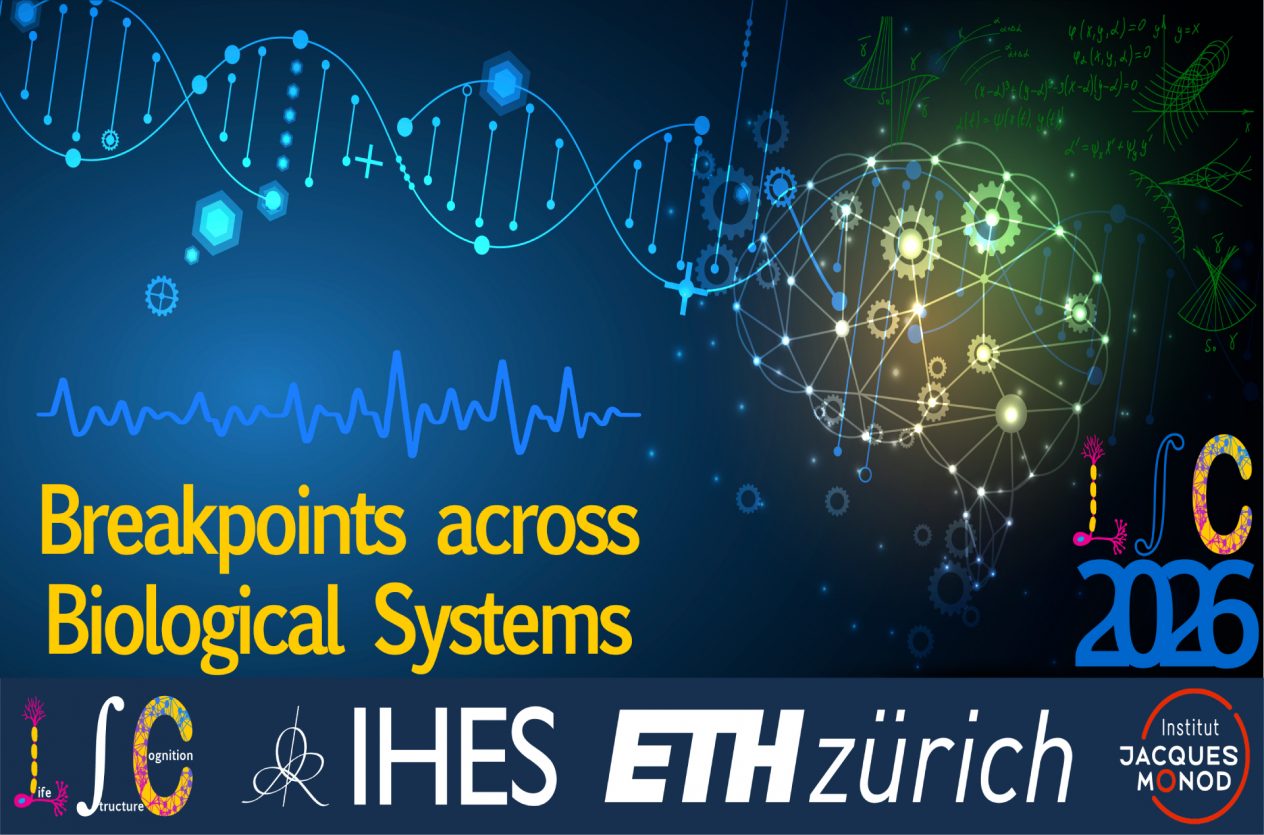
LSC, pour Life, Structure, and Cognition (Vie, Structure et Cognition), a pour objectif de s’informer sur les avancées entre la biologie et l’intelligence artificielle. Rendez-vous du 22 au 25 juin pour la quatrième édition LSC 2026.
En savoir plus
L'IHES est fier d'annoncer que Jean-Pierre Bourguignon, ancien directeur de l'IHES, et Francis Brown, ancien chercheur CNRS à l'IHES, ont été élus Fellows de la Royal Society.
En savoir plus