 IHES
IHES
Claudia Rella awarded the 2026 L’Oréal-UNESCO For Women in Science France Prize
IHES postdoctoral researcher Claudia Rella is one of the 35 laureates of the 20th edition of the prize, joining a community of more than 5,000 women scientists from over 140 countries.
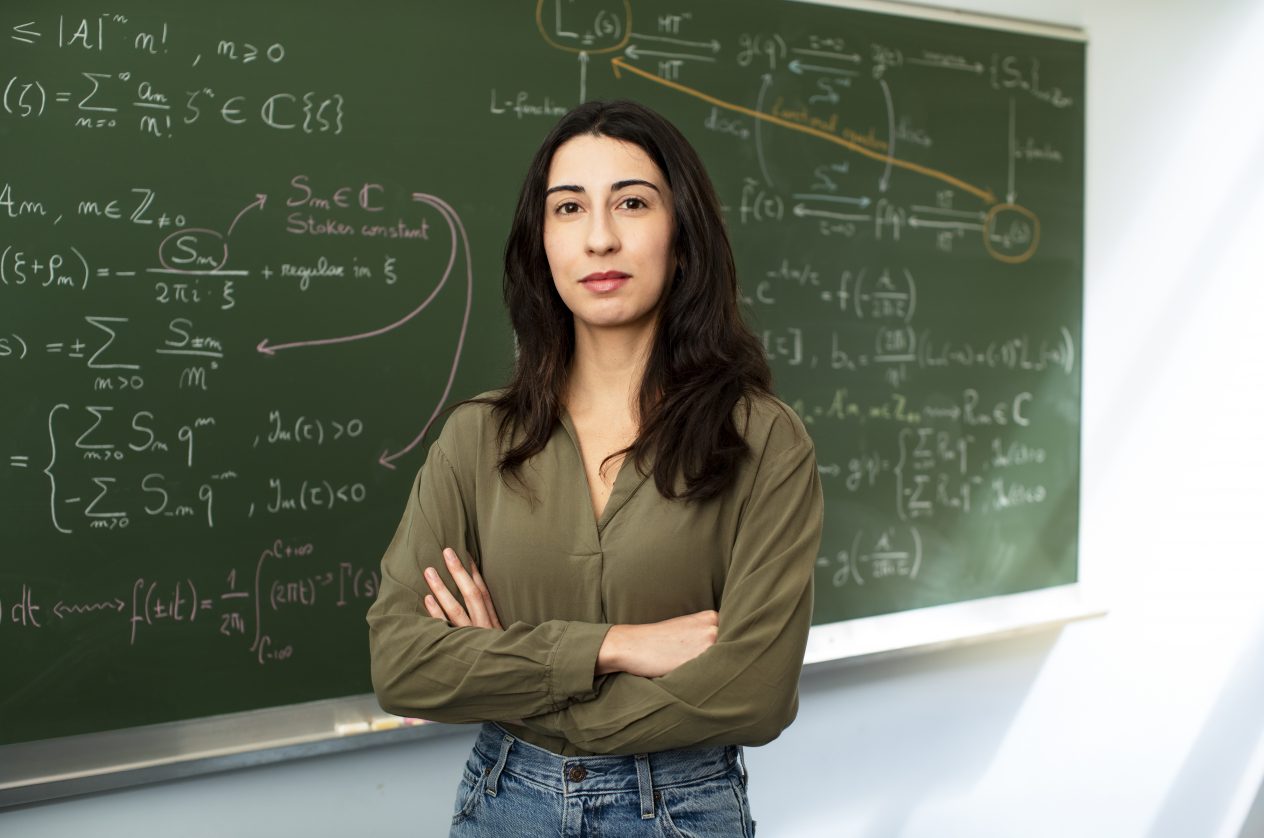
On 6 October 2026, the L’Oréal Foundation, in partnership with the French Académie des sciences and the French National Commission for UNESCO, announced the laureates of the 2026 L’Oréal-UNESCO For Women in Science France Awards. Among the 35 PhD students and postdoctoral researchers honoured, selected from over 800 applications by a jury of more than 50 members of the Académie des sciences, is Claudia Rella, postdoctoral researcher at IHES (a founding member of Université Paris-Saclay) and affiliated with the Laboratoire Alexander Grothendieck (LAG, UMR 9009 CNRS-IHES, CNRS Mathematics – INSMI). She is recognised in the category “Understanding the laws of the Universe” for her work bringing mathematics and physics into dialogue to unlock the laws of the infinitely small.
A worldwide community
The prize is part of the L’Oréal-UNESCO For Women in Science programme, created in 1998, which runs national and regional programmes in 140 countries. Claudia Rella now joins a community of more than 5,000 women scientists from over 140 countries, a network that fosters collaboration, inspiration and support in the face of the obstacles encountered during a career. This edition alone received 823 applications from 73 nationalities.
“This award has many facets for me,” she says. “It means joining a community promoting both scientific excellence and gender equality in shaping the future of science. It means recognition and visibility for the work I have done at a pivotal moment in my career.” Practically, “the funds will finance international research visits.”
Research at the heart of resurgence
Sometimes, in mathematics and theoretical physics, a problem is too hard to be solved exactly with current techniques. One can, however, produce an approximate solution by constructing it term by term in an infinite power series expansion in some small parameter. Such a series often diverges, meaning that its terms eventually grow too fast for the sum to settle to a finite value. Yet, Claudia explains, these infinities “aren’t shapeless alarm signals that something went wrong; instead, they encode a wealth of information about the exact solution to the problem.” Decoding this information from the behaviour of the series’ coefficients is the aim of the theory of resurgence.
Claudia exploits resurgence to explore hidden features of non-perturbative phenomena in quantum physics and mathematics. In the examples she studies, the numbers appearing in the resurgent analysis of the divergent series satisfy striking arithmetic properties and transformation laws, revealing symmetries that connect quantum physics to mathematical structures studied in number theory, geometry, and topology.
A collaboration born at IHES
During her doctoral studies, Claudia discovered a remarkable number-theoretic duality relating the resurgent properties at weak and strong coupling of certain quantum operators appearing in topological string theory. She visited IHES for the first time in spring 2023, after being invited to give a seminar on that discovery. That visit turned out to be the beginning of a long-term research collaboration with mathematician Veronica Fantini. Together they initiated and pursued the development of the framework of modular resurgence, linking non-perturbative phenomena, arithmetic structures and quantum modular symmetries. “As it happens, the more we progress, the more questions arise,” she says.
“Extraordinary freedom”
At IHES, a founding member of Université Paris-Saclay, Claudia says she has “extraordinary freedom to pursue my research ideas in a quiet yet stimulating environment”, with “some of the world’s leading experts in my field” a few steps away. Her days are punctuated by communal lunch at the institute’s cafeteria, the four o’clock tea ritual, and discussions in front of one of the many blackboards scattered throughout the institute.
A field that is still predominantly male
Claudia notes that mathematical physics is still a predominantly male field: “It takes only one look at the list of speakers of a typical conference to realise this fact.” Throughout her training, however, she encountered women scientists as mentors, collaborators and colleagues, which is why she strongly believes in the mission of the programme. “To a teenage girl who loves maths but thinks it isn’t for her, she would say that ‘prejudices aren’t limits’ and that ‘you will only ever know by trying.’”
Looking five years ahead, she sees herself “working at the forefront of an expanding domain of research and being part of a community that keeps striving to be more open and more representative.”
About the prize
Created in 2007, the L’Oréal-UNESCO For Women in Science France Awards recognise outstanding PhD students and postdoctoral researchers each year. The awards ceremony takes place on 7 October at the Académie des sciences in Paris. Laureates receive a grant and a leadership training programme.
Everyone at IHES warmly congratulates Claudia Rella.