 IHES
My work with Christophe Soulé
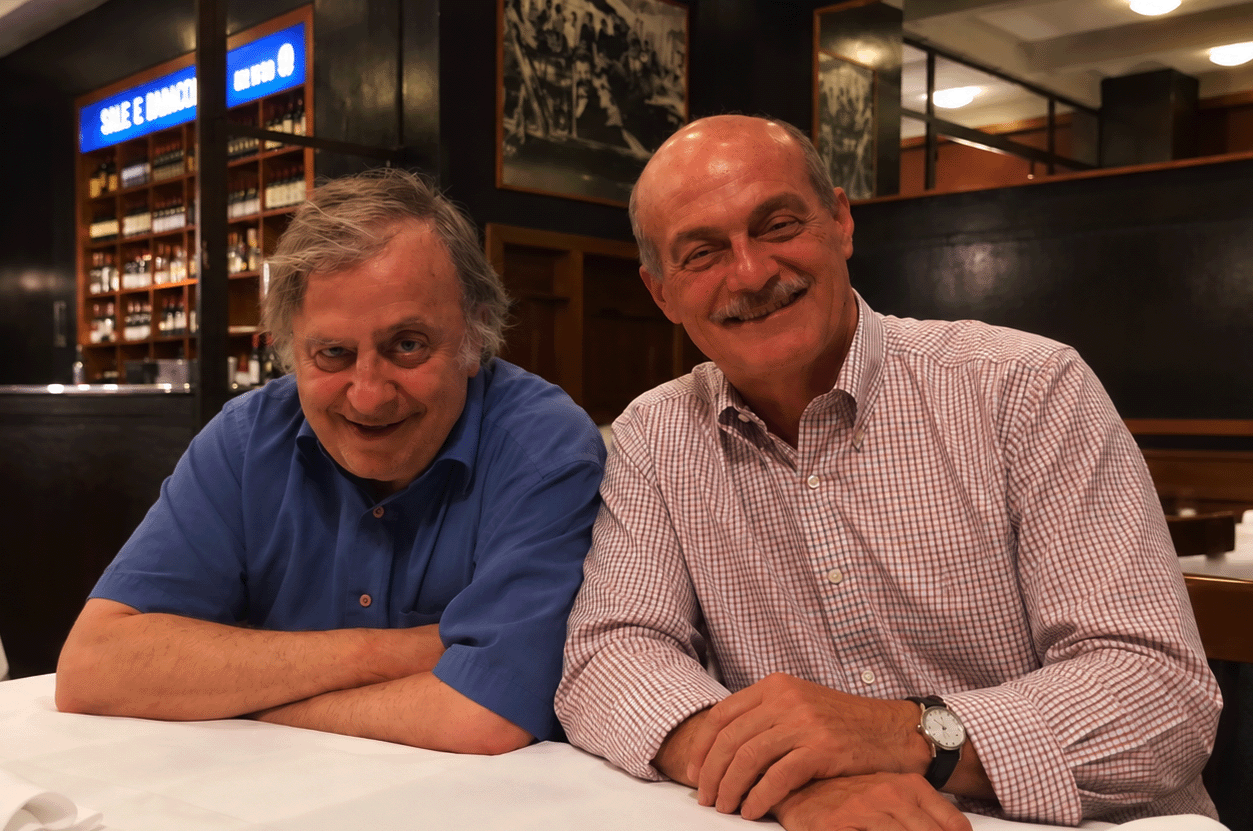
The picture above shows Christophe Soulé and Henri Gillet.
It is very difficult for me to remember exactly when I first met Christophe Soulé. I remember this was after my work on the local version of the Atiyah–Singer theorem for families, using Quillen’s superconnections. Together with Freed, we had constructed a natural metric and connection on the determinant line bundle of a family of Dirac operators, and had established a local formula for the curvature of this connection. We had proved a conjecture of Witten concerning the holonomy of the conjectural “natural” connection on the determinant line bundle of a family of Dirac operators. These results were obtained by developing a secondary version of the local family index theorem. In these questions, the geometric data consisted of a metric on the relative tangent bundle of a fibration and a horizontal distribution. The mental picture I had developed for these questions was connected to the equivariant cohomology of loop space, based on an observation by Witten and Atiyah. I had devised a dictionary that enabled me to answer any question of this kind immediately.
In a holomorphic setting, the metric determines the Chern connection. It was therefore fairly clear that any question involving holomorphicity could not be an immediate consequence of my results with Freed. Moreover, Quillen had introduced what are now known as Quillen metrics on the determinant of the cohomology of a family of $\bar{\partial}$-operators, where the family was defined over a fixed Riemann surface. He had proved a curvature theorem for the Chern connection associated with his metric.
Almost immediately upon meeting Christophe, our discussions turned to the holomorphic version of my result with Freed and to Quillen’s result: was there a direct connection between the two curvature theorems? As soon as we began discussing these questions, our conversations were disrupted by supposed “results” claiming to apply the results obtained with Freed to the holomorphic setting. These results were false, yet they were spreading rapidly, and continue to circulate to this day. Christophe and I were fully aware of the absurdity of all this. We therefore decided to pay no attention to this background noise and set to work.
Christophe immediately informed me that any discussion with him had to be understood as also involving his collaborator Henri Gillet (whom I did not know!), with whom he formed an inseparable unit. I readily accepted this rather unusual arithmetic: what was at stake was well worth it. Our collaboration quickly took on a frenetic pace. In particular, we needed to verify that the constructions I had developed in a $C^\infty$ framework were compatible (in a sense yet to be determined) with holomorphicity. Armed with my dictionary, I found it relatively easy to verify that this was indeed the case. But everything still remained to be done: the $C^\infty$ formalism of my work with Freed had to be made holomorphic. We learned to incorporate the machinery of Gillet and Soulé’s Hermitian K-theory, which proved wonderfully suited to what we were trying to achieve, particularly through the introduction of Bott–Chern cohomology. My collaboration with Christophe was one of the most stimulating and happiest periods of my mathematical life.
Christophe was nevertheless worried, and he had his reasons. I fear I may also have caused him some concern. These worries quickly faded, however, as each step forward raised new questions, and we scarcely had time to argue. Integrating Quillen’s superconnections into Gillet and Soulé’s Grothendieck-style direct image formalism was another extraordinary stage of our work. Quillen’s Gaussian formalism (which was a godsend for me!) proved remarkably well suited to resolving the questions of local analysis that arose in this context. Deformation to the normal cone provided another, parallel avenue of exploration.
All of this was exhausting, and we eventually collapsed—not quite at the same time, but almost.
I shall end my recollections here. I do believe, however, that it may have been worth reminding readers that mathematics could represent a kind of enchanted island for those who practiced it, long before the intolerable vulgarity introduced by artificial intelligence.
Jean-Michel Bismut
Professor of Mathematics Emeritus at the Institut de Mathématique d’Orsay, Université Paris-Saclay