 IHES
Danylo Radchenko and Campbell Wheeler Make a Breakthrough on Hilbert’s 12th Problem
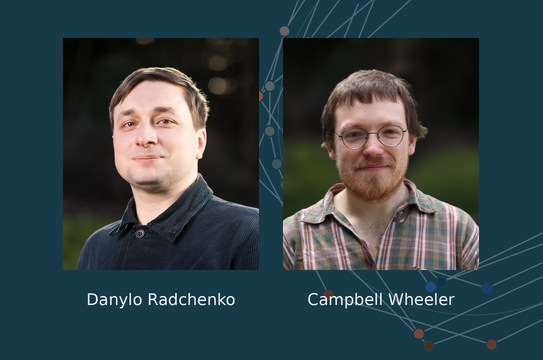
Danylo Radchenko, CNRS researcher at IHES, and Campbell Wheeler, a postdoctoral fellow at IHES, have just taken a decisive step on a problem in algebraic number theory related to Hilbert’s 12th problem. “It took more than 100 years to reach this new milestone,” says Campbell Wheeler. In their paper Real quadratic fields and finite quantum dilogarithms I, the two mathematicians prove that Stark units are algebraic numbers, that is, that they are solutions of polynomial equations with rational coefficients.
The central objects of algebraic number theory are fields: sets of numbers in which addition, subtraction, multiplication and division make sense. This means that, excluding division by $0$, these four elementary operations can be applied to the elements of the field, and the results always remain in the field. For example, the rational numbers form a field, denoted $\mathbb{Q}$.
A field can be extended to a larger field by adding elements to it. Mathematicians call this a field extension. For example, the equation $X^2-2=0$ has no solution among the rationals, its solutions being $\sqrt{2}$ and $-\sqrt{2}$. But one can build an extension of the field of rationals that contains these two elements: the resulting field is the set of numbers of the form $a+\sqrt{2}\,b$, where $a$ and $b$ are rational numbers. It is denoted $\mathbb{Q}(\sqrt{2})$.
“The big question in this area is to describe all the extensions of a given field. But we don’t know how to do that. A simpler case that we can study instead is abelian extensions,” says Don Zagier, former director of the Max Planck Institute for Mathematics and former doctoral advisor of Danylo Radchenko and Campbell Wheeler.
Some numbers are favoured for building extensions: most of the time, mathematicians are interested in algebraic numbers, such as $\sqrt{2}$. “There is a lot of interesting mathematics involving algebraic numbers, which is why they are central. But these numbers are not enough to describe the world,” stresses Danylo Radchenko. Indeed, some numbers are not solutions of any polynomial equation with rational coefficients, such as $\pi$ or $e$ (the value of the exponential function at $1$). They are called “transcendental”.
Although set aside by algebraic number theory, transcendental numbers sometimes find their way back into it. Mathematicians have known this since the work of Leonhard Euler in the 18th century and one of the most famous identities in mathematics: $e^{2i\pi}=1$. While the exponential function takes transcendental values most of the time, it equals $1$ when evaluated at $2i\pi$.
This property means that $e^{2i\pi/3}$ is a solution of $X^3-1=0$, and more generally that the exponential function can be used to construct algebraic numbers: the solutions of the equation $X^n-1=0$. This might have been merely a pretty property, but these solutions (called “roots of unity”) make it possible to describe all the abelian extensions of the field of rationals. Thus, the transcendental exponential function describes these extensions. This is what the mathematicians Leopold Kronecker and Heinrich Weber proved in the 19th century.
“One may wonder whether the exponential function is the only one with this property, or whether the story continues with another transcendental function,” says Danylo Radchenko. Beyond the rationals, what about other fields: can their abelian extensions be described using other transcendental functions? This question lies at the heart of the 12th of the problems listed by David Hilbert at the beginning of the 20th century.
As it turns out, the exponential function is not the only one with this remarkable property. Towards the end of the 19th century, mathematicians discovered the so-called theory of “complex multiplication”. It shows that certain functions, called modular functions, evaluated at points of an imaginary quadratic field $\mathbb{Q}(\sqrt{-n})$, take algebraic values lying in an abelian extension of that field. In other words, these transcendental functions generate the abelian extensions of imaginary quadratic fields, just as the exponential function generates those of the field of rationals. “There was no reason to think it would not go beyond these two functions,” argues Danylo Radchenko.
After that, “the most accessible case is real quadratic fields,” explains Campbell Wheeler, that is, the extensions of $\mathbb{Q}(\sqrt{n})$. This work began in the 1970s with Harold Stark and Takuro Shintani, who studied transcendental functions called “$L$-functions” (generalisations of the Riemann zeta function). “They noticed that these functions could be used to construct certain extensions,” recalls Danylo Radchenko.
This is how they came across Stark units: numbers obtained from these highly transcendental functions, which nevertheless appear to be algebraic. “Appear” only, because these objects are complicated: “you have to do a lot of work to compute them,” explains Campbell Wheeler. Harold Stark was among those who undertook this work: as far as computer precision allows, these numbers do indeed appear to be algebraic and to lie in the desired extension. “But that doesn’t tell you why they are algebraic,” notes Danylo Radchenko. This still had to be proved.
Drawing in particular on the work of Ludvig Faddeev, Stavros Garoufalidis, Rinat Kashaev and Don Zagier, Danylo Radchenko and Campbell Wheeler were able to rewrite these Stark units in a different way, using the quantum dilogarithm, a function originating in physics that extends the properties of the logarithm, which turns a product into a sum ($\log(ab)=\log(a)+\log(b)$).
“Danylo Radchenko and Campbell Wheeler managed to combine the work of several people in a very beautiful way. Nobody had thought of it. I was overwhelmed when Danylo told me about it,” says Don Zagier. Using the properties of the quantum dilogarithm, the two mathematicians construct a system of many equations. “One surprising thing is that the equations are simple,” says Campbell Wheeler. This finally allowed them to prove that Stark units are solutions of these equations, and are therefore algebraic. This opens the way to resolving a new case of Hilbert’s 12th problem and fulfils, in another case, Leopold Kronecker’s “Jugendtraum” (“dream of youth”). Kronecker had hoped that it would be possible to construct all the abelian extensions of imaginary quadratic fields using transcendental functions. Mathematicians now know that this is also possible for the abelian extensions of real quadratic fields.
Danylo Radchenko and Campbell Wheeler are not done with this question yet. They now plan to explain how they came up with their strategy, and perhaps to explore it further: “What we can ask now is how far these ideas can be pushed to explore other extensions. Perhaps, step by step, we will find a way to attack Hilbert’s problem in general,” says Campbell Wheeler.
Their preprint “Real quadratic fields and finite quantum dilogarithms I” can be found here.
—
This article was written by science journalist Charlotte Mauger.