New International Mathematics Journal

Ahmed Abbes is co-editor-in-chief of a new international mathematics journal with a very high-level board of editors.

Ahmed Abbes, CNRS Research Director at the ERL Alexandre Grothedieck of IHES, is co-editor-in-chief of a new international mathematics journal with a very high-level board of editors.

The Tunisian Journal of Mathematics (TJM) is an international publication organized by the Tunisian Mathematical Society and published in electronic and print formats by MSP in Berkeley. It publishes research articles in all areas of mathematics. These will be selected by a distinguished, international board of editors based on outstanding quality and interest, and according to the highest international standards.

The purpose of TJM is the advancement of mathematics. Editors evaluate submitted papers strictly on the basis of scientific merit. All articles submitted to this journal are peer-reviewed. The TJM uses a single blind peer-review process which means that the reviewers know who the authors of the manuscript are, but the authors do not know who the peer reviewers are.

The African continent is increasingly interested in scientific development, particularly in mathematics. The Tunisian Mathematical Society was founded in 1992 and is a permanent institutional member of the International Mathematical Union. It plays a major role in stimulating and sustaining high level mathematical research in Tunisia and its surrounding region. With the launch of this journal, the Tunisian Mathematical Society contributes to the development in Africa of scientific research meeting high international standards.

The TJM editorial board invites mathematicians from all over the world to take part in this stimulating project by submitting high-level research articles.

The IHES extends his wishes of success to the Tunisian Journal of Mathematics.

Œuvres mathématiques, Volume 1 by René Thom published by the French Mathematical Society

The French Mathematical Society just published the first volume of René Thom’s complete mathematical works as part of the series Documents mathématiques. This volume contains the articles that were published before 1960.

The French Mathematical Society, Société Mathématique de France, just published the first volume of René Thom’s complete mathematical works, titled Œuvres mathématiques complètes, as part of the series Documents mathématiques. This volume contains the articles that were published before 1960.

René Thom writes his thesis under the supervision of Henri Cartan, who at the beginning of the 1950s is surrounded by a small group of brilliant mathematicians that gather around him. When Cartan moves to Strasbourg, René Thom follows him as a young CNRS researcher. In Strasbourg he also meets Charles Ehresmann. It is on contact with these two mentors that René Thom develops his interest for algebraic and differential topology which leads him to be awarded the Fields Medal in 1958 for having “invented and developed the cobordism theory in algebraic topology”.

The articles that René Thom writes during this period are collected in this volume gathering his mathematical work until 1960. His published articles appear here together with previously unpublished texts and comments that help contextualize them.

Later on, René Thom’s interest moved to the study of singularities – in this volume you’ll find his foundational articles – which during the 1960s will give birth to the theory of catastrophes.René Thom is recruited at IHES by Léon Motchane and he arrives at the Institute in 1963 (after Jean Dieudonné and Alexander Grothendieck). He will keep on working at IHES until the end of his career.

The idea of publishing René Thom’s complete mathematical works came in 2011 from André Haefliger. IHES provided several preprints and contributed to the preparation of the René Thom’s complete bibliography, which are included in this volume.

For more information, visit the French Mathematical Society’s webpage.

Some of Grothendieck’s archives published online by the University of Montpellier

The archives consist of some of Alexandre Grothendieck's handwritten and typed notes as well as of some of his letters. It contains his works for the period 1949 - 1991 and some sor far unpublished manuscripts.

Alexandre Grothendieck is considered one of the greatest mathematicians of the 20th century. He revolutionised the foundations and the mathods of algebraic geometry. A Fields medal winner in 1966, he was a permanent professor at IHES from 1959 to 1970, and in 1973 he joined the University of Montpellier. The latter just published an important fraction of the Grothendieck’s archives, 18000 pages out of 28000.

The archives consist of some of Alexandre Grothendieck’s handwritten and typed notes, as well as of some of his letters. It contains his works for the period 1949 – 1991 and some so far unpublished manuscripts.

Alexandre Grothendieck himself gave the documents to Jean Malgoire, one of his former students working as a researcher and professor at the University of Montpellier, in two times: once in 1990 and once in 1995. Jean Malgoire kept Grothedieck’s archives until 2010, when he gave them to the University of Montpellier, which took charge of their digitalisation and online publication.

You can find them at the following address: grothendieck.umontpellier.fr.

Renowned French scientist Cécile De Witt dies at 94

All employees join the Institute’s scientists to express their heartfelt condolences to Cécile's family.

It is with great sadness that IHES learnt of the death of Cécile DeWitt-Morette, Jane and Roland Blumberg Centennial Professor in Physics at the University of Texas – Austin, occurred on 8 May 2017.  A renowned French scientist, she worked at the frontiers of mathematics and physics. Although she decided to lead her career in the United States, she was dedicated to the French scientific community. In 1951 she founded the Les Houches Physics School, which soon became an internationally renowned meeting place for physicists, bringing together experienced as well as young researchers. She run the school for over 20 years and she was still very involved in it during her later years.

Cécile DeWitt-Morette played a crucial part in the founding of IHES by liaising Léon Motchane and Robert Oppenheimer, then director of the Institute for Advanced Study, Princeton. Since the early years, Cécile would always defend IHES, notably by being member of the Board of Directors and by faithfully participating to the Board meetings from 1996 to 2014.

In addition to her international scientific stature she was a woman who inspired respect and admiration for her strength of character and determination, but who, when visiting IHES, was equally concerned about each one at the Institute and discussed with everyone humbly and amiably. All employees join the Institute’s scientists to express their heartfelt condolences to Cécile DeWitt-Morette’s family.

More information can be found on the website of the University of Texas – Austin.

“Quels lieux pour quelles mathématiques?”

Anne-Sandrine Paumier will discuss the reasons that lead Léon Motchane to choose the Bois-Marie for his IHES.

The association Les Amis de l’IHES organises a new cultural event that will take place at the Institute on Thursday, May 4th.

The evening will start at 5pm with a general interest conference given by Anne-Sandrine Paumier, a post-doc at IHES who studies the history of mathematical sciences, particularly at the Institute. On this occasion, Anne-Sandrine will talk about the different aspects that lead Léon Motchane, the founder of IHES, to choose the Bois-Marie as the ideal place for the temple of mathematics that IHES has been since its very foundation. The conference will be in French.

A piano interlude will follow, when Paloma Kuider will play W. Byrd, L. V. Beethoven, F. Chopin and L. Janacek.

Refreshments will be offered to the participants at the end.

To register, please contact Ingrid Peeters (peeters@ihes.fr) before April 30th and specify the number of people you will come with.

Le Mystère du Monde Quantique awarded the 2017 FNAC Comics Prize in Belgium

The prize was announced on Friday 10 March during the Brussels Book Festival.

Le Mystère du Monde Quantique, the comic book written by Thibault Damour in collaboration with the comics artist Mathieu Burniat, obtained the 2017 FNAC Comics Prize in Belgium. The winners, that are chosen every year by readers and by FNAC booksellers, were announced on Friday 10 March, on the occasion of the Brussels Book Festival.

This prize recognizes the success of this comic book summarizing the discoveries that lead to the foundation of quantum physics, and exploring the ways in which they affect our view of the world.

Le Mystère du Monde Quantique tells the story of Bob and his dog Rick who meet the early protagonists of quantum theory. During their journey they will slowly need to change their understanding of how reality works – as readers we share their struggle with the counterintuitive nature of quantum physics.

So far 35000 copies of The Mydtère du Monde Quantique have already been sold in France, 4000 in Belgium, 1000 in Switzerland and 1000 in Canada.

Grothendieck on France Culture (FRENCH ONLY)

Portrait d'un génie des mathématiques par Pierre Cartier (ENS), Anne Sandrine Paumier (IHES) et Claude Viterbo (ENS), dans la Méthode Scientifique de Nicolas Martin.

Portrait d’un génie des mathématiques par Pierre Cartier (ENS), Anne Sandrine Paumier (IHES) et Claude Viterbo (ENS), dans la Méthode Scientifique de Nicolas Martin.
À réécouter ici

Interview with Philibert Nang

Philibert Nang, mathematician and professor at Ecole Normale Supérieure in Libreville, Gabon, helps us understand the importance of international visiting programs such as the one at IHES.

The tasks of developing international exchanges, promoting spontaneous meetings among scientists and ensuring freedom of research in mathematics and physics are at the heart of the IHES mission. In order to fulfill them it is fundamental to allow researchers to freely come and go between institutions and to thus spread knowledge.

Over the years, IHES has engaged in a fruitful co-operation with mathematicians from Africa. Thanks to the generous gifts of the Schlumberger Foundation, between 2004 and 2009, and of the Lounsbery Foundation, between 2013 and 2015, the Institute has created a steady stream of African visitors coming to IHES for their research visits.

Specific support for this activity ended in 2015. IHES continues to invite African scientists, but not longer within this privileged framework that allowed African visitors to have their often hard to afford travelling expenses refunded. An interview with Philibert Nang, mathematician and professor at Ecole Normale Supérieure in Libreville, Gabon, helps us understand the importance of international visiting programs such as the one of IHES.

Interested in algebraic analysis, and in D-modules in particular, Philibert Nang visited the Institute for the second time between September 17th and December 5th 2016. His first visit to IHES was in 2008, and it was covered by the African Fund, founded by the Schlumberger Foundation. It was thanks to the flyers and posters that IHES distributed to African universities, often still suffering from insufficient internet connection, that he discovered the IHES visiting program.

What is the impact of your stay at IHES on your work?

To understand the importance of research visits abroad for African scientists and mathematicians, it is necessary to keep in mind that Gabonese universities are extremely under-equipped. Even libraries there are often lacking, or obsolete.

This is true even though Gabon is not considered as a least developed country, bur rather as a developing country: the internet connection is slow and, moreover, universities cannot pay for the access to most scientific online journals. That is a huge handicap for researchers, who need to stay up to date with the state of the art in their domains and who need to be exposed to different ideas in order to get their own.

From this point of view, Gabon is in an even worse shape than other African states, whose status of least developed countries in recognised. Specific programs exist, where institutions like ICTP in Trieste, and other organisms related to UNESCO, provide least developed countries with an if limited access to online scientific journals.

On top of that, Gabonese universities do not fund research stays abroad. Rasearch institutes such as IHES – or the Max Planck Institute for Mathematics in Bohn, Germany, allow sub-Saharian African researchers to work with some of the best scientists and mathematicians in their domains.

Staying at IHES is a great opportunity for me. Here I find an exceptional scientific atmosphere. What makes it so enriching are daily seminars, high-level courses and the possibility to share my work with scientists at a very high level. All this implies that one month of work here is equivalent to 4-6 months in Gabon. My stay at IHES will allow for a substantial progress in my work.

Are there any other aspects of the life at IHES that make it a particularly good place for a researcher?

The atmosphere at IHES is calm and quiet, ideal to work. Moreover, IHES took charge of my accommodation. To my knowledge, there is no other institution that provides an accommodation to the researchers and to their families. Considering the current political situation in Gabon, the presence of my family ensured that I had the right state of mind to focus on my work and to make substantial progress, which would have been much harder had my family not been here.

The Ormaille residence, where I am staying with my wife and my daughters, is a very comfortable, spacious and pleasant place where to live. Moreover, our apartment is well equipped with modern devices and we have access to a fast internet connection, which is quite exceptional for us.

I also believe that a dynamic and effective administrative staff, as the one of IHES, constitutes an important help, allowing researchers to focus on their work, as it is them who deal with all the bureaucratic procedures.

Do you have any suggestions to improve our visiting program?

It would be very important to continue with the African Fund : by inviting African researchers to France, IHES considerably contributes to promoting mathematics and theoretical physics in African countries.

I would like to have access to longer visits, which would allow for greater continuity in my work. Also, it would be important for countries that are scientifically isolated as Gabon and other sub-Saharian countries are, to access IHES databases, and particularly to be allowed access to electronic journals also from abroad. That would make my work back in Gabon much easier.


photo credit: ICTP

Marcel Berger passed away at age 89­­

Marcel Berger, Director of IHES from 1985 to 1994, passed away Saturday October 15, 2016.­ ­ ­

Marcel Berger, Director of IHES from 1985 to 1994, passed away on Saturday, October 15, 2016.

Born on April 14, 1927, Marcel Berger earned a degree in mathematics (1951) at Ecole Normale Supérieure, Paris, and a degree in physics (1953) from the University of Paris where he also obtained his thesis in 1954. He joined the CNRS in 1951 and held positions in different universities in France, Strasbourg, Nice and Paris, and also abroad, at the Massachusetts Institute of Technology and the University of California at Berkeley. In 1985, he became Director of IHES, a post he held until 1994.

A wide spectrum Riemannian geometer, Marcel Berger is credited with the ¼-pinching sphere theorem, which became one of the starting points for global geometry. From his thesis prepared under André Lichnerowicz’s supervision, he has been interested in the holonomy groups of Riemannian metrics of which he gave the first list in 1955. Later, Jim Simons and many others took over his works since the topic of holonomy groups became of great interest in theoretical physics from the very end of the 80’s.­

Marcel Berger was the author of two authoritative mathematics course books:
Differential Geometry, Manifolds, Curves and Surfaces, co-written with Bernard Gostiaux (PUF) and Geometry (Cassini editions)

He was President of the Mathematical Society of France (1979-1981), corresponding member of the Academy of Sciences of Paris and member of the American Mathematical Society. He received academic honors and was made Officer of the Legion of Honour.

A Mass will be celebrated in his memory on November 8 at Saint-Léon Church (1 place du Cardinal Amette, Paris 15e), chapelle de la Vierge, at 10.00 am.

Marwan Lahoud, on behalf of the Board, and Emmanuel Ullmo on behalf of IHES, send their heartfelt condolences and sympathy to Odile, his wife, and to his family and  friends.

Claire Voisin is the laureate of the CNRS 2016 gold medal

The mathematician, a specialist in Algebraic Geometry and managing editor of the Publications Mathématiques de l’IHES, is the laureate of the CNRS 2016 gold medal, the highest distinction in France.

The mathematician, a specialist in algebraic geometry, is the laureate of the CNRS 2016 gold medal, the highest distinction in France. A CNRS researcher for around thirty years, she now holds the Chair in Algebraic Geometry at the Collège de France.

From 2007 to 2009 she was a CNRS research Director at IHES and she is still the managing editor of the Publications Mathématiques de l’IHES.

This award honors her major contributions to complex algebraic geometry and recognises the originality and diversity of her work, that gave her an exceptional influence on the international scene.

IHES is happy about this distinction and congratulates her! ­

The European Heritage Days at IHES were a great success

IHES opened its doors on September 17th on the occasion of the European Heritage Days

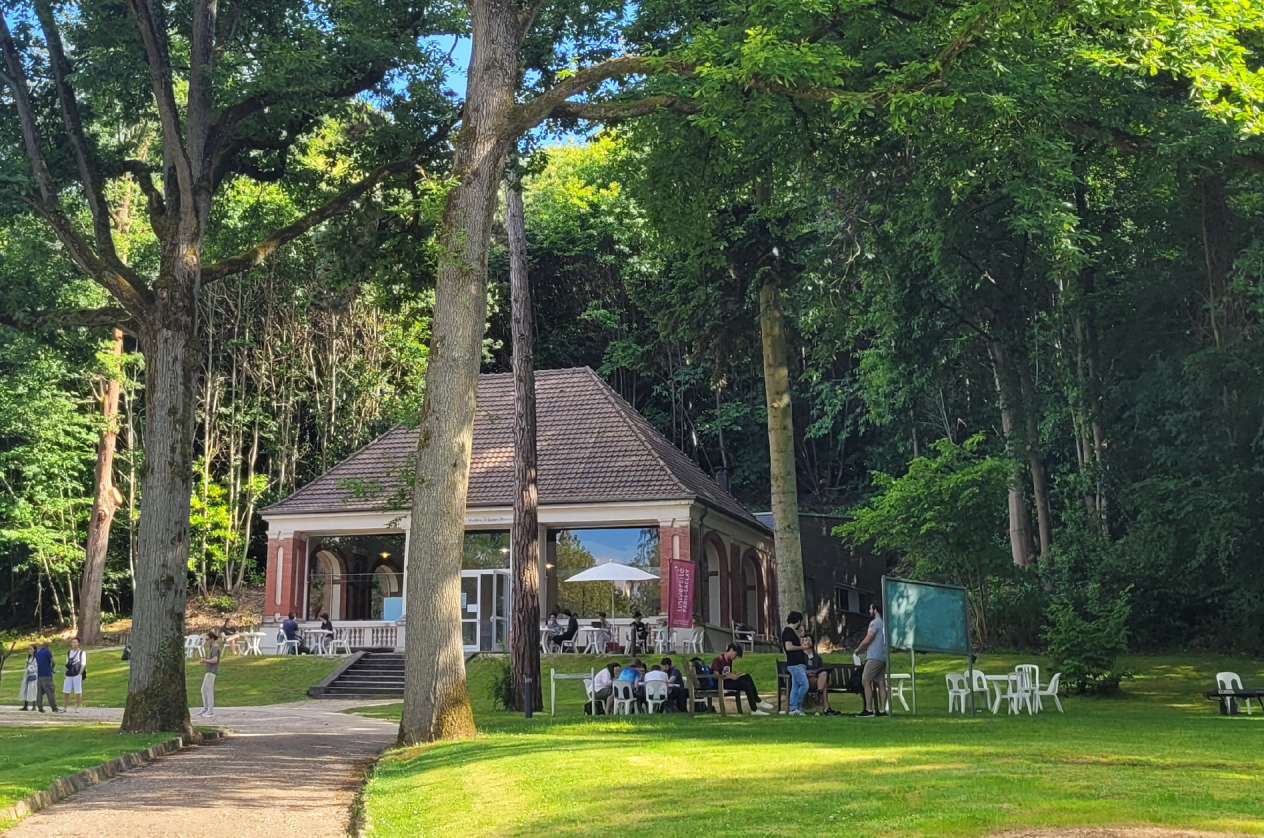
the occasion of the European Heritage Days IHES opened its doors on Saturday, September 17th. Almost 300 people explored the venue, our Bois-Marie, met some of the exceptional researchers that work at the Institute, visited an exhibition created for the occasion, and discovered some unpublished historical archives.

Laurent Lafforgue, mathematician, permanent professor since 2000 and Fields medallist in 2002, gave a talk on “The creativity in mathematics according to Grothendieck” and clarified the great mathematician’s take on the concept, stressing the importance it had for him.

Emmanuel Ullmo, the IHES Director, led the visitors through the different places where some of the most brilliant mathematicians of the last seventy years have discussed, devised and exchanged their ideas. The visit of the various places where the science happens at IHES was followed by an interactive presentation of the “Skolem, choc de blocs & chiffres au vent” sculpture, during which visitors could channel their inner mathematician.

The day ended with a roundtable discussion with Pierre Cartier and Alain Connes, Léon Motchane professor since 1979 and Field medallist in 1982, and moderated by Anne-Sandrine Paumier and Emmanuel Ullmo, whose theme was “Stories and interactions at IHES”.

The visitors then had the chance to explore the exhibition on the “IHES Scientific Heritage”, that summarised the history of IHES, starting from its early years and that included the presentation of unpublished historical archives.


logo_ladiagonaleThe unpublished documents that were presented at the exhibition, as well as a selection of the historical archived documents of IHES, were digitised with the support of Diagonale Paris-Saclay.
IHES intensifies its post-doctoral program

On 15 September an induction day was organised at IHES to welcome the new post-docs

Giving young scientists the opportunity to continue their training and their work in an environment that fosters freedom of research and of intellectual exchange is at the heart of the IHES mission. Since the arrival of Emmanuel Ullmo at the head of the Institute, the number of post-doctoral researchers welcomed every year at IHES has increased.

During its December meeting, the Scientific Council selects a group of successful post-doctoral applications. The post-doctoral contracts, that last one or more years, can be part of specific programs, of collaboration projects involving several institutes, or they might belong to the IHES general invitation program.

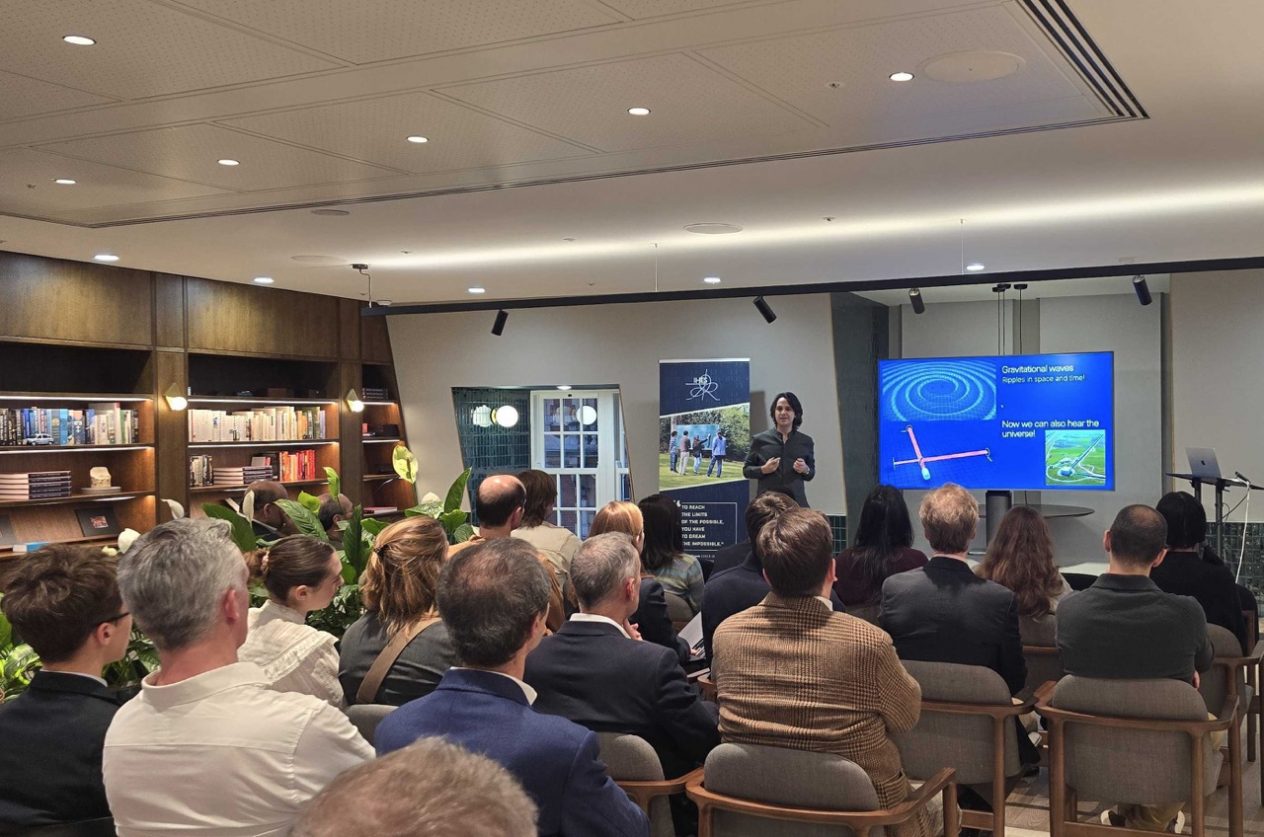
This year the Institute welcomes nine new postdocs, for whom an induction day was organised on 15 September, whose aim was to introduce them to the Institute’s scientific environment. The young researchers that have joined IHES had the chance to meet their colleagues from the year before, as well as the director and some permanent professors.

The exchanges went on informally, in perfect agreement with the spirit of the Institute, which is to promote free, curiosity-driven research: this recipe has so far allowed some of the most brilliant ideas to be born and to grow at IHES. The Institute warmly welcomes this new group of young researchers!
