In Memoriam: Nicolas Bergeron (1975 – 2024)

The IHES community is deeply saddened by Nicolas Bergeron's passing. Close to IHES, Nicolas Bergeron was a Professor at Sorbonne University and a member of the Department of Mathematics and Applications at École Normale Supérieure - Paris Sciences & Lettres.

The IHES community is deeply saddened by Nicolas Bergeron‘s passing. Close to IHES, Nicolas Bergeron was a Professor at Sorbonne University and a member of the Department of Mathematics and Applications at École Normale Supérieure – Paris Sciences & Lettres. As the Editor-in-Chief of Publications mathématiques de l’IHES from 2019 to 2022, he worked towards transitioning this prestigious journal to diamond open access.

In his research, Nicolas Bergeron was particularly interested in the connections between geometry and number theory. Alongside Zhiyuan Li, John Millson, and Colette Moeglin, he notably proved the Lefschetz-Noether conjecture for quasi-polarized K3 surface moduli spaces.

Nicolas Bergeron was an invited speaker at the European Congress of Mathematics in 2016 and the International Congress of Mathematicians in 2018. In 2023, he was awarded the State Funded Prize by the Academy of Sciences.

Furthermore, Nicolas Bergeron was deeply involved in teaching and disseminating mathematics. Passionate about Henri Poincaré’s work, he collaborated on the Analysis Situs project and on the Uniformization of Riemann Surfaces book editing within the Henri Paul de Saint-Gervais groupe. In 2020, he contributed to the production of the web series “Voyages au pays des maths” broadcasted on arte.tv.

Statement from Emmanuel Ullmo, Director of IHES:

“It is with infinite sadness that I learnt of the passing of Nicolas Bergeron. In addition to being a talented and creative geometer, Nicolas was a delightful human being appreciated by all, who contributed greatly to the mathematical community. My thoughts go out to his family and loved ones.”

Statement from Hugo Duminil-Copin, Permanent Professor at IHES:

“Nicolas Bergeron was truly one of the pillars of the French mathematical community. His remarkable ethics, exceptional human qualities and unwavering commitment were admired by all. The loss of our colleague and friend leaves a deep void that we feel with great sorrow.”

Read the tribute to Nicolas Bergeron published in Publications mathématiques de l’IHES here.

Interview with Lauren Williams

Lauren Williams is Professor of Mathematics at Harvard and at the Radcliffe Institute. This interview was conducted during her time as a visiting professor at IHES. This interview is published on the occasion of the International Day of Women and Girls in Science (Feb 11th).

Lauren Williams is Dwight Parker Robinson Professor of Mathematics at Harvard and Sally Starling Seaver Professor at the Radcliffe Institute. She studied mathematics at Harvard University and completed her PhD at MIT, under the supervision of Richard Stanley. After post-doctoral fellowships at the University of California, Berkeley, and Harvard University, she moved back to UC Berkeley in 2009, first as an Assistant Professor, then Associate Professor and became full Professor in 2016. She obtained a new professorship from Harvard University and the Radcliffe Institute in 2018. Her research interests are in algebra and combinatorics. Prof. Williams spent almost a year at IHES as a visiting professor between August 2022 and July 2023. Her visit was funded by the ENGIE Foundation, which has committed to supporting the visits of women researchers at IHES. This interview is published on the occasion of the International Day of Women and Girls in Science (Feb 11th).

Yours is an impressive career path. Have you always known that you wanted to be a mathematician?

In high school I already liked mathematics very much, but I did not know what sort of careers existed out there. There is a particular program that was very important for me and that I attended after my second year of high school, called the Research Science Institute (RSI). It takes place every summer at MIT and welcomes high school students from all over the US as well as some international students. All the students were paired with mentors and I was matched with a math graduate student who gave me a research problem in combinatorics to think about, together with some references to read to learn combinatorics and how to program. That was very intensive, but extremely interesting and fun. It was my first experience doing research and I really enjoyed the freedom and the creativity that it involved. After that summer I wanted to continue working on my project, but I was going back home to California, so my mentor got me in touch with a researcher at UCLA who agreed to meet with me to help me continue my project, which was very rewarding.

How did you find out that research in mathematics was a possibility and that was what you wanted to do?

After RSI, I understood that it was possible to have a career in math and I decided that I would try to be a researcher. Despite my limited experience, I thought I might enjoy a career doing research and teaching. I knew the path might be difficult though, so during my summers as an undergraduate, I explored various career options: I spent one summer at a math research program in Minnesota, one summer at the National Security Agency doing cryptography, and another summer in New York doing financial consulting. After these experiences I understood that if in the future I didn’t manage to get a job as a professor then there were other possibilities.

A pivotal moment for me was in graduate school, during the second year of my PhD. I had recently started on a research problem, and after several months, had formulated a conjecture that I really wanted to prove. I was working almost every day all day but for nine months nothing really seemed to work. I was completely stuck and I was starting to feel depressed and discouraged. I had to wonder whether I should give up and find another problem, or continue, knowing that I might not ever prove my conjecture. That was a period of time that was quite difficult for me. But I did find the solution to my problem eventually. After those nine months I started making progress, and once I started on the right path it took me another three or four months to prove the conjecture. Finding the solution gave me some confidence in my abilities, and with every new problem I solved and every paper I wrote I gained more confidence that I could continue on this path. In retrospect, I know now that my experience was not unusual — nearly everyone I know who went through graduate school had times when they felt lost. One has to realize that in research we are stuck most of the time, and that there will be many days when we work, not knowing if our efforts will take us anywhere. But then, when one finally finds the result, the feeling is very rewarding!

How would you describe your experience as a woman in mathematics?

I realized that there were not many girls in mathematics already in high school. I was doing some math competitions and attending math summer programs where there were not many girls. During the summer after my third year of high school, I participated in the Math Olympiad Summer Program, a residential 3.5-week program that trained students for the International Math Olympiad. There were 24 participants, and I was the only girl. Everyone was friendly, but the experience was strange and isolating; moreover I felt a tremendous pressure that if I did badly, it would reflect badly on all females.

In the math departments that I have been part of (as a student or faculty member), the proportion of professors who are women has ranged from 0% to about 15%, which is obviously not ideal. On the other hand, I think there can be a very nice community among women mathematicians. I have been lucky to have had multiple extremely good women collaborators, some of whom I have worked with for nearly two decades. I am thinking of Sylvie Corteel, who is now at Université Paris Cité and UC Berkeley, and of Konstanze Rietsch, who is at King’s College London. I have been collaborating with them for perhaps seventeen years and it has been really nice to have these very strong women collaborators that I am also good friends with. I have also had some exceptional female undergraduate and graduate students, which makes me optimistic about the future.

Which conditions or factors do you think would help more women choose a career in mathematics?

I think it is helpful for younger women to see more senior women having a successful career in mathematics who are also happy in their job.

Providing opportunities for girls in middle school and high school to experience the joy of discovering mathematics, of creating mathematics, could help with the “pipeline” problem. Girls Angle is an excellent example of such program. There are other great co-educational programs including MIT Primes.

Childcare is another key factor, as childcare in the US can be extremely expensive. That can make it difficult for academics, especially women, to continue their career in research once they start a family. So grants that cover childcare can be helpful: for example, the Alfred Sloan research fellowship can be used to cover childcare costs, which was very helpful to me when I had my first child.

Another thing that can make it hard for young researchers to pursue a career in academia is the length of time it takes to obtain a permanent position. In the United States, many people spend 3 to 5 years as a postdoctoral fellow, then get a tenure-track position (if they are lucky!), and then wait six or seven years until they have a tenured (permanent) position. While I know it’s also difficult in France, it seems to me that there are more positions available and the length of time from obtaining a PhD to obtaining a permanent position is shorter. In this way France makes it easier for people (especially women) to choose a career in academia.

How have you heard about IHES and what has your experience been as a visiting researcher?

Although I have been to France many times, particularly during a sabbatical in 2014, August 2022 was my very first time setting foot in Bures-sur-Yvette. I had heard a lot about IHES from many different colleagues who would wax eloquent about the Institute, but I had never applied before.
I am very happy with my year at IHES, which is a wonderful place to do research. The offices are comfortable and there is a room with huge blackboards and a smartboard which is nice for collaboration. Everything here is designed to make the life of a researcher as easy as possible. IHES is also very international and over the course of this past year I have unexpectedly run into colleagues from the US who I was not expecting to see; this has been very nice.

Additionally, I have found IHES to be a very tranquil place to work. This year I have been living in Paris, and it always feels like a retreat in the countryside whenever I get out of the train at Bures- sur-Yvette, breathe the fresh air, and hear the birds singing rather than the noise of the city.

Finally, my children like IHES too! I have come to France with my family, and have taken my children to the Institute multiple times on weekends. They have enjoyed drawing on my blackboard, spinning in my rotating chair, drinking hot chocolate from the coffee machine, and doing cartwheels in the hallways. They think the life of a researcher is great!

What do you think that IHES could do to ensure that more women mathematicians apply to come to the Institute?

I had heard about IHES almost exclusively through word of mouth. I doubt that everyone knows about IHES and its visiting program: I think that it would be important to make it more visible.

Inaugural Ceremony of the Jean-Pierre Bourguignon Chair

IHES is proud to announce the creation of a Permanent Professor’s Chair carrying the name of Jean-Pierre Bourguignon, who was the Director of the Institute from 1994 to 2013 and who is now Nicolaas Kuiper Honorary Professor at IHES.

Thanks to an exceptional donation to the Friends of IHES Endowment Fund made by Claire-Lise and Philippe Tondeur, and matched by Marilyn and Jim Simons through the Simons Foundation International, IHES is proud to announce the creation of a Permanent Professor’s Chair carrying the name of Jean-Pierre Bourguignon, who was the Director of the Institute from 1994 to 2013 and who is now Nicolaas Kuiper Honorary Professor at IHES.

Following the scientific conference organised on January 26th by Dustin Clausen, permanent professor at IHES and first holder of the Jean-Pierre Bourguignon Chair, along with Emmanuel Ullmo, Director of IHES, the Institute will hold an inaugural ceremony at the Marilyn and James Simons Conference Center on February 1st at 5:30 p.m to honor Jean-Pierre Bourguignon, Claire-Lise and Philippe Tondeur on one hand and Marilyn and Jim Simons on the other hand.

The program of the Inaugural Ceremony is the following:

5.30 pm          Welcoming speech by Marwan Lahoud, President of the IHES Board of Directors
5.45 pm          Speech by Claire-Lise & Philippe Tondeur and Marilyn & Jim Simons, major donors
6.00 pm          Speech by Jean-Pierre Bourguignon
6.20 pm          A word by Emmanuel Ullmo
6.30 pm          A word by Dustin Clausen
6.40 pm          Cocktail

We are particularly pleased to have the donors join us online from the United States. In their speech, they will reflect on their longstanding relationship with Jean-Pierre Bourguignon and IHES.

To attend the ceremony online, click here (code: 160668).

IHES in Singapore

IHES started 2024 with a trip to Singapore on the occasion of the participation of Hugo Duminil-Copin, permanent professor at IHES and 2022 laureate of the Fields Medal, in the Global Young Scientists Summit 2024.

IHES started 2024 with a trip to Singapore on the occasion of the participation of Hugo Duminil-Copin, permanent professor at IHES and 2022 laureate of the Fields Medal, in the Global Young Scientists Summit 2024.

The Institute received a warm welcome from its Singaporean community! It was thrilled to meet its partner companies, such as Qube Research & Technologies, BNP Paribas, Société Générale or Huawei, represented in Singapore, and science lovers, including the community of Ecole Polytechnique alumni or start-ups, such as Horizon Quantum Computing.

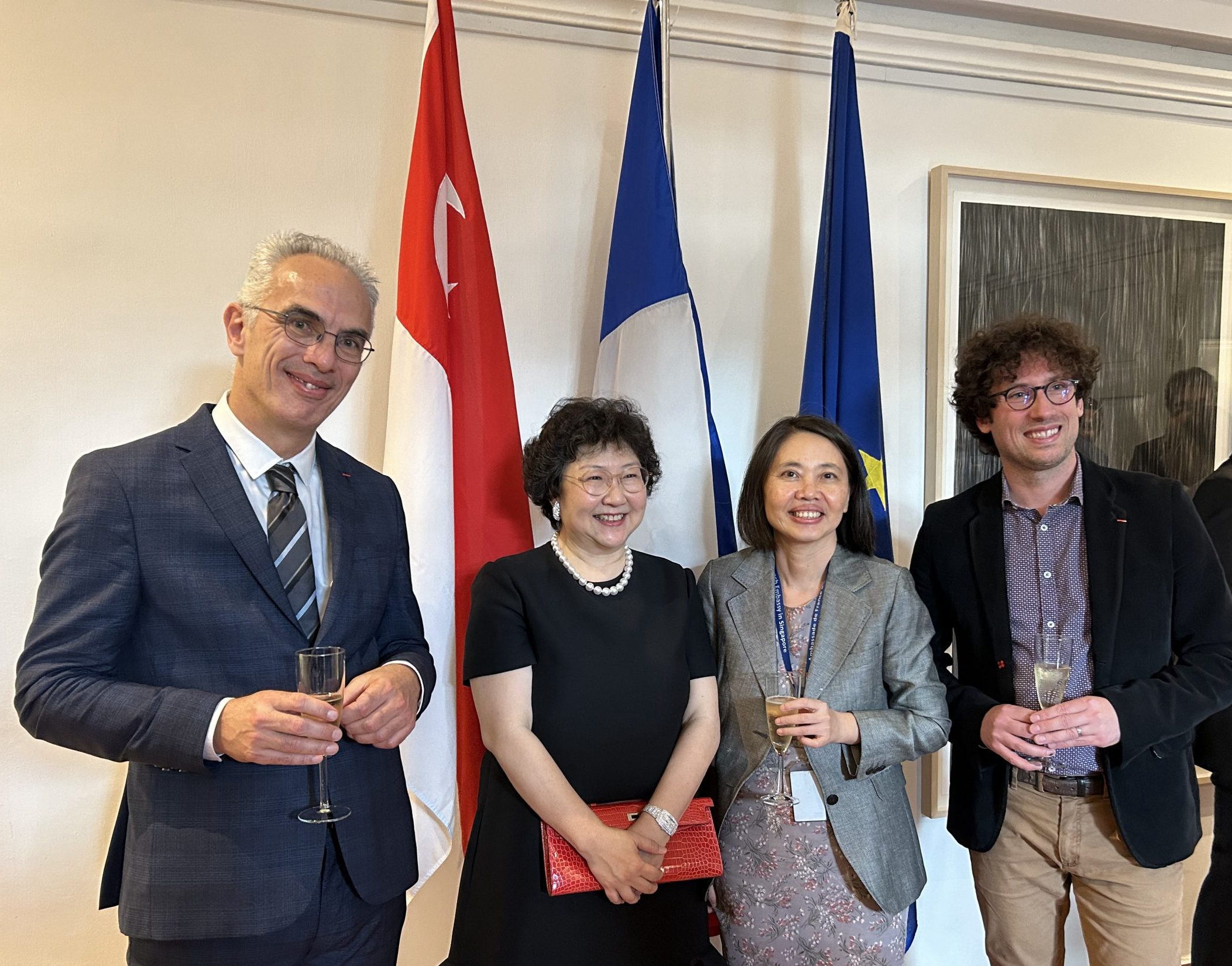
On January 9th, the Institute gathered its friends, in collaboration with the French Embassy in Singapore, at the Residence of France, where Hugo Duminil-Copin, one of the twelve members of the Presidential Council for Science set up by Emmanuel Macron in December 2023, gave a talk intitled «Why Math?»

From left to right: Emmanuel Ullmo, Director of IHES, Alice Hung, Founder of Paeonia Group, Minh-Di Tang, Ambassador of France to Singapore and Hugo Duminil-Copin, permanent professor at IHES

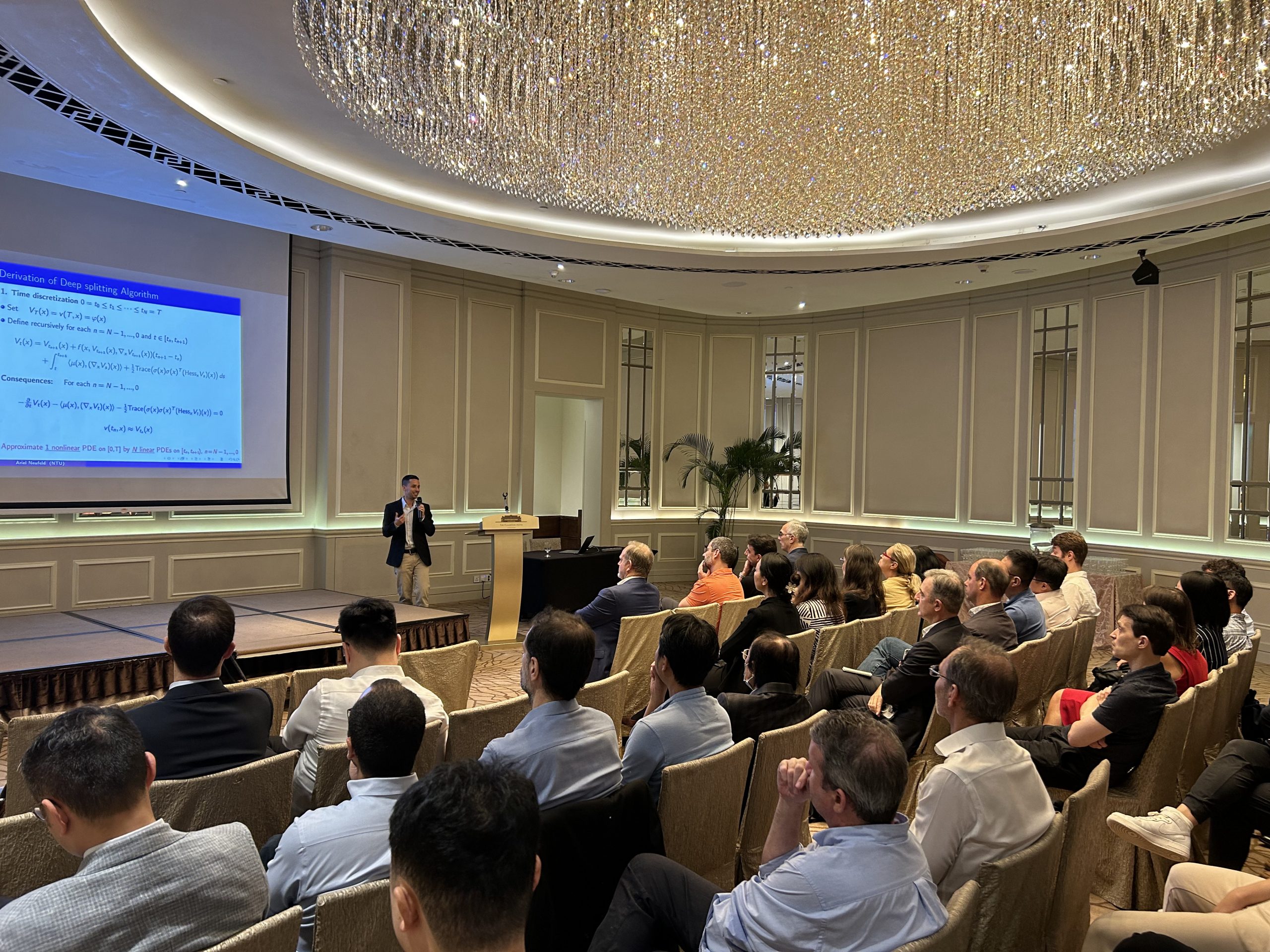
On January 10, IHES, together with Qube Research & Technologies, hosted a private dinner at the iconic Fullerton hotel with Ariel Neufeld, Nanyang Assistant Professor in Mathematics at NTU, as keynote speaker. Ariel Neufeld gave a talk on «Deep Learning algorithm for solving high-dimensional nonlinear PDEs in finance», that generated an active discussion among the public.

Ariel Neufeld, Nanyang Assistant Professor in Mathematics at NTU

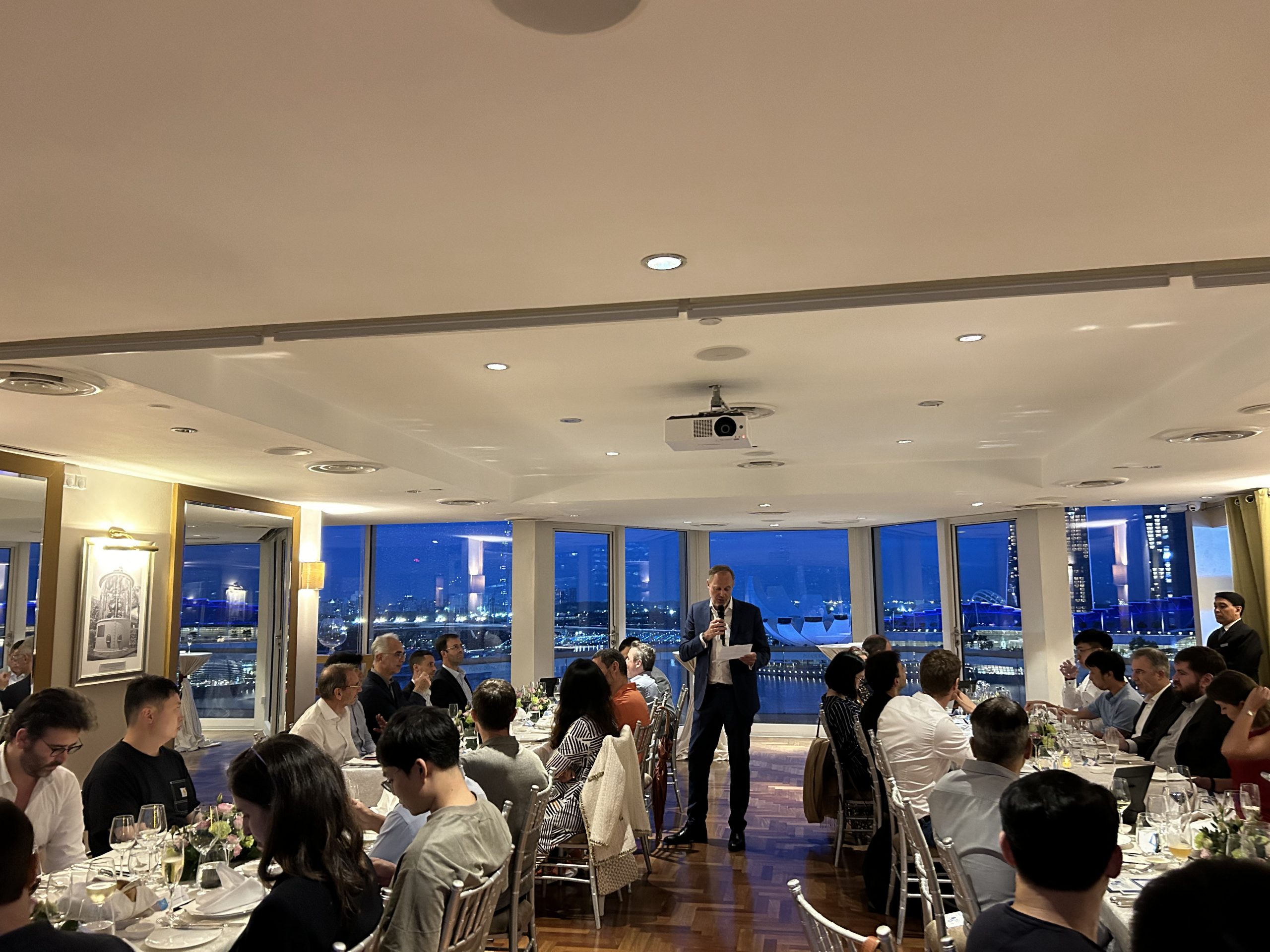
The dinner took place at the Fullerton Lighthouse room, the first lighthouse of Singapore, that provided the guests with an amazing view of the illuminated city. Pierre-Yves Morlat, CEO of QRT, took part in this event and opened the dinner with his welcome speech, inviting the guests to follow QRT’s example and support the development of the Institute.

QRT became a major donor to IHES in 2022, through an initial donation of €100k that contributed to the Institute’s endowment fund, to support the IHES Summer Schools. It renewed and strengthened its support to IHES in 2023, and more particularly to its summer schools, with a second donation of €150k to the Institute. QRT announced the renewal of its support in 2024 to IHES’ summer schools with a donation of €200k.

Pierre-Yves Morlat, CEO of QRT

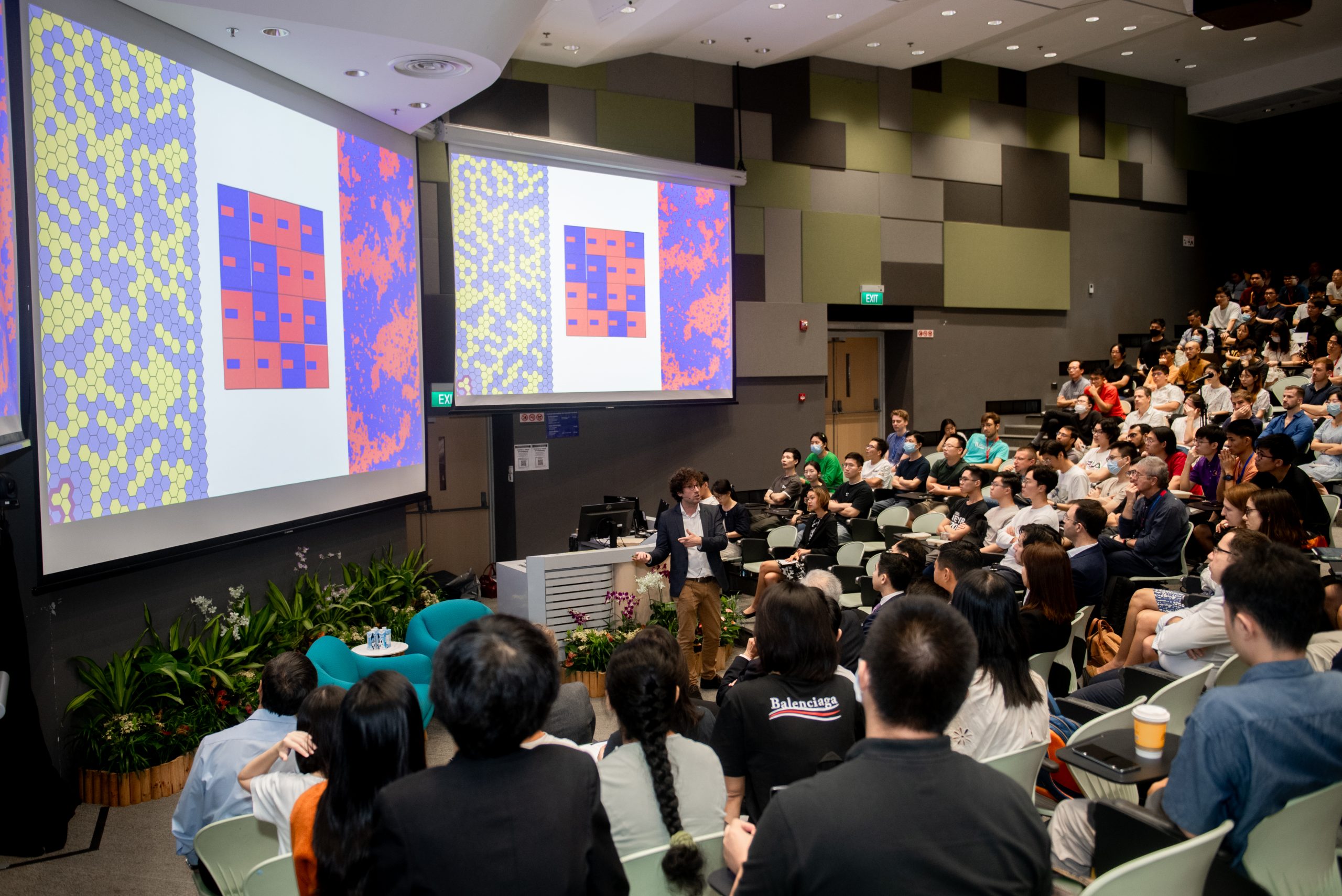
The Institute’s stay in Singapore was concluded with Lee Kong Chian Distinguished Professor Public Lecture given by Hugo Duminil-Copin at NTU Institute for Advanced Studies on January 12. The lecture, supported by Paeonia Foundation and Lee Foundation, and organized in partnership with the Singapore National Research Foundation’s Global Young Scientists Summit 2024 and the Embassy of France in Singapore, gathered more than 300 participants, highly interested in Hugo Duminil-Copin’s scientific achievements.

Lee Kong Chian Distinguished Professor Public Lecture given by Hugo Duminil-Copin. © IAS, Nanyang Technological University Singapore

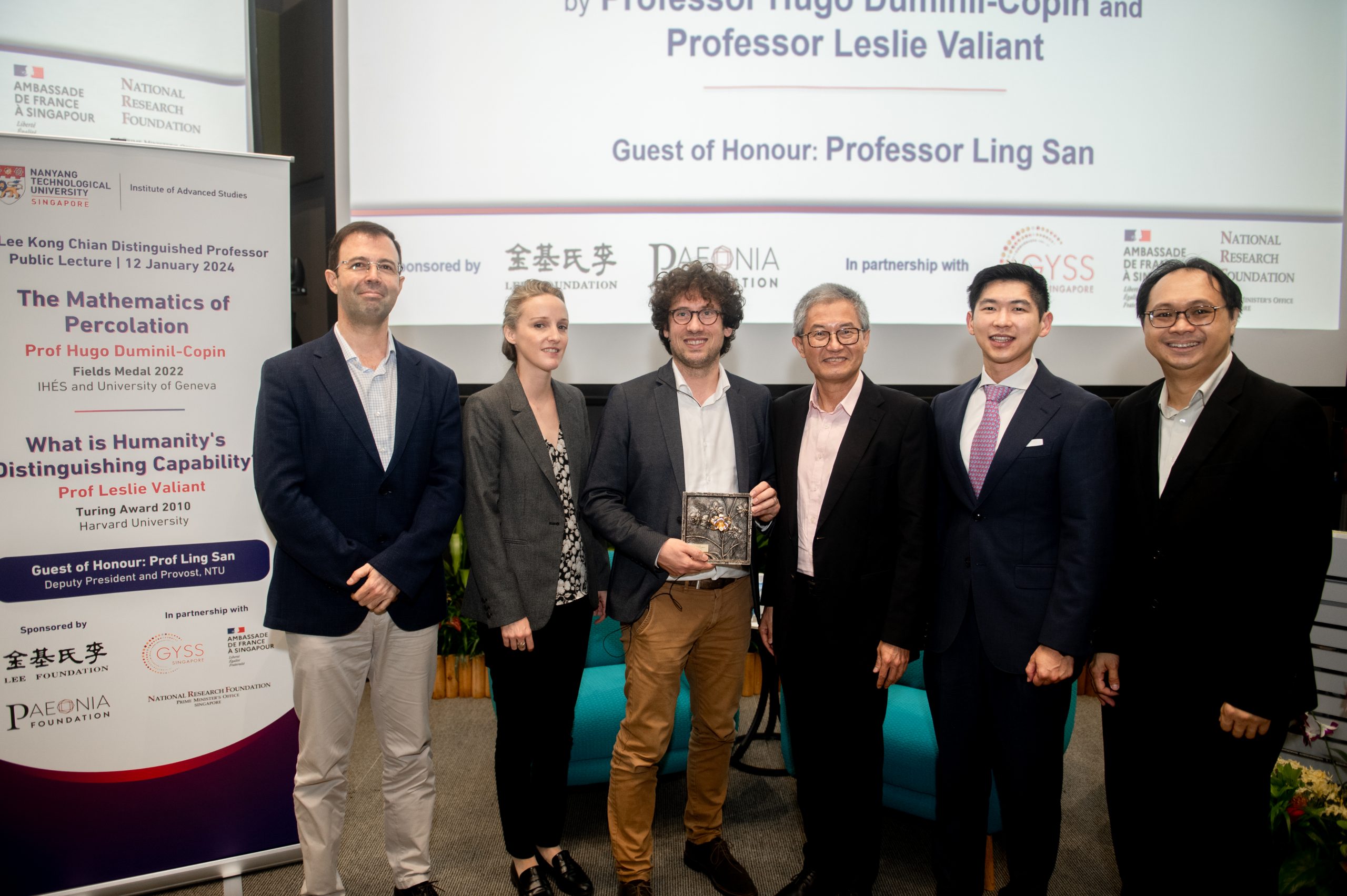
On this occasion, Hugo Duminil-Copin was appointed as the IAS Lee Kong Chian Distinguished Professor. Lee Kong Chian, founder of the Lee Foundation, was a prominent Chinese businessman and philanthropist known for his significant contributions to education and society.

From left to right: Juan-Pablo Ortega, Head, Division of Mathematical Sciences at NTU, Julie Blazy, Attachée for Science and Higher Education, French Embassy in Singapore, Hugo Duminil-Copin, permanent professor at IHES, Ling San, Deputy President and Provost, NTU Singapore, Andy Chua, Managing Director, Paeonia Group and Sum Tze-Chien, Director, Institute of Advanced Studies, NTU. © IAS, Nanyang Technological University Singapore


Scientific conference celebrating the new Jean-Pierre Bourguignon Chair at IHES

Thanks to an exceptional donation by Claire-Lise and Philippe Tondeur, and Marilyn and Jim Simons, IHES is proud to announce the creation of a Permanent Professor’s Chair named after Jean-Pierre Bourguignon. The first holder of the Chair is Dustin Clausen.

Thanks to an exceptional donation to the Friends of IHES Endowment Fund made by Claire-Lise and Philippe Tondeur, and matched by Marilyn and Jim Simons through the Simons Foundation International, IHES is proud to announce the creation of a Permanent Professor’s Chair carrying the name of Jean-Pierre Bourguignon, who was the Director of the Institute from 1994 to 2013 and who is now Nicolaas Kuiper Honorary Professor at IHES. The first holder of the Jean-Pierre Bourguignon Chair is Dustin Clausen, who joined the Institute in April 2023.

To celebrate this new Jean-Pierre Bourguignon Chair, a scientific conference is organized by Dustin Clausen on Friday, January 26. The program of this conference is the following:

9am Welcome coffee
9:30am A word by Emmanuel Ullmo, Director of IHES
9:40am Tomer Schlank, Hebrew University of Jerusalem
Stable Homotopy Group, Higher Algebra and the Telescope Conjecture
10:45am Coffee break
11:15am Arthur-César le Bras, CNRS, Université de Strasbourg
Stacks in the p-adic Hodge Theory of Rigid Analytic Spaces
12:15pm Lunch break
1:30pm Vincent Pilloni, CNRS, Université Paris-Saclay
Modularity of Abelian Surfaces
2:45pm Peter Scholze, Max Planck Institute of Mathematics, Bonn
Motives and Ring Stacks
3:45pm Closing remarks by Dustin Clausen, holder of the Jean-Pierre Bourguignon Chair
4pm Coffee & tea

Registrations for this conference are open to all and now available online here. Download here the poster of the conference.

A dedicated ceremony will then be held on Thursday, February 1st, at the Institute and online, to celebrate the inauguration of the Jean-Pierre Bourguignon Chair, with the online participation of the major donors who contributed to this Chair.

2024 Best Wishes

Discover the Institute’s greetings card looking back 2023!

IHES, foundation in the public interest and founding member of Université Paris-Saclay, wishes you all the best for 2024!

Appointments to Académie des Sciences de Paris

Hugo Duminil-Copin, permanent professor at IHES and ordinary professor at the University of Geneva, and Frank Merle, Chair of Analysis CY Cergy Paris Université - IHES are appointed to the Académie des Sciences de Paris.

Hugo Duminil-Copin, permanent professor at IHES and ordinary professor at the University of Geneva, and Frank Merle, Chair of Analysis CY Cergy Paris Université – IHES are appointed to the Académie des Sciences de Paris.

This Tuesday, December 12, 2023, two IHES researchers have been elected to the Paris Academy of Sciences.

Hugo Duminil-Copin is a permanent professor at IHES and ordinary professor at the University of Geneva, 2022 Fields Medal laureate, and one of the 12 members of the Presidential Council for Science set up by Emmanuel Macron on December 7, 2023. Hugo Duminil-Copin is a probabilist. His work focuses on the mathematical branch of statistical physics. He uses ideas from probability theory to study the critical behavior of various models on networks, such as the Ising, Potts, the self-avoiding walks and the percolation models.

Frank Merle has made many important and seminal contributions to the qualitative study of solutions of nonlinear partial differential equations coming from Physics. Merle’s work has been pioneering in the sharp analysis of blowup solutions and of the collision of solitons, as well as in the soliton resolution conjecture. His groundbreaking work has been very influential in the field and beyond. Throughout his career, Frank Merle received many distinctions.

Meeting with Bachelor students from Ecole Polytechnique at IHES

On November 28, IHES welcomed 80 students from Ecole Polytechnique's Bachelor program.

On November 28, IHES welcomed 80 students from Ecole Polytechnique’s Bachelor program. These students, gathered by AX, the Ecole Polytechnique Alumni Association, and l’ORE, the Bachelor program student organization, came to the Institute to meet the mathematicians of IHES community.

Konstantinos Alexopoulos, Bachelor program alumnus, now a PhD student at ETHZ, Leila Bassou, X2016, PhD student at École polytechnique, Antonin de Courcel, X2019, PhD student at IHES, Orso Forghieri, X2018, PhD student at École polytechnique, Adrien Hardy, mathematician, quantitative researcher at Qube R&T, Selmen Jnifen, X2019, Pascal Massart, mathematician, Director of the Fondation Mathématique Jacques Hadamard and Jing-Rebecca Li, applied mathematician at INRIA, shared their experiences and revealed their career paths, while illustrating the diversity of opportunities available to students wishing to pursue their studies in the field of mathematics.

Inspired by the challenges raised by the speakers, some Bachelor students left IHES with the ambition to pursue a career in mathematics research.

Opening of a childcare center at Ormaille

The Institute is pleased to announce the opening of a childcare center within the Ormaille residence, a residence where can stay researchers during their visit at IHES.

The Institute is pleased to announce the opening of a childcare center, with the support of Ardian, within the Ormaille residence, a residence where can stay researchers during their visit at IHES.

One of the Institute’s key missions is to create an environment conducive to research, offering scientists all the freedom they need to devote themselves fully to their work, without administrative or teaching constraints. A dedicated team assists them with administrative formalities prior to their arrival, and once on site, not only do they have access to an exceptional workspace, they are also provided with an accommodation to suit their needs, including the possibility to host their families.

In an ongoing effort to improve these conditions, the Institute is strengthening its offer to adapt it ever more closely to the needs of its researchers. This new facility provides a childcare solution for children aged 2 months to 6 years old, making it easier for scientists and their families to consider a visit at the Institute.

At the same time, the Institute continues to renovate its infrastructures, and it now offers overdue barrier-free accessible facilities to people with mobility impairments on all its Bois-Marie campus. On top of this, following major renovation work, all the accommodations at the Ormaille residence now meet the highest standards in terms of energy efficiency and equipment.

If IHES is able to welcome scientists in these excellent conditions, it is thanks to the generosity of its donors from all over the world. That is why, this year, IHES has chosen to take part in #GivingTuesday, the worldwide movement promoting generosity, by unveiling the video below presenting the renovated Ormaille residence. You too can celebrate this #GivingTuesday by making a donation to IHES!

Record-breaking 2023 Gala on Jazz and Physics

Friends of IHES Gala on "Jazz and Physics" was held in the iconic Rainbow Room at Rockefeller Center in New York on November 2nd, 2023.

More than 220 people gathered at the iconic Rainbow Room at Rockefeller Center on November 2nd for the 2023 Friends of IHES Gala celebrating Jazz and Physics.

Thanks to the generosity of gala sponsors and guests, over $1,220,000 were raised in both gifts and pledges, reaching a new record in the history of the Friends of IHES galas.

Following the cocktail, guests were greeted by Marcus Miller, the Master of ceremonies, who ensured that every moment of the evening was unforgettable. While the gala was under the high patronage of Laurent Bili, Ambassador of France to the United States and Jérémie Robert, Consul general of France in New York, it is Damien Laban, Deputy Consul general of France in New York, who delivered the inaugural speech of the evening.

A professional tenor saxophonist and a cosmologist, Stephon Alexander then delivered a captivating speech about Jazz and the Musical Spheres, before offering the audience a very unique musical performance, along honorary guest performers Will Calhoun, Santi Debriano, and Hector Martignon, who were also joined for a couple of songs by Marcus Miller. Together, their talent and unwavering passion seamlessly united the worlds of physics and music.

Jim and Marilyn Simons, co-Chairs of Friends of IHES, also encouraged the guests to contribute to the Friends of IHES endowment fund by offering to match all donations made during the call to action led by auctioneer Lydia Fenet. Over $450,000 were raised just towards this goal, after much excitement around the exclusive auction items that were proposed. Special thanks to X, Moonshot Factory, SETI, Unistellar, Will Calhoun and his band the Living Colour as well as to Stephon Alexander for their contributions to this auction.

Friends of IHES and IHES thank all the gala donors who made this exceptional event possible. Special thanks to the Simons Foundation International, gala underwriter, and thank you in particular to Societe Generale, Premier Sponsor, as well as other gala sponsors, including Jump Trading, David Faucon, XTX Markets, BNP Paribas, Bristol Assurances, Michael R. & Nina Douglas, Ross Garon, Kavita Shah & Benjamin Servenay, Bloomberg, Ipsos, as well as Farida Khelfa & Henri Seydoux. Thanks also to gala benefactor, William R. Hearst III, for his support.

A very warm thank you to all the donors and supporters, whose contributions to Friends of IHES and to its endowment fund during this gala have a direct and lasting impact on international scientific conversation and freedom of research.

Discover the photos from the gala on the dedicated website here!

Arrival of a new junior professor

Clément Delcamp joined the Institute as Junior Professor in Theoretical Physics on October 1st 2023.

The Physics of Abstract Nonsense

Clément Delcamp joined the Institute as Junior Professor in Theoretical Physics on October 1st 2023.

Originally trained as an engineer in France, Clément went on to study theoretical physics in the UK and Canada. After finishing his PhD at the Perimeter Institute, he went on to work as a postdoc for the Max Planck Society in Germany, and Ghent University in Belgium.

In his research, Clément is bridging the gap between highly abstract mathematics (category theory) and condensed matter physics, aiming to better understand phases of matter.

A central motif in Clément’s work is the notion of generalized symmetry. Guided by a modern viewpoint on symmetry in terms of topological field theories, it has become apparent that the usual notion of symmetry can be widely extended. In particular, this has allowed the extension of Landau’s theory of symmetry-breaking to accommodate theories that were initially thought to fall beyond its scope. Just as ordinary symmetries are understood in terms of groups, the language of these generalized symmetries is that of fusion n-categories. Consequently, physicists have started to apply the machinery of category theory to understand the role of symmetry in physical systems, broadly speaking.

Clément in particular now applies the tools he has been developing in the context of topological field theories to symmetric theories in the discrete setting. Ideally, he aims to construct a dictionary between (higher) category theory and condensed matter physics. One of his tools in shaping such a dictionary are tensor networks, a concept he studied with leading experts in the field: Guifré Vidal, Norbert Schuch and Frank Verstraete. Broadly speaking, tensor networks offer an efficient way of parametrizing states and operators in quantum mechanics. The key idea underlying tensor networks is that many large physical operators can be efficiently obtained by gluing together small building blocks. The decomposition of an operator hides a lot of physical information. Coupled with the intuitive graphical representation of tensor networks, this approach has enabled to reveal the physical interpretation of seemingly obscure category theoretic constructions. This feature is particularly striking in (3+1)-dimensional systems. While significant progress has been made in the (2+1)-dimensional theory, the situation in (3+1) dimensions remains even more mysterious. Building on ideas first developed by John Baez, it is widely believed that physics in n dimensions is governed by n-categories.  Accordingly, transitioning from (2+1) to (3+1)-dimensional systems should involve a sort of categorification process within the realm of mathematics. Part of Clément’s research amounts to trying to understand categorification in the context of condensed matter systems.

At IHES, Clément is enthusiastic about continuing his research in between physics and mathematics. Since his arrival, he has already engaged in discussions with mathematician Edmund Heng, who recently proved a generalized version of Gabriel’s theorem within the framework of fusion categories. Additionally, Clément plans to collaborate with Slava Rychkov to resume his work on tensor networks and renormalization groups.

CNRS delegation at IHES

Delegation is a specific position offered to lecturers and university professors working in research at CNRS.

Delegation is a specific position offered to lecturers and university professors working in research at CNRS.

For 2023, IHES, in partnership with INSMI, is offering two 6-month delegations.

Teacher-researchers are invited to submit their applications for CNRS delegations via the Galaxie application (the application deadline is 4:00 p.m. on October 20, 2023). You are also invited to contact an IHES researcher or to write to Emmanuel Ullmo, ullmo@ihes.fr, to express your interest in a research stay at IHES. Delegation can begin on September 1, 2024 or February 1, 2025. Selected applicants will be offered accommodation at the Institute’s residence, some being suitable for a family. Help with childcare is also available.

Delegations to CNRS are subject to an agreement between CNRS and the teacher-researcher’s home institution. Financial compensation is paid by CNRS to the home institution for the replacement of the teacher-researcher’s teaching duties. IHES will reimburse CNRS for the cost of delegations at IHES.

For more information (in French)