Cellular and Molecular Biotechnology

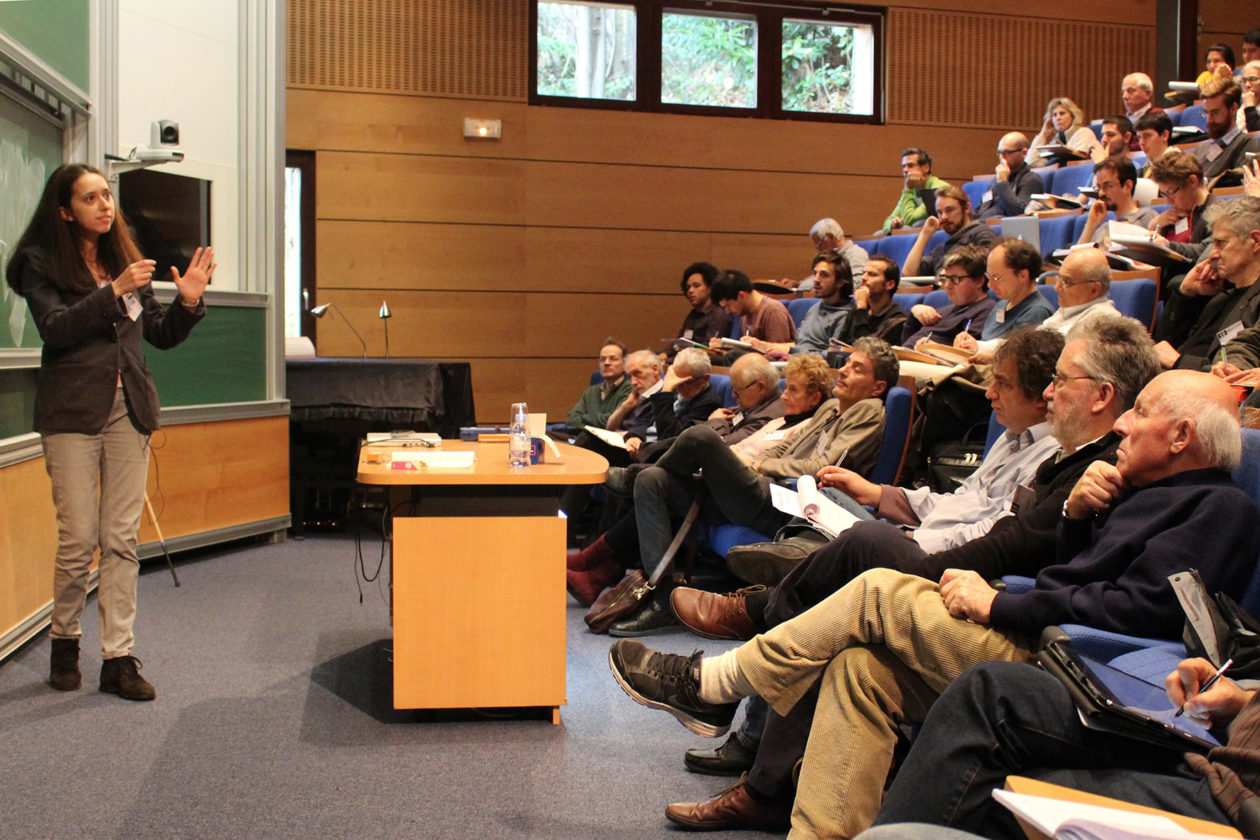
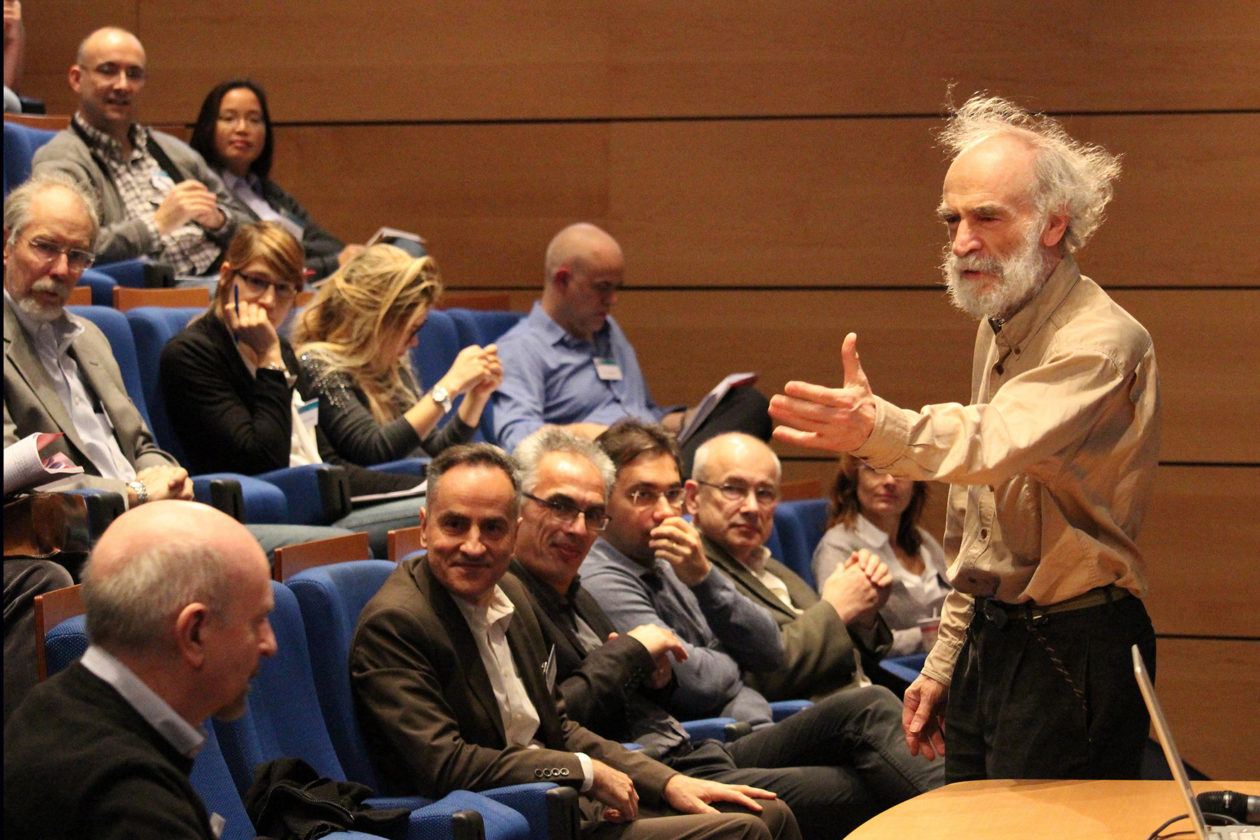
In December 2015 a meeting was held at the IHES to explore the consequences of the newest developments in cellular and molecular biotechnology, comprising 29 invited speakers from seven countries and attended by about a hundred participants.

Since recombinant DNA technology was pioneered in the 1970s, the molecular technology toolbox has been filled up with such a large variety of techniques that so-called “Synthetic Biology” is no longer a hollow phrase but has become reality, or at least almost so.These developments raise various issues, of course, in terms of potential benefits and risks. Experimentally modifying fundamental processes may give new insight into evolutionary pressures that produced biological systems as they are today, and may also lead to novel practical applications. Biological evolution does not tend to produce radically new designs because typically natural selection has only variants to act upon that greatly resemble their ancestors in most ways. Big evolutionary jumps are vanishingly rare because random modification of fundamental processes is extremely unlikely to result in something that is viable. However, intelligent engineering is a much more focused process, and therefore the creation of new viable life forms that use fundamentally different processes is no longer unthinkable. During the meeting various contributors addressed a whole suite of methods that modify organisms in many fundamental ways.


For instance, the molecular machinery that handles genetic material can be made to use synthetic nucleotides (building blocks of DNA and RNA) and even new amino acids (building blocks of proteins). The organisms that result can have fundamentally new properties. “Frankensteinian Science” may have a bad name, but it may have practical benefits too. Modified bacteria that produce therapeutic molecules on command may one day help to fight many a disease, and these bacteria may even be instructed to do this with precision. Just to give an example, one day diabetics might receive implants with bacteria that measure blood sugar levels and produce insulin only when necessary, thus abolishing the need of regular finger pricks and insulin injections.

Modifying genetic systems is already a big feat but, as participants of the meeting showed, synthetic biology does not stop there. For instance, new metabolic pathways have been designed and engineered to produce new compounds. It may be possible to design new metabolic pathways and to fine-tune cellular systems such as immune systems to produce new compounds and carry out new tasks.

Minus van Baalen, François Képès & Mikhail Gromov.

Watch all 38 videos on YouTube

Topos à l’IHES

The "Topos à l’IHES" conference, organised by O. Caramello, P. Cartier, A. Connes, S. Dugowson and A. Khelif thanks to a L’Oréal-Unesco For Women in Science fellowship, took place from 23 to 27 November 2015.

“A. Joyal and I gave introductory lectures on the first two days, followed by three days of presentations: 11 plenary presentations and 11 short presentations, mostly given by young researchers.There were over 100 participants,especially during the first two days, which enabled many people to become familiar with the topic.Videos of the lectures and presentations have also been viewed extensively online.

The conference illustrated the fruitfulness and impact of the notion of topos – introduced by A. Grothendieck at IHES in the 1960s – on various mathematical fields such as algebraic geometry, number theory, mathematical logic, functional analysis, topology and mathematical physics. The unifying nature of the notion of topos had already been glimpsed by Grothendieck, who compared the topos theme to a “bed” or a “deep river” realising a union between “the world of continuum and that of discontinuous or discrete structures”, that makes it possible “to perceive with finesse, by the same language rich in geometric resonances,an “essence” which is common to situations most distant from one another”

After Grothendieck’s introduction of toposes as purveyors of cohomology invariants useful in

algebraic geometry (in particular in relation to Weil’s conjectures), new insights on the concept of topos emerged. According to W. Lawvere and M. Tierney, toposes can be seen as sorts of mathematical universes in which the familiar constructions on sets remain possible, but which have each their own properties. In addition, the theory of classifying toposes enables to associate to any mathematical theory of a very general form a topos which embodies its “semantic content”.

More recently, toposes have started being used as sorts of “unifying bridges” making it possible to link different mathematical theories together, to generate and study dualities and equivalences, to transfer ideas and results from one mathematical field to another and to demonstrate new results within a given theory.” Olivia Caramello.

All videos are on YouTube

Conference in honour of Arthur Ogus

A conference on algebraic geometry in honour of A. Ogus on the occasion of his 70th birthday took place at IHES from 23 to 25 September.

A. Ogus is a professor at the University of California in Berkeley, where he was also Chairman of the Department of Mathematics from 2012 to 2015. He has been invited to IHES on numerous occasions: the first being in 1974, the most important in 1977-1978 and the most recent from September to December 2015. He has also been invited by a number of French universities, including Université Paris-Sud (Orsay) in 1978-1979 and in 1991. His area of research lies at the intersection of arithmetic and algebraic geometry. Many of his ideas, following the themes developed by A. Grothendieck and his colleagues found a natural home in France – at IHES in particular – where they were introduced, appreciated and discussed. Among the resulting long-lasting working partnerships in which A. Ogus was involved, the work undertaken with P. Berthelot from the early 1970s should be mentioned, together with the now classic publications that accompanied it: an introductory monography on crystalline cohomology (1978) and the article on the comparison between crystalline cohomology and De Rham cohomology (1983).

More recently, his interest in logarithmic geometry prompted by L. Illusie, A. Ogus has become one of its leading exerts and his hotly anticipated book on the topic is likely to also become a reference text.Those are just two examples of the strong links IHES has contributed to develop over the years between A. Ogus and some of the finest representatives of arithmetic geometry in the French mathematical school.


A. Ogus has always been very open-minded and generous in sharing his intuitions during his visits to France. In organising a conference on the occasion of his 70th birthday and his four-month stay at the Institute, IHES wanted to be the first to acknowledge the considerable progress made thanks to him.The conference brought together many of the leading experts in A. Ogus’s favourite areas of research. It enabled participants to glimpse into the future development of those topics to which he has made such significant contributions and which IHES is determined to continue to support.

Ahmed Abbes

Watch all videos on IHES YouTube channel