This year, Slava Rychkov has uncovered a connection between Deligne categories (mathematical structures defined by Pierre Deligne in 2004), and symmetries of probabilistic loop ensembles on lattices, playing an important role in statistical physics.
His other major project was an application of renormalization group and conformal field theory to phase transitions with a random field type of disorder.
Finally, Slava Rychkov has developed a method for analytic continuation of Euclidean conformal field theories to the Lorentzian signature, which is more direct than the classic construction of Osterwalder and Schrader (1975).
His work lies at the intersection of algebraic geometry and arithmetic. He has worked in particular on motivic periods, especially multizeta functions. His contributions include the resolution of the Goncharov-Manin conjecture on moduli spaces of curves, Hoffman’s conjecture on multizeta functions, and the Deligne-Ihara conjecture on mixed Tate motives over Z.
Part of Francis Brown’s research revolves around questions arising from quantum field theory, especially the “cosmic Galois group” program, which was started by many people connected with IHES, in particular Pierre Cartier, Alain Connes, Maxim Kontsevich, and Dirk Kreimer.
Robert C. Penner
The main research interests of Robert C. Penner are moduli spaces and their applications to physics and biology; geometry, especially in its confluences with theoretical physics, specifically 2d and 3d quantum gravity, and with theoretical biology, notably structural biology and macromolecules; string theory – and attempt to reconcile the theories of quantum gravity and quantum mechanics with general relativity; theoretical high-energy physics and mathematical physics, particularly quantum physics; low-dimensional topology.
Robert Penner wrote an article in which he explains how curiosity and a little help from friends have led to his COVID initiative.
Frank Merle
The Chair held by Frank Merle at IHES is funded by the Simons Foundation.
Emmanuel Ullmo
Emmanuel Ullmo alternated between positions in France and abroad, including 18 months at IMPA in Brazil, two years at Princeton University in the United States and six months at Tsing-Hua University in the People’s Republic of China.
Professor at Université Paris-Sud in 2001, Emmanuel Ullmo became Director of the Department of Mathematics of Orsay and President of the Commission of Experts between 2007 and 2010. Member of the Scientific Council of the Centre Émile Borel from 2002 to 2006, he is also a member of the editorial board of Inventiones Mathematicae since 2006, being one of two editors-in-chief from 2008 to 2014.
Recently, Emmanuel Ullmo showed, in collaboration with Chris Daw and Alexander Gorodnik, that the space of homogeneous measures on the maximum Satake compactification of a locally symmetric space is compact. In other words, the boundary measure of a sequence of homogeneous measures is supported on a single edge component and is homogeneous. Moreover in collaboration with Gregorio Baldi, he demonstrated the finitude of the set of maximal totally geodesic subvarieties of a ball quotient unit of the complex affine space of dimension n by a non-arithmetic network.
René Thom’s proposals, often grouped under the name of ″catastrophe theory″, were sometimes controversial but elicited considerable interest from outside the scientific community. He spent the rest of his scientific life studying theoretical biology and, even more importantly, Aristotelian philosophy.
Conference by Marie-Cécile Bruwier on June 2, 5:30 pm
New event organized by Les Amis de l'IHES with Marie-Cécile Bruwier on Tuesday, June 2 2026 at 5:30 pm in the Marilyn and James Simons Conference Centre and on Zoom.
Slava Rychkov Receives the Humboldt Research Award
Slava Rychkov, Permanent Professor of Physics at IHES, has been awarded the prestigious Humboldt Research Award by the Alexander von Humboldt Foundation.
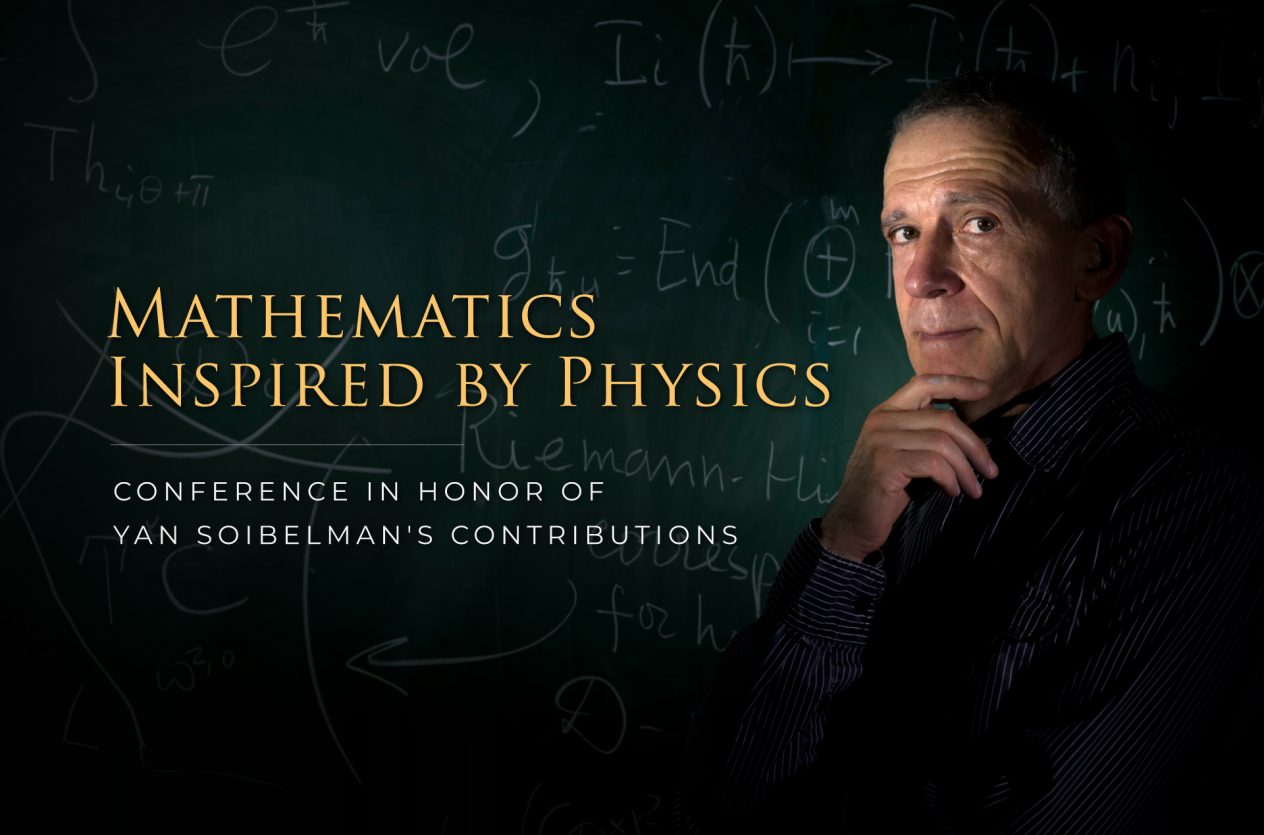
“Mathematics Inspired by Physics”, A Conference in Honor of Yan Soibelman’s Contributions
On June 1st and 2nd, a conference will be held celebrating the career of Yan Soibelman, professor at Kansas State University and regular visitor to IHES.
Nous utilisons les cookies pour améliorer votre expérience sur notre site Web. En parcourant ce site, vous acceptez notre utilisation des cookies.
We use cookies to enhance your experience on our website. By browsing this site, you agree to our use of cookies.
This website uses cookies to improve your experience while you navigate through the website. Out of these, the cookies that are categorized as necessary are stored on your browser as they are essential for the working of basic functionalities of the website. We also use third-party cookies that help us analyze and understand how you use this website. These cookies will be stored in your browser only with your consent. You also have the option to opt-out of these cookies. But opting out of some of these cookies may affect your browsing experience.