 IHES
IHES
A memory of Heisuke Hironaka
Heisuke Hironaka was one of the most influential persons in my life, and I’ll never forget to express my respects and gratitude to him.
In the end of 1960s when I was a graduate student at the university of Tokyo, I learned about his early work from Shigeru Iitaka who expressed his surprise. Then, a few years later at the International Congress of Mathematicians in Nice in 1970, I, as a starter in my mathematical carrier, was watching Hironaka from a distance receiving the Fields medal and talking on his work.
My real acquaintance with Hironaka happened in the year 1972, when Frédéric Pham had organised a summer school on singularities in Cargèse in Corsica, where Hironaka gave a course on sub-analytic sets. I attended the school accompanied by Egbert Brieskorn from Göttingen. It was a wonderful school and time, where I could meet Hironaka and many of his students in Paris. We had enough time to talk and discuss mathematics and other things. I watched also how Hironaka was talking to his mentor Oscar Zariski.
After I came back to Tokyo in Fall 1973, I tried to invite Hironaka to the University of Tokyo but I was not successful. In 1975, he returned to the Research Institute in the Mathematical Sciences (RIMS), at Kyoto University. Still, our contacts continued in the mid-1970s mostly by exchanging letters. One night, driving a car, Hironaka enthusiastically talked to me that he wanted to start some organisation that could help young mathematicians. Actually, he started an office in Shibuya Tokyo with the help of a journalist N, and where I helped from the mathematical side
In 1979, Hironaka invited me to RIMS where I then spent most of my carrier. Also Hironaka invited me to Harvard University for the period Fall 1979 – Spring 1980, where, at that time, David Mumford and Phillip A. Griffiths were faculty members and Jean-Pierre Serre was lecturing. I met also Shigefumi Mori, who was just proving the Hartshorne conjecture. Under such strongly impressive circumstances, I concentrated my efforts on constructing “higher residue theory” (in previous summer, I noticed that it is the key concept to construct primitive forms). I am sure that I could not have achieved this work without Hironaka’s help offering me such a great chance, and I would never miss to express my gratitude to him.
In Kyoto, Hironaka set to work hard to organise the new foundation. He contacted numerous people mostly outside the mathematical community to get their support and understanding. It was quite impressive to witness that he really achieved this work almost alone. At the opening ceremony of the new foundation Japan Association of Mathematical Sciences (JAMS) in 1984, I saw representatives of not only the academic community but also leaders of the economic or political communities in Kyoto. I started to work for JAMS. Shortly after that, Tadao Oda joined JAMS. Since then, for decades, we jointly worked to operate JAMS from the mathematical side. Taking into account changes in the organization of research in Japan, we needed to reform the formats of activities of the association and this led to more international cooperation. However, Hironaka remained always the leader with clear ideas on what had to be done.
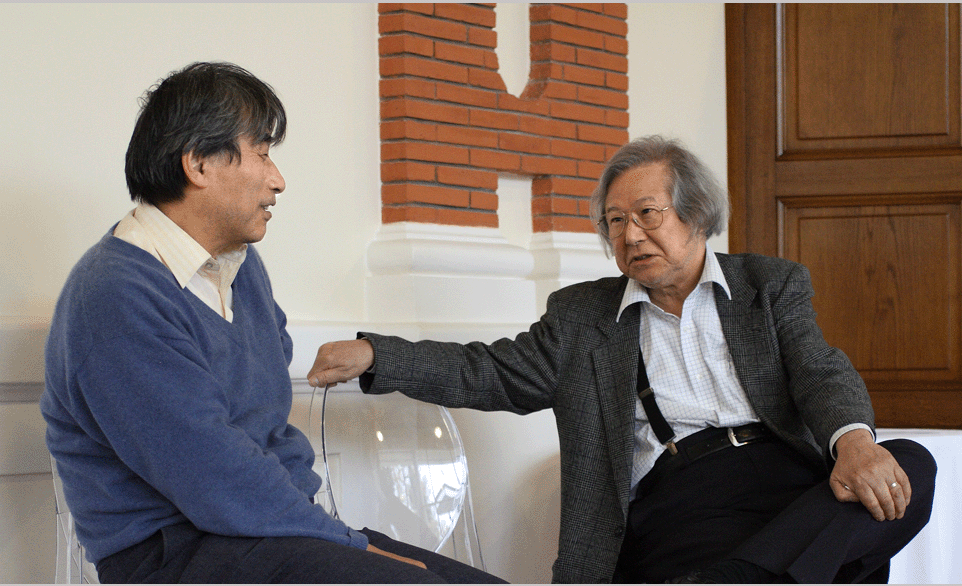
These are rather social aspects of Hironaka’s activity, but I have learned more from him through direct conversations. He liked to talk about the early history of IHES, when Leon Motchane started to support mathematics and physics. Hironaka talked how IHES started (privately) by a small office with Grothendieck who, at that time, had no job, and how it grew to a great institute afterwards. I am sure that this was the proto-model for him for a good institute. Once, Hironaka told me the story of two great buddhists monks Saicho and Kukai at the beginning of the 9th century in Kyoto. Saicho started a school and quite influentially educated the young generations, whereas Kukai rather lived in a high peak mountain so that his influence was not directly on students around him but has long distance effects in the world. I thought that Hironaka was comparing himself with Kukai and felt some loneliness. Another day, a few years before he passed away, he said “Saito-san, mathematics is wonderful! You can work on it even when you are in a high age”. His words push me forward. These were the last words I could get from a direct contact with Hironaka, and it was about mathematics.
I close the present testimony by expressing again my deepest gratitude to Heisuke Hironaka.
Kyoji Saito
Research Institute for Mathematical Sciences
Kyoto University