 IHES
IHES
Heisuke Hironaka: Building the Social Foundations of Mathematics
Heisuke Hironaka ranks among the most influential mathematicians of the twentieth century. His groundbreaking work on the resolution of singularities earned him the Fields Medal. He was also named a Chevalier of the Legion of Honour, in recognition not only of his scientific achievements but also of his contributions to international academic exchange, especially between Japan and France.
Yet Hironaka devoted equal energy to building the social and institutional foundations on which mathematics in Japan could flourish. Among his many contributions, three deserve particular emphasis: the founding of the Japan Association for Mathematical Sciences (JAMS), his leadership in the creation and development of the Sansu Olympics, and his long and fruitful association with the Institut des Hautes Études Scientifiques (IHES).
Hironaka believed that mathematics is a language for understanding the world. But the ability to appreciate mathematics does not arise spontaneously; it must be nurtured through challenge, encouragement, and opportunity. If we care about the future, we must engage young minds and give them the freedom to explore mathematics deeply and creatively. It was with this conviction that he helped establish JAMS in 1984. At a time when Japan’s research environment was changing rapidly, he recognized the need for a flexible and independent organization that could complement universities and public funding. Drawing on his international experience, especially in the United States and Europe, he envisioned an institution that would support research, encourage young mathematicians, and promote international exchange.
Under his leadership, JAMS developed a wide range of activities, including research grants, fellowships for young researchers, and support for international conferences and collaborative projects. It enabled Japanese mathematicians to study abroad and brought distinguished scholars from overseas to Japan, thereby fostering a lively exchange of ideas. Hironaka placed particular importance on supporting younger generations, convinced that timely encouragement and access to opportunity could shape a mathematician’s future in lasting ways. Through JAMS, he never hesitated to provide financial support for worthwhile mathematical activities that lay beyond the scope of public funding. Through these efforts, the organization helped build a strong and enduring base for mathematical research in Japan.
Another central aspect of his legacy was his commitment to nurturing young minds. Among his distinctive achievements were the establishment of the “Wings of Mathematical Thought” program and the creation and development of the Sansu Olympics. The former is a residential program that brings together talented young students with a passion for mathematics; the latter is a nationwide mathematics competition for elementary school students in Japan. Through these two initiatives, many young people were encouraged to develop their gifts and to contribute to society.
While sansu refers to elementary-level mathematics, Hironaka once remarked, “I believe mathematics is a language through which children can explore ideas, express creativity, and develop logical thinking.” He envisioned the Sansu Olympics as a place where children could encounter mathematics not as a rigid school subject, but as something joyful and exciting, like a game or a sport. He often spoke of the richness and depth of mathematics at this level, far beyond what is usually encountered in the classroom. Through carefully designed problems, the competition encourages children to think independently, respond creatively to difficulty, and develop perseverance. For him, it was not merely a contest, but an occasion for meaningful learning.
He also supported these initiatives personally and financially, and established the Hironaka Cup, a mathematics competition for junior high school students in Japan. Today, the Sansu Olympics is widely recognized throughout Japan and has introduced many young students to the beauty of mathematical thinking.
Among his many activities, we would especially like to highlight the deep and enduring relationship he maintained with IHES. His visits there in the 1960s left a lasting impression on him. At IHES, he encountered an environment in which researchers could devote themselves fully to fundamental questions, free from the usual demands of teaching and administration. There he interacted with leading mathematicians such as Alexander Grothendieck and Jean-Pierre Serre, and came to appreciate the importance of sustained and profound collaboration.
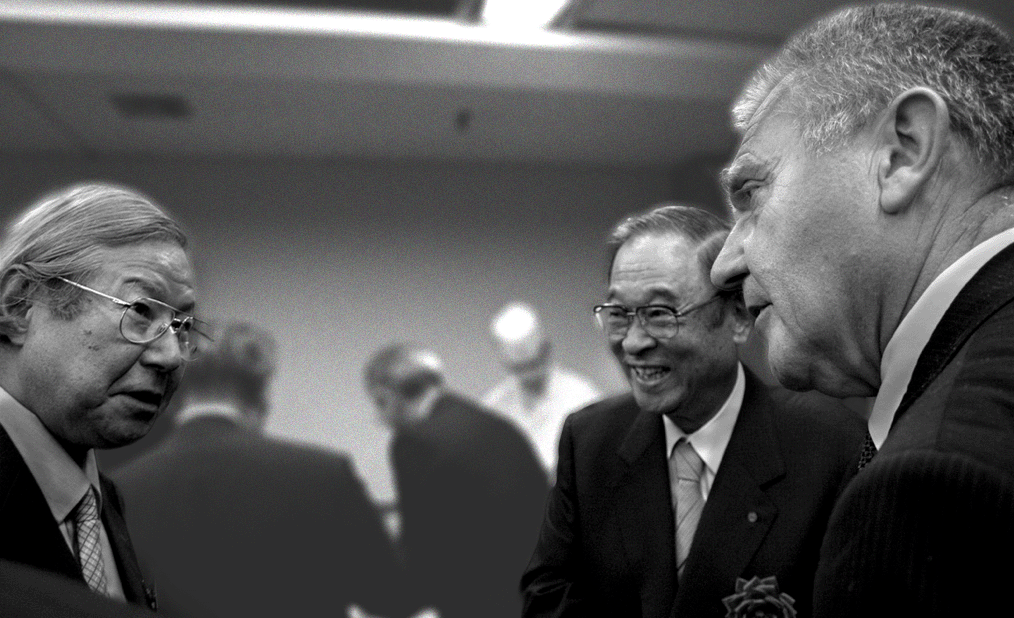
This experience later led him to support the creation of the “Japan Fund,” a program designed to send young Japanese mathematicians to IHES. The initiative was realized through collaboration with Jean-Pierre Bourguignon and with the support of André Lévy-Lang of BNP Paribas. Jointly established by Japan and France, with approximately two million euros in funding, the program enables two Japanese researchers each year to spend an extended period at IHES.
On the Japanese side, key figures such as Yusuke Yasuda and Toru Yosano led the fundraising effort, with strong backing from Keidanren under the leadership of Fujio Cho of Toyota Motor Corporation. Despite the difficult economic climate following the global financial crisis, the initiative was successfully brought to fruition. Throughout this process, Hironaka played an essential role as an advisor, linking academia and industry while articulating with clarity the long-term value of pure mathematics. Thanks to this fund, many talented young mathematicians have been able to work at IHES, strengthening international collaboration and contributing to the global development of mathematics.
Through all these efforts, Hironaka not only advanced his own research, but also supported many mathematicians, especially among the younger generations, and helped forge enduring ties between Japan and France. In doing so, he contributed to the development of an international network for mathematical research.
Hironaka’s life reminds us that mathematics is not merely a collection of results, but a living human activity. For mathematics to grow, it requires institutions, education, and international cooperation. By working across all of these domains, he expanded the role of the mathematician into that of a builder of communities and a supporter of intellectual life.
We would like to express our heartfelt gratitude for Professor Hironaka’s immense contributions to the mathematical community.
Yusuke Yasuda
Toru Yosano
Yoshiaki Maeda
Members of the IHES supporting committee in Japan