 IHES
IHES
Laure Saint-Raymond : to connect with the public through mathematics
A permanent professor at IHES and at ENS de Lyon, and a member of the Académie des sciences, Laure Saint-Raymond has for several years developed a sustained commitment to scientific outreach aimed at a wide range of audiences. Through lectures, workshops, and talks in school, university, and institutional settings, she contributes to spreading mathematics far beyond the scientific community.
She emphasizes that mathematics makes it possible both to describe the world precisely, to structure explanations of complex phenomena, and to produce forms of thought that can be shared, combining rigor and creativity. She insists that it is not a discipline of selection, but rather a mode of thinking and expression. “I do not like the idea that mathematics is a discipline of selection, a discipline about which people say: ‘I never understood anything,’” she explains. As she recently recalled at the Institut de France as part of the series Les clés pour comprendre, mathematics constitutes a language that allows both “poetry,” with elements of play, aesthetics, and self-transcendence, and “prose,” by enabling concise and precise descriptions of the world around us.
At the end of March and the beginning of April, several of her engagements illustrated the diversity of audiences and formats involved.
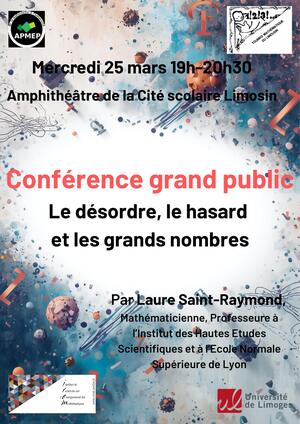 On March 25 in Limoges, Laure Saint-Raymond gave a public lecture at the Cité scolaire Limosin on disorder, randomness, and large numbers. The presentation explored probabilistic phenomena and the very robust structures that emerge in complex systems.
On the same day, she addressed university students at the Université de Limoges in a lecture devoted to the mathematician and physicist Yvonne Choquet-Bruhat, a major figure in contemporary mathematics, whose name will soon be inscribed on the Eiffel Tower. This talk reflects a desire to highlight scientific careers and transmit key historical references.
On March 26, she worked with school audiences through two workshops on random walks for middle school students, as well as a presentation entitled Maths in Music for high school sophomores, focusing on acoustic waves.
On March 27, she took part in a conference in Reims organized by the Association Française des Acteurs de l’Éducation, devoted to changes in the education system. There, she presented work carried out over the past two years at the initiative of the Académie des sciences on the challenges and transformation of schools.
She was also the patron of the Le Printemps des Mathématiques festival, organized by the Maths en scène in Castanet-Tolosan from March 23 to 28. This event, celebrating its tenth anniversary, brought together researchers, teachers, and students around lectures and workshops dedicated to the dissemination of mathematics.
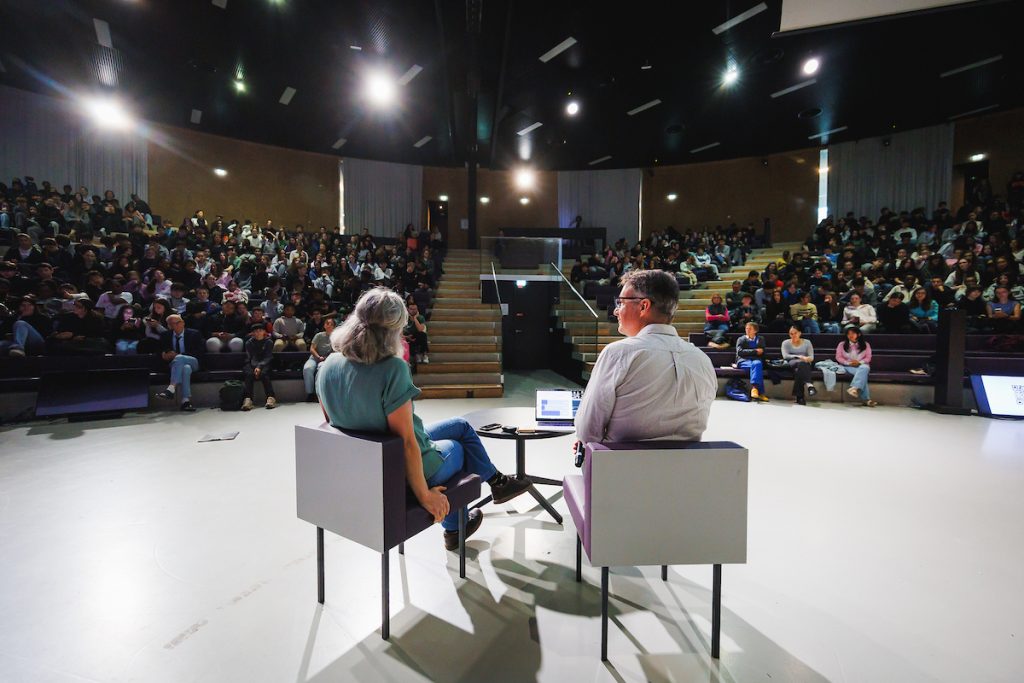
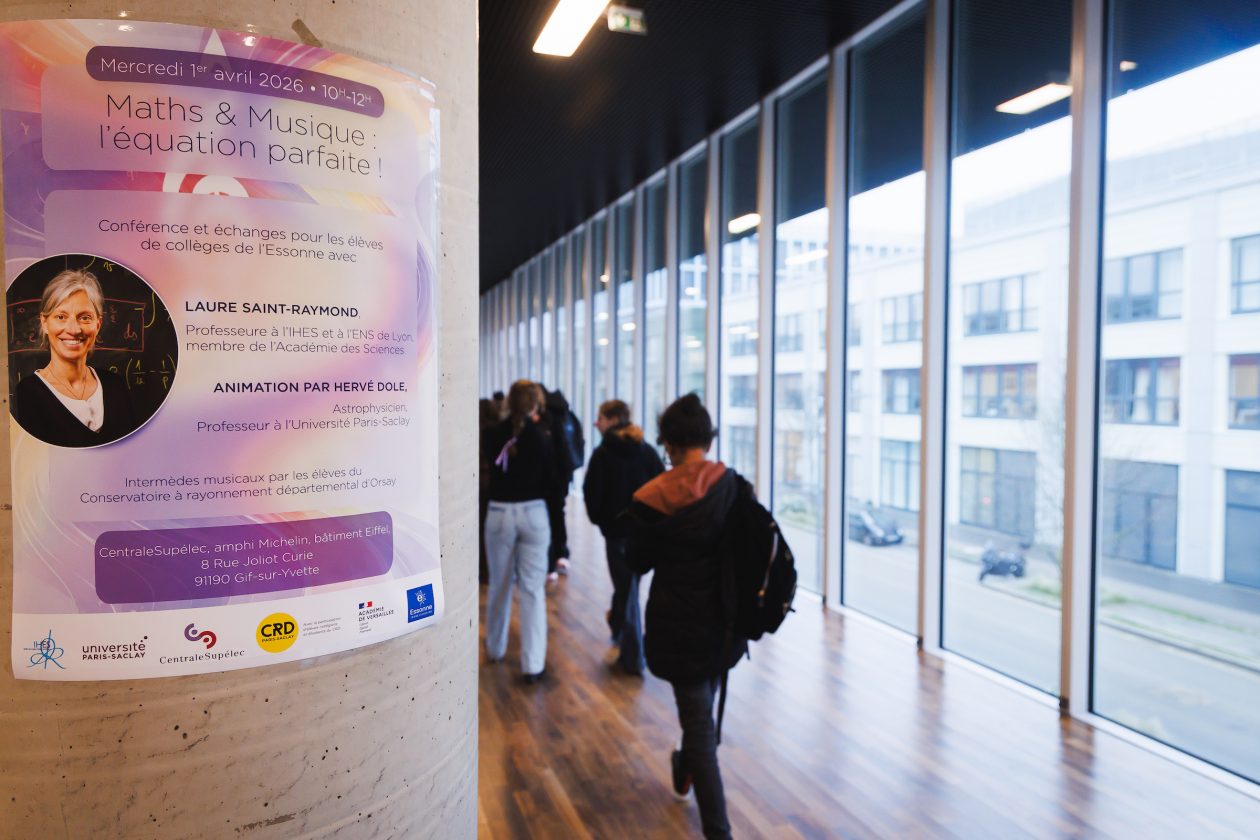
On April 1 and 2, she also gave two lectures in Orsay titled Maths & Music: The Perfect Equation!, aimed at school audiences. On April 1, more than 500 middle school students were welcomed to the Michelin amphitheater at CentraleSupélec. The following day, around 250 high school students attended a second session in the Cartan amphitheater at Université Paris-Saclay. These two events, hosted by Hervé Dole, combined personal accounts of scientific careers, mathematical presentations, exchanges with students, and musical interludes performed by students from the Conservatoire à rayonnement départemental d’Orsay.
Beyond the diversity of formats and venues, this outreach activity is based on constant attention to adapting content to different audiences. The topics covered (random walks, history of mathematics, music, and the education system) are chosen depending on context, current events, or local exchanges.
For Laure Saint-Raymond, mathematics makes it possible to tell many stories—sometimes amusing, sometimes illuminating complex phenomena in physics or biology. She notes that these stories have a particular feature: they reach consensus, regardless of whether one likes them or not.
By multiplying such engagements, Laure Saint-Raymond promotes a vision of mathematics as a living practice, circulating between academic institutions, schools, and public spaces—reminding us that research is not limited to producing results, but is also part of an ongoing dialogue with society.