 IHES
IHES
Tribute to Heisuke Hironaka
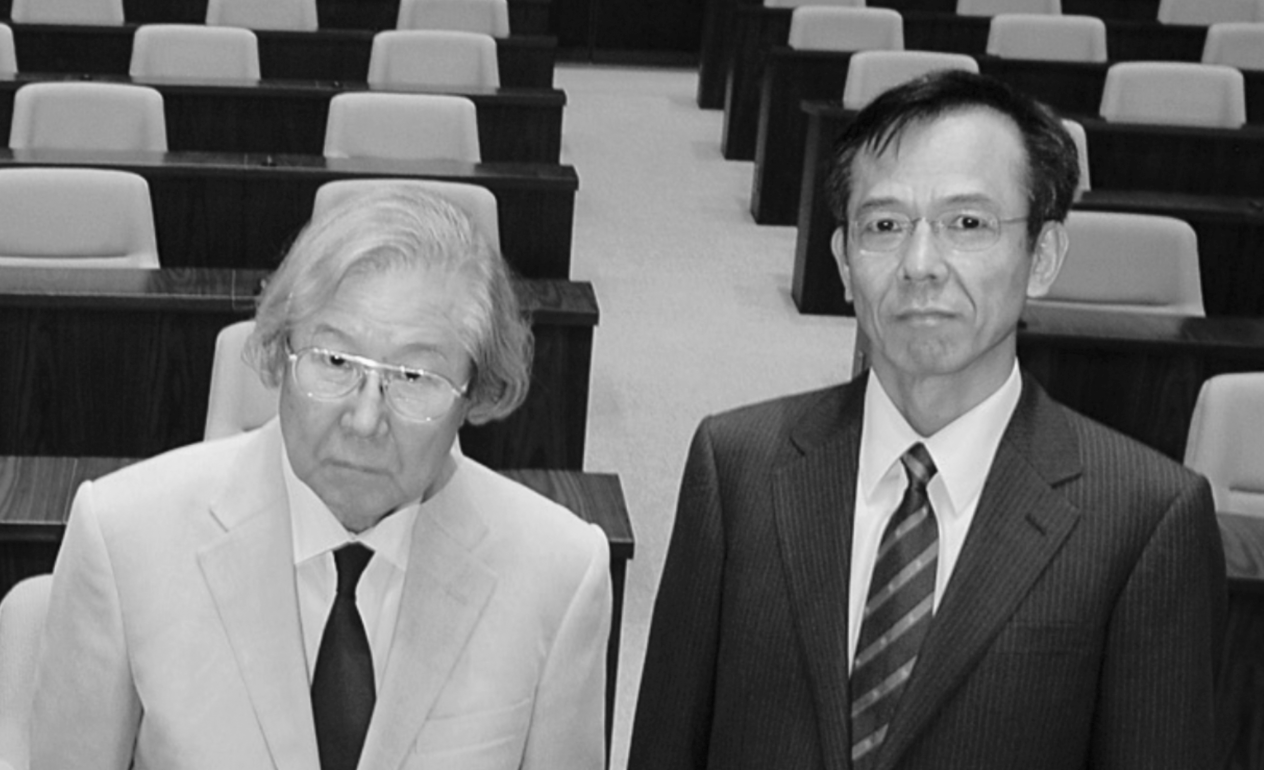
Caption: Taken at the Japan Academy for the occasion of Prof. Hironaka’s interview commemorating the 100th anniversary of the Japan Academy Prize on 13 Sept 2009.
I first met Professor Heisuke Hironaka in the Fall of 1971, when I was a third-year student at Kyoto University. I took his introductory course in Algebraic Geometry from September to March 1972 I had previously studied Algebraic Geometry a little by reading André Weil‘s book “Foundations of Algebraic Geometry”, and Professor Hironaka’s lectures were clear and easy to understand, providing a good opportunity for me to relearn the material. Partway through, Professor Shigeo Nakano of the Research Institute for Mathematical Sciences of Kyoto University (RIMS) asked me to take notes, which also encouraged me.
In fact, I had a valuable experience during that period. While reading Weil’s book, I became curious whether a non-projective compact manifold can exist, and asked Professor Hironaka about it. He quickly drew an illustration and explained about it. I was impressed by the clarity and simplicity of his explanation, which became one of the major motivations for me to pursue Algebraic Geometry. That diagram is cited in Hartshorne’s textbook “Algebraic Geometry” which was published later.
I was deeply impressed by the brilliance of Professor Hironaka’s approach toward singularities after having started my own research. His insight lay in realizing that something as concrete as a birational transformation can be systematically treated by his theory of resolution of singularities only via an extra process of abstraction. Regarding abstraction, I was also attracted by his Harvard doctoral dissertation “On the Theory of Birational Blowing-up,” which deals with cones related to birational morphisms. It was remarkable for its abstraction.
In the summer of 1977, I got a three-year postdoctoral position as assistant professorship at Harvard University, while Professor Hironaka was staying at Kyoto University that year. Soon after meeting him in Harvard in the Summer of 1978, I was able to prove the Hartshorne Conjecture and then to pursue my own mathematical research.
After spending the Fall of 1980 in Japan, I stayed at Harvard University again the Spring of 1981 to finish writing up a paper on the theory of extremal rays which became the basis for my subsequent research, whose starting point for extremal rays was in Professor Hironaka’s doctoral dissertation.
Around that time, my wife and I were invited to his home, and met not only him and his wife, but also their children Eriko and Joe.
We stayed for one year after the Fall of 1981 at the Institute for Advanced Study (IAS) in Princeton for an Algebraic Geometry Year. In the meantime, from May to August, we could stay at Harvard thanks to the support from Professor Hironaka’s Educational Project for Japanese Mathematical Scientists (called then JMS). It was there that I met young researchers such as Takahiro Shiota and Akihiko Yukie, who had also received JMS support. Shigeru Mukai, who was with me at IAS, and Keizo Yamaguchi, who stayed at Columbia University around the same time, also received support from JMS. Many researchers like us, who later played leading roles in Japanese mathematics. could study abroad and achieve results thanks to Professor Hironaka. His project culminated in the creation of the Japan Association for Mathematical Sciences (JAMS) in 1984, and from the following year it provided support to a wider range of researchers. Later, it played a major role in securing related donations for the International Congress of Mathematicians in 1990 in Kyoto, and provided support totaling approximately 100 million Japanese yen until around 2000.
Reading his essay “Fame, Sweet and Bitter” in the Springer book “Miscellanea mathematica”, I realized that his commitment to support mathematical scientists was on a level that few other mathematicians could ever match.
Since 1999, I had been able to meet Professor Hironaka at the Japan Academy once a month, which I looked forward to, but in recent years it became increasingly difficult. The last time I could see him was on the night of the Kyoto Gozan Okuribi (five mountain bonfires) on August 16, 2023. His family organized a get-together for the occasion and we had a beautiful memorable night.
Looking back now, I am deeply grateful to Professor Heisuke Hironaka not only for his academic achievements but also for the generous support to a great number of mathematical scientists.