 IHES
A Look Back at the 2026 IHES Summer School: “Cosmological Correlators”
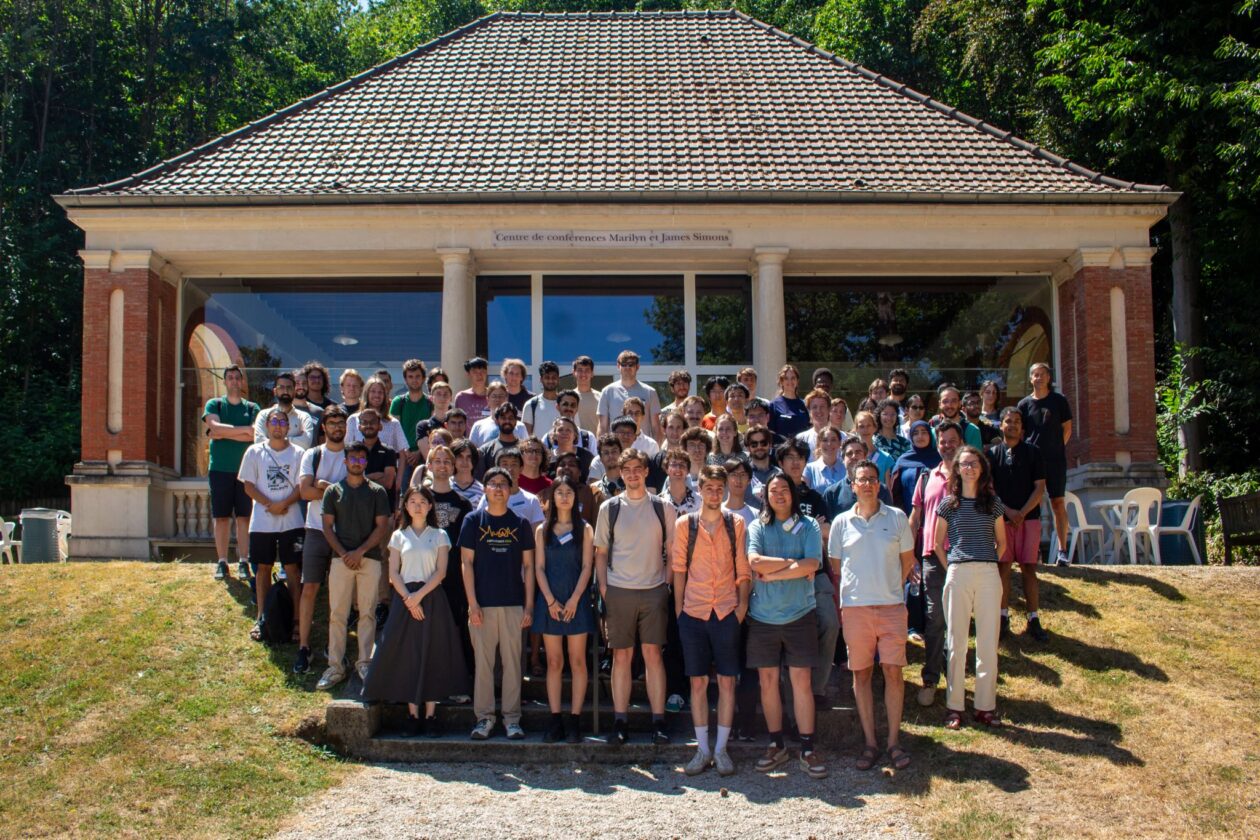
From July 6 to 17, 2026, IHES hosted its summer school in Bures-sur-Yvette, devoted this year to “Cosmological Correlators.” Over two weeks, young scientists from around the world gathered to attend mini-courses and research talks given by experts in theoretical cosmology.
Why a School on Cosmological Correlators?
The sky preserves traces of the early Universe: the tiny temperature variations in the cosmic microwave background, light emitted about 380,000 years after the Big Bang, and the large-scale distribution of galaxies are two examples. “Cosmological correlators,” which gave the school its title, are statistical quantities that compare properties of the sky at different points. Computed from theory and tested against observations, they make it possible to study the physical processes at work in the early Universe.
The field has seen major progress in recent years. At the same time, theoretical cosmology now cuts across the boundaries between subfields of high-energy physics. The school aimed to prepare young researchers to contribute to the study of cosmological correlators, from the early to the late Universe, by offering a broad overview of these topics.
Two Weeks, a Complete Overview
The first week laid the foundations: an introduction to cosmological correlators and the techniques used to compute them, the open quantum systems approach to cosmology, the cosmological bootstrap, and the effective field theory of large-scale structure.
The second week turned to more advanced topics at the interface of particle physics and cosmology: quantum gravity in de Sitter space, positivity in cosmology, physics beyond the Standard Model and cosmological correlators, and the connection between theory and observations.
The IHES Spirit: Time for Exchange
In keeping with the Institute’s tradition, the school left ample room for informal exchanges. Between lectures, on the lawns of the Bois-Marie, over lunch, or during the coffee breaks built into the day, participants and speakers continued discussions begun in the lecture hall. This is precisely what makes a residential school so valuable for early-career scientists.
The school was organized by a committee composed of Daniel Baumann (University of Amsterdam and National Taiwan University), Daniel Green (UC San Diego), Austin Joyce (University of Chicago), and Guilherme Pimentel (Scuola Normale Superiore, Pisa). The scientific committee included Eiichiro Komatsu (Max Planck Institute for Astrophysics), Marilena LoVerde (University of Washington), Eva Silverstein (Stanford University), and Raman Sundrum (University of Maryland).
Acknowledgments
IHES warmly thanks the partners who made this school possible: QRT (Qube Research & Technologies), Société Générale, and the Fondation Mathématique Jacques Hadamard (FMJH). It also thanks CROUS Versailles, and especially Mohamed Bouyanfif, director of the university residences in Bures-sur-Yvette and Orsay, who has supported us since 2006, the year of the very first IHES summer school. This local partnership allows us to offer affordable housing to participants in our summer schools.