 IHES
IHES
When Math Meets High School Students: A Morning of Research at IHES
On Saturday, May 30, 2026, the Institute opened its doors to more than 60 high school students for a morning of immersion at the heart of mathematical research. Through a guided tour and interactive talks, students got a real glimpse of what it truly means to do research.
Nestled in the leafy surroundings of Bures-sur-Yvette, IHES is one of the world’s leading centers for research in mathematics and theoretical physics. That Saturday morning, its walkways and conference rooms welcomed some sixty young visitors eager to discover a world that had, until then, been largely unknown to them.
The morning kicked off with a guided tour of the Institute, giving students a chance to get acquainted with the space and understand how the researchers in residence go about their daily work. Emmanuel Ullmo, the Institute’s director, then took the floor to welcome the students and set the tone for the day: to show that mathematics is not merely a school subject, but a living intellectual adventure, full of open questions and surprises.
Randomness: A More Complex Notion Than It Seems
The first talk, presented by Raphaël Tran-Thanh, plunged students into an unsettling question: what does it actually mean to choose something “at random”?
To illustrate this, he introduced Bertrand’s paradox, a classic problem in geometric probability. The starting question is straightforward: if you draw a chord at random on a circle, what is the probability that the chord is longer than the side of an equilateral triangle inscribed in that circle?
The surprise lies in the possible answers: depending on how you define “randomness” (that is, depending on the method used to select the chord), you get different probabilities, each one mathematically valid. This result highlights a fundamental principle in probability: a question only makes sense if you rigorously specify how randomness is constructed.
The talk was deliberately interactive, inviting students to vote, make mistakes, and reconsider their intuitions.
If Raphaël had one thing to say to the students, it would be: “If there’s one thing I’d tell young high schoolers, it’s to dare to dive into math, to find what excites them about it, and not to let themselves be held back by the idea that they’re not at the right level. All that matters is the desire to try!
Mathematics in the Service of Public Health
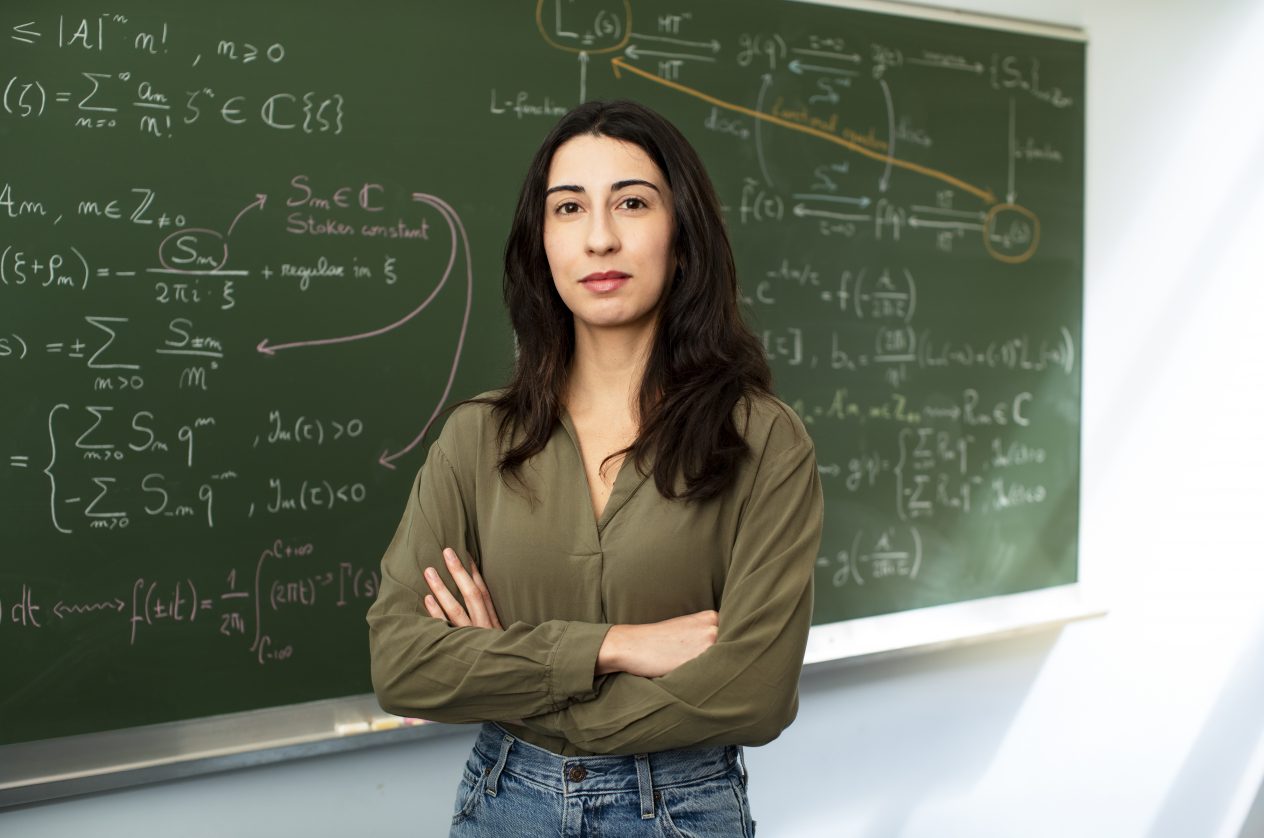
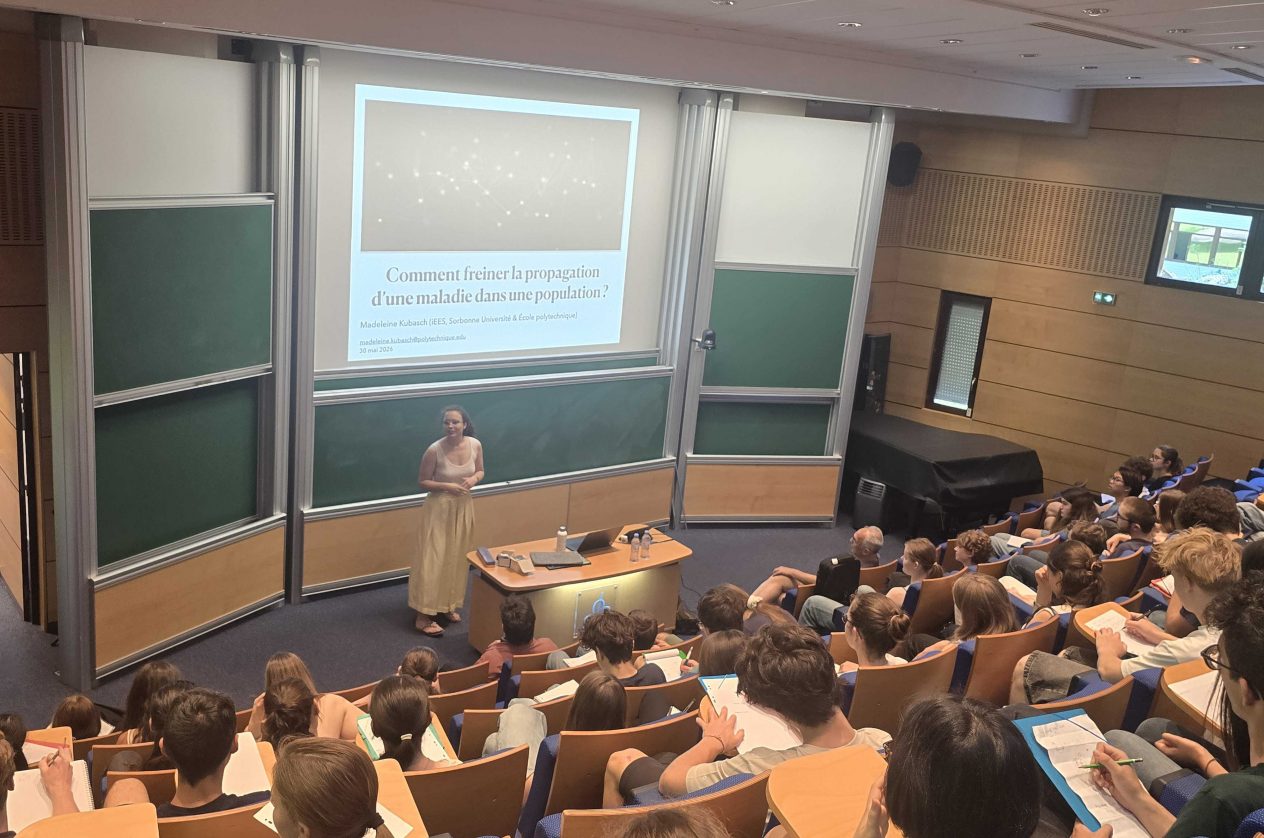
The second talk, given by Madeleine Kubasch, tackled a subject students had experienced firsthand: the spread of disease and the tools used to contain it.
How do you measure the effectiveness of social distancing? What is the real impact of vaccination on an epidemic? Can we predict how quickly a disease will spread through a population? These are exactly the kinds of questions that mathematics — and more specifically, mathematical modeling — can help answer.
Madeleine Kubasch walked students through the principles of epidemiological models: tools that simulate how a disease evolves by factoring in parameters such as transmission rates, the number of contacts between individuals, and vaccine efficacy. These models played a central role in managing the Covid-19 pandemic and continue to shape public health policy around the world.
For the students, this presentation shed light on a reality that often goes unrecognized: abstract mathematics has concrete, life-saving applications that reach far beyond the classroom.
And for those still on the fence, Madeleine had a clear message: “There is no single profile for someone who does math, or science more broadly : it’s the diversity of life paths and educational backgrounds that drives innovation!”
A Mission at the Heart of IHES’s Identity
The morning wrapped up with a few words from the Académie de Versailles, a partner in the event, who commended the quality of the exchanges and the dedication of the speakers.
While IHES is first and foremost a place for fundamental research at the highest level, it has also taken on a mission to share its passion for mathematics as broadly as possible, and especially with the next generation. These encounters with high school students are a direct expression of that ambition: to show that research is accessible, stimulating, and deeply meaningful.
The Institute warmly thanks Raphaël Tran-Thanh and Madeleine Kubasch for the quality and clarity of their presentations, as well as the Académie de Versailles for its support of this initiative.