Greater Paris postdocs in mathematics Welcome Day

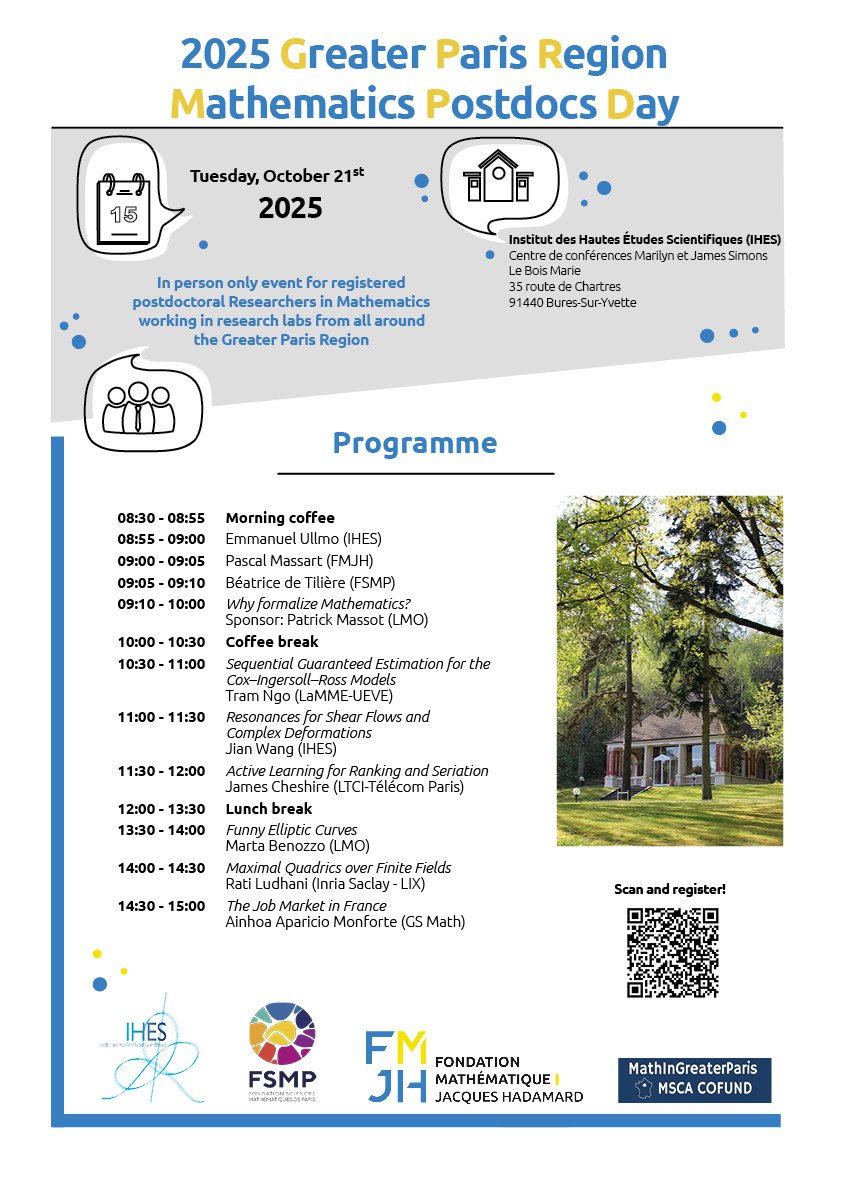
Special event for all math post-doc from Paris Region on Tuesday October 21, 2025, at IHES

This year, the Special event for all math post-doc from Paris Region will take place on Tuesday, October 21, 2025, at IHES, in the Marilyn and James Simons Conference center.

Organized jointly with the FMJH and the FSMP, the goal of this welcome day is to provide young mathematicians with an opportunity to meet their colleagues, help newcomers find out more about the mathematical environment in the Paris region, including possible funding opportunities for future research projects, and give an overview of the French (academic) job market.

To attend this special day, go to the FMJH website to register.

“Mathematics on the Crossroad of Centuries”, a Conference in Honor of Maxim Kontsevich’s 60th Birthday

2024 marks the 60th birthday of mathematician Maxim Kontsevich, a permanent professor at IHES since 1995. A week-long conference is organized at IHES in his honor from September 16 to 20. Registration is open until September 5!

This year marks the 60th birthday of mathematician Maxim Kontsevich, permanent professor at IHES since 1995. In his honor, Denis Auroux (Harvard University), Ludmil Katzarkov (University of Miami), Tony Pantev (University of Pennsylvania) and Yan Soibelman (Kansas State Universtiy & IHES), Yuri Tschinkel, SCGP & New York University organize a week-long conference at IHES from September 16-20, Mathematics on the Crossroad of Centuries.

The work of Maxim Kontsevich has been a unique combination of spectacular ideas in algebra, combinatorics, topology, algebraic geometry, and theoretical physics.

No other mathematician has played such a pivotal role in enhancing the interaction of mathematics and physics on the crossroad of 20th and 21st centuries.

In this week-long meeting we will be celebrating the 60th birthday of Maxim Kontsevich and his profound influence on mathematics.

Please register before September 5, 2024 on the dedicated web page.

Find out more about the guest speakers:

  • Mohammed Abouzaid, Stanford University
  • Mina Aganagić, UC Berkeley
  • Jørgen Andersen, Odense University
  • Denis Auroux, Harvard University
  • Tom Bridgeland, University of Sheffield
  • Vladimir Drinfeld, University of Chicago
  • Pavel Etingof, MIT
  • Kenji Fukaya, SCGP
  • Davide Gaiotto, Perimeter Institute
  • Alexander Goncharov, Yale University
  • Fabian Haiden, Syddansk Odense University
  • Mikhail Kapranov, IPMU
  • Curtis McMullen, Harvard University
  • Takuro Mochizuki, RIMS, Kyoto University
  • Alexander Odesskii, Brock University
  • Tony Pantev, University of Pennsylvania
  • John Pardon, SCGP
  • Yan Soibelman, Kansas State Univ. & IHES
  • Yuri Tschinkel, SCGP & New York University
  • Lauren Williams, Harvard University
  • Don Zagier, MPI Bonn & ICTP

Matrix Models for Quantum Systems – Special Day of the Seed Seminar of Mathematics and Physics

The Seed Seminar of Mathematics and Physics is holding a special day on Matrix Models for Quantum Systems at IHES, organized by Ariane Carrance (CMAP), Matteo D'Achille (LMO), and Edoardo Lauria (LPENS).

The Seed Seminar of Mathematics and Physics is a seminar series that aims to foster interactions between mathematicians and theoretical physicists, with both online and in-person events.

This year, a special day is organized at IHES on June 7, 2024 by par Ariane Carrance (CMAP), Matteo D’Achille (LMO) et Edoardo Lauria (LPENS). The day will focus on Matrix models for quantum systems, with contributions from Guillaume Aubrun (Institut Camille Jordan), Philippe Biane (Laboratoire d’Informatique Gaspard Monge), Bertrand Eynard (Institut de Physique Théorique, CEA Saclay) et Vladimir Kazakov (Laboratoire de Physique, ENS Paris).

Registration is free and open until May 31, 2024.
Registration for either in-person or online participation at the following link: https://indico.math.cnrs.fr/event/12052/registrations/1129/

Researchers associated to IHES are awarded the 2023 Bôcher Prize

Frank Merle, Pierre Raphaël, Igor Rodnianski, and Jérémie Szeftel have been awarded the 2023 Bôcher Memorial Prize of the American Mathematical Society.

A team of four mathematicians, including Frank Merle, holder of the CY Cergy Paris Université-IHES Chair in Analysis, Pierre Raphaël, holder of the Schlumberger Chair for mathematical sciences at IHES and Professor at the University of Cambridge, Igor Rodnianski, Professor at Princeton University, and Jérémie Szeftel, CNRS Research Director at Sorbonne Université and a regular visitor of IHES, have been awarded the 2023 Bôcher Memorial Prize of the American Mathematical Society.

The prize was announced on December 5, and it acknowledges the laureates’ “groundbreaking work establishing the existence of blow-up solutions to the defocusing non-linear Schrödinger equation in some supercritical regimes and to the compressible Euler and Navier-Stokes equations” published in [1,2,3].

The collaboration that led to these results involved long-distance conversations as well as long eye-to-eye discussions, many of which took place at IHES. The four researchers, who have known each other and collaborated on different projects for many years, started working on these problems in 2012.

“Supercritical regimes were unexplored ground, so we needed to develop a completely new theoretical framework”, explains Frank Merle, a mathematician specializing in partial differential equations who has been associated with IHES since 2006 and part time at CY Cergy Paris Université. “There were no rigorous mathematical results, and for a long time it felt like walking in the dark. This implied many trials and errors, especially because intuition based on subcritical and critical regimes revealed not to be the best guide when dealing with systems as complex as the defocusing Schrödinger equation and the compressible Navier-Stokes equation.”

It took about five years to find the key that allowed the quartet to tackle the problem. This was the first, and arguably the most important part of their work: “What is most important, Szeftel explains, is to find the good idea to take advantage of a weak point of the problem, and that takes time because it follows a process that you cannot always control and that requires a deep understanding of the problem”.

After many discussions, a lot of thinking, and some faux pas, the four mathematicians found in 2017 that a specific class of solutions of the compressible Euler equation could be transposed into the compressible Navier-Stokes. That was the key that opened up the way to obtaining singular solutions of the complete equation and of the defocusing Schrödinger equation. “The strength of our team is the diversity of our scientific culture”, says Raphaël. “This creates quite a bit of chaos, and we do get lost many times, but exploring unknown territory in good company is the best part of our job”.

The second part of the work, which led to the publication of an impressive series of three articles totaling more than 450 pages, was more systematic, albeit not easier, and consisted in applying the mathematical skills and expertise that the four mathematicians had honed over years of experience.

Numerical simulations and mathematical intuition had led mathematicians to rule out the possibility of singular solutions for the defocusing non-linear Schrödinger equation, to the point that Fields medalist and former permanent professor at IHES Jean Bourgain had formalized that in a conjecture. The solutions found by the quatuor instead are divergent, thus making the results acknowledged by the 2023 Bôcher Prize all the more groundbreaking.

Frank Merle, who already received the Bôcher Prize in 2005 for his work in the analysis of nonlinear dispersive equations, is the only researcher to have received it twice. “I am very grateful for this award. The Bôcher prize I received in 2005 meant a lot to me, as it was the first time that my work as a mathematician was recognized at a high level. I am particularly happy to be able to share this second prize with Pierre, Igor and Jérémie”.

The Bôcher Memorial Prize is awarded every three years for a notable research work in analysis published in a peer-reviewed journal during the preceding six years. The 2023 prize will be awarded on Wednesday, January 4 during the Joint Prize Session at the 2023 Joint Mathematics Meetings of the AMS in Boston.


[1] On the implosion of a compressible fluid II: singularity formation. Ann. of Math. (2) 196 (2022), no. 2, 779–889. arXiv:1912.11009

[2] On the implosion of a compressible fluid I: smooth self-similar inviscid profiles. Ann. of Math. (2) 196 (2022), no. 2, 567–778. arXiv:1912.10998

[3] On blow up for the energy super critical defocusing nonlinear Schrödinger equations. Invent. Math. 227 (2022), no. 1, 247–413. arXiv:1912.11005

Talk by the mathematician Sergiu Klainerman on April 22, 2021

Friends of IHES and IHES organized an online event on April 22, 2021 at 12.00 pm EST. On this occasion, Sergiu Klainerman gave a talk on “Are Black Holes Real? A Mathematics perspective”.

Friends of IHES and IHES organized an online event on April 22, 2021 at 12.00 pm EST. On this occasion, Sergiu Klainerman gave a talk on “Are Black Holes Real? A Mathematics perspective”.

Sergiu Klainerman is the Eugene Higgins Professor of Mathematics at Princeton University. He is a Partial Differential Equations analyst with a strong interest in General Relativity. His research deals with the mathematical theory of black holes, more precisely on their rigidity and stability. He is also interested in the dynamic formation of trapped surfaces and singularities. Recently, in collaboration with Jeremie Szeftel, Klainerman has published a book in Princeton University Press which establishes the first nonlinear stability result for the Schwarzschild black holes for general polarized perturbations.

He has received several awards including the Bôcher Memorial Prize by the American Mathematical Society, the MacArthur Fellowship and the Guggenheim Fellowship.

Klainerman is a member of the U.S. National Academy of Sciences, a foreign member of the French Academy of Sciences, Fellow of the American Academy of Arts and Sciences and, he was recently elected Fellow of the American Mathematical Society.

He was the co-Editor-in-Chief of Publications mathématiques de l’IHES and is currently a member of Friends of IHES.

To watch the replay.

Test your knowledge on the history of maths with a quiz offered by IHES

IHES invites all math enthusiasts to test their knowledge on mathematics and its history and to discover the Institute with a series of fun questions!

Do you know after whom the equation that many consider to be the most beautiful in mathematics is named? Or how many women have won the Fields Medal since it was awarded for the first time in 1936?

You will be able to answer these and many other questions in a quiz realized by IHES, which will be an occasion to test your knowledge and learn more about the history of mathematics and the Institute in a fun way.

By offering you this quiz, IHES is taking part in the #GivingTuesday initiative, the worldwide movement that encourages generosity and sharing.

Stay connected with IHES on its website and social networks to participate in this initiative and help us spread the spirit of #GivingTuesday. You too will have the opportunity to unleash your generosity and contribute to the advancement of research in mathematics and theoretical physics by making a gift to the Institute.

On December 1st (starting in the morning right after midnight, French time), the first person to donate 300€ (or $300 for US residents) or more will receive a copy of ‘A history of IHES‘, a book retracing the first 60 years of the history of IHES through images and historical texts, explained and commented by Anne-Sandrine Paumier and Josselin Blieck, two historians who worked on the Institute’s archives.

Let us celebrate together our passion for mathematics and sharing. Join us online and take the quiz of IHES!

Conference: “Integrability, Anomalies and Quantum Field Theory”

In honor of the 60th birthday of the physicist Samson Shatashvili, Anton Alekseev and Maxim Kontsevich organised a conference from February 10 to 14, 2020 at the IHES.

From February 10 to 14, 2020, the Institut des Hautes Études Scientifiques hosted the conference “Integrability, Anomalies and Quantum Field Theory“. Organised by Anton Alekseev (University of Geneva) and Maxim Kontsevich (IHES), this conference honoured Professor Samson Shatashvili on his 60th birthday.

The interactions of Mathematics and Physics have greatly intensified during the last three decades, and it led to a number of very significant breakthroughs in Mathematics. Among other things, these breakthroughs include new invariants of 3 and 4-dimensional manifolds, the discovery of mirror symmetry in Algebraic Geometry, and the theory of deformation quantization.
This progress became possible due to close interactions between Mathematics and theoretical Physics and due to the dialogue between mathematicians and physicists working on similar problems but using very different methods.

The conference touched upon two important aspects of interaction between Mathematics and Quantum Field Theory.

Quantum Integrability is a very interesting theory which was first discovered on the Physics side. It was soon realized that it is related to Algebra through the theory of Vertex Operator Algebras (VOA) and to Complex Analysis (through the study of various Riemann-Hilbert problems). The problem of Bethe Ansatz completeness became an important mathematical problem and a driving force in Combinatorics and Representation Theory. Recently, relations between quantum integrability and Geometric Representation Theory (on the Mathematics side) and Quantum Gauge Theory (on the Physics side) attracted a lot of attention of the research community. These links will be one of the major topics of the conference.

Anomalies were discovered in Physics as the phenomenon when symmetry of a system changes under quantization. Famously, it occurs in gauge theories and in string theory, and it serves as one of the key criteria for choosing realistic models of field theory. Anomalies also became one of the important topics in Mathematics. They are related to the behaviour of determinant bundles of Dirac operators on manifolds, to the index theory and to K-theory. In many cases, anomalies represent the part of Quantum Field Theory which can be defined and computed mathematically. Anomalies will be one of the key topics of the meeting.

Professor Samson Shatashvili made deep contributions in the theory of anomalies and in quantum integrability. In particular, in collaboration with Ludwig Faddeev he discovered the interpretation of gauge theory anomalies in terms of abelian extensions of gauge groups on manifolds of odd dimension. In the theory of quantum integrability, together with a number of collaborators he discovered a deep link between Bethe equations and supersymmetric quantum gauge theory.
Professor at the Trinity College, Dublin and at the Simons Center for Geometry and Physics, Stony Brook, he served as a Louis Michel Chair and then as an Israel Gelfand Chair at IHES. He contributed in a significant way in the development of ideas and in the unique research atmosphere of IHES.

Invited speakers were:
Costas Bachas (ENS-Paris), Jean-Michel Bismut (Université Paris-Sud Orsay), Gregory Gabadadze (New York University), Sergei Gukov (Caltech), Simeon Hellerman (IPMU), Chris Hull (Imperial College London), Vladimir Kazakov (ENS-Paris), Zohar Komargodski (SCGP), Vladimir Korepin (Stony Brook University), Manuela Kulaxizi (Trinity College Dublin), Sergei Lukyanov (Rutgers University), Ruben Minasian (IPhT & CEA Saclay), Vasily Pestun (IHES), Alexey Rosly (ITEP, Skoltech, HSE, IITP, Moscow), Sinead Ryan (Trinity College Dublin), Ivo Sachs (LMU Munich), Nana Shatashvili (Tbilisi State University, Georgia), Fedor Smirnov (LPTHE Sorbonne-Université), Leon Takhtajan (Stony Brook University), Anne Taormina (Durham University), Cumrun Vafa (Harvard University), Pierre Vanhove (IPhT & CEA Saclay), Erik Verlinde (Universiteit van Amsterdam), Alexander Zamolodchikov (Stony Brook University).

Programme and registration on the conference web page.

Video playlist of the conference: