 IHES
IHES
Episodes from Heisuke Hironaka’s interaction with French mathematicians
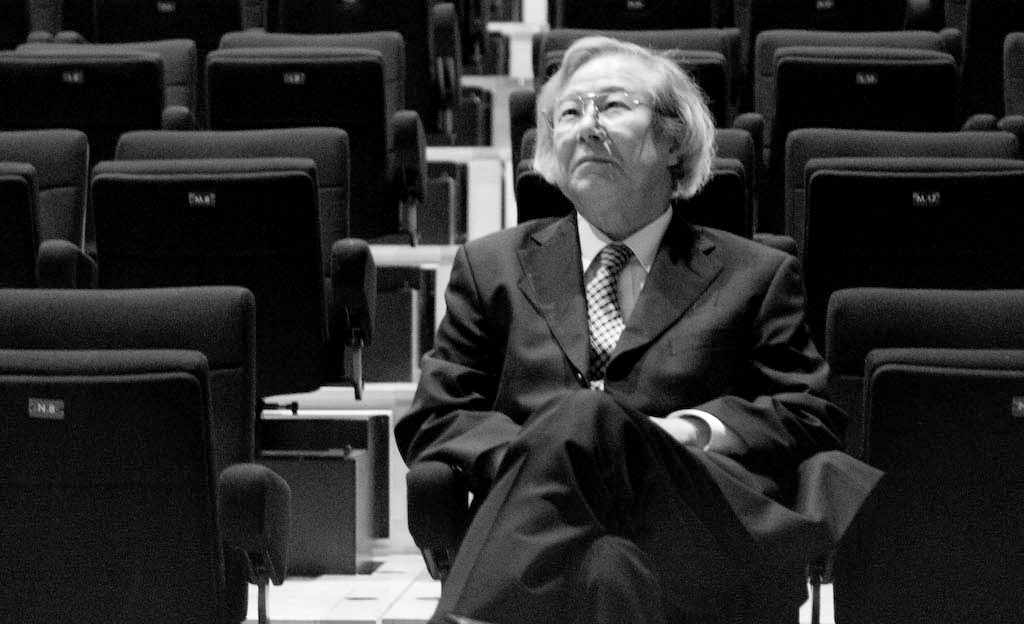
During the 1967–68 academic year, Heisuke Hironaka visited IHES. His work on the resolution of singularities was of interest to French theoretical physicists who were studying the singularities of scattering amplitudes and who had met him at a Battelle conference the previous year.
Hironaka was invited to the thesis defence of one of them, Dimitri Fotiadi. The latter was a member of the Centre de Physique théorique at École Polytechnique, founded by Louis Michel, who was then closely associated with the that had just been established by Laurent Schwartz.
It was there that two young members of the Centre de Mathématiques, Lê Dūng Tràng and the author of these lines, met Hironaka at Fotiadi’s thesis reception, without even knowing whether he was a mathematician. Finding him likeable, we asked him what he was working on, and he replied, “A little commutative algebra”. As we were already drawn to Oscar Zariski’s saturation theory thanks to lectures he had given, the conversation continued and Hironaka offered to give us some lectures. A small group, including Frédéric Pham, Monique Lejeune-Jalabert and Jean-Pierre Henry, therefore gathered around him at IHES in the Spring of 1968, and he spoke to us about singularities of curves, John Milnor’s book “Singular Points of Complex Hypersurfaces” – of which he had the manuscript – and his ideas on equisingularity. Lejeune-Jalabert had been drawn to singularities by a course given by Jean Giraud at Orsay. Giraud was the first established French mathematician to take a close interest in Hironaka’s work on resolution of singularities, and he was of great assistance to young French and Spanish singularity theorists.
Furthermore, Lê Dūng Tràng, myself and a few other young mathematicians had previously made plans to rent a house in Scandinavia during the summer of 1968 so that we could work there together. We asked Hironaka whether he would like to join us and he accepted immediately. When Fotiadi and Jean Lascoux, the director of the Centre de Physique théorique, heard about this plan, as they were aware of the importance of Hironaka’s work, the scale of the project was expanded. The result was a stay of several weeks in Ruuponsaari, Finland, for a dozen mathematicians and physicists, during which Hironaka introduced us to his ideas on the resolution of singularities in complex analytic spaces.
After Finland, the members of the group remained in close contact with Hironaka. Lejeune-Jalabert and I were invited to Harvard in 1970–71 to work on the drafting of his book on the resolution of complex analytic singularities. Then there was the Cargèse conference in 1972 where the small group of French singularists was able to discuss matters not only with Hironaka and Zariski, but also with René Thom, Stanislas Łojasiecicz, Egbert Brieskorn and many others.
Then came the period when the young people grew older and had students of their own. The community of singularists, which had been joined by David Trotman, coming from the English school of Charles T. C. Wall and Christopher Zeeman, grew and diversified considerably. Today, it represents well what, in my view, singularity theory is: a melting pot where algebra, algebraic and analytic geometries, differential topology, dynamical systems and foliations, D-modules, combinatorics, model theory, and I’m sure I’m forgetting some.
The aim of this testimony is to highlight the importance of Hironaka’s (and IHES’) role in the emergence of a group of singularists in France. It is also important to mention that Hironaka worked on a large scale not only to advance mathematics in Japan through his foundation of the Japan Association for Mathematical Sciences (JAMS), but also to foster mathematical links between Japan and France, in particular by supporting IHES.
Bernard Teissier
Université Paris Cité et Sorbonne Université, CNRS, IMJ-PRG, F-75013 Paris, France