Several mathematicians affiliated to IHES are among the researchers who were distinguished with the Frontiers of Science Award in Beijing last July.
Several mathematicians affiliated to IHES are among the researchers who were distinguished with the Frontiers of Science Award during the International Congress of Basic Science whose inaugural edition took place in Beijing on July 16-28.
The award celebrates both basic and applied research results, published during the past five years in the fields of mathematics, theoretical physics and computer science. They must be of highest scientific value and originality and must have made an important impact in one of the three areas of interest. They must also have been published in a peer-reviewed journal.
Among the 134 publications selected overall, two were co-authored by Hugo Duminil-Copin, permanent professor at IHES, professor at the University of Geneva and laureate of the 2022 Fields Medal:
Sharp phase transition for the random-cluster and Potts models via decision trees, published in the Annals of Mathematics in 2019. This paper was co-written by Hugo Duminil-Copin, Vincent Tassion (ETH Zürich), and Aran Raoufi, who spent three years at IHES between 2016 and 2018 as a PhD student, under the supervision of Prof. Duminil-Copin.
Marginal triviality of the scaling limits of critical 4D Ising and $\phi_4^4$ models, published in the Annals of Mathematics in 2021and co-authored by Michael Aizenman (Princeton) and Hugo Duminil-Copin.
Three of the research articles selected for the award were co-authored by Maxim Kontsevich, permanent professor at the Institute:
Canonical bases for cluster algebras, published in the Journal of the American Mathematical Society in 2018, and co-written by Mark Gross (University of Cambridge), Paul Hacking (University of Massachusetts Amherst), Sean Keel (University of Texas), and Maxim Kontsevich.
Specialization of birational types, published in Inventiones mathematicae in 2019, and co-authored by Maxim Kontsevich and Yuri Tschinkel (New York University).
Wick rotation and the positivity of energy in quantum field theory, published in the Quarterly Journal of Mathematics in 2021 and written by Maxim Kontsevich and Graeme Segal (University of Oxford).
The list of publications that were celebrated during the International Congress for Basic Science also includes ‘On the implosion of a compressible fluid II: Singularity formation’, published in the Annals of Mathematics in 2022. This is one of three much celebrated papers co-written by Frank Merle, CY Cergy Paris Université-IHES Chair in Analysis, Pierre Raphaël, holder of the Schlumberger Chair for mathematical sciences at IHES and Professor at the University of Cambridge, Igor Rodnianski, Professor at Princeton University, and Jérémie Szeftel, CNRS Research Director at Sorbonne Université. In addition to the Frontiers of Science Award, their most recent contributions have already earned them the 2023 Bôcher Prize of the American Mathematical Society and the 2023 Clay Research Award, of the Clay Mathematics Institute.
Sébastien Boucksom, editor in chief of the Publications mathématiques de l’IHES, and a CNRS Research Director at Institut de Mathématiques de Jussieu – Paris Rive Gauche, is also among the researchers who were distinguished in Beijing for his paper entitled ‘A variational approach to the Yau-Tian-Donaldson conjecture’, published in the Journal of the American Mathematical Society in 2021 and co-written with Robert J. Berman (University of Gothenburg) and Mattias Jonsson (University of Michigan).
IHES is very proud of the important scientific contributions achieved by the IHES researchers honored with the Frontiers of Science Award and extends its sincere congratulations to all of them!
“Advances in Nonlinear Analysis and Nonlinear Waves”, conference in honor of Frank Merle
In honor of mathematician Frank Merle's 60th birthday, a conference will be organized at IHES and CY Advanced Studies from May 22 to 26, 2023.
Frank Merle has made many important and seminal contributions to the qualitative study of solutions of nonlinear partial differential equations coming from Physics. Merle’s work has been pioneering in the sharp analysis of blowup solutions and of the collision of solitons, as well as in the soliton resolution conjecture. His groundbreaking works have been very influential in the field and beyond.
Throughout his career, Frank Merle received many distinctions, including:
ICM Invited Speaker (1998)
Bôcher Memorial Prize – American Mathematical Society (2005)
Silver Medal – Centre National de la Recherche Scientifique (2005)
ERC Advanced Grant “Blow-up, Dispersion and Solitons” (2011)
ICM Plenary Speaker (2014)
Grand prix Ampère de l’électricité de France – French Academy of Sciences (2018)
Member of the Academia Europaea (2020)
The scientific objective of the conference is twofold. First, several experts in the field of dispersive and wave equations will present their recent advances. A second objective is to propose some conferences in analysis beyond the field of dispersive PDEs. The Scientific Committee hopes that all talks will be accessible to a general audience in analysis.
Scientific Committee: M. Dafermos, A.-L. Dalibard, H. Duminil-Copin, T. Duyckaerts, E. Hebey, Y. Martel, G. Ponce, P. Raphaël, L. Saint-Raymond et H. Zaag
Organising Committee: C. Collot, R. Côte, F. Demengel, T. Duyckaerts, J. Jendrej, Y. Lan, E. Logak, Y. Martel, C. Muñoz, P. Raphaël, J. Szeftel, N. Tzvetkov et H. Zaag
Researchers associated to IHES are awarded the 2023 Bôcher Prize
Frank Merle, Pierre Raphaël, Igor Rodnianski, and Jérémie Szeftel have been awarded the 2023 Bôcher Memorial Prize of the American Mathematical Society.
A team of four mathematicians, including Frank Merle, holder of the CY Cergy Paris Université-IHES Chair in Analysis, Pierre Raphaël, holder of the Schlumberger Chair for mathematical sciences at IHES and Professor at the University of Cambridge, Igor Rodnianski, Professor at Princeton University, and Jérémie Szeftel, CNRS Research Director at Sorbonne Université and a regular visitor of IHES, have been awarded the 2023 Bôcher Memorial Prize of the American Mathematical Society.
The prize was announced on December 5, and it acknowledges the laureates’ “groundbreaking work establishing the existence of blow-up solutions to the defocusing non-linear Schrödinger equation in some supercritical regimes and to the compressible Euler and Navier-Stokes equations” published in [1,2,3].
The collaboration that led to these results involved long-distance conversations as well as long eye-to-eye discussions, many of which took place at IHES. The four researchers, who have known each other and collaborated on different projects for many years, started working on these problems in 2012.
“Supercritical regimes were unexplored ground, so we needed to develop a completely new theoretical framework”, explains Frank Merle, a mathematician specializing in partial differential equations who has been associated with IHES since 2006 and part time at CY Cergy Paris Université. “There were no rigorous mathematical results, and for a long time it felt like walking in the dark. This implied many trials and errors, especially because intuition based on subcritical and critical regimes revealed not to be the best guide when dealing with systems as complex as the defocusing Schrödinger equation and the compressible Navier-Stokes equation.”
It took about five years to find the key that allowed the quartet to tackle the problem. This was the first, and arguably the most important part of their work: “What is most important, Szeftel explains, is to find the good idea to take advantage of a weak point of the problem, and that takes time because it follows a process that you cannot always control and that requires a deep understanding of the problem”.
After many discussions, a lot of thinking, and some faux pas, the four mathematicians found in 2017 that a specific class of solutions of the compressible Euler equation could be transposed into the compressible Navier-Stokes. That was the key that opened up the way to obtaining singular solutions of the complete equation and of the defocusing Schrödinger equation. “The strength of our team is the diversity of our scientific culture”, says Raphaël. “This creates quite a bit of chaos, and we do get lost many times, but exploring unknown territory in good company is the best part of our job”.
The second part of the work, which led to the publication of an impressive series of three articles totaling more than 450 pages, was more systematic, albeit not easier, and consisted in applying the mathematical skills and expertise that the four mathematicians had honed over years of experience.
Numerical simulations and mathematical intuition had led mathematicians to rule out the possibility of singular solutions for the defocusing non-linear Schrödinger equation, to the point that Fields medalist and former permanent professor at IHES Jean Bourgain had formalized that in a conjecture. The solutions found by the quatuor instead are divergent, thus making the results acknowledged by the 2023 Bôcher Prize all the more groundbreaking.
Frank Merle, who already received the Bôcher Prize in 2005 for his work in the analysis of nonlinear dispersive equations, is the only researcher to have received it twice. “I am very grateful for this award. The Bôcher prize I received in 2005 meant a lot to me, as it was the first time that my work as a mathematician was recognized at a high level. I am particularly happy to be able to share this second prize with Pierre, Igor and Jérémie”.
The Bôcher Memorial Prize is awarded every three years for a notable research work in analysis published in a peer-reviewed journal during the preceding six years. The 2023 prize will be awarded on Wednesday, January 4 during the Joint Prize Session at the 2023 Joint Mathematics Meetings of the AMS in Boston.
[1] On the implosion of a compressible fluid II: singularity formation. Ann. of Math. (2) 196 (2022), no. 2, 779–889. arXiv:1912.11009
[2] On the implosion of a compressible fluid I: smooth self-similar inviscid profiles. Ann. of Math. (2) 196 (2022), no. 2, 567–778. arXiv:1912.10998
[3] On blow up for the energy super critical defocusing nonlinear Schrödinger equations. Invent. Math. 227 (2022), no. 1, 247–413. arXiv:1912.11005
Trimester on nonlinear waves
A series of special events on nonlinear waves took place at IHES during the trimester between 2 May and 29 July, 2016. Together with the regular seminars and workshops that were organised weekly, three main events characterised the scientific life of IHES during this time: two five-days conferences and a summer school, between the 18th and the 29th July.
Over the course of the trimester, the programme brought together 80 leading scientists in the field, together with many students during the summer school. It was made possible with the support of the European Commission via an ERC Advanced Grant (Principal Investigator: F. Merle): “Blow up, dispersion and solitons (Blowdisol)” hosted by Université de Cergy-Pontoise. Contributions from Société Générale and the Clay Mathematics Institute were also essential to the organisation of the summer school which concluded this wonderful trimester.
Two of the IHES trimester organisers had already organised a thematic semester in the spring of 2009 called “Nonlinear waves and dispersion”.The objective of this previous programme was to take stock, after almost twenty years of developments linked to the “model” nonlinear dispersive equations, from Korteweg-de-Vries to non-linear Schrödinger, as well as wave equations in their various forms.This work, initiated mostly in the United States by researchers with a background in harmonic analysis (C.Kenig,G.Ponce,L.Vega, J. Bourgain), naturally came across the pioneering efforts in Europe of J. Ginibre, G.Velo, J.-C. Saut, then H. Bahouri, J.-Y. Chemin, P. Gérard, F. Merle and many others after them.
The 2009 programme had been very successful, with a high participation rate from many high-calibre researchers invited from abroad, sometimes for the entire programme, and at least for a month.
In a way, the programme had marked the end point of a cycle of activity in the field of dispersive equations, centred around Cauchy problems for the various model equations. It had at the same time enabled a number of the then latest developments to be presented: the analysis of blow-up models such as focusing Schrödinger, together with concentration- compactness-rigidity methods (which have spread beyond dispersive models).
In some respects, current scientific activity in the field is much more varied than four or five years ago, as can be seen in the scientific activity undertaken during the thematic trimester at IHES: the analysis of the main dispersive toy models has shifted to tricky points relating to the asymptotic behaviour of solutions, be that in the precise dynamical description of blow-up models,in the progress made towards the soliton resolution conjecture, with the analysisofcollisionsbetweenmultiplesolitons,orin studying the stability of breather-type solutions.The emergence of a corpus of clearly identified tools has also highlighted their versatility, their deployment on models other than dispersive models having proved productive, in particular on geometric dispersive equations that were out of reach until recently (for example, the analysis of blow-up dynamics for Schrödinger maps) and also, as already mentioned, to revisit parabolic equations. More generally, classification theorems on the behaviour of solutions of various nonlinear systems are now within reach; there was a full programme of presentations during the trimester (given by C. Kenig during seminars, Hadamard Foundation lectures and the summer school) on the recent results achieved by T. Duyckaerts, C. Kenig and F. Merle on the soliton resolution of solutions for energy-critical focusing nonlinear wave equation.
At the same time, a great deal of development on dispersive effects is being done on much more sophisticated models,oftenclosertophysicalreality. Even simpler yet “physical” models such as the (nonlinear) Dirac equation present difficulties not encountered to date with waves or Schrödinger. The IHES trimester enabled many researchers from different backgrounds to interact on fluid models such as water waves and more generally on wave/dispersive-type models, which appear in many “asymptotic” derivations of fluid phenomena. Dispersive effects have played a key role in the latest existence and asymptotic behaviour results, which were presented during seminars, the two conferences and the summer school. In the context of water waves, asymptotic behaviour is the area of chief interest, as are models that are increasingly sophisticated and close to physical reality (surface tension, finished depth, etc.)
New developments are occurring, in particular in the case of 2D, which is the most difficult: there is a phase shift phenomenon in the study of scattering which had not to date been studied on a quasilinear problem. All these results are promising, because they introduce new tools, liable to being applied in various ways in the field of dispersive fluid models and beyond.
Interesting developments are also to be found in the study of vortex filaments, in connection with geometric dispersive equations such as “Schrödinger maps” or mKdV, which were presented during the trimester. Even in a vacuum, understanding the geometry of space-time requires the analysis of sophisticated quasilinear wave equations; many achievements in the field of general relativity, some of which were directly influenced by the rapid progress in the analysis of dispersive models, were presented and discussed during the various trimester events.
Let us recall that this area of research has seen a number of major advances in recent years, including “the L2 curvature conjecture” (S. Klainerman, I. Rodnianski et J. Szeftel) and the linear stability of the Kerr family of metrics (M. Dafermos, I. Rodnianski, D. Tataru, etc.), two issues where an understanding of dispersive phenomena plays a key part.The formation of trapped surfaces (D. Christodoulou, S. Klainerman, I. Rodnianski) also forms part of asymptotic analysis, with tools very similar to microlocal analysis, and the trimester provided a forum for presenting the latest developments on these very active topics.
In addition, linear equations continue to generate significant work, in contexts closer to realistic physical models:“sophisticated” geometry (variable metrics, possibly not very regular, existence of boundary conditions, influence of the environment’s geometry on propagation and dispersion).
A growing area of research should also be mentioned here, in a field of investigation that is at the interface of dispersive PDEs and probability; it has seen rapid development with the study of nonlinear dispersive equations, where the initial datum is almost certainly chosen in a space that is out of reach of deterministic theories.
The IHES trimester had a number of objectives: taking stock of this new cycle, started a few years ago, paying special attention to young researchers in the field, where the ever-growing complexity of the work is an increasing challenge in the early stages of one’s career. Another objective was to bring together researchers for whom areas of convergence are even more obvious than they were in 2009: let us mention here the large French community engaged in the mathematical study of fluid models, kinetic theory, dynamical systems and partial differential equations linked to infinite-dimensional Hamiltonian systems. In the United States, the work around dispersive modems, fluid and nonlinear wave mechanics (in particular when linked to general relativity and mathematical physics) is expanding rapidly (as evidenced by the success of the large-scale thematic programme at MSRI in the autumn of 2015).There are now recognised areas of overlap among all these communities and the scientific activity of the IHES trimester has made it possible to bring together the various strands of research, by providing opportunities for productive interactions among scientists from different backgrounds.
The IHES trimester was a success, as evidenced by the large number of invited professors who stayed at the Institute for several weeks, several months even, for some of them (more than 80 invited professors over the course of the three months), and by the very high demand for the summer school which concluded the scientific programme. Although it is too early to assess the scientific impact of the trimester itself – beyond noting that the continuum of work from autumn at the MSRI to July in Bois-Marie seems to have accelerated a number of developments – a number of trends can be mentioned: the objective of classifying the behaviour of Hamiltonian partial differential equation models no longer seems unattainable, a complete solution to the soliton resolution conjecture for nonintegrable models has never been so close to being found; techniques arising from dispersive models are now prevalent in most of the work relating to mathematical physics equations, general relativity and fluid mechanics. It is striking to note that an increasing number of researchers are working indifferently on these various themes and that progress in one quickly spreads to related themes.
The trimester on nonlinear waves ended with a two-week summer school, alternating mini-lectures, aimed at presenting active research topics, with more traditional presentations of research work.
The trimester on nonlinear waves ended with a two-week summer school, alternating mini-lectures, aimed at presenting active research topics, with more traditional presentations of research work.
The mini-lectures were given by R. Frank (California Institute of Technology), C. Kenig (University of Chicago), N. Masmoudi (Courant Institute of Mathematical Sciences), B. Pausader (Brown University), M. Procesi (Universita di Roma 1), R. Strain (University of Pennsylvania), D.Tataru (University of California at Berkeley). They showed the range and thematic depth of the trimester, as illustrated by the presentation titles (listed in the above order of speakers):
• “A microscopic derivation of Ginzburg-Landau theory”;
• “Soliton resolution for the energy critical wave equation”;
• “Stability of the 3D Couette Flow”;
• “Asymptotic behavior for the cubic nonlinear Schrödinger equation on product spaces”;
• “Recurrent and diffusive dynamics for the NLS equation on tori”;
• “On theVlasov-Maxwell System in theWhole Space;”
• “Two dimensional water waves”.
The more traditional presentations were given by S. Bianchini (SISSA), R. Carles (CNRS – IMAG Montpellier), S. Gustafson (University of British Columbia), J. Krieger (EPFL), H. Lindblad (Johns Hopkins University), H. Matano (School of Science, University of Tokyo), N. Pavlovic (University of Texas at Austin), R. Pego (Carnegie Mellon University), S. Roudenko (George Washington University), G. Staffilani (Massachusetts Institute ofTechnology),T.-P.Tsai (University of British Columbia), N. Visciglia (Universita di Pisa), S. Wu (University of Michigan), on themes related closely or loosely to the topics of the previous mini-lectures.
Société Générale has been sponsoring every summer school since 2006.
And also
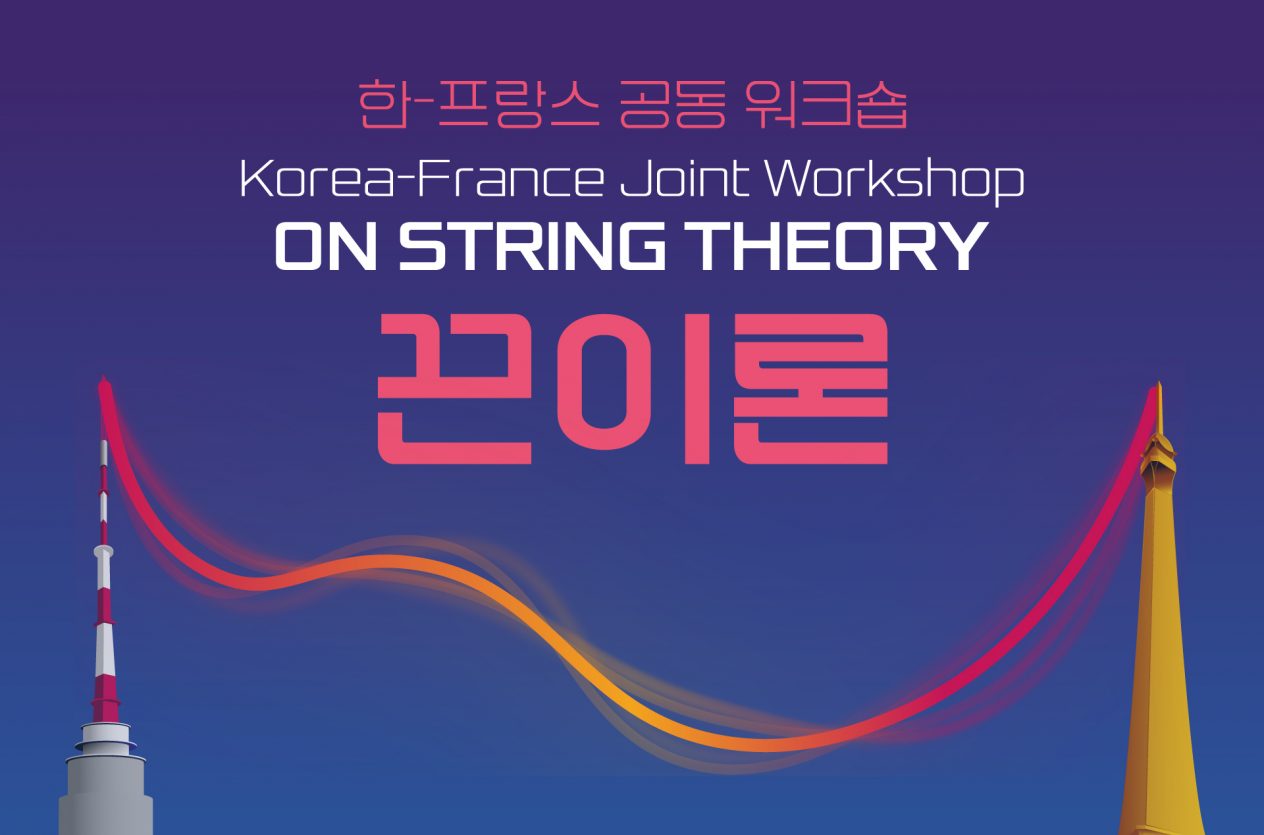
Korea-France Joint Workshop on String Theory
From September 15 to 18, Piljin Yi (KIAS), Sangmin Lee (KIAS), Sungjay Lee (KIAS), Ruben Minasian (IPhT, CEA Saclay), Julio Parra Martinez (IHES) and Eric Perlmutter (IPhT, CEA Saclay) will organize a Korean-French Workshop on String Theory.
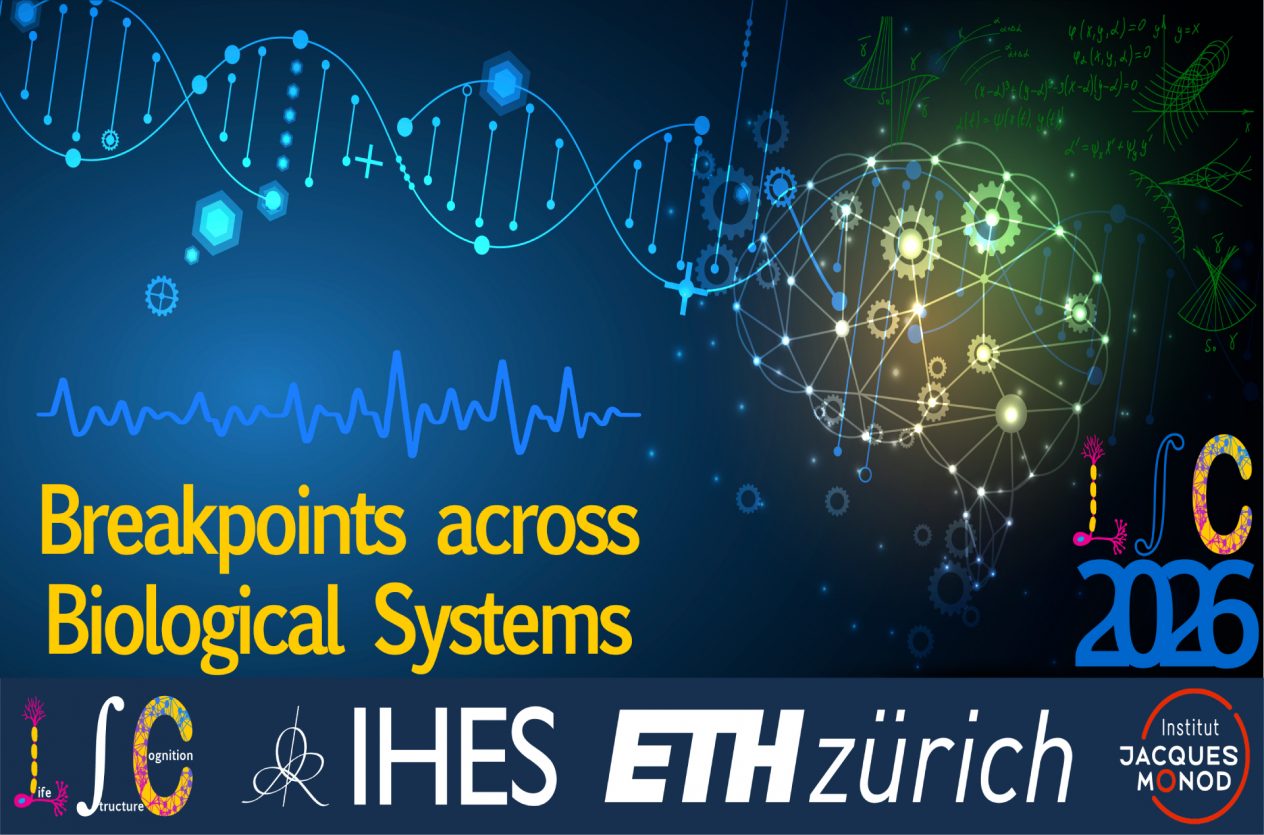
Life, Structure and Cognition (LSC) 2026: Breakpoints across Biological Systems
LSC, pour Life, Structure, and Cognition (Vie, Structure et Cognition) is an initiative with the aim of learning about and exploring the modalities for cooperative progress between Biology and Artificial Intelligence. June 22-25 for the 2026 LSC.
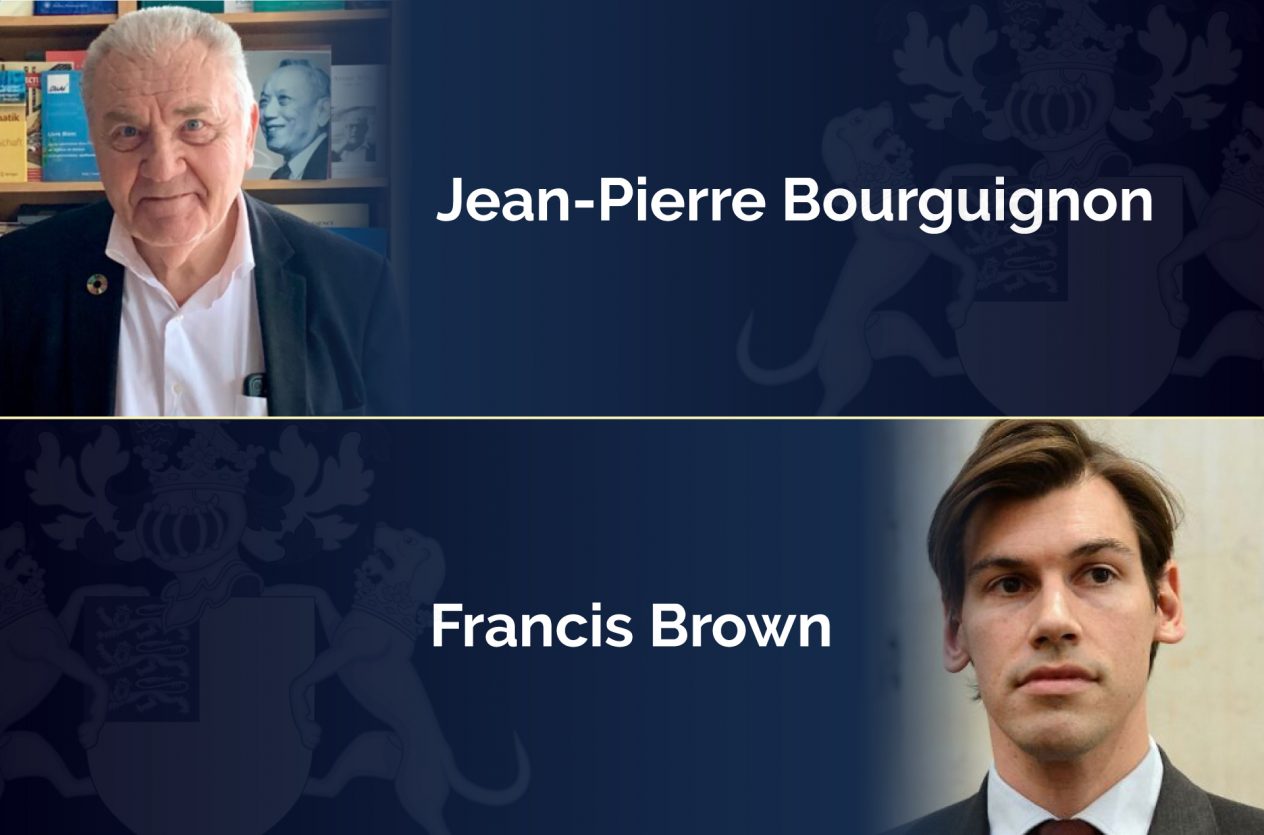
Jean-Pierre Bourguignon and Francis Brown elected Fellows of The Royal Society
IHES is proud to share that Jean-Pierre Bourguignon, former Director of IHES, and Francis Brown, former CNRS Researcher at IHES, have been elected Fellows of The Royal Society.
Nous utilisons les cookies pour améliorer votre expérience sur notre site Web. En parcourant ce site, vous acceptez notre utilisation des cookies.
We use cookies to enhance your experience on our website. By browsing this site, you agree to our use of cookies.
This website uses cookies to improve your experience while you navigate through the website. Out of these, the cookies that are categorized as necessary are stored on your browser as they are essential for the working of basic functionalities of the website. We also use third-party cookies that help us analyze and understand how you use this website. These cookies will be stored in your browser only with your consent. You also have the option to opt-out of these cookies. But opting out of some of these cookies may affect your browsing experience.