Tribute to Jim Simons by Jean-Pierre Bourguignon

James Harris Simons, known to all as Jim, died on Friday 10 May after a long illness, following an extraordinary life as a mathematician, an investor creating new standards and a philanthropist.

James Harris Simons, known to all as Jim, died on Friday 10 May after a long illness, following an extraordinary life as a mathematician, an investor creating new standards and a philanthropist.

Jim was an exceptional mathematician because few of us have contributed, as he did, three major results in distinct fields, even though they are all related in one way or another to differential geometry: in his thesis, he developed his conceptual approach to the identification of holonomy groups of Riemannian metrics (revisiting Marcel Berger’s thesis); he discovered the possibility for minimal hypersurfaces of the sphere to be singular from dimension 8 onward and finally, from the analysis of the boundary term of a 4-dimensional invariant, he introduced the Chern-Simons functional, a concept whose impact has been considerable beyond mathematics, in theoretical physics in particular. And all this in just 15 years!

First of all, it is as a mathematician that I am indebted to Jim because, in 1972, he invited me to join the Stony Brook department that included no less than 14 differential geometers, many of them very young like Yau Shing Tung, and most of them attracted by Jim himself. I also owe it to him to have been exposed, just before the mid-1970s, to the beginning of the very positive interactions between mathematicians and theoretical physicists around gauge theories. This was possible thanks to the excellent quality of the physics department at the University – where Yang Cheng Ning was based. Jim was in contact with him, a type of contact which was not common at the time. It was in this context that a little later, inspired by some mathematical work Jim had done shortly before his new life as an investor started – which he had presented at a conference in Tokyo –, Blaine Lawson and I came up with a result whose announcement he eventually agreed to co-sign. To get him to do so, we had to insist heavily. His line of argument was that he had not contributed directly to our result.

Others than myself are competent to comment on the methodological breakthrough in the world of finance that was the creation of Renaissance Technologies by Jim and a few friends and its exceptional success, which made him a billionaire in just fifteen years.

In 1994, he and his wife Marilyn set up the Simons Foundation, which has enabled them to provide very substantial support to a number of fundamental research projects. Initially, the Foundation concentrated on the fields of autism and mathematics, and then acted much more broadly. I became director of IHES also in 1994, but was soon faced with a difficult financial situation. I was very grateful when, in 1998, he himself suggested to make a donation to the Institute, the first of many. But their help took a structural turn when the IHES developed, on his advice in particular, a policy of seeking patrons on an international scale. This scale is the only one appropriate for an institute that is by nature completely open to the world. This was the start of a long adventure, during which their contribution often made all the difference.

Their support was for example decisive in building the Conference Centre at the Institute, which bears their name. It has become a fundamental tool in completing the Institute’s range of tools for sharing scientific ideas and facilitating exchanges under the best possible conditions.

The latest stage in Jim’s involvement in the life of IHES has been his appointment in 2014 as a member of the Board of Directors, followed by the recent consolidation of the Friends of IHES in the United States, under his and Marilyn’s leadership, with the constitution of its own funds doubled by the Simons Foundation International.

This exceptional friendship, which has had such a strong impact on my professional life, found a form of consecration in the interview he gave me last year. On the initiative of Dennis Sullivan, on the eve of his 85th birthday, he answered my questions on the birth of the Chern-Simons theory. For that, I am also very grateful to him.

Interacting with Jim was always a pleasure, as he was such a good listener, passionate as he was about discovery, the daughter of curiosity. Driven by a sense of mission, he was always available to explore other ways of providing support. We can’t talk about Jim without mentioning his great sense of humour and self-deprecation, which is by no means feat for someone who reached the heights he did. A great creator has just left us, and I personally have lost a friend to whom I owe so much.
In Memoriam: Jim Simons (1938-2024)

With deep sorrow, IHES shares the news of Jim Simons' passing last Friday, May 10th, 2024. Jim Simons was an award-winning mathematician, a legend in quantitative investing, and an inspired and generous philanthropist.

With deep sorrow, IHES shares the news of Jim Simons’ passing last Friday, May 10th, 2024.

Jim Simons was an award-winning mathematician, a legend in quantitative investing, and an inspired and generous philanthropist.

He chaired the math department at Stony Brook University in New York, and his mathematical breakthroughs during that time are now instrumental to fields such as string theory, topology and condensed matter physics.

In 1978, Jim founded what would become Renaissance Technologies, a hedge fund that pioneered quantitative trading and became one of the most profitable investment firms in history. He then turned his focus to making a difference in the world through the Simons Foundation, Simons Foundation International, Math for America and other philanthropic efforts.

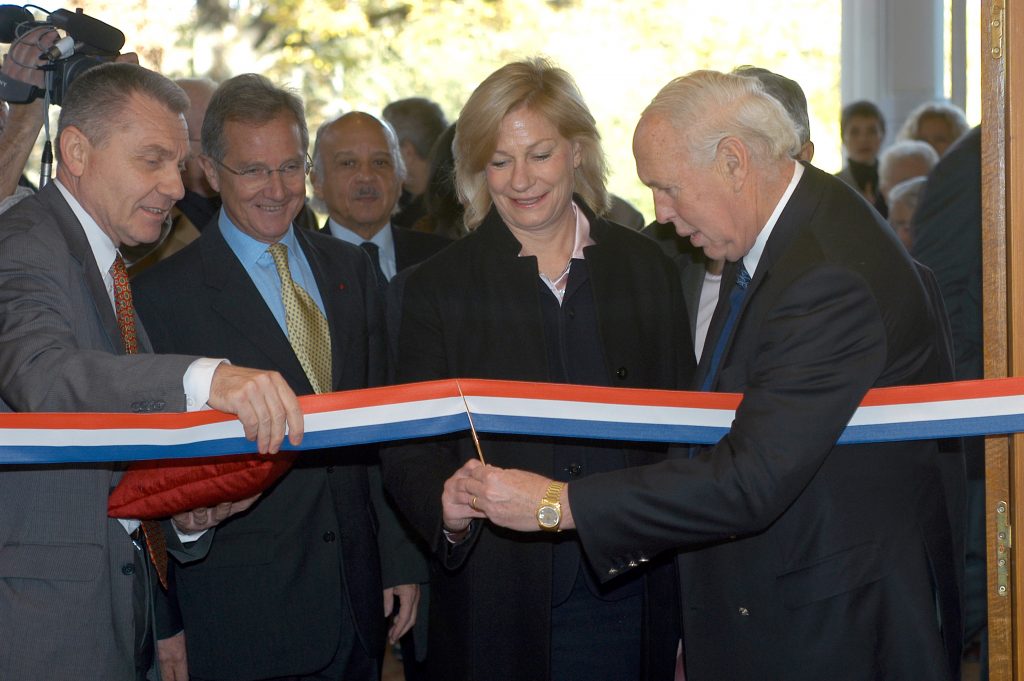
Jim first visited IHES in the seventies and he stayed very close to the Institute ever since. Together with his spouse Marilyn, they are the Institute’s most significant donors and their support of IHES has been completely transformative and unparalleled. The Institute’s most iconic building, the Marilyn and James Simons Conference Center, is named after them.

Jim was personally involved in ensuring the success and development of IHES. He was a member of the IHES Board of Directors since 2014. In 2022, Jim and Marilyn Simons also became Co-Chairs of Friends of IHES, the Institute’s partner organization in the United States. Together, they successfully established a complementary endowment fund for IHES in the United States.

In recognition for all the support he gave to IHES, and more generally to French mathematics and fundamental research, facilitating scientific cooperation and dialogue at an international level, Jim Simons was awarded the Legion of Honor in 2016 by the French Ambassador to the United States Gérard Araud.

Over the past few days, numerous tributes to Jim Simons have been shared in the media and on social networks, and I too would like to honor the legendary figure that Jim was.
In the private sector, many of us harbor a deep passion for mathematics—its elegance and beauty, particularly those with a scientific background. Some of us even persist in keeping abreast of the latest advancements in our respective fields of interest. Few among us began our careers in academia, and even fewer are those who excelled in it. As a brilliant mathematician, Jim was thus already an exception when he started in finance. His extraordinary success with Renaissance Technologies made him truly one of a kind.
And yet, beyond his achievements in mathematics and finance, it is certainly the extent of his philanthropic efforts that is most remarkable. As the president of IHES, which has benefited from the unwavering generosity of Jim, his wife Marilyn, and the Simons Foundation
for over 25 years, I have witnessed the tremendous impact of their commitment and support. It was an honor but also a real pleasure to have Jim among the members of the Institute’s board of directors.”
— Marwan Lahoud, President of the IHES Board of Directors

Read Emmanuel Ullmo’s personal tribute to Jim Simons here. 

Read Jean-Pierre Bourguignon’s tribute to Jim Simons here.

Read Jean-Pierre Bourguignon’s and Antoine George’s tribute to Jim Simons published in the French newspaper Le Monde here.

Read Thibault Damour’s tribute to Jim Simons here.

Read Vasily Pestun’s tribute to Jim Simons here.

Read Jim Simons’ Return to Mathematics by Dennis Sullivan here.

Looking back at the conference by Catherine Goldstein and Clémence Perronnet

On Thursday, April 4th, IHES welcomed over a hundred participants for a conference by Catherine Goldstein and Clémence Perronnet on female models in science.

On Thursday, April 4th, IHES welcomed over a hundred participants, including a large number of students from Université Paris-Saclay and École polytechnique, for a conference by Catherine Goldstein and Clémence Perronnet on female models in science, and particularly in mathematics. This event marked the inauguration of the “Just Do Maths” exhibition at IHES.

Following words of welcome by Emmanuel Ullmo, Director of IHES, and Pierre Pansu, Director of Université Paris-Saclay’s Graduate School in Mathematics, Audrey Antoine, a Master’s student in Applied Algebra and moderator of the event, shared her own experience as a woman in STEM and reflected on the importance of mentors such as Susanna Zimmermann, a mathematician at Orsay, whose guidance helped her envision a career in mathematics for herself.

Catherine Goldstein then started the conference by providing her perspective as a historian of mathematics on often-cited female role models in science, such as Hypatia or Sophie Germain. With only very few historical sources for Hypatia, and an often-romanticized story for Sophie Germain, these examples of role models in fact contribute to the dissemination of false, at best stereotyped images of women in science. Catherine Goldstein, therefore, emphasized the importance of authentic testimonies from female scientists to provide young students with real-life examples of possible scientific careers.

Clémence Perronnet’s talk was based on the chapter “Models – Do female models create vocations among girls?” from the book “Matheuses”, of which she is a co-author, and which was just published by CNRS Éditions. In this sociological study, she drew on the testimonies of 45 high school girls participating in a mathematics workshop at CIRM to analyze the influence that female models can have on creating vocations among girls with a firm interest in mathematics. Echoing Catherine Goldstein’s remarks, Clémence Perronnet argued that the existence of female role models is not a sufficient condition to inspire young girls to pursue studies, and eventually a career in science and mathematics. She emphasized the importance of not only highlighting the pathways of female scientists but also ensuring diversity of profiles to allow as many people as possible to find models to identify with.

The event ended with an engaging Q&A session that continued during the cocktail.

The recording of the event is now available on the Institute’s YouTube channel.

—————————————–

The Just Do Maths! Exhibition

Just Do Maths!” is a portrait exhibition of female mathematicians conceived by Université Paris-Saclay’s Graduate School Mathematics, Université Paris-Saclay’s Communications and Branding Department (DirMarC), and the UFR Sciences of Université Paris-Saclay. After being displayed at IHES in April and May, the exhibition will continue to travel to other University campuses (AgroParisTech, CentraleSupélec, ENS Paris-Saclay, Évry, Orsay, and Versailles).

Qube Research and Technologies renews its support to IHES

In 2024, Qube Research and Technologies (QRT) renewed and increased its support for IHES for the third consecutive year. This gift contributes to supporting the IHES summer schools, which are an essential moment in the Institute’s scientific activity, and a unique opportunity for exchange and collaboration.

In 2024, Qube Research and Technologies (QRT) renewed and increased its support for IHES for the third consecutive year.

Qube Research and Technologies became a major donor of IHES in 2022 by making a €100k gift to the Institute’s endowment. This gift contributed to supporting the IHES summer schools, which are an essential moment in the Institute’s scientific activity, and a unique opportunity for exchange and collaboration.

Organized around a different theme each year, these summer schools, that usually take place over two weeks, are aimed mainly towards early-stage researchers. They gather a number of PhD students and post-doctoral researchers, as well as more experienced scientists eager to pass their knowledge on to the future generations of mathematicians and theoretical physicists.

A global quantitative and systematic investment manager operating across the world, QRT strongly relies on advanced research and technology to implement a scientific approach to investing. By supporting the Institute’s summer schools, QRT carries forward its commitment to supporting academic research at its highest level.

In 2023, QRT renewed its support to the summer schools organized at the Institute with a donation of €150k to the Institute’s endowment fund. This donation has been renewed and increased in 2024, reaching a support of €200k to IHES’s endowment fund.

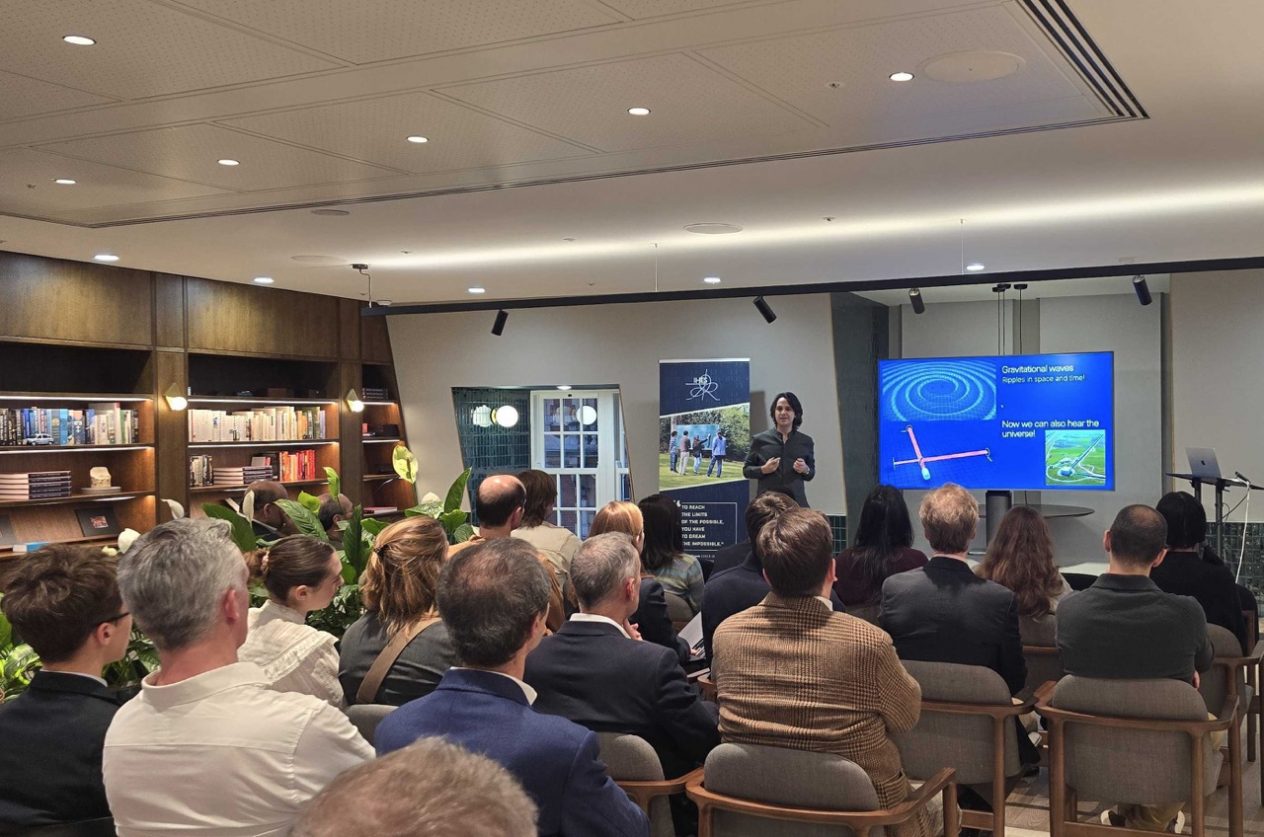
The renewal of this partnership was announced at the private dinner organized by IHES in January 2024 in Singapore in collaboration with QRT. This exclusive event took place at the iconic Fullerton Hotel with Ariel Neufeld, Associate Professor of Mathematics at NTU, who gave a scientific talk on this occasion. Other scientific conferences have been organized by IHES and QRT in recent years in Paris and London, notably with the participation of Michael Douglas, mathematician at Harvard University, Thibault Damour, theoretical physicist and Emeritus Professor at IHES, as well as Rama Cont, professor of mathematics, Head of the Oxford Mathematical and Computational Finance Group at the University of Oxford, and a regular visitor of IHES.


“Blaise Pascal, la mathématique au coeur de l’humanité” by Cédric Villani

Join us on March 21 for the first Amis de l'IHES conference for the general public, presented by Cédric Villani.

Cédric Villani (IHES & Université Lyon 1) gave a conference organized by Les Amis de l’IHES on Thursday, March 21, 2024, at 6 pm:

« Blaise Pascal, la mathématique au cœur de l’humanité »  

The Philosophes des Lumières were tempted to drive Blaise Pascal into a corner, portray him as a mad genius, and avoid taking into account his disturbing vision of the world and of knowledge. However, the torments of the twentieth century and recent advances in science have made him a precursor in many areas, such as his passion for the relationship between automaticity and reflection. In retrospect, he appears to be the only mathematician of his time to reflect all the facets of this discipline, including its economic side, with an adventure that made him the first entrepreneur in the “tech” industry.

Let’s explore some of his still fascinating facets.

Watch the conference:

Contact: Ingrid Peeters

Conference by Catherine Goldstein and Clémence Perronnet

On April 4th, 2024, the Institute will host a conference featuring mathematician and historian of mathematics Catherine Goldstein, as well as sociologist Clémence Perronet. The focus will be on female role models and how they can, or cannot, contribute to advancing gender equality in the sciences.

On April 4th, 2024, the Institute will host a conference featuring mathematician and historian of mathematics Catherine Goldstein, and sociologist Clémence Perronet. The focus will be on female role models and how they can, or cannot, contribute to advancing gender equality in the sciences. This event, entirely conducted in English, marks the arrival of the “Just Do Maths!” exhibition at the Marilyn & Jim Simons Conference Center at IHES.

In France, mathematics ranks among the least gender-equal disciplines in higher education and research. The book “Matheuses – Les filles, avenir des mathématiques” by Clémence Perronnet, Claire Marc, and Olga Paris-Romaskevich—with a preface by Catherine Goldstein— analyzes the causes of social inequalities in mathematics and highlights various means that could bring change.

During their presentation, Catherine Goldstein and Clémence Perronnet will draw on their research and focus on a specific chapter of the book that addresses the issue of role models in science. They will reflect on the place of women in the depiction of mathematics and on the conditions under which role models can effectively encourage the aspirations and career paths of female students.

In parallel to their talk, the “Just Do Maths!” exhibition will showcase portraits of women mathematicians working at Université Paris-Saclay. “Just Do Maths!” notably features Yilin Wang, a junior professor at IHES.

The program of the event is the following:

5:30 PM – Doors open

5:50 PM – Introductory remarks and welcome by Emmanuel Ullmo, Director of IHES

5:55 PM – Introductory remarks by Pierre Pansu, Director of Paris-Saclay’s Graduate School of Mathematics

6:00 PM – Conference by Catherine Goldstein and Clémence Perronnet

6:50 PM – Q&A

7:10 PM – Cocktail

The event will be moderated by Audrey Antoine, a student in the Applied Algebra master’s program at Université Paris-Saclay.

Participants will have the opportunity to purchase Matheuses – Les filles, avenir des mathématiques during the cocktail.

The event is free and open to all. RSVP here. To attend the event via Zoom, click here.

IHES in New York City

After visiting Singapore earlier this year, IHES traveled to the United States to meet its friends and supporters in New York City.

After visiting Singapore earlier this year, IHES traveled to the United States to meet its friends and supporters in New York City, as well as Board members of its partner organization, Friends of IHES, during the week of February 12, 2024.


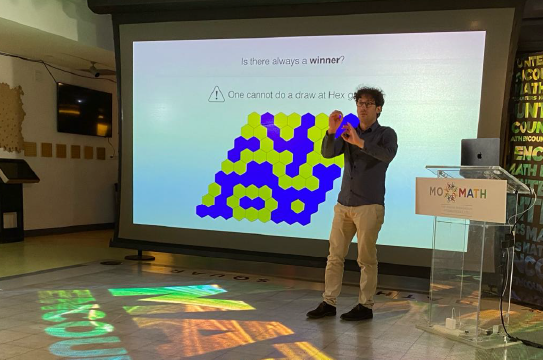
Hugo-Duminil Copin at MoMath, Feb 14, 2024.

On February 14, Hugo Duminil-Copin, Permanent Professor at IHES and 2022 Fields Medalist, spoke at the National Museum of Mathematics for its free and public Math Encounters series. After an introduction by Michael Aizenman, Professor of Physics and Mathematics at Princeton University, Hugo shared his passion for the game of HEX, its mathematical underpinnings, and how it relates to his research on percolation. The audience notably included Ingrid Daubechies, a regular IHES visitor and laureate of the 2023 Wolf Prize in Mathematics, and Alex Kontorovich, Distinguished Professor of Mathematics at Rutgers University and a member of the Scientific Board for Quanta Magazine. Ingrid Daubechies is currently serving as the Distinguished Visiting Professor for the Public Dissemination of Mathematics at MoMath, where she hosts the monthly web series Meet a Mathematician.

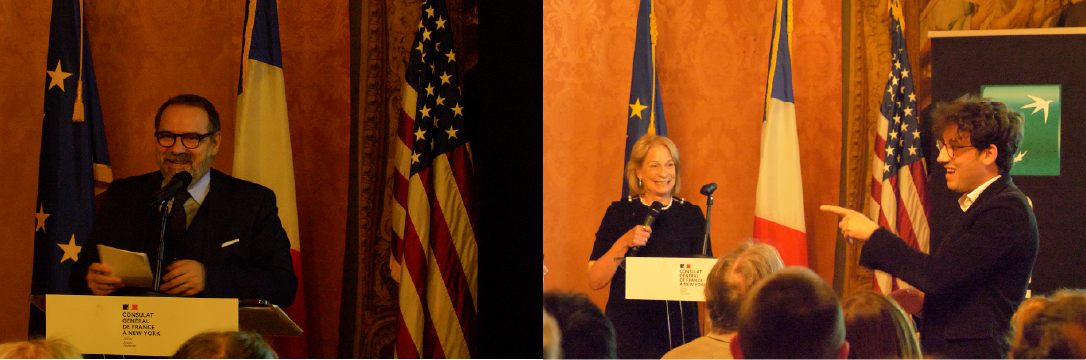
Damien Laban, Marilyn Simons, and Hugo Duminil-Copin at the Consulate General of France in New York City, Feb 15, 2024.

On February 15, Friends of IHES, in cooperation with BNP Paribas, organized an exclusive evening with Hugo Duminil-Copin at the Consulate General of France in New York City. Following an introduction by Damien Laban, Acting Consul General, Emmanuel Ullmo, Director of IHES, and Joe Bonnaud, Deputy Head of the Global Markets Americas, Hugo Duminil-Copin delved into the question of the true nature of randomness in front of about 100 participants. The audience included the Friends of IHES Chair, Marilyn Simons, the Friends of IHES Treasurer, Mark Howard, and several Friends of IHES Board members and supporters. Dennis Sullivan, former Permanent Professor at IHES and Abel Prize Winner, also attended the event.

Before enjoying the cocktail, Marilyn Simons also shared great news about the endowment fund launched by Friends of IHES in 2022: with over 17 million dollars in gifts and pledges, the goal of raising 20 million dollars by 2025 is nearly reached. She encouraged participants to contribute to get to this ambitious target, reminding them that any gift made before 2025 will be matched by the Simons Foundation International, up to 10 million dollars.

The week in New York not only allowed IHES to reconnect with friends and partners but also to reinforce its connections in the United States, notably with leaders from Antin Infrastructure Partners, Goldman Sachs, Societe Generale, and Tikehau Capital.

The Squarepoint Foundation funds the Israel Gelfand Chair

The Squarepoint Foundation becomes a new supporter of IHES with a donation of 100,000 euros, which will finance the Israel Gelfand Chair of Mathematics from 2024 to 2026.

The Squarepoint Foundation becomes a new supporter of IHES and will finance the Israel Gelfand Chair of Mathematics from 2024 to 2026. Through this funding, which facilitates research stays at IHES,  the Foundation affirms its support for basic sciences as well as the model of free and disinterested research which characterizes the Institute.

This Chair, created in 2014 by Emmanuel Ullmo, the director of IHES, makes it possible to invite, upon nomination from the Scientific Council, high-level mathematicians for visits of at least two months per year, for three consecutive years. The researchers thus selected contribute to the seminar program and have the opportunity to invite collaborators during their stay.

Since its creation, the Israel Gelfand Chair has allowed the Institute to welcome great scientists in different mathematical fields. Spencer Bloch, the first holder of the Chair, is now R.M. Hutchins Professor Emeritus at the University of Chicago (United States). Samson Shatashvili, whose research is at the crossroads of theoretical physics and mathematics, is today University Chair of Natural Philosophy, Pure & Applied Mathematics at Trinity College Dublin (Ireland). Francis Brown is a professor at All Souls College, Oxford (UK). Sergiu Klainerman is a professor at Princeton University (United States). Olivia Caramello, whose research focuses on part of Gelfand’s own work, is an associate professor at Università degli Studi dell’Insubria (Italy).

The current holder of the Chair, Dennis Gaitsgory, is a researcher at the Max-Planck-Institute for Mathematics in Bonn (Germany). He interacted extensively with “disciples” of Israel Gelfand and is known for his research into the Langlands program.


Israel Gelfand (1913-2009) was one of the great mathematicians of the 20th century. His research has made major contributions in several mathematical fields. His work is also recognized in the field of biology. He is the author of several hundred articles and numerous books, and multiple theorems bear his name. He has received several prestigious awards recognizing the scope of his research, including the Wolf Prize in 1978 and the Kyoto Prize in 1989.

Israel Gelfand made several research visits to IHES in the 1970s and 1980s before becoming a regular visitor, coming to the Institute every year between 1992 and 1998. The values of scientific excellence and knowledge sharing, fundamental to the Institute, were particularly dear to Israel Gelfand. IHES thus paid tribute to him by giving his name to this Chair which precisely combines these two values.


Looking back on this year’s “Budding Maths” and “MathTech” events

On January 17th and January 25th, 2024, IHES once again hosted the "Budding Maths Day" and "MathTech Meetings" of the Fondation mathématique Jacques Hadamard.

On January 17th and January 25th, 2024, IHES once again hosted the “Budding Maths Day” and “MathTech Meetings” of the Fondation mathématique Jacques Hadamard (FMJH), of which the Institute is a founding member.

The Budding Maths Day is primarily designed for third-year mathematics students at Université Paris-Saclay. Its goal is to offer students a dynamic and varied perspective on mathematical research, with the hope of inspiring them to further pursue their studies in the field. During the event, students had the chance to attend talks by research mathematicians, including Cédric Villani, holder of the IHES-Université de Lyon Chair in analysis. The Budding Maths Day also aims to foster discussions between undergraduate students and PhD students or postdocs, allowing them to explore potential career paths in mathematics.

On the other hand, the MathTech Meetings are geared towards doctoral and postdoctoral researchers in mathematics. The event aims to develop connections between mathematicians and industry leaders, highlighting a PhD as a gateway to research or scientific management in the public or private sectors. This year, participants had the opportunity to hear testimonials from mathematicians working in the aerospace, energy, finance, or healthcare sectors. Alex Gerko, founder of the algorithmic trading company XTX Markets and a major donor to FMJH and IHES, shared his journey from obtaining a PhD in mathematics to becoming the founder and CEO of one of the world’s leading financial technology firms. Amidst the various talks by professionals, selected PhD students from the Ecole Doctorale Mathématique Hadamard had the chance to pitch their research projects to the audience.

The Rencontres MathTech ended with the first award ceremony of the Pierre Lamoure Prize. Named in honor of the founder of Groupe Atlantic, the Pierre Lamoure Prize recognizes a mathematical research project on an industry-related problem. Pierre Lamoure indeed viewed science and mathematics as means for economic, and more generally, human progress. The laureate, Thibaud Ehret, a postdoctoral researcher at the Centre Borelli lab at ENS Paris-Saclay, was awarded the Pierre Lamoure Prize for his work on the automatic detection and quantification of methane emissions through satellite imagery. These efforts, in collaboration with Kayrros, led to the creation of the Methane Watch platform, supported by the European Space Agency. The prize was awarded to the laureate in the presence of Jacques Lamoure, son of Pierre Lamoure, and major donor to both FMJH and IHES.

IHES is delighted to host these events as part of its partnership with FMJH, as they provide opportunities for the exchange of ideas within the mathematical community and with the private and public sector.

Tribute to Anatoly Moiseevich Vershik

The Russian mathematician Anatoly Moiseevich Vershik passed away on February 14th, 2024. IHES mourns the loss of a truly remarkable mathematician and respected leader in the Russian mathematical community. Misha Gromov, Professor Emeritus at IHES, wrote a few words in his tribute.

The Russian mathematician Anatoly Moiseevich Vershik passed away on February 14, 2024. Anatoly Vershik was Head of the Laboratory of Representation Theory and Dynamical Systems at the St. Petersburg Department of the Steklov Institute of Mathematics and Chair of Mathematical Analysis at the Department of Mathematics and Mechanics at St. Petersburg State University. From 1998 to 2008 he was President of the St. Petersburg Mathematical Society. Anatoly Vershik made significant contributions to various areas of mathematics, including representation theory, dynamical systems, ergodic theory, asymptotic combinatorics, operator algebras, and measure theory. His students include Alexander Barvinok, Anna Erschler and Sergey Fomin. Anatoly Vershik was a regular visitor at IHES in the 1990s, with his last visit to the Institute in 2012. IHES mourns the loss of a truly remarkable mathematician and respected leader in the Russian mathematical community. Misha Gromov, Professor Emeritus at IHES, wrote a few words to pay him tribute.

“Anatoly Vershik died on February 14, 2024. Throughout his life, he consistently generated new mathematical ideas and generously shared them with his friends and students. Over time, several of these ideas—some developed by Vershik himself, and others by his students and colleagues—have evolved into established mathematical theories.

(I recall that—around 1960 or 1961—I overheard Vladimir Abramovich Rokhlin expressing great expectations regarding the possible outcomes of Vershik’s original point of view on mathematics.)

The last time I spoke to Vershik was over the phone on December 28, 2023. During our conversation, we discussed his new preprint on the classification of measurable functions in k variables, which he had sent me a couple of weeks earlier. In it, he elaborated on his old idea of using ergodic theory in this context.

Interestingly enough, one of the first problems he shared with me (in 1964 or 1965) was the description of the combinatorial structure of convex hulls of orbits of products of permutation groups $\prod_{n_1} \times \dots \times \prod_{n_k}$, which act on the tensor products $\mathbb{R}_{n_1} \hspace{-.25em} \otimes \dots \otimes \mathbb{R}_{n_k}$.

Around the same time, I also learned about Vershik’s (isoperimetric) Følner function. The introduction of this function was motivated by Følner’s criterion for amenability. The study of Vershik’s Følner function has since become an active branch of research in infinite group theory.

Over the years, I have often spoken with Vershik, and what I remember most are his elegant ideas and probabilistic descriptions of the universal Urysohn spaces, as well as the classification of metric measure spaces. Vershik was interested in everything in life; he welcomed truth and courageously fought against wrongs. At 90 years of age, he died too young.

His friend, Misha Gromov.”

Bibliography

A.I. Barvinok and A.M. Vershik. Convex hulls of orbits of representations of finite groups and combinatorial optimization. Functional Analysis Its Applications 22, 224–225 (1988)

T. Ceccherini-Silberstein and M. D’Adderio. Topics in groups and geometry. Growth, amenability, and random walks. Springer (2021)

A. Erschler. Poisson-Furstenberg boundaries, large-scale geometry and growth of groups. Proceedings of the International Congress of Mathematicians Hyderabad, India (2010)

M. Gromov. Entropy and Isoperimetry for Linear and non-Linear Group Actions. Groups, Geometry, and Dynamics 2, no. 4, 499-593 (2008)

A.M. Vershik. Countable groups that are close to finite ones, Appendix in F.P. Greenleaf “Invariant Means on Topological Groups and their Applications”, Moscow, Mir, 1973 (in Russian), a revised English translation “Amenability and approximation of infinite groups” was published in Selecta Mathematica Sovietica 2, no. 4, 311–330 (1982)

A.M. Vershik. Classification of Measurable Functions of Several Variables and Invariantly Distributed Random Matrices. Functional Analysis and Its Applications 36, 93–105 (2002)

A.M. Vershik. Random metric spaces and universality. Russian Mathematical Surveys 59 259 (2004)

A.M. Vershik. Classification of measurable functions of several variables and matrix distributions. arXiv:2311.01281 (2023)

A.M. Vershik, G.A. Veprev and P.B. Zatitskii. Dynamics of metrics in measure spaces and scaling entropy. arXiv:2311.14550 (2023)

T. Zheng. Asymptotic behaviors of random walks on countable groups. Proceedings of the International Congress of Mathematicians (2022)

IBM renews its support to IHES

IBM has been supporting IHES since its creation in 1958. Both organizations have maintained strong and consistent ties ever since, and IBM is now renewing its support to the Institute.

IBM has been supporting IHES since its creation in 1958. Both organizations have maintained strong and consistent ties ever since.

In the 1980s, IBM provided IHES with its first computer. In the picture below, one can see Oscar Lanford III, Permanent Professor of Physics at IHES from 1982 to 1989, testing the new working tool. He is surrounded by Louis Michel, Permanent Professor of Physics at IHES from 1962 to 1992, Henri Epstein, CNRS Researcher Emeritus at IHES, and Marcel Berger, Director of the Institute from 1985 to 1994. In 2021, IBM contributed to the success of the “Women in Fundamental Research” Gala organized by Friends of IHES in the United States by offering participants an exclusive visit to ProMare’s and IBM’s AI-controlled research vessel, the “Mayflower Autonomous Ship”.

IBM supports IHES because innovation has always been part of the company’s DNA, and because IBM believes in the importance of free and disinterested research at IHES; because mathematics provides the necessary tools to understand the fundamental concepts of quantum computing, giving it solid theoretical foundations; and because of the company’s goal to skill 30 million people globally on topics in science and technology by 2030.

Emmanuel Ullmo, Director of IHES, is delighted by IBM’s support: “IHES greatly values the reliable support from major companies like IBM. In addition to the essential financial backing, IBM’s patronage fosters dialogue among scientists in diverse research areas and, more broadly, strengthens the connections between academia and industry.

Béatrice Kosowski, President of IBM France and a member of the Strategic Orientation Committee of Université Paris-Saclay, adds: “Basic research, which demands ample time and true freedom for scientists to be creative, discover, and innovate, is crucial for IBM. We take pride in supporting IHES, a founding member of Université Paris-Saclay and a unique institution in the landscape of fundamental research in mathematics and theoretical physics.

Inaugural Ceremony of the Jean-Pierre Bourguignon Chair

On February 1st, 2024, IHES celebrated the launch of a new Permanent Professor’s Chair named after Jean-Pierre Bourguignon.

On February 1st, 2024, the Institute celebrated the launch of a new Permanent Professor’s Chair named after Jean-Pierre Bourguignon, Director of IHES from 1994 to 2013 and now Nicolaas Kuiper Honorary Professor at the Institute. The creation of this Chair was made possible through an exceptional gift to the endowment fund of Friends of IHES by Claire-Lise and Philippe Tondeur, which was then matched by Marilyn and Jim Simons through the Simons Foundation International. The inaugural holder of the Jean-Pierre Bourguignon Chair is Dustin Clausen, a Permanent Professor at the Institute since April 2023.

During the ceremony, Marwan Lahoud, President of the IHES Board of Directors, as well as the donors, spoke about their friendship and admiration for the scientific and political career of Jean-Pierre Bourguignon. They particularly emphasized that it is also thanks to Jean-Pierre Bourguignon’s vision that the Institute is now able to launch a new Permanent Professor’s Chair. It was indeed shortly after the beginning of his term as Director of IHES in 1994, that he began to see private funding as an essential means to ensure the Institute’s financial sustainability. Through their donations, Claire-Lise and Philippe Tondeur, on one hand, and Marilyn and Jim Simons, on the other, hope to provide the necessary material resources to continue making IHES a conducive environment for top-level mathematical creation, especially for its Permanent Professors.

In his speech, Jean-Pierre Bourguignon also reflected on his friendships with the donors. He reminisced about his initial meetings with Philippe Tondeur at the Arbeitstagungen in Bonn and his stay at Stony Brook in 1972-1973 upon Jim Simons’ invitation. To put this major donation into perspective, he highlighted the crucial role of the Permanent Professors in the history of the Institute: it is their research and attractiveness that have built the reputation of the Institute.

It is in this lineage that Emmanuel Ullmo, Director of IHES, sees Dustin Clausen, the first holder of the Jean-Pierre Bourguignon Chair. The scientific conference to inaugurate the new Chair, organized by Dustin Clausen and held on January 26th, 2024, offered a comprehensive overview of his diverse mathematical interests including stable homotopy theory, p-adic geometry, geometric Langlands correspondence, number theory, and more. These fields have recently seen exciting new developments thanks to the theory of condensed mathematics developed by Dustin Clausen and Peter Scholze.

To conclude the inaugural ceremony of the Jean-Pierre Bourguignon Chair, Dustin Clausen discussed some of the work he has undertaken since his arrival at the Institute in April 2023. He notably established a generalization of the Quillen-Lichtenbaum descent conjecture with Robert Burklund (to appear), and developed unstable algebraic K-theory with Mikala Ørsnes Jansen. Together with Peter Scholze, he has been teaching a widely followed course on condensed mathematics, serving as the foundation for a forthcoming research monograph. Through this book, Dustin Clausen hopes to make the theory of condensed mathematics more accessible to the broader mathematical community.

Claire-Lise and Philippe Tondeur

Claire-Lise and Philippe Tondeur are a Swiss-American academic couple who have spent most of their lives as university professors in the United States. While Philippe is a mathematician, Claire-Lise specializes in French literature. It was through her husband that she was introduced to the world of mathematics and mathematicians. Both are particularly fascinated by the creative process in both science and art. Philippe has been heavily involved in science and technology policy, notably as the director of the Division of Mathematical Sciences at the NSF at the turn of the century.

Marilyn and Jim Simons

Marilyn and Jim Simons have been involved in the development of IHES for almost 30 years. As co-Chairs of Friends of IHES, they have set up a dedicated endowment fund for the Institute in the United States with the goal of raising 20 million dollars by 2025. To encourage donations to the fund, they have committed to match every gift of up to 10 million dollars through the Simons Foundation International. To this day, more than 17 million dollars in gifts and pledges have already been secured for the endowment.

Rewatch the ceremony here.