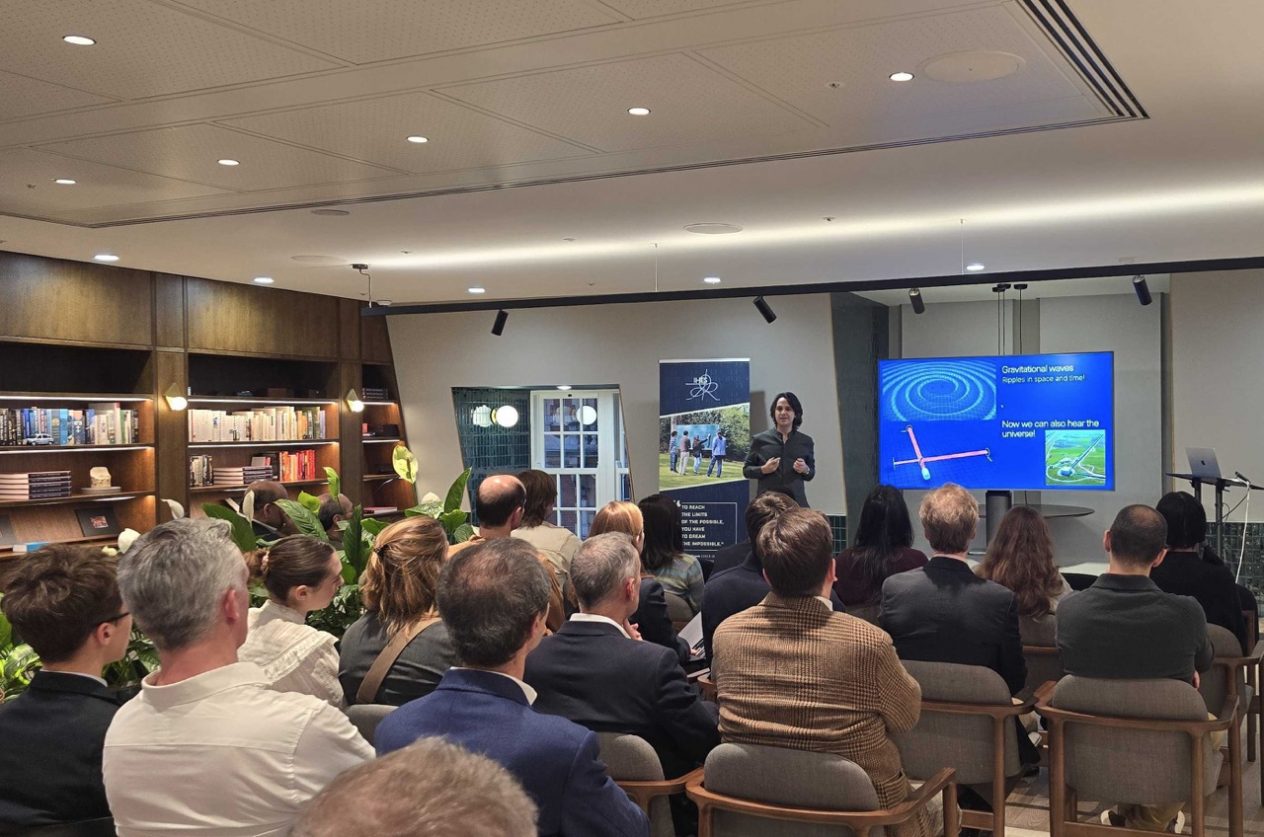
Conference by Marleen Temmermann on November 10th 2023

New event organized by Les Amis de l'IHES with Marleen Temmerman on November 10th 2023 at 5:30 pm in the Marilyn and James Simons Conference Centre and on Zoom


Marleen Temmerman, obstetrician and WHO expert, gave a conference (in French) entitled:

“Why are Pregnancy and Childbirth still so deadly?”

According to a recent update from WHO, worldwide every two minutes a woman dies in childbirth, totalling 800 women every day or 287,000 women annually. Why, after almost 30 years since ICPD and Beijing Declaration and numerous other declarations, commitments, and reaffirmations, is global health failing on women and girls, and on gender equity? What is holding back governments and institutions from realising their commitments?

The need for transformational shift on gender equity in global health is urgent. For it to happen, we need to start by understanding the supremacies, hierarchies and powers that create and enable the structures in global health and unearth the dynamics these structures operate within.

Marleen Temmermann has presented the causes of maternal mortality in the world and the possible keys to address the problem.

Upload the poster

Contact : Ingrid Peeters

Looking back at the conference celebrating René Thom

2023 marks the centenary of the birth of René Thom, the 1958 Fields medalist, who served as a permanent professor at IHES from 1963 to 1988 and profoundly influenced not only mathematics but science as a whole.

2023 marks the centenary of the birth of René Thom, one of the two 1958 Fields medalists, who served as a permanent professor at IHES from 1963 to 1988 and profoundly influenced not only mathematics but science as a whole.

To celebrate René Thom’s life and work, the French Academy of Sciences held a public event on September 19th, followed by a 3-day scientific program at IHES from September 20th to 22nd.

The broad range of invited speakers in mathematics showcased how René Thom’s ideas shaped 20th-century mathematics and continue to inspire research today.

While many lectures naturally focused on different aspects of singularity theory (as discussed in the lectures by N. A’Campo, K. Kurdyka, D. Sullivan, and B. Teissier) and dynamical systems (as discussed in the lectures by A. Chenciner, and A. Rechtman), it was also shown how the notions of cobordism and transversality are now being adapted to the categorical setting to answer questions from quantum topological field theory, a particularly active research area in mathematical physics (as discussed in the lecture by O. Randal-Williams).

A less well-known fact is that René Thom developed the notion of “partial differential relation” in his 1949 paper “Sur une partition en cellules associée à une fonction sur une variété”. His work was picked up in the 1980s by Misha Gromov, whose famous h-principle revolutionized the study of non-linear partial differential equations (as discussed in the lecture by E. Giroux). M. Gromov was a permanent professor at IHES from 1982 to 2015 and is now emeritus.

Finally, Ivar Ekeland showed how René Thom’s ideas might help us overcome the limitations of optimization in the analysis of models coming from climate science.

Furthermore, René Thom’s influence is not only confined to mathematics. His book “Structural Stability and Morphogenesis” had a major impact on the development of theoretical biology in the 1970’s (as discussed in the lecture by A. Danchin). His approach to scientific modeling, and his correspondence with C.H. Waddington are now objects of study in the philosophy of science (as discussed in the lectures by S. Franceschelli, and J. Petitot). Contrary to the mathematicians affiliated to the Bourbaki collective, images were always important for Thom’s thinking. They not only provided him with conceptual hints but also, as in the case of Waddington’s ‘Epigenetic Landscape’, helped him define a research agenda in theoretical biology.

More surprisingly, Thom’s catastrophe theory also provided the conceptual framework in chemistry for Richard Bader’s quantum theory of atoms in molecules (as discussed in the lecture by C. Matta). Since the 19th century, chemists have been interested in atomic bond paths in molecules. These bond paths may undergo sudden changes during a chemical reaction. Understanding these changes as catastrophes helped Bader gain new insights into molecular structure.

Recently, Thom’s ideas were also applied in psychology, visual arts, and music (as discussed in lectures by D. Bennequin, and W. Wildgen).

On a more personal level, a souvenir session was organized, including interviews and film extracts. This session not only allowed conference participants to effectively hear and see René Thom but also provided an opportunity for some who knew Thom personally to share their stories and reminiscences.

In 2011, the late André Haefliger suggested that Thom’s collected works should include his correspondence. Thanks to the dedicated efforts of Marc Chaperon and the editorial team, the three volumes of his collected works are now published by the French Mathematical Society (also available for purchase via the AMS). In addition to his scientific papers and correspondence, the books also feature commentaries by Alain Chenciner, François Laudenbach, Jean Petitot, Bernard Teissier, and David Trotman.

Videos of all lectures will be available soon on carmin.tv.

Interview with Dustin Clausen

Dustin Clausen joined IHES in April 2023 as a permanent professor in mathematics. In this interview he talks about his relationship with mathematics and about what being at IHES means to him. He also gives us a glimpse into his research interests.

Dustin Clausen joined IHES in April 2023 as a permanent professor in mathematics. In this interview he talks about his relationship with mathematics and about what being at IHES means to him. He also gives us a glimpse into his research interests.

•    What drew you to mathematics?

At the beginning, it was two aspects. The first was the possibility of definite answers. In mathematics, as opposed to many other human affairs, statements can be precisely formulated, and will simply either be true or false. As a young person in an uncertain world, I was drawn to this certainty. The second reason was the sense of independence that mathematics provides. One doesn’t need to accept any authority; one can verify everything oneself by following the logic. Later, I also came to appreciate what could be called beauty in mathematics. The rigid structure of mathematics generates a world of incredible depth, intricacy, and wonder, where, perhaps paradoxically, human creativity can really flourish. In a way one sees a similar connection between rigidity and creativity in other artistic disciplines: many times in history groups of artists have set rules for themselves in order to focus their creative force. But in mathematics the rules are set by nature itself, and generate a world whose structure goes well beyond what man-made rules could yield.

•    What does being a permanent professor at IHES mean to you?

The position of permanent professor at IHES is, for me, the ultimate instantiation of the independence and freedom I’ve always been striving for. Here, I feel that I can truly just work. I am endlessly grateful that a place like this exists, and that I was offered such a position here.

•    What are the research projects that you are planning to work on in the near future?

With Peter Scholze, and based on the groundbreaking work of Alexander Efimov, I have been investigating the K-theory of analytic spaces. Peter and I formulated a conjecture saying that this K-theory in the world of complex analytic spaces should just be a form of Deligne cohomology, and I’m very interested in trying to prove this conjecture. Meanwhile, in chromatic homotopy theory, a new door has been opened due to the resolution (in the negative!) of the telescope conjecture by Robert Burklund, Jeremy Hahn, Ishan Levy, and Tomer Schlank. I may devote some time to trying to understand what structure is truly present in telescopic homotopy theory given this disproof of the original vision.

•    What do you work on?

In broad terms, I tend to work on linear algebra. This sounds simple, and simplicity is indeed one of the main appeals of linear algebra. But it is also remarkably powerful. Naively, one might think that linear algebra is limited, because, geometrically speaking, it can only describe flat objects. After all, solutions to linear equations are always flat. But a surprising shift in perspective shows that linear algebra can capture all kind of geometric objects. Namely, one thinks not of plain linear algebra, but of the manner in which linear algebraic structure can vary from point to point in a given geometric object. For example, the fact that there are no consistent global coordinates on a sphere (the surface of the Earth, say) tells us something about the shape of the sphere. With Peter Scholze, I have recently developed an extension of linear algebra, which allows to describe ever more intricate geometry. We call this extension “condensed mathematics”, and the idea is to marry linear algebra and topology at the very level of foundations, allowing for a richer class of basic linear algebraic objects, and consequently richer geometric objects.

A related theme which runs through my work is that of K-theory. A fundamental fact in linear algebra is that finite-dimensional vector spaces are classified uniquely by their dimension. In other words, there’s only one kind of flat space in every dimension. But the situation changes when one thinks about finite dimensional spaces which vary over a geometric object, as in the previous paragraph. More precisely, such objects are known as vector bundles, and a vector bundle requires more information than just its dimension to determine it, because the linear algebra can get “twisted” when one changes the point continuously. The basic example of this is the famous Möbius band. Here the geometric object is the circle sitting at the center of the Möbius band, and the perpendicular slices can be thought of as one-dimensional vector spaces varying in a “twisted” manner with the point on the circle.

The nature of the possible twistings depends very much on the geometric object one starts with, to such an extent that the classification of vector bundles gives us a lot of information about the geometry. One instantiation of this is the K-theory of Alexandre Grothendieck, which is remarkably adept at converting linear algebra into geometrically relevant information. The idea is that we simplify the classification of vector bundles by only considering certain particularly well-behaved so-called “additive” invariants of vector bundles, these being variants of the familiar dimension function. It turns out that there are enough of these additive invariants that the theory gives a lot of information, but not too many that we have no hope of understanding it. I have studied linear algebra and K-theory in many different settings, from number theory to algebraic topology to analysis, but my motivation and understanding often came from geometry.

Another major aspect of my work is the systematic use of homotopy-theoretic methods. Fundamentally, doing homotopy theory means paying very special attention to what is meant by equality. Often, when we say that two things are equal, what we mean is that we have a way of viewing them as being the same, or more precisely, that we have an identification between them. In homotopy theory, one takes this very seriously: the possible identifications are viewed as fundamental objects themselves, worthy of the same detailed study as the original things being identified. Pursuing this idea quickly leads to an infinite hierarchy: one must then also study the ways of identifying different identifications, and so on up to infinity. The origins of homotopy theory come from topology: given a space, one can say that two points are “the same” if they can be connected by a path, that two paths are the same if they can be connected by a path of paths, and so on. For example, on a circle, all points are “the same” in this sense, but more precisely two points can be viewed as the same in many different ways: one can go around the circle any number of times (clockwise or counterclockwise) before ending up at the second point. One says that “the fundamental group of the circle is the group of integers Z”, and this gives a way of capturing the geometric/topological fact that a circle is made to enclose 2-dimensional regions without passing through them.

However, homotopy theory has relevance well beyond its origins in topology, as the situation of considering identifications between identifications and so on arises in many situations with no a priori connection to paths in space. One such situation is precisely in K-theory. There, we decided to identify two vector bundles when every additive invariant yields the same result on both of them. But there is a more fundamental way of expressing when this happens, or rather how it happens, and then the question of identifications between identifications, and so on, arises. The resulting theory called higher algebraic K-theory, was developed flexibly by Daniel Quillen, and has been put to great use in the many fields where K-theory has relevance. It is higher algebraic K-theory that has been a particular focus of mine. To make serious progress in higher algebraic K-theory, one needs a flexible and faithful language for discussing homotopy-theoretic matters. Thankfully, such a language has been provided by my Ph.D. advisor Jacob Lurie, who spent a long time developing the foundations of what is called infinity categories, these being the native environments where homotopy theory happens. Like many researchers these days who rely on homotopy-theoretic techniques, I freely use infinity categories in my work.

However, in the end, despite all this talk of linear algebra, K-theory, homotopy theory, and infinity categories, my basic interest in mathematics is number theory.  I started to study K-theory because as a PhD student, I discovered a truly new proof of a basic fact in number theory, the quadratic reciprocity law, and I realized that K-theory provided the correct language for expressing this proof. I quickly pushed the method to recover a more serious reciprocity law, the Artin reciprocity law. Since then I have made many attempts to generalize further to the fascinating and deep extensions of the reciprocity law which one finds in the Langlands program. So far, I have not had success, but this is my greatest goal: to understand the Langlands program in a similar way to how I’ve understood the Artin reciprocity law. I hope that the study of linear algebra, K-theory, and homotopy theory that I’ve done in the meantime will help me with this. But even more, I hope that other people will get interested in the same problem as well! But for this, I probably need to figure out some program or path that could be followed.

Conference by Claudia Silva and Oscar Garcia-Prada on October 3rd 2023

New event organized by Les Amis de l'IHES with Claudia Silva and Oscar Garcia-Prada on October 3rd 2023 at 6:00 pm in the Marilyn and James Simons Conference Centre and on Zoom

New event organized by Les Amis de l’IHES on Tuesday October 3rd, 2023, 6:00 pm (French time) at IHES

Claudia SILVA, an anthropologist, photographer and videographer, and Oscar GARCIA-PRADA, a geometer holding a research Chair at the Instituto de Ciencias Matemáticas (CSIC, Madrid) gave a joint conference (in French) as part of the photograph exhibition:

“Kolam: An Ephemeral Women´s Art of South India”

Strolling through the streets of South India, one can have the surprise to find beautiful geometrically-inspired designs on the ground, made from rice flour. This ephemeral art form, known as Kolam, is practiced every morning by women in the Tamil Nadu state at the entrance of their homes.

In her talk, Claudia SILVA presented some aspects and ideas on the beautiful South Indian tradition of Kolam. She discussed some of the anthropological aspects of Kolam and the relation to ephemeral art, education and women cultural practices.

Oscar GARCIA-PRADA then explored some of the connections of Kolam with geometry, graph theory, number theory, fractals and computer science.

The conference was followed by a friendly drink, during which participants discovered an exhibition showing photographs of Kolam by Claudia Silva.

The replay of the conference (in French) can be watched here.

Download the poster

Contact : Ingrid Peeters

Tribute to Eugenio Calabi

We were deeply saddened to learn of the death of Eugenio Calabi, a, italian-born American mathematician and Professor Emeritus at the University of Pennsylvania, at the age of 100 years and 4 months.

We were deeply saddened to learn of the death of Eugenio Calabi, an Italian-born American mathematician and Professor Emeritus at the University of Pennsylvania, at the age of 100 years and 4 months. A specialist in differential geometry and partial differential equations, he was notably recognized for his outstanding coverage of geometry in many facets, with numerous and varied contributions.

His conjecture concerning a fundamental question of Kählerian geometry structured research in this field for many years, leading to the systematic exploration of Calabi-Yau varieties by numerous mathematicians and theoretical physicists.

In 1991, he was awarded the Leroy P. Steele Prize “for his fundamental work on global differential geometry, and more particularly on complex differential geometry”. In 2012, he was elected Fellow of the American Mathematical Society and in 2022 named Commander of the Order of Merit of the Italian Republic.

After a first visit in 1968, Eugenio Calabi became a regular visitor to the Institute, with which he has always maintained close ties. In 2007, he returned to IHES for the last time, for a conference in honor of the 60th birthday of Jean-Pierre Bourguignon, then Director. In addition to his close ties with IHES scientists, Eugenio and his wife Giuliana had been donors of the Institute for many years,

His Collected Works were published by Springer in 2022, with Jean-Pierre Bourguignon, Chen Xiuxiong and Simon Donaldson as editors. A tribute to his 100th birthday was published by the European Mathematical Society in its June 2023 Magazine.

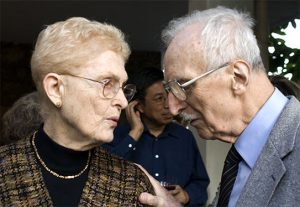
Giulana et Eugenio Calabi
Giulana and Eugenio Calabi

Back on the round table held on September 8, 2023

On Friday September 8, IHES hosted the final day of the Women Initiative Foundation / Paris-Saclay Program week: Women in Business, Become a Leader.

On Friday September 8, IHES hosted the last day of the week of the Women Initiative Foundation / Paris-Saclay Program: Women in Business, Become a Leader (in french only). On this occasion, the Institute organized a round-table discussion on the topic “How can we develop and cultivate an environment conducive to our professional fulfillment?”. The panel was made up of Sylvie Benzoni, Director of the Institut Henri Poincaré, Nathalie Bontoux, Associate Vice-President, Director of Transformation Programs for the Diagnostics and Genomics Group, Agilent Technologies, Olivier Sala, Vice-President of the Engie Group, in charge of Research and Innovation, and Emilie Urbany, member of Kyndryl France’s management team in charge of the Healthcare and Software divisions. The discussion, moderated by Claire Lenz, Director of Communications and Development at the IHES, was followed by numerous questions and testimonials from the 19 women who attended this week selected from various companies and research institutions in Europe and Canada.

The replay of the round table, in French, can be watched here.

Piet Lammers is awarded the Claude-Antoine Peccot prize by Collège de France

Piet Lammers, a post-doctoral researcher at IHES between 2020 and August 2023, has been awarded the Claude-Antoine Peccot prize by Collège de France and will give a series of Peccot lectures in 2024.

Piet Lammers has been awarded the Claude-Antoine Peccot prize by Collège de France and will give a series of Peccot lectures in 2024. This prestigious distinction is reserved for mathematicians under the age of 30 who have made significant contributions to their field. The courses focus on the Peccot Lecturers’ recent work.

Piet Lammers was a postdoctoral researcher at IHES between September 2020 and August 2023, working in collaboration with permanent professor and 2022 Fields medalist Hugo Duminil-Copin, who is also a professor at the University of Geneva.

Starting in September 2023 Lammers will hold a CNRS junior professorship — a tenure-track position recently created by CNRS — at the Laboratoire de Probabilités, Statistique et Modélisation (Sorbonne Université / Université Paris Cité / CNRS).

Over his three years at IHES, Lammers made important contributions to the understanding of the XY model — a variation of the Ising model in which spins can take any direction in the plane. While important progress has recently been made in the understanding of the Ising model, it has been challenging to study the XY model mathematically. This makes this research line particularly interesting.

Piet Lammers’ contributions have recently appeared in a series of three articles [1-3] that advance the understanding of the XY model by establishing new connections with height functions. These are random integer-valued functions on the square lattice, and they constitute his main domain of expertise.

The Peccot Lectures that Piet Lammers will give in 2024 will provide a general overview of this research line and a perspective on its possible developments, while also delving into each one of his three key papers.

“I am very happy to be given this opportunity and I look forward to taking up the challenge of explaining my results to a highly respected audience from a heterogeneous background”, said Piet Lammers when receiving the news of the prize. “Being at IHES and working with Hugo made a profound difference for me. It was incredibly inspirational and gave me the confidence to work on difficult problems — which is an essential quality for doing research in mathematics”, he added.

IHES warmly congratulates Piet on this honor, which recognizes the importance and novelty of his contributions.


Piet Lammers

Piet Lammers did his undergraduate studies in Liberal Arts and Science at University College Utrecht, in the Netherlands, which allowed him to attend courses in different fields, before moving to the University of Cambridge to specialize in mathematics during his postgraduate studies. It is there that he discovered his love for probability theory, which led him to do a PhD under the supervision of Prof. James Norris. During the PhD he started working on height functions and, after a recommendation of Prof. Nathanaël Berestycki (who was at the University of Cambridge at the time) he collaborated with Martin Tassy, then a postdoctoral researcher at Dartmouth College. Piet Lammers spent three years at IHES as a postdoctoral researcher working in collaboration with Hugo Duminil-Copin.


[1] Lammers, P. Height function delocalisation on cubic planar graphs. Probab. Theory Relat. Fields 182, 531–550 (2022). https://doi.org/10.1007/s00440-021-01087-9
[2] Lammers, P. A dichotomy theory for height functions, arXiv:2211.14365
[3] Lammers, P. Bijecting the BKT transition, arXiv:2301.06905

Other references:

[4] https://link.springer.com/article/10.1007/s00220-022-04550-3
[5] https://arxiv.org/abs/2110.09498
[6] Fröhlich J. and Spencer T. The Kosterlitz-Thouless transition in two-dimensional Abelian spin systems and the Coulomb gas, Communications in Mathematical Physics 81 (1981), no. 4, 527–602.


Photo: ©Patrick Imbert (Collège de France)

Tribute to Marcel Boiteux

IHES was deeply saddened by Marcel Boiteux's passing, on September 6.

Marcel Boiteux once wrote that “IHES is a radiant home, a beehive and at the same time a monastery where profound work, long matured in calm, germinates” (Petit Mémorial de l’IHESa series of testimonials about the Institute written on the occasion of its 40th anniversary),

IHES was deeply saddened by Marcel Boiteux’s passing, on September 6.
After being a member of the Institute’s Board of Directors in the early 1980s, in the role of representative of EDF, he succeeded to Renaud de la Génière (Banque de France) as president from 1985 until 1994. During the years he led the Board of Directors, he strove to “find money”, as he used to say, from companies, but also to retain subsidies from the foreign organizations and institutes that supported IHES at the time. He also appointed two directors, Marcel Berger, in 1985, and Jean-Pierre Bourguignon, in 1994.

A mathematics graduate of Ecole Normale Supérieure, Marcel Boiteux spent his entire career at the EDF group (then Electricité de France),  which he headed from 1967 to 1987. He was the driving force behind the development of France’s nuclear power program. In addition to IHES, he has chaired or sat on the boards of several leading organizations, including Institut Pasteur, Biosphère, Fondation Hôpitaux de Paris and Fondation du Patrimoine. He was awarded the highest rank of the Légion d’honneur, the Grand Croix, and was was elected to the Académie des sciences morales et politiques in 1992.

A personal tribute from Philippe Lagayette, former president of IHES:

“I knew Marcel Boiteux well when he was at EDF, and also in connection with IHES, where he asked me to succeed him. From his original training in mathematics and mathematical economics, he retained rigorous intellectual reflexes and a rational approach to problems. This in no way prevented him from being a brilliant conversationalist and an enthusiastic man. In the exercise of his responsibilities, he acted according to his convictions, which he set out with elegance, always based on a solid intellectual foundation; even when he himself was attacked by other means, such as exploding a bomb on his doorstep…
He was very attached to IHES, which he considered to be a precious singularity in our academic system, in that it combined high quality work, total freedom for researchers, international openness and freedom of management, all by combining resources from the public sphere and private contributions. Even after leaving the presidency of the Institute, he continued to follow its activities with interest.”


Find the full testimonial written by Marcel Boiteux on the occasion of the Institute’s 40th anniversary here.

Yilin Wang is awarded a European Research Council Starting Grant

IHES junior professor Yilin Wang has been awarded an ERC Starting Grant to explore new connections between random conformal geometry and Teichmüller theory.

IHES junior professor Yilin Wang has been awarded an ERC Starting Grant to explore new connections between random conformal geometry and Teichmüller theory. She is among the 400 young scientists recognized by the ERC in 2023.

The funding will be about 1,5 million euros, given over five years, and it will allow Yilin Wang to start her team, organize conferences, and continue her groundbreaking work on this mathematically interdisciplinary subject.

Despite having known important developments over the past few years, the connections between these two lines of research have only been discovered recently and remain largely unexplored.

Yilin Wang, who found a surprising and close link between the Loewner energy – a concept in random conformal geometry – and the Kähler potential of the Weil-Petersson metric on the universal Teichmüller space – a concept in Teichmüller theory, is planning to use her ERC Starting Grant to break new grounds in exploring these links and going beyond, while combining techniques from probability theory, complex analysis, geometric analysis, Kähler geometry, spectral theory, etc. She named her research project RaConTeich to stress her aim to establish the connections between the fundamental concepts in random conformal geometry and Teichmüller theory.

She believes that a better and deeper understanding of those links will bring significant developments to both fields. Such advancements also carry the promise to shed new light on several areas in mathematical physics – such as statistical mechanics, conformal field theory, and string theory – to which many of the questions fueling this line of research pertain.

“I am very happy for this great opportunity to carry out my research and to develop my team. I look forward to five years of exciting work with my colleagues and collaborators exploring new grounds in mathematics!”- said Yilin Wang upon receiving the news of the award.

IHES is very proud that Yilin Wang, who joined the Institute in 2022, has obtained this prestigious grant, which will bring new occasions for scientific discussions and collaborations that will have an incredibly positive impact on the Institute’s activity.

ERC Starting Grants are awarded to talented early-career scientists with 2 to 7 years of experience as supervised researchers after their Ph.D., and who have shown potential to make important research contributions independently.

IHES researchers honored in Beijing

Several mathematicians affiliated to IHES are among the researchers who were distinguished with the Frontiers of Science Award in Beijing last July.

Several mathematicians affiliated to IHES are among the researchers who were distinguished with the Frontiers of Science Award during the International Congress of Basic Science whose inaugural edition took place in Beijing on July 16-28.

The award celebrates both basic and applied research results, published during the past five years in the fields of mathematics, theoretical physics and computer science. They must be of highest scientific value and originality and must have made an important impact in one of the three areas of interest. They must also have been published in a peer-reviewed journal.

Among the 134 publications selected overall, two were co-authored by Hugo Duminil-Copin, permanent professor at IHES, professor at the University of Geneva and laureate of the 2022 Fields Medal:

  • Sharp phase transition for the random-cluster and Potts models via decision trees, published in the Annals of Mathematics in 2019. This paper was co-written by Hugo Duminil-Copin, Vincent Tassion (ETH Zürich), and Aran Raoufi, who spent three years at IHES between 2016 and 2018 as a PhD student, under the supervision of Prof. Duminil-Copin.
  • Marginal triviality of the scaling limits of critical 4D Ising and $\phi_4^4$ models, published in the Annals of Mathematics in 2021and co-authored by Michael Aizenman (Princeton) and Hugo Duminil-Copin.

Three of the research articles selected for the award were co-authored by Maxim Kontsevich, permanent professor at the Institute:

  • Canonical bases for cluster algebras, published in the Journal of the American Mathematical Society in 2018, and co-written by Mark Gross (University of Cambridge), Paul Hacking (University of Massachusetts Amherst), Sean Keel (University of Texas), and Maxim Kontsevich.
  • Specialization of birational types, published in Inventiones mathematicae in 2019, and co-authored by Maxim Kontsevich and Yuri Tschinkel (New York University).
  • Wick rotation and the positivity of energy in quantum field theory, published in the Quarterly Journal of Mathematics in 2021 and written by Maxim Kontsevich and Graeme Segal (University of Oxford).

The list of publications that were celebrated during the International Congress for Basic Science also includes ‘On the implosion of a compressible fluid II: Singularity formation’, published in the Annals of Mathematics in 2022. This is one of three much celebrated papers co-written by Frank Merle, CY Cergy Paris Université-IHES Chair in Analysis, Pierre Raphaël, holder of the Schlumberger Chair for mathematical sciences at IHES and Professor at the University of Cambridge, Igor Rodnianski, Professor at Princeton University, and Jérémie Szeftel, CNRS Research Director at Sorbonne Université. In addition to the Frontiers of Science Award, their most recent contributions have already earned them the 2023 Bôcher Prize of the American Mathematical Society and the 2023 Clay Research Award, of the Clay Mathematics Institute.

Sébastien Boucksom, editor in chief of the Publications mathématiques de l’IHES, and a CNRS Research Director at Institut de Mathématiques de Jussieu – Paris Rive Gauche, is also among the researchers who were distinguished in Beijing for his paper entitled ‘A variational approach to the Yau-Tian-Donaldson conjecture’, published in the Journal of the American Mathematical Society in 2021 and co-written with Robert J. Berman (University of Gothenburg) and Mattias Jonsson (University of Michigan).

IHES is very proud of the important scientific contributions achieved by the IHES researchers honored with the Frontiers of Science Award and extends its sincere congratulations to all of them!

Publication of the 2022 Annual Report

The 2022 Annual Report is available online, with a foreword by Marwan Lahoud, IHES President.

The 2022 Annual Report is available online, with a foreword by Marwan Lahoud, IHES President.

“The Institute was created so that the best researchers in mathematics and theoretical physics could dedicate themselves fully to their work, relieved of practically all constraints, and in total freedom. Here, freedom and blue-sky research are such important concepts that they feature in the IHES statutes. Scientists are entirely free to engage in deep thinking and this broad availability also facilitates collaborative work.

A visit to the Institute makes it clear why IHES is such an absolute gem in the world of scientific research. The answer is, of course, the excellence of the researchers’ work. The answer also lies in the IHES’s surroundings and unique setting, in a 25-acre park at the heart of the Chevreuse Valley. Scientists enjoy walking in the woods and letting their minds meander.

Being at IHES means finding oneself in a leafy cocoon at the heart of the Université Paris-Saclay perimeter – with distinguished scientists from all over the world – and turning a research visit into an enchanted interlude. And this is what makes the Institute successful, as confirmed once again this year. In March 2022, Dennis Sullivan, permanent professor at IHES from 1974 to 1997, holder of the Albert Einstein Chair at the City University of New York and professor at Stony Brook University, was awarded the Abel Prize. In July, Hugo Duminil-Copin, permanent professor at IHES since 2016, won the Fields Medal.

For IHES to attract and retain such high-profile scientists in France and preserve its unique model of free and disinterested research, philanthropy is crucial. This year we were delighted to celebrate the closure of our third fundraising campaign, “IHES at the avant-garde of science”, the objective of which was reached and even surpassed. Please allow me to thank all the donors who support IHES and contribute to its many success stories.”

Marwan Lahoud
IHES President

IHES returned to London

IHES closed out 2022 with two events in London, bringing together many friends of the Institute and science lovers.

IHES closed out 2022 with two events in London, bringing together many friends of the Institute and science lovers. In July 2023, the Institute returned to the British capital with a rich agenda of events and meetings.

On Tuesday July 4th, the Institut Français du Royaume-Uni hosted a scientific breakfast organized by IHES in collaboration with the Higher Education, Research and Innovation Department of the French Embassy in the UK.

After an introduction by Emmanuel Ullmo, director of IHES, Thibault Damour, theoretical physicist and emeritus professor at IHES, gave a talk entitled “Proust and Einstein: In Search of Time”. Friends of IHES, scientists and French science and literature lovers gathered together to discover the similarities between the idea of Time illustrated in Marcel Proust’s “À la recherche du temps perdu” and the conception of Time suggested by Albert Einstein’s theories of relativity.

The French bookshop La Page joined the event organized by the Institute with the support of the Embassy, and offered participants the chance to purchase a signed book “Mysteries of the Quantum Universe” by Mathieu Burniat and Thibault Damour.

This stay also allowed IHES to greet several of its London-based friends. It was concluded with the signing of a new sponsorship agreement with Qube Research & Technologies at the company’s London office. On this occasion, Thibault Damour gave a lecture on gravitational waves and black holes (find out more).