Tribute to Yuri Manin

IHES was saddened by the passing of mathematician Yuri Ivanovich Manin, who died on January 7 at the age of 85.

IHES was saddened by the passing of mathematician Yuri Ivanovich Manin, who died on January 7 at the age of 85.

He was born in 1937 in Simferopol, Crimea, former Soviet Union and studied mathematics at Lomonosov Moscow State University. He received his PhD from the Steklov Institute of Mathematics in Moscow, under the supervision of Igor Shafarevich, specializing in algebraic geometry.

It is in 1967 that he first visited IHES and met there Alexander Grothendieck, who was then revolutionizing algebraic geometry. Manin later visited the Institute as an invited professor several other times in his career, notably in 1989, 2000, 2007, 2008, 2012 and 2014.

Manin was part of the faculty at MIT for one year in 1992-1993, before becoming a director at the Max Planck Institute for Mathematics in Bonn in 1993 where he remained until 2005, when he became director emeritus. In 2002, Manin also started teaching two terms each year at Northwestern University, Illinois, where he later became professor emeritus. Across his long career, he supervised numerous PhD students, some of whom have become very prominent mathematicians.

For his major contributions to algebraic geometry and number theory, Manin received various honours. He was awarded the Brouwer Medal in 1987, the first Nemmers Prize in Mathematics in 1994, the Schock Prize of the Royal Swedish Academy of Sciences in 1999, the Cantor Medal of the Deutsche Mathematiker Vereinigung in 2002, the King Faisal International Prize in 2002 and the Bolyai Prize of the Hungarian Academy of Sciences in 2010. He was a member of the Russian Academy of Sciences, the Pontifical Academy of Sciences, the Academy of Sciences of the USSR, the French Academy of Sciences, the Royal Netherlands Academy of Arts and Sciences, the Academia Europaea, the Göttingen Academy of Sciences, the American Academy of Arts and Sciences and the German Academy of Sciences Leopoldina. and an Honorary Member of the London Mathematical Society. He held honorary degrees from Sorbonne, the Universities of Oslo and of Warwick.

In addition to his mathematical endeavors, he also explored and contributed to other disciplines, such as physics, linguistics and philosophy.

In 2012, the conference “7½: An   international   colloquium in honor of Professor Yuri Manin for his 75th birthday” took place at IHES, a location that emphasized his connection and that of his students with the French school of mathematics. The Institute remembers him fondly.

The Max Planck Institute held a memorial event for Yuri Ivanovich Manin on Friday, January 13, which was opened opened by Maxim Kontsevich.

Photo: © Jean-François Dars


2023 Best wishes

Institut des Hautes Etudes Scientifiques wishes you a Happy New Year 2023!

Looking back on 2022 which has been full of events!

The Institut des Hautes Etudes Scientifiques, foundation in the public interest and founding member of Université Paris-Saclay, wishes you an excellent year 2023.

Hugo Duminil-Copin is awarded the Grand Prix des Personnalités de L’Express

Hugo Duminil-Copin, mathematician, permanent professor at IHES and a 2022 Fields medalist, is the winner of the Grand Prix des Personnalités awarded by the weekly news magazine L'Express.

Hugo Duminil-Copin, mathematician, permanent professor at IHES and a 2022 Fields medalist, is the winner of the Grand Prix des Personnalités awarded by the weekly news magazine L’Express. The award was presented to him by Laura Chaubard, Director General of Ecole Polytechnique, at the first edition of the awards ceremony held on Wednesday, December 7 and chaired by Alain Weill, Chairman and CEO of L’Express.

The five prizes awarded on December 7 recognize personalities who have distinguished themselves in 2022 through their stance, influence or actions in the fields of ecological transition, tech, science, Europe and freedom.

Along with Hugo Duminil-Copin, laureate of the Grand Prix, the other laureates are Valérie Masson-Delmotte, Director of Research at the Climate and Environmental Sciences Laboratory at the French Atomic Energy Commission (Prize for ecological transition), Thomas Jonas, Managing Director and co-founder of Nature’s Fynd (Prize for tech), and the writers Andreï Kurkov (Prize for Europe) and Salman Rushdie (Prize for freedom).

Copyright © L. Bonaventure – F. Coffrini/AFP – V. Moilanen/Lehtikuva/AFP – MC Vergne/IHES – F. Scotti/UNIGE Faculty of Science

Events in London

Hélène Duchêne, Ambassador of France to the United Kingdom, hosted the event "How mathematics enriches our lives", which was organized by IHES in partnership with BNP Paribas UK and held at the French Residence in London on November 29.

Hélène Duchêne, Ambassador of France to the United Kingdom, hosted the event “How mathematics enriches our lives”, which was organized by IHES in partnership with BNP Paribas UK and held at the French Residence in London on November 29. After an introduction by IHES Director Emmanuel Ullmo, Hugo Duminil-Copin, permanent professor at the Institute, gave a lecture on the theme “From coffee to mathematics”. Aimed at an audience ranging from the simply curious to mathematics enthusiasts, the presentation delighted the guests present.

The conference was followed by a dinner, during which the Ambassador of France reminded the audience of how important scientific collaborations and international cooperation were in the field of research. Hugo Duminil-Copin and Thibault Damour explained why the environment offered to scientists at IHES made it a unique place, highly conducive to creativity. Most importantly, professors are relieved of any teaching constraints or administrative tasks and can enjoy the great freedom that characterizes the Institute’s research model. Furthermore they benefit from the many available opportunities for exchange with the most talented scientists from around the world. Anne Marie Verstraeten, who heads BNP Paribas in the United Kingdom, then spoke about the importance of mathematics in finance, and more generally, its essential place in our societies. Finally, the evening was concluded by Marilyn and Jim Simons, co-presidents of Friends of IHES, the Institute’s partner organization in the United States, who shared their vision of IHES, which they consider to be a true gem in the world of fundamental research.

Earlier in the day, the Lycée Charles de Gaulle de Londres and the Higher Education, Research and Innovation (HERI) department of the French Embassy also invited Jean-Pierre Bourguignon, former director of IHES and current honorary professor at IHES, holder of the Nicolaas Kuiper Chair, to participate in the first “Coding Competition” event launched by HERI and the Lycée. The competition was organized by Mikael Tupin-Bron (teacher of mathematics as well as digital and computer sciences) and Antoine Cadeddu (teacher of physics and chemistry and head of the science department) and five teams of high school students presented their creative project which involved different computer languages. At the end of these presentations, Jean-Pierre Bourguignon gave a talk to the students,”Flexahedrons don’t smoke”, which led to a lively discussion.

Researchers associated to IHES are awarded the 2023 Bôcher Prize

Frank Merle, Pierre Raphaël, Igor Rodnianski, and Jérémie Szeftel have been awarded the 2023 Bôcher Memorial Prize of the American Mathematical Society.

A team of four mathematicians, including Frank Merle, holder of the CY Cergy Paris Université-IHES Chair in Analysis, Pierre Raphaël, holder of the Schlumberger Chair for mathematical sciences at IHES and Professor at the University of Cambridge, Igor Rodnianski, Professor at Princeton University, and Jérémie Szeftel, CNRS Research Director at Sorbonne Université and a regular visitor of IHES, have been awarded the 2023 Bôcher Memorial Prize of the American Mathematical Society.

The prize was announced on December 5, and it acknowledges the laureates’ “groundbreaking work establishing the existence of blow-up solutions to the defocusing non-linear Schrödinger equation in some supercritical regimes and to the compressible Euler and Navier-Stokes equations” published in [1,2,3].

The collaboration that led to these results involved long-distance conversations as well as long eye-to-eye discussions, many of which took place at IHES. The four researchers, who have known each other and collaborated on different projects for many years, started working on these problems in 2012.

“Supercritical regimes were unexplored ground, so we needed to develop a completely new theoretical framework”, explains Frank Merle, a mathematician specializing in partial differential equations who has been associated with IHES since 2006 and part time at CY Cergy Paris Université. “There were no rigorous mathematical results, and for a long time it felt like walking in the dark. This implied many trials and errors, especially because intuition based on subcritical and critical regimes revealed not to be the best guide when dealing with systems as complex as the defocusing Schrödinger equation and the compressible Navier-Stokes equation.”

It took about five years to find the key that allowed the quartet to tackle the problem. This was the first, and arguably the most important part of their work: “What is most important, Szeftel explains, is to find the good idea to take advantage of a weak point of the problem, and that takes time because it follows a process that you cannot always control and that requires a deep understanding of the problem”.

After many discussions, a lot of thinking, and some faux pas, the four mathematicians found in 2017 that a specific class of solutions of the compressible Euler equation could be transposed into the compressible Navier-Stokes. That was the key that opened up the way to obtaining singular solutions of the complete equation and of the defocusing Schrödinger equation. “The strength of our team is the diversity of our scientific culture”, says Raphaël. “This creates quite a bit of chaos, and we do get lost many times, but exploring unknown territory in good company is the best part of our job”.

The second part of the work, which led to the publication of an impressive series of three articles totaling more than 450 pages, was more systematic, albeit not easier, and consisted in applying the mathematical skills and expertise that the four mathematicians had honed over years of experience.

Numerical simulations and mathematical intuition had led mathematicians to rule out the possibility of singular solutions for the defocusing non-linear Schrödinger equation, to the point that Fields medalist and former permanent professor at IHES Jean Bourgain had formalized that in a conjecture. The solutions found by the quatuor instead are divergent, thus making the results acknowledged by the 2023 Bôcher Prize all the more groundbreaking.

Frank Merle, who already received the Bôcher Prize in 2005 for his work in the analysis of nonlinear dispersive equations, is the only researcher to have received it twice. “I am very grateful for this award. The Bôcher prize I received in 2005 meant a lot to me, as it was the first time that my work as a mathematician was recognized at a high level. I am particularly happy to be able to share this second prize with Pierre, Igor and Jérémie”.

The Bôcher Memorial Prize is awarded every three years for a notable research work in analysis published in a peer-reviewed journal during the preceding six years. The 2023 prize will be awarded on Wednesday, January 4 during the Joint Prize Session at the 2023 Joint Mathematics Meetings of the AMS in Boston.


[1] On the implosion of a compressible fluid II: singularity formation. Ann. of Math. (2) 196 (2022), no. 2, 779–889. arXiv:1912.11009

[2] On the implosion of a compressible fluid I: smooth self-similar inviscid profiles. Ann. of Math. (2) 196 (2022), no. 2, 567–778. arXiv:1912.10998

[3] On blow up for the energy super critical defocusing nonlinear Schrödinger equations. Invent. Math. 227 (2022), no. 1, 247–413. arXiv:1912.11005

Observation of a dynamical capture of two black holes

A group of researchers connected to IHES has recently suggested that an enigmatic gravitational wave could have been generated by the dynamical capture of two heavy black holes in a dense stellar environment.

A group of researchers, some of whom are connected to IHES, has recently suggested that an enigmatic gravitational wave event, different from the ones observed so far, could have been generated by the dynamical capture of two heavy black holes in a dense stellar environment.

The team includes Alessandro Nagar, former holder of the Chair of Cosmology and Astrophysics, as well as former visiting researchers Sebastiano Bernuzzi, Piero Rettegno, Rossella Gamba, Simone Albanesi, and Gregorio Carullo. The gravitational wave signal they have been working on is GW190521, which was detected by the LIGO and Virgo observatories in 2019.

The idea came from a very sophisticated data analysis carried out under the lead of Prof. Sebastiano Bernuzzi (FSU Jena) and Dr. Alessandro Nagar (INFN Torino). Their respective groups developed a general-relativistic framework for highly eccentric black hole mergers and performed an in-depth analysis of the observational data.

No dynamical capture models had ever been employed in gravitational wave data analysis before, meaning that the analysis required extreme care and considerable computational power.

These results were published on November 17 in the scientific journal “Nature Astronomy” [1]

Alessandro Nagar held the Chair of Cosmology and Astrophysics at IHES and was at the Institute between 2007 and 2016. He has been a frequent visitor to IHES ever since.

Simone Albanesi, Sebastiano Bernuzzi, Gregorio Carullo, Rossella Gamba , Alessandro Nagar, and Piero Rettegno visited IHES in 2022 and have collaborated with Thibault Damour, permanent professor at IHES, who participated in some of the discussions that led to these results. Some of these visits were funded thanks to the support of the Balzan Prize Foundation, thus contributing to train a new generation of physicists in GW astronomy, in the full spirit of the Balzan Prize.

IHES warmly congratulates the group on these important results!

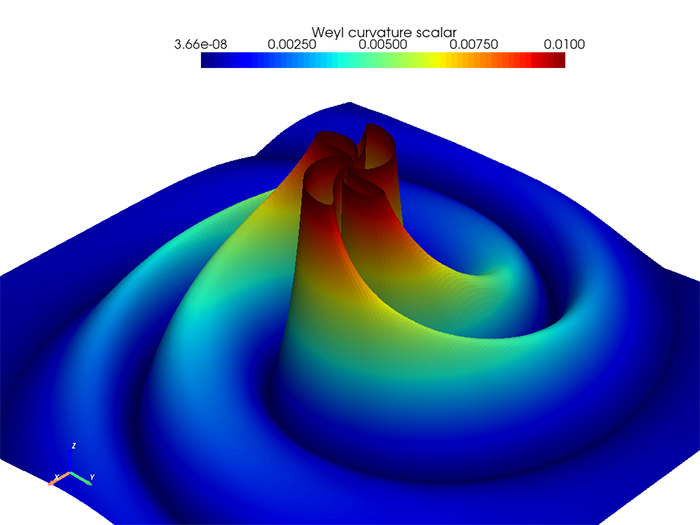
Spacetime curvature around merger moment
The spacetime curvature around merger moment
obtained via numerical relativity simulations.

Strange black hole merger may have been a rare random encounter, find more about this news in an article published on ArsTechnica.

[1] Gamba, R., Breschi, M., Carullo, G. et al. GW190521 as a dynamical capture of two nonspinning black holes. Nat Astron (2022). https://doi.org/10.1038/s41550-022-01813-w

Mathemathics and psychoanalysis meet in the book “À l’ombre de Grothendieck et de Lacan”

Mathematician Alain Connes and psychoanalyst Patrick Gauthier-Lafaye have just co-written the book "À l'ombre de Grothendieck et de Lacan", published last May in French by Editions Odile Jacob.

Mathematician Alain Connes and psychoanalyst Patrick Gauthier-Lafaye have just co-written the book “À l’ombre de Grothendieck et de Lacan“, published last May in French by Editions Odile Jacob.

The book was born from the encounter between the two authors, who met just a few years ago in Cérisy-la-Salle, and it imagines a possible meeting between two of the most emblematic minds of the 20th century, who revolutionized their respective fields: Alexandre Grothendieck and Jacques Lacan. More precisely, the two authors present a point of contact between the theory of topos developed by Grothendieck and the concept of the unconscious as described by Lacan.

Alain Connes, professor at Collège de France, member of the Académie des Sciences, holder of the Léon Motchane Chair at IHES and Fields Medalist, explains that it all began when Patrick Gauthier-Lafaye, a psychiatrist and psychoanalyst, showed him a diagram presented by Lacan in one of his famous seminars.

It was by overcoming an initial mistrust of what at first looked like incomprehensible signs, and by following through on his intuition, that the mathematician was able to find a possible solution in the intuitionist logic and the theory of topos.

The two authors will participate, with Marc Darmon and Bernard Vandermersch, in a round table discussion about the book on Saturday, November 19, 2022 at the ALI, 25 rue de Lille in Paris.


For more information: https://mathinees-lacaniennes.net/fr/

Nikita Nekrasov has been awarded the 2023 Dannie Heineman Prize for Mathematical Physics

Nikita Nekrasov, theoretical physicist, for many years associated with IHES, has been awarded the 2023 Dannie Heineman Prize for Mathematical Physics.

Nikita Nekrasov, theoretical physicist, for many years associated with IHES, has been awarded the 2023 Dannie Heineman Prize for Mathematical Physics.

This award acknowledges Nekrasov’s “elegant application of powerful mathematical techniques to extract exact results for quantum field theories, as well as shedding light on integrable systems and non-commutative geometry.”

Professor at the Simons Center for Geometry and Physics at Stony Brook, Nikita Nekrasov was a permanent professor at IHES in 2000-2013, and a visiting professor almost every year since then. He is also on the board of Friends of IHES, a US-based non-profit organization.

Some of the important contributions that have earned him this prestigious prize are discussed in the paper “Seiberg-Witten Prepotential from Instanton Counting”, that he has worked on during the time he spent as a permanent professor at IHES. Remarkably, this is the most-cited single-author paper by a researcher affiliated with IHES and this year marks its 20th anniversary.

The Dannie Heineman Prize is awarded every year by the American Institute of Physics and the American Physical Society to researchers who have made significant contributions to the field of mathematical physics.

IHES warmly congratulates Prof. Nekrasov on this award!

To learn more about Nikita Nekrasov and his work, watch this interview he gave in 2018.

Success of the campaign “IHES, at the Avant-Garde of Science”

Officially launched in November 2018 on the occasion of the 60th anniversary of IHES, the Institute's third fundraising campaign displayed a very ambitious goal of 50 Millions euros.

Officially launched in November 2018 on the occasion of the 60th anniversary of IHES, the Institute’s third fundraising campaign displayed a very ambitious goal of 50 Millions euros. Thanks to all donors’ generosity and commitment as well as to the Campaign Committee members’ involvement, chaired by Jean-Laurent Bonnafé and Philippe Camus, but also to all scientific and administrative staff of the Institute, this result has not only been achieved but exceeded. A little bit more of 55 Millions euros were collected!

The Institute could relied on loyal supporters, private or public, but also on support from new donors. Whereas this campaign has already allowed superb advances, as a brand new building on the campus or the recruiting of new scientists, some of the financing obtained will support longer term projects. IHES therefore warmly thanks all those who took part to this campaign and contributed to this remarkable result.

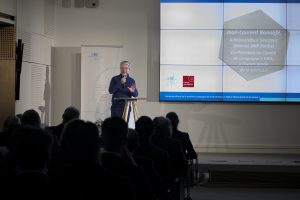
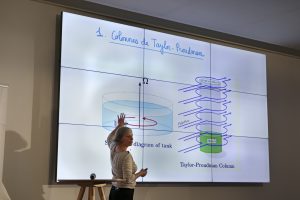
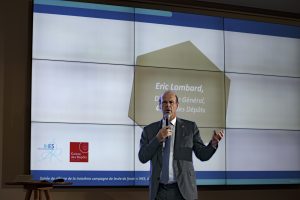
To celebrate this success and mark the official ending of this campaign, an event has been organized on October 24, 2022, with the support of Caisse des Dépôts, IHES major donor. Isabelle Laudier, Head of the Institut pour la recherche of Caisse des Dépôts and representative of Caisse des Dépôts at the board of IHES, was the Master of Ceremony. After an introduction of Sophie Quatrehomme, Director of Communications of the Caisse des Dépôts Group and contributions of Jean-Laurent Bonnafé, Director and Chief Executive Officer of BNP Paribas, Marwan Lahoud, Chairman of the board of IHES, the audience could enjoyed a the scientific talk given by Laure Saint-Raymond, Permanent Professor at IHES. Eric Lombard, Chief Executive Director of Caisse des Dépôts, concluded this event.

To view contributions (in French) and highlights of this evening in video.

Isabelle Laudier
Isabelle Laudier
Jean-Laurent Bonnafé
Laure Saint-Raymond
Laure Saint-Raymond
Eric Lombard
Eric Lombard

Conference by Cécile Michel on November 18, 2022

New event organized by Les Amis de l'IHES with Cécile Michel on Friday November 18, 2022 at 5:00 pm in the Marilyn and James Simons Conference Centre and on Zoom.

New event organized by Les Amis de l’IHES on Friday November 18, 2022 at 5:00 pm (French Time) at IHES

Cécile MICHEL Research Director at CNRS and Professor at Hamburg University, will give gave a conference (in French) in hybrid format, entitled:

“Business women, weavers and spouses: the life of Assyrian women 4000 years ago”

About 4,000 years ago, Assyrian merchants established a trading post in the ancient city of Kaneš in Central Anatolia. Their history is known from clay tablets on which they wrote. The voice of Tarām-Kūbi, an Assyrian woman who corresponded with her brother and husband who settled in Kaneš, takes us back in time.

Cécile MICHEL, Research Director at CNRS and Professor at Hamburg University will introduce the film “Ainsi parle Tarām-Kūbi. Correspondances assyriennes” that she dedicated to this woman. This presentation will be followed by a musical interlude.

Registration to attend online
Registration to attend in person

Contact: Ingrid Peeters (01 60 92 66 64)

Thierry Bodineau is awarded the Sophie Germain Prize – Fondation de l’Institut de France

Thierry Bodineau was awarded the 2022 Sophie Germain Prize by the French Academy of Sciences on October 18, during a ceremony held under the “cupola” of the Institut de France.

Thierry Bodineau was awarded the 2022 Sophie Germain Prize by the French Academy of Sciences on October 18, during a ceremony held under the “cupola” of the Institut de France. The evening ended with the intervention of astrophysicist and member of the Academy Anne-Marie Lagrange on the “Exploration of exoplanets”.

A CNRS research director at IHES since last September, Thierry Bodineau specializes in probability theory and his work focuses on mathematical problems in statistical mechanics.

The Sophie Germain Prize of the Institut de France has been awarded every year by the French Academy of Sciences since 2003 to researchers who have carried out fundamental research in mathematics. Through this prize, the Academy of Sciences furthers its mission of encouraging the advancement of science.

This award underlines the importance of Thierry Bodineau’s contributions, whose research subjects touch different problems at the interface with physics. He has worked the coexistence of phases in the Ising model and its consequences on the dynamical relaxation. In collaboration with Bernard Derrida, he has also studied stochastic processes to characterize the flow in non-equilibrium systems. More recently, he has collaborated with Isabelle Gallagher, Laure Saint-Raymond and Sergio Simonella, to analyze the stochastic behavior of hard sphere dynamics in the kinetic limit.

The IHES is delighted by this recognition attributed to Thierry Bodineau and congratulates him warmly.

Successful launch of the program funding Africa-based researchers

At the beginning of 2022 IHES launched a special program dedicated to visiting researchers from the African continent that will be carried over ten years.

As part of a generous funding from the Simons Foundation, at the beginning of 2022 IHES launched a special program dedicated to visiting researchers from the African continent, that will be carried over ten years. Thanks to this funding, as part of its visiting program, on top of the package offered to all visitors, IHES can now refund traveling costs of researchers coming from the African continent.

The aim is to make the opportunity of visiting IHES available to the largest number of researchers, especially those coming from African countries, currently underrepresented at the Institute.

The Institute has already been able to measure the impact of the program on the number of applications: IHES received more than a hundred requests for a visit from researchers affiliated to an institution based in the African continent ahead of the June selection by the Scientific Council. At the same period in 2019, before the pandemic, it had received only seven applications.

This important increase in the number of applications from Africa-based researchers is already a sign that covering travelling costs for Africa-based researchers is a significant improvement, opening the access to the Institute’s visiting program to a larger number of scientists.

Considering the Institute’s capacity and the available resources, the Scientific Council could only accept six Africa-based applicants in 2022 but IHES will be accepting new applications for the December selection starting in November, and scientists interested in this opportunity will be able to participate in a new selection process.

Dedicated funding for this program is secured for the next ten years, which will allow to develop a longstanding relationship between IHES and various communities of mathematicians and physicists on the African continent, thus increasing the perspectives of collaboration and the program’s impact over the long term.