Doors Open Day at IHES

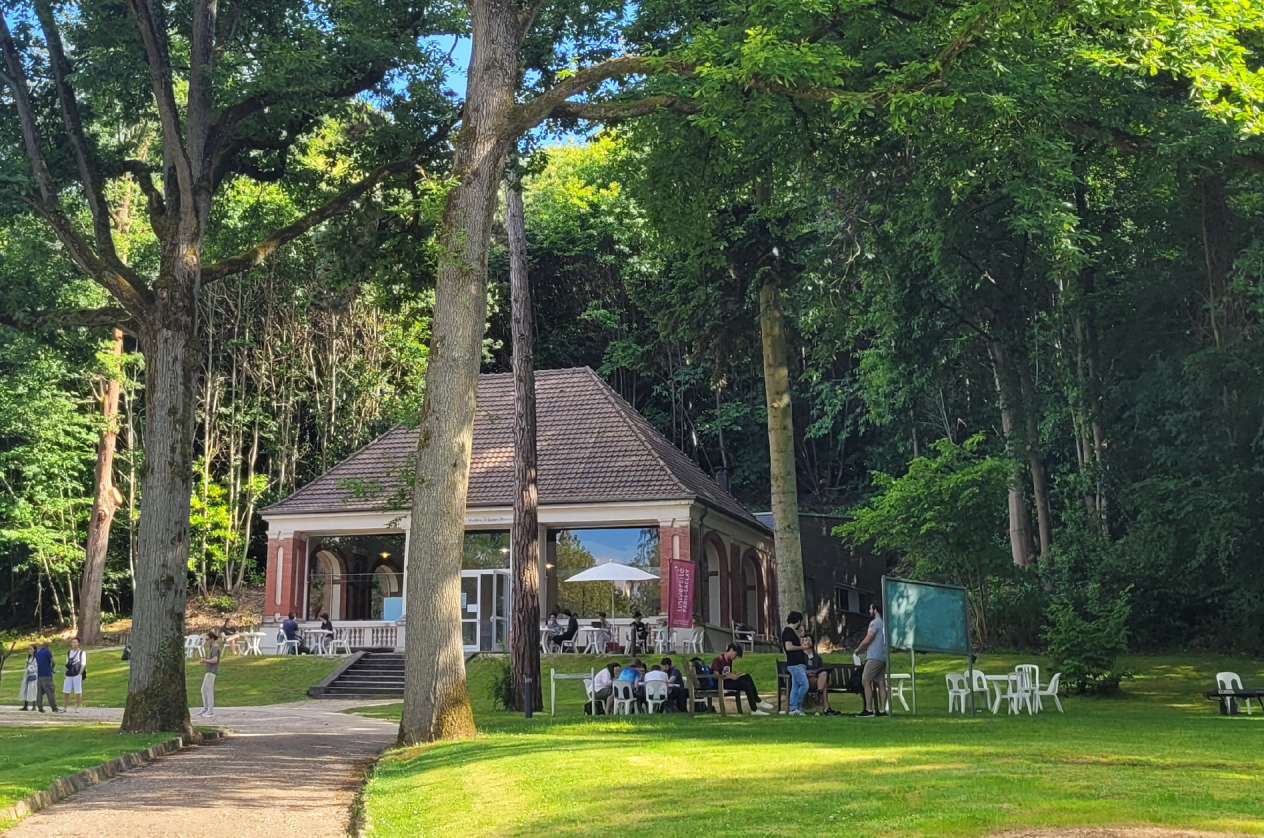
IHES opened its doors to the public on Saturday, September 17, on the occasion of the European Heritage Days.

IHES opened its doors to the public on Saturday, September 17, 2022 from 1:30 to 5:30 pm, on the occasion of the European Heritage Days.

Nearly 200 visitors discovered the infrastructures, as well as the functioning and organization of the Institute. They were also able to learn more about the international scientists who have marked the history of IHES for over 60 years.

The program included the possibility to watch an exhibition of mathematical artworks and discuss them with Claude Bruter, a mathematician specializing in this subject; an interactive visit of the sculpture “Skolem, clash of blocks and numbers to the wind” presented by Jean-Pierre Bourguignon, director of IHES from 1994 to 2013 and president of the association “Les Amis de l’IHES”; a privileged discussion with Emmanuel Ullmo, director of IHES, and Cédric Villani, holder of the IHES-Université de Lyon chair of analysis; as well as video testimonies of Hugo Duminil-Copin, winner of the Fields Medal in 2022, talking about his career and research, as well as of women researchers expressing themselves on their links with the Institute.

This special day was also the occasion to mark the 60th anniversary since the Institute moved to Bois-Marie, in Bures-sur-Yvette.

Publication of the last results of the MICROSCOPE mission

The last results of the MICROSCOPE mission confirm the equivalence principle with an unprecedented precision.

The last results of the MICROSCOPE mission (MICROSatellite à trainée Compensée pour l’Observation du Principe d’Équivalence) were published on September 14, 2022 and confirm the equivalence principle with an unprecedented precision of 10-15. This result confirms once again the theory of General Relativity proposed by Albert Einstein.

Launched in 2016, a century after the publication of Einstein’s theory, the MICROSCOPE mission aims to test the equivalence principle between inertia and gravitation, a fundamental pillar of General Relativity, postulating that all bodies fall in the same way in the vacuum.

The violation of the equivalence principle is predicted by some unification theories between gravitation and quantum physics. In particular, a weak but non-zero violation of the equivalence principle by the dilaton in string theory has been predicted by recent work studying the mechanism of cosmological attraction [1,2] – hence the importance of testing the equivalence principle with high precision.

The mission was designed by the Office National d’Etudes et de Recherches Aérospatiales (ONERA), in collaboration with the Observatoire de la Cote d’Azur (OCA), the CNES (Centre National d’Etudes Spatiales) and the ZARM (Bremen, Germany). Thibault Damour, a permanent professor at IHES and one of the world’s leading experts on gravitation, is a Member of the Microscope Science Working Group and was one of its initiators.

MICROSCOPE uses very advanced technologies to compare the free fall acceleration of two bodies of different compositions, one made of platinum, the other of titanium. The whole thing takes place aboard a satellite that orbited the Earth from April 2016 until October 2018, making 1,642 revolutions and thus traveling 73 million km, equivalent to half the Earth-Sun distance.

Preliminary results were published in 2017 – this was already a confirmation of the equivalence principle with unparalleled accuracy that allowed the mission’s co-investigators and project leaders to win the 2019 Grand Prix Servant of the French Academy of Sciences.

The analysis of the data collected during two and a half years by the ONERA and OCA scientific teams, with the contribution of CNES and the collaboration of European laboratories, was published on September 14, 2022 in two prestigious journals: Physical Review Letters, and Classical and Quantum Gravity. These latest results push the limits of the accuracy of the equivalence principle test even further.

With its results, MICROSCOPE provides important constraints on new theories of gravitation at a level of precision that researchers expect to remain unmatched for a long time.


The press release by ONERA and CNES
Thibault Damour explains the motivations and the theoretical background of the mission – December 2019 (in French)
The conference in honor of the MICROSCOPE mission that took place at IHES in December 2019 (in French).

[1] T. Damour, A. M. Polyakov, The String dilaton and a least coupling principle, Nucl. Phys. B 423, 532-558 (1994) doi:10.1016/0550-3213(94)90143-0, [arXiv:hep-th/9401069]
[2] T. Damour, F. Piazza, G. Veneziano, Runaway dilaton and equivalence principle violations, Phys. Rev. Lett. 89, 081601 (2002) doi:10.1103/PhysRevLett.89.081601 [arXiv:gr-qc/0204094]


Cédric Villani joins IHES

Cédric Villani, a mathematician specializing in analysis, 2010 laureate of the Fields Medal and former deputy, joins IHES as of September 1, 2022.

Press release – 1 September 2022

Cédric Villani, a mathematician specializing in analysis, 2010 laureate of the Fields Medal and former Member of the French Parliament, will join IHES as of September 1, 2022. Also affiliated to Claude Bernard Lyon 1 University, he will hold the IHES-University of Lyon Chair in Analysis and will share his time between the two institutions.

Born in 1973, Cédric Villani attended preparatory classes at Lycée Louis-le-Grand and entered the École normale supérieure in Paris in 1992. After passing the “agrégation” in mathematics, a competitive exam to become a teacher in the French public education system, and obtaining a diploma in numerical analysis from Sorbonne University, he was an “agrégé-préparateur” from 1996 to 2000. He successfully defended his thesis in 1998, at Université Paris-Dauphine, under the supervision of mathematician Pierre-Louis Lions (1994 Fields medalist), studying the Boltzmann and Landau equations in the kinetic theory of gases and plasmas. In 2000, he became a professor at the École normale supérieure of Lyon, then at Claude Bernard Lyon 1 University, where he remained until 2010. He was the director of the Institut Henri Poincaré from 2009 to 2017.

Important recognitions underline the importance of his work. In 2009 he received the Henri Poincaré prize, and in 2010 he was awarded the Fermat prize and the prestigious Fields medal, the highest recognition in mathematics. Since then, he has been strongly committed to the popularization of science through the publication of several books, such as the autobiographical essay “Birth of a Theorem“.

In 2017, he was elected deputy for the 5th constituency of Essonne, a department in the Paris region of Ile-de-France. As part of his mandate, he participated in the French Committee for Economic Affairs and he chaired the Parliamentary Office for the Evaluation of Scientific and Technological Choices (Office parlementaire d’évaluation des choix scientifiques et technologiques), responsible for informing the French Parliament of the consequences of scientific and technological choices. He also participated in the drafting of a report on the teaching of mathematics in primary and secondary schools.

His research focuses on the study of partial differential equations and their applications to physics, particularly to statistical physics and optimal transport theory.

As a mathematician, Cédric Villani has long been involved in the scientific life of the Institute, where he regularly visited and where he gave lectures and seminars. While he was director of the Institut Henri Poincaré, he also promoted important collaborations between the two institutes, such as the initiatives led by the LabEx CARMIN (Centre d’Accueil et de Rencontres Mathématiques Internationales – which also includes CIMPA and CIRM).

“For me, as for any mathematician, IHES is an essential reference, a hub with some of the leading figures in our discipline. My conversations with Mikhail Gromov, for example, were essential for my work on the Ricci curvature,” says Cédric Villani. “I am delighted to be joining this Institute, which is so dear to me.”

Emmanuel Ullmo, Director of IHES, commented: “I am delighted that Cédric has accepted the Institute’s Scientific Council’s proposal to join IHES – his great qualities as a mathematician will allow IHES to further attract top researchers and his presence will be an important asset for the scientific development of the Institute.”

Thierry Bodineau, a CNRS research director, joins IHES

Thierry Bodineau, currently CNRS research director at École Polytechnique, joins IHES as a CNRS research director starting on September 1, 2022.

Press release – 31 August 2022

Thierry Bodineau, currently CNRS research director at École Polytechnique, joins IHES as a CNRS research director starting on September 1, 2022. He thus becomes a member of Laboratoire Alexander Grothendieck, a CNRS/IHES joint research unit.

After graduating from École normale supérieure (ENS) in Paris, Thierry Bodineau completed his PhD in 1997 at Université Paris Diderot (now Université Paris-Cité), under the supervision of Francis Comets, before becoming a CNRS researcher at the same university. In 2007, he joined ENS as a CNRS research director. Between 2008 and 2009, he spent a year in the United States, at Rutgers, New Jersey, and then at the Institute for Advanced Study.

It is upon his return from the United States that he began a very fruitful collaboration with Laure Saint-Raymond, now a permanent professor at IHES, who was then head of the mathematical analysis research team at ENS, and with whom he continues to work today.

In 2014, Thierry Bodineau joined the Center for Applied Mathematics (CMAP) at École Polytechnique. He served as deputy director of École doctorale Jacques Hadamard before becoming the director of CMAP in 2020, following Anne de Bouard.

Thierry Bodineau is a mathematician specializing in probability theory, and his work focuses on problems related to statistical mechanics. He was first interested in the study of the Ising model, the coexistence of phases and the interface problems that characterize these systems. He also worked on understanding non-equilibrium phenomena through stochastic modeling. More recently, he has become interested in renormalization aspects related to the study of the dynamics of particle systems and is working on the kinetic theory of gases, also in collaboration with Laure Saint-Raymond.

His relationship with the Institute dates back to the time when, as a student at ENS, he heard about it as a mythical place. But it is especially in the 2000’s that he started to regularly come to the Institute motivated by his collaboration with Joel Lebowitz, an American mathematical physicist known for his important contributions in the field of statistical physics, who was then already a frequent visitor to IHES. Thierry Bodineau then continued to attend courses and seminars organized at the Institute.

“I am delighted that Thierry Bodineau is joining IHES. The mathematical community interested in questions at the interface with statistical physics at IHES has grown significantly during these last few years, under the impulse of Hugo Duminil-Copin and Laure Saint-Raymond, and Thierry’s arrival will make an important addition”, commented Emmanuel Ullmo, director of IHES.

“IHES is a great place, and the ideal environment to do mathematical research, both because of its calm and because of the opportunities for discussion that it provides,” explains Thierry Bodineau. “Being at IHES will allow me to focus on my research while at the same time interacting with a dynamic community of colleagues working on topics closely related to mine.

The Ukrainian team obtains excellent results at the International Mathematical Olympiad

IHES congratulates all Ukrainian students who took part in the last International Mathematical Olympiad (IMO), held in Oslo from July 9 to 16, on their excellent results.

IHES congratulates all Ukrainian students who took part in the last International Mathematical Olympiad (IMO), held in Oslo from July 9 to 16, on their excellent results. The Ukrainian team placed 17th with one gold, one silver and 4 bronze medals. Ihor Pylaiev got a perfect score of 42/42 ranking first out of about 600 candidates from 104 countries. This achievement is all the more remarkable as it comes in the context of the Russian invasion of Ukraine and its horrors for the population, especially for these high school students and their teachers.

Ihor Pylaiev and his classmate Vadym Hassieiev, who won a bronze medal, will continue their studies in preparatory classes at Lycée Louis-le-Grand in Paris starting in September. Before the war, they were students in the final year of high school at Lyceum 27 in Kharkiv. They arrived at Louis-le-Grand a few weeks after the beginning of the Russian invasion, supported by IHES at the initiative of Ahmed Abbes, a CNRS research director.

IHES wishes much success in their studies to all the members of the Ukrainian team and hopes to welcome them in a few years as postdocs or visitors. On this occasion, IHES also renews its full solidarity with the Ukrainian mathematicians and population in the ordeal they are currently experiencing.


Photo:
The Ukrainian team at the IOM in Oslo. Front row, from left to right: Anton Havryliuk (Kyiv), Semen Andriiets (Kyiv), Ivan Bortnovskyi (Kharkiv); back row: Ihor Pylaiev (Kharkiv), Vadym Hassieiev (Kharkiv), Sviatoslav Denyskov (Kharkiv). © Zarina Kodyrova

Tribute to Nicola N. Khuri (1933 – 2022)

IHES was sorry to learn that Nicola N. Khuri, brilliant scientist and dear friend to the Institute, passed away on August 4th, 2022, aged 89.

IHES was sorry to learn that Nicola N. Khuri, brilliant scientist and dear friend to the Institute, passed away on August 4th, 2022, aged 89.

A physicist with broad interests, Nicola Khuri succeeded in building the mathematical foundation of potential scattering theory, which allows investigation of how waves and particles deviate from their standard trajectories in response to collisions or other outside forces. His results (in particular with Kinoshita and with A. Martin) have suggested experiments at the large particle accelerators at CERN. Having an in-depth understanding of physical theories, Nicola was also deeply immersed in examining the general mathematical properties of quantum field theories.

Born in 1933 in Beirut, Lebanon, Nicola received his Ph.D. from Princeton University and continued on with fellowships there for a few years. There, he met Louis Michel, who later became the first permanent professor in physics at IHES. Later, Nicola taught at his undergraduate alma mater, the American University of Beirut, followed by the Institute for Advanced Study in Princeton, and Columbia University. Though he held visiting professorships at countless esteemed universities, he never left Rockefeller after joining its community in 1964 as an associate professor, becoming full professor in 1968, a position he held until his retirement, at which time he became professor emeritus.

Nicola worked with several professors at IHES, including Henri Epstein, David Ruelle and Thibault Damour, who became his friends. He importantly helped IHES in its efforts to create an endowment, developing a very close relation with Jean-Pierre Bourguignon, during his directorship.

Read here Nicolas Khuri’s recollection of IHES published in the book “Le Petit Mémorial pour les 40 ans de l’IHÉS“, written for the IHES 40th anniversary.

More on his biography on Rockefeller University’s website here.

David Ruelle, professor emeritus at IHES, receives the Dirac medal

David Ruelle, theoretical physicist and professor emeritus at IHES, is among the three laureates of the prestigious Dirac Medal, along with Joel Lebowitz of Rutgers University, USA, and Elliott Lieb of Princeton University.

David Ruelle, theoretical physicist and professor emeritus at IHES, is among the three laureates of the prestigious Dirac Medal, along with Joel Lebowitz of Rutgers University, USA, and Elliott Lieb of Princeton University.

They have been awarded the Dirac Medal “for groundbreaking and mathematically rigorous contributions to the understanding of the statistical mechanics of classical and quantum physical systems”. The prizes recognizes the important work of the three physicists have done in providing a deeper mathematical understanding of phenomena inherent in statistical physics, such as non-equilibrium systems, chaos and turbulence.

David Ruelle, who specializes in statistical mechanics and chaotic systems, was a permanent professor at IHES between 1964 and 2000 before becoming professor emeritus. This award is the culmination of a career punctuated by important recognitions: the Matteucci Medal, the Henri Poincaré Prize and the Max Planck Medal are among the most recent. Like the other two winners of the prize announced today, David Ruelle also received the Boltzmann Medal.

He is a foreign member of the American Academy of Arts and Sciences, an associate foreign member of the National Academy of Sciences, and a foreign member of the Accademia Nazionale dei Lincei. Last May, he was conferred the rank of Commander of the Order of Leopold by His Majesty the King of the Belgians, which was presented to him by Ambassador of Belgium to France François de Kerchove d’Exaerde.

The Dirac Medal is awarded annually by the International Center for Theoretical Physics “Abdus Salam” (ICTP) in Trieste to researchers who have made important contributions to the field of theoretical physics. The award is announced on August 8, the birthday of the great physicist Paul Dirac, to whom it pays tribute.

In 2021, Thibault Damour, a permanent professor at IHES, was among the four winners of the Dirac Medal, together with Alessandra Buonanno (Albert Einstein Institute), Frans Pretorius (Princeton University), and Saul Teukolsky (Caltech and Cornell University).

Qube Research and Technologies becomes a major donor of IHES

Qube Research and Technologies (QRT) becomes a major donor of IHES by making a €100k gift to the Institute’s endowment.

Press release – 8 July 2022

Qube Research and Technologies (QRT) becomes a major donor of IHES by making a €100k gift to the Institute’s endowment. The gift will contribute to supporting the IHES summer schools, which are an essential moment in the Institute’s scientific activity, and a unique opportunity for exchange and collaboration.

Organized around a different theme each year, these summer schools, that usually take place over two weeks, are aimed mainly towards early-stage researchers. They gather a number of PhD students and post-doctoral researchers, as well as more experienced scientists eager to pass their knowledge on to the future generations of mathematicians and theoretical physicists. Since 2020, the IHES summer schools have taken on a hybrid format, which allows for a much larger audience, who can access high-level courses from across the globe.

A global quantitative and systematic investment manager operating across the world, QRT strongly relies on advanced research and technology to implement a scientific approach to investing. By supporting the Institute’s summer schools, QRT carries forward its commitment to supporting academic research at its highest level. Through this gift, QRT also reinforces its support in favor of Université Paris-Saclay, IHES being one of its founding members.

Emmanuel Ullmo, Director of IHES, comments: “Through this generous gift, QRT directly joins the Institute’s major donors and it helps IHES organize its annual summer school, thus participating in the advancement and dissemination of knowledge. IHES is very grateful for this precious support.”

Pierre-Yves Morlat, CEO of Qube Research and Technologies, said “IHES is a recognized symbol of scientific excellence.  As a science-driven company we benefit immensely from Paris-Saclay’s scientific ecosystem. QRT is proud to support IHES’s efforts in promoting scientific creativity and global knowledge dissemination”.


Qube Research and Technologies
Qube Research & Technologies (QRT) is a global quantitative and systematic investment manager, operating in all liquid asset classes across the world. QRT combines data, research, technology and trading expertise in a collaborative effort to solve highly complex challenges. QRT’s culture of innovation drives its ambition to deliver high quality returns for its investors.


Barry Mazur has been awarded the Chern Medal

Barry Mazur, Gerhard Gade University Professor at Harvard University, and a mathematician very close to IHES, has been awarded the Chern Medal.

Barry Mazur, Gerhard Gade University Professor at Harvard University, and a mathematician very close to IHES, has been awarded the Chern Medal, on the occasion of the International Congress of Mathematicians taking place in Helsinki.

Barry Mazur’s research interests include number theory and algebraic geometry. His profound contributions to these areas of mathematics have earned him many awards, including the Veblen Prize in geometry, the Cole Prize in number theory, the Chauvenet Prize for exposition, and the Steele Prize for seminal contribution to research from the American Mathematical Society. In 2013, he was presented with one of the 2011 National Medals of Science by President Barack Obama.

Barry Mazur’s close relationship with IHES dates back to 1962, when he first came to the Institute as a visiting professor. The Institute had just moved to Bois-Marie, where it still is. He then visited IHES regularly almost every year over a period of two decades, thus nourishing fruitful collaborations and friendships with some of the community of algebraic geometers at IHES, including Alexander Grothendieck, Pierre Deligne, Ofer Gabber, who was his PhD student at Harvard in the 1970s. In 2018, thanks to a generous gift from William R. Hearst III, the Institute created the “Gretchen and Barry Mazur Chair” to honor him and his wife Gretchen, who has often been by his side during his visits to the Institute.

The Chern Medal is awarded every four years “to an individual whose accomplishments warrant the highest level of recognition for outstanding achievements in the field of mathematics”. Previous laureates are Louis Nirenberg, Phillip Griffiths and Masaki Kashiwara.

The Institute extremely well-deserved prize that once again highlights the importance of Barry Mazur’s work. Warm congratulations, Prof. Mazur!

To learn more:

William R. Hearst III supports a triennial chair in mathematics
Sixty years of history of IHES
Gretchen and Barry Mazur Day at IHES
Event “Barry Mazur and the Infinite Cheese of Knowledge”

Several mathematicians related to IHES have been honored at the ICM 2022

The award ceremony of the International Union of Mathematicians honored several mathematicians who have, at some point or another, been related to the Institute.

The award ceremony of the International Union of Mathematicians held on July 5 in Helsinki honored several mathematicians who have, at some point or another, been related to the Institute.

The Fields Medal is considered the world’s most prestigious award in mathematics and is awarded every four years at the International Congress of Mathematicians. The four winners of this year’s Fields Medal announced today are Hugo Duminil-Copin, permanent professor at IHES and professor at the University of Geneva, Maryna Viazovska, professor at the Ecole Polytechnique Fédérale de Lausanne, June Huh, Professor at Princeton University, and James Maynard, Professor at the University of Oxford.

Ukrainian mathematician Maryna Viazovska, a full professor at EPFL, where she holds the Chair of Arithmetic, was a post-doctoral researcher at IHES between 2012 and 2013. She also gave a series of six Hadamard lectures on automorphic forms and optimization in Euclidean space, organized by the Fondation Mathématique Jacques Hadamard at IHES in 2019. Prof. Viazovska solved the problem of compact packing of spheres in dimensions 8 and 24.

During the ceremony, other important prizes were awarded to scientists very close to the Institute. Most notably, Barry Mazur, Gerhard Gade University Professor at Harvard University, was awarded the Chern Medal, given every four years “to an individual whose accomplishments warrant the highest level of recognition for outstanding achievements in the field of mathematics”. Barry Mazur’s close relationship with IHES dates back to 1962, when the Institute had just moved to Bois-Marie, in the South of Paris. His research interests include number theory and algebraic geometry. His profound contributions to these subjects have earned him many awards, and this medal is the culmination of a lifetime’s work.

Other scientists from the Institute were also honored at the International Conference held online on July 6-14. Laure Saint-Raymond, a tenured professor at IHES, and this year’s ICM plenary speaker, addressed the dynamics of dilute gases in her lecture on Saturday, July 9.
Ofer Gabber, CNRS research director at IHES, was an invited speaker and gave a talk entitled “Bounding the torsion in the l-adic cohomology of smooth projective varieties without unbounded searches” on Monday, July 11.

IHES warmly congratulates these mathematicians on these prestigious awards, which testify to the profound impact of their research.

Publication of the 2021 Annual Report

The 2021 Annual Report is available online, in an interactive digital format, with a foreword by Marwan Lahoud, IHES Chairman.

The 2021 Annual Report is available online, in an interactive digital format, with a foreword by Marwan Lahoud, IHES Chairman.


“Many invited researchers tell us how much they love coming to IHES, where they can interact with other prominent scientists and also enjoy the friendly atmosphere and the peace of Bois-Marie, as well as the accommodation at the Ormaille residence. The magic that characterizes IHES is thanks to our entire community: visiting and permanent researchers, administrative staff, supporters, donors and friends. Thank you so much to all of you!

Speaking of community, I would like to pay tribute to the work of Friends of IHES, our fundraising partner organization in the United States and to thank especially Michael R. Douglas, who was its President and Chairman from 2013 to 2021. Under his guidance, many successful events were organized – galas, conferences, dinners – which helped IHES develop relationships with its American sponsors.

We are delighted that Marilyn and Jim Simons, the Institute’s main donors, have accepted to take over his presidency. Their commitment to our work is important and transformational for IHES. I would also like to express my warm thanks to them both for their new gift of 25 million euros, donated by the Simons Foundation: not only does this represent a record gift for IHES but a record one for basic research in France generally.

In France, we were honored to receive the visit of His Serene Highness the Prince Albert II of Monaco in June 2021. Permanent professor Thibault Damour gave a lecture on gravitational waves during this visit. The Prince chatted with several young researchers and was able to appreciate both the vitality of scientific activity undertaken at IHES and its clearly international reach.In order to preserve the Institute’s unique atmosphere and continue offering scientists the highest hosting standards, major work was carried out in the Ormaille residence in 2021. IHES benefited from funding provided by the Ministry of the Economy, Finance and the Recovery, as part of an ambitious program of renovation and improved energy efficiency for its buildings.

There were many hybrid (in person/on line) events in 2021, including scientific conferences and seminars, Board meetings, a Cercle des Mécènes event and the Friends of IHES gala. We noted that events and meetings continued to operate successfully, even remotely. Nonetheless, it is such a pleasure to meet face-to- face once again, to enjoy the cafeteria and teatime at the Institute and to soak up the magic of Bois-Marie: we very much look forward to meeting you here soon!”

Marwan Lahoud
IHES Chairman

Jean-Pierre Bourguignon elected new president of Les Amis de l’IHES

Jean-Pierre Bourguignon elected new president of Les Amis de l'IHES

Jean-Pierre Bourguignon, director of the Institut des Hautes Études Scientifiques (IHES) from 1994 to 2013 and honorary professor of the Institute since then, was elected president of Les Amis de l'IHES at the meeting of the Board of Directors of the association that took place on May 31, 2022.

Jean-Pierre Bourguignon, director of the Institut des Hautes Études Scientifiques (IHES) from 1994 to 2013 and honorary professor of the Institute since then, was elected president of Les Amis de l’IHES at the meeting of the Board of Directors of the association that took place on May 31, 2022. He succeeds Valentin Poénaru, former professor of mathematics at Université Paris-Sud (now Université Paris-Saclay), who was president of Les Amis de l’IHES from 2009 to 2022. The Board has decided to appoint him honorary president of the association. Jean-Marc Deshouillers, who was himself president of Les Amis de l’IHES, was elected Secretary. The details of the new governance of Les Amis de l’IHES are available here.

The next event organized by the association will take place on Thursday, June 23, 2022 at 5:00 pm (French Time) at IHES in a hybrid format. It will be a conference given by Annie Sainsard-Chanet, former professor at Université Paris-Saclay, entitled “Molecular scissors: a biological revolution” (full information here).

As usual, it will be followed by a musical moment.