Second edition of Life, Structure, and Cognition (LSC): Evolution & Learning
LSC, for Life, Structure, and Cognition, is an initiative with the aim of learning about and exploring the modalities for cooperative progress between Biology and Artificial Intelligence. June 26-30 for the 2023 LSC.
LSC, for Life, Structure, and Cognition, is a new initiative led by Yves Barral(ETH Zurich),Mikhail Gromov (IHES, University of Paris-Saclay),Eugene Koonin(NIH), and Robert Penner (IHES, University of Paris-Saclay). The 2023 edition will take place from June 26 to 30, 2023, at IHES, with the theme “Evolution & Learning”.
Over the course of a week, 2023 LSC will bring together scientists from all fields to present the latest progress in understanding evolution as a process of learning, and conversely, evolution of learning, in the context of their respective disciplines.
A conference for the general public will also be held at the Institut Jacques Monod in Paris. Given by Pierre-Yves Oudeyer, director of the Flowers team at INRIA Bordeaux Sud-Ouest and Université de Bordeaux, it will focus on evolution and learning.
Nicolas Minc, Institut Jacques Monod, U. Paris Cité/CNRS
Rosalyn Moran, King’s College London
Pierre-Yves Oudeyer, INRIA Bordeaux
Bob Penner, IHES & UC Los Angeles
Paul Rainey, Max Planck Institute for Evolutionary Biology, ESPCI Paris
Grégoire Sergeant-Perthuis, INRIA Paris
Eörs Szathmáry, Eötvös University
Yukiko Yamashita, MIT
Adam Yanai, Boston University
Itai Yanai, New York University Langone Health
The goal of the 2023 LSC is to provide an annual update on the latest advancements in LSC components and to explore the modalities for cooperative progress between Biology and Artificial Intelligence (AI). The objective is to investigate how biological systems evolved cognitive functions, using AI both as a concept toolbox and as a tool; and in turn, to investigate how biological systems can serve as models for understanding and stimulating new advances in AI.
The idea is to organize an annual evaluation, expert discussion, and lecture series on these topics, given by world experts covering multiple disciplines.
First edition of the Life, Structure, and Cognition (LSC) event
LSC, for Life, Structure, and Cognition, is an initiative with the aim of learning about and exploring the modalities for cooperative progress between Biology and Artificial Intelligence. The first edition will take place from June 26 to 30, 2022 for one week of the conference.
LSC, for Life, Structure, and Cognition, is a new initiative led by Yves Barral (ETH Zurich), Mikhail Gromov (IHES, University of Paris-Saclay), Robert Penner (IHES, University of Paris-Saclay), and Vasily Pestun (IHES, University of Paris-Saclay).
The goal of this event is to provide an annual update on the latest advancements in LSC components and to explore the modalities for cooperative progress between Biology and Artificial Intelligence (AI). The objective is to investigate how biological systems evolved cognitive functions, using AI both as a concept toolbox and as a tool; and in turn, to investigate how biological systems can serve as models for understanding and stimulating new advances in AI.
The idea is to organize an annual evaluation, expert discussion, and lecture series on these topics, given by world experts covering multiple disciplines.
1) LSC 2022 Webinars: there will be two webinars leading to the meeting followed by more in the Fall.
A first webinar, given by Pierre-Yves Oudeyer (Microsoft Research Lab, Montreal & Inria Bordeaux-Ouest), will take place on May 18, 2022, who will present a research program called Development AI, which studies open-ended developmental and learning models with the goal of building machines that learn like children.
A second webinar will be given by Eugene V. Koonin (NIH Bethesda) on June 7, 2022, and will focus on the evolution of complexity and the origins of life with its complexity.
2) LSC 2022 Meeting
The LSC 2022 Meeting is organized by Yves Barral (ETH Zurich), Mikhail Gromov (IHES & NYU), Robert Penner (IHES & UCLA), and Vasily Pestun (IHES & IBM Research), together with Nicolas Minc from the Institute Jacques Monod.
Vasily Pestun, Theoretical Physics, and Machine Learning, IHES & IBM Research
Simon Townsend, Comparative Communication and Cognition, University of Zurich
Yukiko Yamashita, Cellular Biology, Massachusetts Institute of Technology
The LSC 2022 (June 26 – July 1) will consist of:
Informal exchanges among the invited guests, the LSC constitutive committee members and meeting organizers, and the scientific community at large at IHES for the full duration of the meeting.
Hybrid Public Lectures (June 27 – 30) at the Institut Jacques Monod, Amphithéâtre Buffon (Consuelo De Moraes, Mark Mescher, Simon Townsend)
After such a special year, IHES intends to emphasize through its greeting card the importance of exchanges, transmission and dissemination of knowledge.
For researchers, moments of sharing, both formal and informal, are essential. However, in 2020, it has been a real challenge to find the means and formats to preserve a scientific dialogue and the quality of the links with collaborators and colleagues.
This greeting card therefore aims to pay tribute to the researchers who, throughout the world, have adapted, tested new tools and explored alternative approaches, always with a view to maintaining and fostering their exchanges, to facilitate the blossoming and circulation of ideas that will lead to tomorrow’s discoveries and advances.
The Institute’s scientists who wished to do so – permanent and associate professors, invited researchers, postdoctoral and doctoral students – have thus chosen an equation that had a particular meaning for them. Those equations appear on the greetings card, alongside a famous Euler formula, often presented as one of the most beautiful equations in mathematics. You will find below a short presentation of the scientists who participated, as well as their explanations of their choice of equation.
Equation chosen by Thibault Damour, permanent professor at IHES since 1989
Thibault Damour is a theoretical physicist whose main research domains are General Relativity and Cosmology. His work was notably fundamental in the detection of the gravitational waves in 2015.
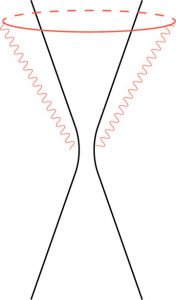
This equation concerns the scattering angle between two classical point masses (for example two black holes) interacting gravitationally according to Einstein’s theory. It says that when we add the effect of gravitational damping on the scattering angle, the result admits a high energy limit (HE) which coincides with the angle obtained with the so-called “eikonal” quantum approximation.
This physical process is illustrated in the figure on the right, which is a space-time diagram showing the collision (at a distance) of two black holes producing gravitational waves.”
Equation chosen by Arthur Parzygnat, postdoctoral researcher
Arthur Parzygnat is a mathematician whose main research domains are Applied Category Theory, Mathematical Physcics and quantum information. He has been a postdoctoral researcher at IHES for a year and a half and is part of the ERC QUASIFT led by Vasily Pestun.
“This equation is called “Bayes’ rule/theorem,” though it is more common to see it written as P(A|B)P(B)=P(B|A)P(A). It is used to make inferences on outcomes based on evidence, such as diagnosing illnesses, it is the foundation of many machine learning algorithms, and some believe it drives how intelligent beings make decisions. The diagram drawn here is a recent categorical reformulation of Bayes’ rule, which does not rely on its probabilistic interpretation. Such a viewpoint allows one to use the more abstract concept as a definition (as opposed to a theorem) in a completely new context, where an equation such as P(A|B)P(B)=P(B|A)P(A) might not make any sense, but the diagram does. Considering how ubiquitous Bayes’ rule has been, it is very possible that we have only scratched the surface with its applications. What new insight can such a reformulation teach us? Where can it be utilized, and how can we interpret it?”
Equation chosen by Katie Vokes, postdoctoral researcher
Katie Vokes is a mathematician whose main research domains are Geometric Group Theory and Low-Dimensional Topology. She has been a postdoctoral researcher for almost two years and is part of the Huawei Young Talents Programme since October 2020.
“This equation is the statement of the Gauss–Bonnet theorem for a surface M without boundary. This is a beautiful and fundamental result in differential geometry which relates the integral of the curvature K of M to the Euler characteristic χ(M) = 2 − 2 genus(M). The Gauss–Bonnet formula encodes the answers to so many basic questions that we might have while thinking about surfaces. Why must any two hyperbolic surfaces (constant curvature K ≡ −1) of genus 5 have the same area? And why can’t we make a genus 2 surface out of a flat piece of paper without introducing singular non-manifold points? “
Equation chosen by Emmanuel Ullmo, Director of IHES
Emmanuel Ullmo is a mathematician whose research domain is Algebraic and Arithmetic Geometry.
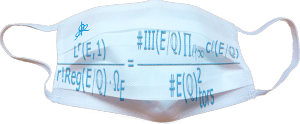
“Let E be a (modular) elliptic curve defined over Q, the field of rational numbers. In the early 80’s, two mathematicians, Bryan Birch and Peter Swinnerton-Dyer, proposed this formula where r denotes the algebraic rank of E, which is assumed to be equal to the analytic rank of E, and X(E/Q) is also assumed to be finite.
Open for more than forty years, the conjecture has only been demonstrated in special cases. And widely recognized as one of the most difficult and deepest mathematical problems still open at the beginning of the 21st century. “
Equation chosen by Veronica Fantini, invited researcher, SISSA (Italy)
Veronica Fantini is a mathematician whose main research domains are Geometry and Mathematical Physics. She is visiting the Institute for 4 months.
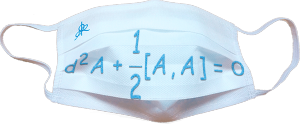
“I choose the Maurer-Cartan equation d² A+½[A,A]=0, because depending on the contest and on the point of view it describes different objects. As the Maurer-Cartan equation has different interpretations, let’s look optimistically to 2021 even in this difficult time. “
Equation chosen by Robert C. Penner, René Thom Chair holder and IHES major donor
Robert C. Penner is a mathematician who is also interested in physics and biology. His main research domains are moduli spaces and their applications to physics and biology. His current work is providing important insights for the development of vaccines against Covid and other viral diseases. Robert Penner has been a regular visitor to the Institute for many years and has been the René Thom Chair holder since 2014.
“I think it is a really cool equation, with a pretty collection of symbols!
This formula expresses the Maurer-Cartan form ξ of the Lie algebra I have built for the topological group of orientation-preserving homeomorphisms of the circle, which I have been studying for 30 years. In other terms, it is the universal generalization of the Eisenstein form E2 (z) dz in hyperbolic what are sometimes called Penner coordinates λA . I am just now finishing a paper with Igor Frenkel where this formula figures prominently as a universal automorphic form intended to capture the Monster.“
Euler’s Identity
Leonhard Euler is an 18th century Swiss mathematician and physicist. He made important discoveries in fields as varied as infinitesimal calculus and graph theory. He is considered one of the greatest and most prolific mathematicians of all time.
“Euler’s identity was voted “most beautiful mathematical formula of all time” in 1988 by a college of mathematicians.
It has the particularity of linking together the five great constants of mathematics: 0, 1, pi, e and i and according to Cédric Villani, “it is the unlikely combination of these five constants that makes this equation beautiful”.
Indeed, these constants have nothing in common a priori. Over the centuries, they have appeared in the great history of mathematics in very different contexts, to solve problems that at first sight had nothing in common.
It also presents elementary operations: multiplication, addition and equality.
It combines arithmetic, geometry, algebra and analysis in an extraordinarily condensed statement. »
The Alexzandria Figueroa and Robert Penner Chair established at the Institut des Hautes Etudes Scientifiques
A mathematician very close to the IHES, which he has been visiting regularly for more than 25 years, Prof. Penner wanted to pay tribute to his partner who died in January 2018.
A mathematician very close to the IHES, which he has been visiting regularly for more than 25 years, Prof. Penner wanted to pay tribute to his partner who died in January 2018. “I am a great believer in the Institute’s mission and am pleased to have associated our names to the IHES,” said Robert Penner. “Even with her only brief glimpse of it, Lexy was dazzled that there could be such a place as the IHES and would be gratified with this association.”
The gift will endow a triennial chair of Mathematics at the Institute that will provide support for prominent scientists. Chair holders are a specific type of invitations of IHES large visitors program: they are nominated by the Scientific Council, and come to the IHES for at least three months each year over three consecutive years, benefiting from the outstanding research and living conditions offered at the Institute.
“We are very grateful to Bob for his generous donation. It enables the IHES to fulfill its mission to offer exceptional scientists a place where their research can flourish,” said Michael R. Douglas, Chairman and President of the Friends of IHES, Inc.
“This generous gift from Bob is also an important contribution to our ongoing fundraising campaign, and I express my deepest gratitude for his support” said Emmanuel Ullmo, Director of the IHES. “Having scientists supporting our campaign is very meaningful and encourages us to pursue our efforts to defend the importance of unconstrained research.”
The first chair holder of the Alexzandria Figueroa and Robert Penner Chair will be Prof. Joseph Ayoub from the University of Zurich. A specialist of Algebraic Geometry, which has a long tradition at the IHES, Ayoub will benefit from all aspects of the academic and community life, that are unique elements of being at the Institute, and will contribute to the scientific dynamism of the IHES.
And also
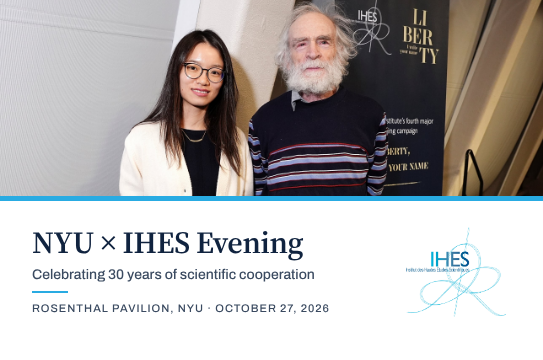
Dinner Celebrating 30 Years of Scientific Cooperation Between IHES and NYU
On Tuesday, October 27, 2026, Friends of IHES brought together its friends and supporters for a dinner at the Rosenthal Pavilion at New York University to celebrate 30 years of scientific cooperation between IHES and NYU, in the presence of Linda Mills, President of NYU, and Marilyn Simons, Chair of Friends of IHES.
Interview with Christophe Soulé, CNRS Emeritus Research Director at IHES and member of the French Academy of Sciences, conducted in May 2025 by Pierre Pansu, Professor of Mathematics Emeritus at Université Paris-Saclay.
Nous utilisons les cookies pour améliorer votre expérience sur notre site Web. En parcourant ce site, vous acceptez notre utilisation des cookies.
We use cookies to enhance your experience on our website. By browsing this site, you agree to our use of cookies.
This website uses cookies to improve your experience while you navigate through the website. Out of these, the cookies that are categorized as necessary are stored on your browser as they are essential for the working of basic functionalities of the website. We also use third-party cookies that help us analyze and understand how you use this website. These cookies will be stored in your browser only with your consent. You also have the option to opt-out of these cookies. But opting out of some of these cookies may affect your browsing experience.

 The goal of the 2023 LSC is to provide an annual update on the latest advancements in LSC components and to explore the modalities for cooperative progress between Biology and Artificial Intelligence (AI). The objective is to investigate how biological systems evolved cognitive functions, using AI both as a concept toolbox and as a tool; and in turn, to investigate how biological systems can serve as models for understanding and stimulating new advances in AI.




 Arthur Parzygnat is a mathematician whose main research domains are Applied Category Theory, Mathematical Physcics and quantum information. He has been a postdoctoral researcher at IHES for a year and a half and is part of the

 Katie Vokes is a mathematician whose main research domains are Geometric Group Theory and Low-Dimensional Topology. She has been a postdoctoral researcher for almost two years and is part of the

 Veronica Fantini is a mathematician whose main research domains are Geometry and Mathematical Physics. She is visiting the Institute for 4 months.



 Leonhard Euler is an 18th century Swiss mathematician and physicist. He made important discoveries in fields as varied as infinitesimal calculus and graph theory. He is considered one of the greatest and most prolific mathematicians of all time.