Mike Fest: A conference in honor of Michael Douglas’ 60th birthday
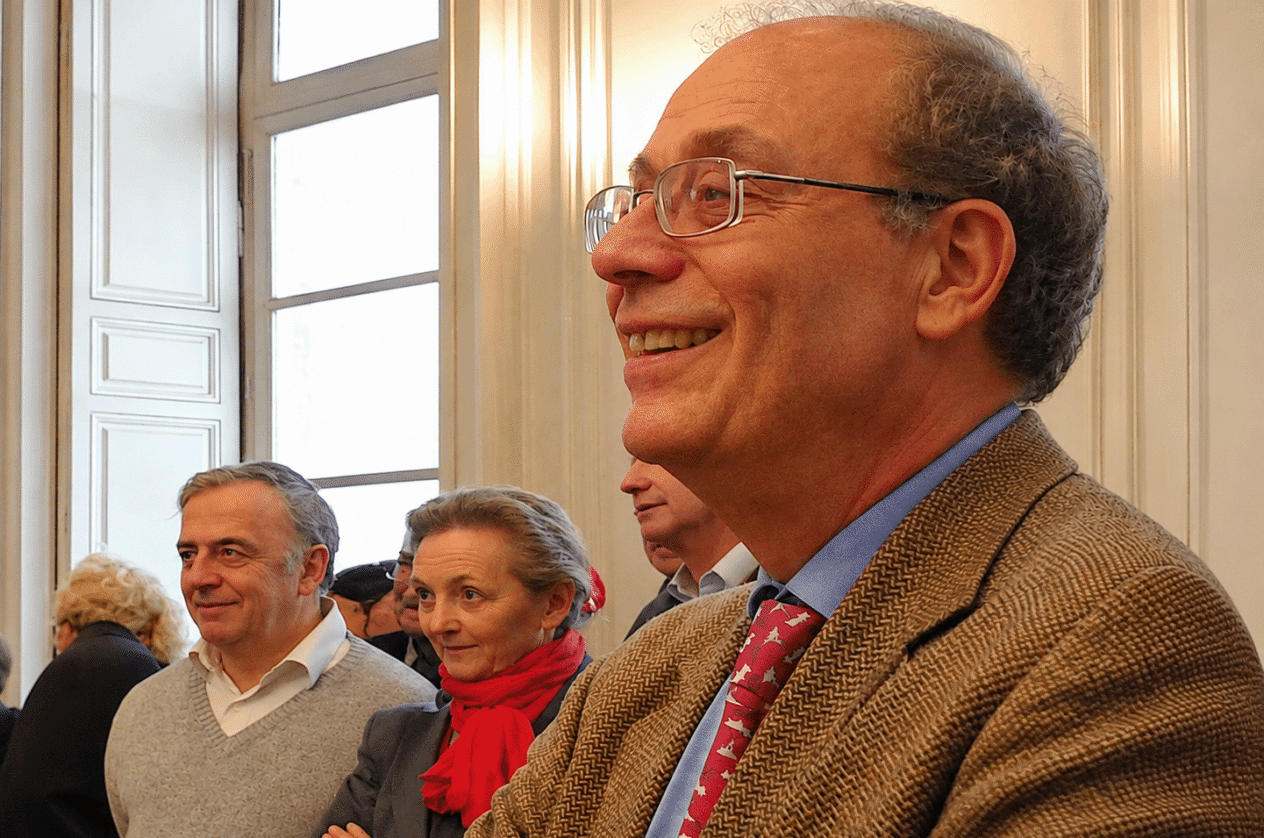
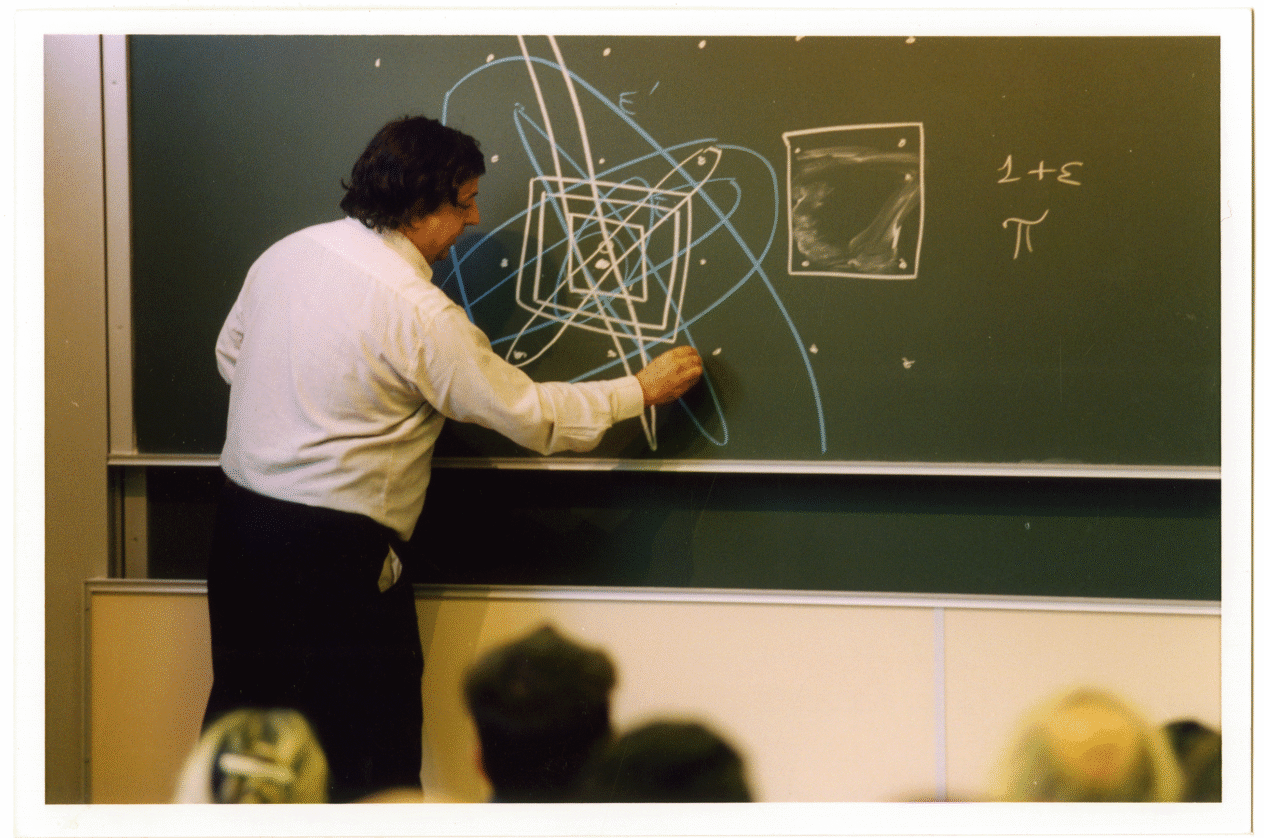
In May, IHES celebrates the 60th birthday of Michael R. Douglas with a five-day conference on string theory and mathematical physics.
MIKE FEST – 9-13 May 2022
In honor of the 60th birthday of Michael R. Douglas, a longtime supporter of IHES, a conference was held in his honor on May 9-13, 2022 at the Institute.
Michael R. Douglas, who recently stepped down as president of Friends of IHES, is a theoretical physicist known notably for his work on string theory and mathematical physics. His relationship with the IHES dates back to 2000 when he became the Louis Michel Chair of Theoretical Physics.
During five days, several international speakers will cover the topics on which Mike Douglas has worked and made profound contributions, namely: string theory, matrix models, mathematical physics, and machine learning.
To register, get more information on the MikeFest program, and stay up to date on the latest action, go to the dedicated webpage.
Replay the conference in videos:
Organizers :
Costas Bachas, LPENS
Semyon Klevtsov, Univ. Strasbourg
Nikita Nekrasov, SCGP & Stony Brook
Emmanuel Ullmo, IHES
Invited speakers:
Vijay Balasubramanian, Univ. of Pennsylvania
Alexander Belavin, Independent Univ. Moscow (TBC)
Ilka Brunner, Univ. München
Alain Connes, IHES & Collège de France
Frederik Denef, Columbia Univ.
Bartomeu Fiol, Univ. de Barcelona
Jaume Gomis, Perimeter Institute(TBC)
Sasha Gorsky, IITP RAS, MIPT
Chris Hull, Imperial College
Shamit Kachru, Stanford Univ.
Volodya Kazakov, LPENS
Maxim Kontsevich, IHES
Patrick Massot, LMO – Univ. Paris-Saclay
Luca Mazzucato*, Univ. of Oregon
David McAllester, TTIC *
Liam McAllister, Cornell Univ.
Greg Moore*, Rutgers Univ.
Rémi Monasson, LPENS
Eliezer Rabinovici, Hebrew Univ. of Jerusalem
John Schwarz, Caltech
Nathan Seiberg*, IAS
Steve Shenker*, Stanford Univ.
Eva Silverstein*, Stanford Univ.
Christian Szegedy, Google Research
Washington Taylor*, MIT
Alessandro Tomasiello, Univ. Degli Studi Di Milano Bicocca
Josef Urban, CIIRC
Steve Zelditch*, Northwestern Univ.
* remote talks
H.S.H. Prince Albert II of Monaco visited IHES
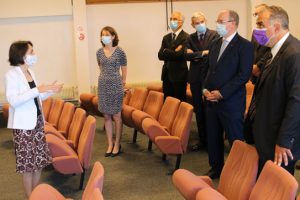
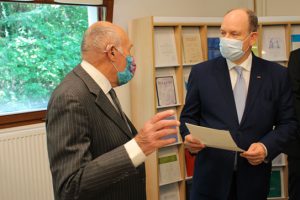
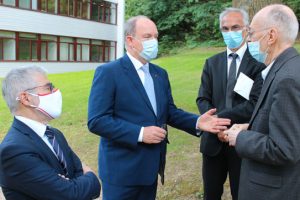
Friday 11 June 2021, H.S.H. Prince Albert II of Monaco came to the Institut des Hautes Etudes Scientifiques, along with Patrice Cellario, the Principality of Monaco’s Minister of Interior.
Friday 11 June 2021, H.S.H. Prince Albert IIof Monaco came to the Institut des Hautes Etudes Scientifiques, along with Patrice Cellario, the Principality of Monaco’s Minister of Interior.
After having been formally greeted by Marwan Lahoud, President of IHES, Emmanuel Ullmo, Director of IHES, Alexander Grimaud, Sub-prefect of the district of Palaiseau and Jean-François Vigier, Mayor of Bures-sur-Yvette, they met three junior researchers currently at the Institute:
– Veronica Fantini, an Italian mathematician specializing in geometry and mathematical physics, is currently a visitor at IHES, where she will start a post-doc in September;
– Alex Takeda, a Brazilian post-doc working on topics related to algebraic geometry and mathematical physics.
In the main scientific building of the Institute, H.S.H. Prince Albert II of Monaco was then able to discuss with Fanny Kassel, mathematician, a CNRS researcher based at IHES, and one of her PhD students, Balthazar Fléchelles. The Institute is thus part of a larger mathematical and scientific community: a founding member of Université Paris-Saclay, it works closely with several partners, including CNRS (the French National Research Center).
H.S.H. Prince Albert II of Monaco and Patrice Cellario also visited the IHES library, where they were able to greet David Ruelle, a physicist and permanent professor until 2000 and now professor emeritus at IHES, winner of the Albert 1er de Monaco prize in 1979, awarded by the Academy of Sciences.
Finally, before going to lunch, they met Luc Illusie, a mathematician specializing in algebraic geometry, who was on site for the conference organized in his honor on the occasion of his 80th birthday (81st in fact due to the pandemic!) from 8 to 11 June. Luc Illusie is a precious and faithful member of the Institute’s community: he attended the famous A. Grothendieck’s Seminar during IHES’ first years.
After having had lunch at the Institute’s cafeteria, H.S.H. Prince Albert II of Monaco and Patrice Cellario went to the Marilyn and James Simons Conference Center, where Thibault Damour, a physicist and permanent professor at IHES, gave a talk on gravitational waves. A good opportunity to get a sense of the scientific progress made since Albert Einstein’s first scientific work on this topic, with the most recent observational breakthroughs and their theoretical basis.
Season’s Greetings from IHES
After such a special year, IHES intends to emphasize through its greeting card the importance of exchanges, transmission and dissemination of knowledge.
For researchers, moments of sharing, both formal and informal, are essential. However, in 2020, it has been a real challenge to find the means and formats to preserve a scientific dialogue and the quality of the links with collaborators and colleagues.
This greeting card therefore aims to pay tribute to the researchers who, throughout the world, have adapted, tested new tools and explored alternative approaches, always with a view to maintaining and fostering their exchanges, to facilitate the blossoming and circulation of ideas that will lead to tomorrow’s discoveries and advances.
The Institute’s scientists who wished to do so – permanent and associate professors, invited researchers, postdoctoral and doctoral students – have thus chosen an equation that had a particular meaning for them. Those equations appear on the greetings card, alongside a famous Euler formula, often presented as one of the most beautiful equations in mathematics. You will find below a short presentation of the scientists who participated, as well as their explanations of their choice of equation.
Equation chosen by Thibault Damour, permanent professor at IHES since 1989
Thibault Damour is a theoretical physicist whose main research domains are General Relativity and Cosmology. His work was notably fundamental in the detection of the gravitational waves in 2015.
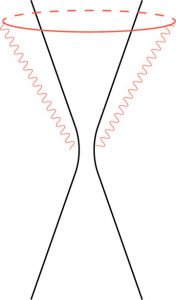
This equation concerns the scattering angle between two classical point masses (for example two black holes) interacting gravitationally according to Einstein’s theory. It says that when we add the effect of gravitational damping on the scattering angle, the result admits a high energy limit (HE) which coincides with the angle obtained with the so-called “eikonal” quantum approximation.
This physical process is illustrated in the figure on the right, which is a space-time diagram showing the collision (at a distance) of two black holes producing gravitational waves.”
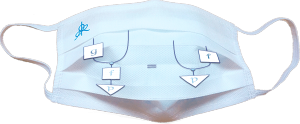
Equation chosen by Arthur Parzygnat, postdoctoral researcher
Arthur Parzygnat is a mathematician whose main research domains are Applied Category Theory, Mathematical Physcics and quantum information. He has been a postdoctoral researcher at IHES for a year and a half and is part of the ERC QUASIFT led by Vasily Pestun.
“This equation is called “Bayes’ rule/theorem,” though it is more common to see it written as P(A|B)P(B)=P(B|A)P(A). It is used to make inferences on outcomes based on evidence, such as diagnosing illnesses, it is the foundation of many machine learning algorithms, and some believe it drives how intelligent beings make decisions. The diagram drawn here is a recent categorical reformulation of Bayes’ rule, which does not rely on its probabilistic interpretation. Such a viewpoint allows one to use the more abstract concept as a definition (as opposed to a theorem) in a completely new context, where an equation such as P(A|B)P(B)=P(B|A)P(A) might not make any sense, but the diagram does. Considering how ubiquitous Bayes’ rule has been, it is very possible that we have only scratched the surface with its applications. What new insight can such a reformulation teach us? Where can it be utilized, and how can we interpret it?”
Equation chosen by Katie Vokes, postdoctoral researcher
Katie Vokes is a mathematician whose main research domains are Geometric Group Theory and Low-Dimensional Topology. She has been a postdoctoral researcher for almost two years and is part of the Huawei Young Talents Programme since October 2020.
“This equation is the statement of the Gauss–Bonnet theorem for a surface M without boundary. This is a beautiful and fundamental result in differential geometry which relates the integral of the curvature K of M to the Euler characteristic χ(M) = 2 − 2 genus(M). The Gauss–Bonnet formula encodes the answers to so many basic questions that we might have while thinking about surfaces. Why must any two hyperbolic surfaces (constant curvature K ≡ −1) of genus 5 have the same area? And why can’t we make a genus 2 surface out of a flat piece of paper without introducing singular non-manifold points? “
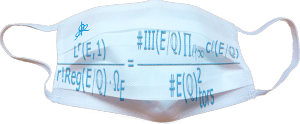
Equation chosen by Emmanuel Ullmo, Director of IHES
Emmanuel Ullmo is a mathematician whose research domain is Algebraic and Arithmetic Geometry.
“Let E be a (modular) elliptic curve defined over Q, the field of rational numbers. In the early 80’s, two mathematicians, Bryan Birch and Peter Swinnerton-Dyer, proposed this formula where r denotes the algebraic rank of E, which is assumed to be equal to the analytic rank of E, and X(E/Q) is also assumed to be finite.
Open for more than forty years, the conjecture has only been demonstrated in special cases. And widely recognized as one of the most difficult and deepest mathematical problems still open at the beginning of the 21st century. “
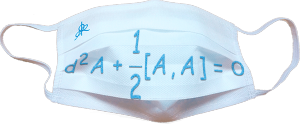
Equation chosen by Veronica Fantini, invited researcher, SISSA (Italy)
Veronica Fantini is a mathematician whose main research domains are Geometry and Mathematical Physics. She is visiting the Institute for 4 months.
“I choose the Maurer-Cartan equation d² A+½[A,A]=0, because depending on the contest and on the point of view it describes different objects. As the Maurer-Cartan equation has different interpretations, let’s look optimistically to 2021 even in this difficult time. “
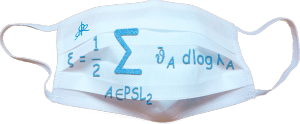
Equation chosen by Robert C. Penner, René Thom Chair holder and IHES major donor
Robert C. Penner is a mathematician who is also interested in physics and biology. His main research domains are moduli spaces and their applications to physics and biology. His current work is providing important insights for the development of vaccines against Covid and other viral diseases. Robert Penner has been a regular visitor to the Institute for many years and has been the René Thom Chair holder since 2014.
“I think it is a really cool equation, with a pretty collection of symbols!
This formula expresses the Maurer-Cartan form ξ of the Lie algebra I have built for the topological group of orientation-preserving homeomorphisms of the circle, which I have been studying for 30 years. In other terms, it is the universal generalization of the Eisenstein form E2 (z) dz in hyperbolic what are sometimes called Penner coordinates λA . I am just now finishing a paper with Igor Frenkel where this formula figures prominently as a universal automorphic form intended to capture the Monster.“
Euler’s Identity
Leonhard Euler is an 18th century Swiss mathematician and physicist. He made important discoveries in fields as varied as infinitesimal calculus and graph theory. He is considered one of the greatest and most prolific mathematicians of all time.
“Euler’s identity was voted “most beautiful mathematical formula of all time” in 1988 by a college of mathematicians.
It has the particularity of linking together the five great constants of mathematics: 0, 1, pi, e and i and according to Cédric Villani, “it is the unlikely combination of these five constants that makes this equation beautiful”.
Indeed, these constants have nothing in common a priori. Over the centuries, they have appeared in the great history of mathematics in very different contexts, to solve problems that at first sight had nothing in common.
It also presents elementary operations: multiplication, addition and equality.
It combines arithmetic, geometry, algebra and analysis in an extraordinarily condensed statement. »
The Alexzandria Figueroa and Robert Penner Chair established at the Institut des Hautes Etudes Scientifiques
A mathematician very close to the IHES, which he has been visiting regularly for more than 25 years, Prof. Penner wanted to pay tribute to his partner who died in January 2018.
A mathematician very close to the IHES, which he has been visiting regularly for more than 25 years, Prof. Penner wanted to pay tribute to his partner who died in January 2018. “I am a great believer in the Institute’s mission and am pleased to have associated our names to the IHES,” said Robert Penner. “Even with her only brief glimpse of it, Lexy was dazzled that there could be such a place as the IHES and would be gratified with this association.”
The gift will endow a triennial chair of Mathematics at the Institute that will provide support for prominent scientists. Chair holders are a specific type of invitations of IHES large visitors program: they are nominated by the Scientific Council, and come to the IHES for at least three months each year over three consecutive years, benefiting from the outstanding research and living conditions offered at the Institute.
“We are very grateful to Bob for his generous donation. It enables the IHES to fulfill its mission to offer exceptional scientists a place where their research can flourish,” said Michael R. Douglas, Chairman and President of the Friends of IHES, Inc.
“This generous gift from Bob is also an important contribution to our ongoing fundraising campaign, and I express my deepest gratitude for his support” said Emmanuel Ullmo, Director of the IHES. “Having scientists supporting our campaign is very meaningful and encourages us to pursue our efforts to defend the importance of unconstrained research.”
The first chair holder of the Alexzandria Figueroa and Robert Penner Chair will be Prof. Joseph Ayoub from the University of Zurich. A specialist of Algebraic Geometry, which has a long tradition at the IHES, Ayoub will benefit from all aspects of the academic and community life, that are unique elements of being at the Institute, and will contribute to the scientific dynamism of the IHES.
IHES launches its third fundraising campaign
The Institute’s third fundraising campaign, "IHES, at the avant-garde of science" was launched by Emmanuel Ullmo on 16 November 2018, during a ceremony presided over by the French Minister Frédérique Vidal, on the occasion of IHES' 60th anniversary.
The Institute’s third fundraising campaign, “IHES, at the avant-garde of science” was launched by Emmanuel Ullmo on 16 November 2018, during a ceremony presided over by Frédérique Vidal, the French Minister of Higher Education, Research and Innovation, on the occasion of IHES’ 60th anniversary. This new and ambitious fundraising project focuses on three key elements: “People, Place, Perpetuity”.
“People“, first of all, because, as it was emphasised by the Institute’s Director during his speech, people are at the heart of the IHES project. Concerning permanent professors, the objective is to go from 5 to 7 posts, a number that has not been achieved at the Institute since the 1970s.
Another flagship project of this campaign is the creation of junior positions, in order to provide young talents with an optimal working environment. Developing post-doctoral opportunities remains a priority. Finally, IHES wishes to continue offering associate and visiting professors optimal research conditions.
“Place” because IHES must maintain the high standard of its hosting facilities. Increasing the number of workspaces to match the increase in scientific activity is a vital necessity. The maintenance and development of the Ormaille residence is equally crucial, as the ability to provide accommodation to researchers from around the world is a key asset.
Finally, “Perpetuity” because enabling IHES to move closer to independence by increasing its endowed capital remains a key priority andwill ensurethat the Institute can continue to operate far into the future.
In order to meet the objectives of the “IHES, at the avant-garde of science” project, the Institute must raise €50 million: €30 million from the private sector, €20 million from public institutions (excluding the Ministry of Higher Education, Research and Innovation). The silent phase of the campaign, which began in May 2015, raised almost half this sum, including more than €14 million in donations from companies, individuals and foundations. In her speech, Frédérique Vidal highlighted the Institute’s remarkable success in bringing philanthropists together to support its mission over the past 20 years. “The primary reason for IHES having convinced socio-economic players to believe in it and invest in it is the fact that a passion for mathematics does not only concern scientists. Mathematics has that “strange beauty” of which David Ruelle speaks, which fascinates and charms”, she recalled.
The official launch of the third campaign, “IHES, at the avant-garde of science”, ended with the inauguration of a new building completely dedicated to research, with twelve offices and collaborative workspaces. The Institute has chosen to name the new building after Alix and Marwan Lahoud, to mark the close relationship between IHES and its Chairman, and to thank the Lahouds for their extraordinary generosity. “With their donation, Alix and Marwan Lahoud became the Institute’s biggest individual donors in France. I am convinced that their commitment will inspire our donor community,” said Philippe Camus, who co-chairs the fundraising campaign with Jean-Laurent Bonnafé.
Official ceremony for the Institute’s 60th anniversary celebrations
Presided by the Minister of Higher Education, Research and Innovation, Frédérique Vidal, the ceremony gathered many officials, scientists and supporters, who were there to express their commitment to the Institute.
The last event of IHES 60th Anniversary program took place on November 16. Presided by the Minister of Higher Education, Research and Innovation, Frédérique Vidal, the ceremony gathered many officials, scientists and supporters, who were there to express their commitment to the Institute.
In his speech, Emmanuel Ullmo honoured the visionary spirit of the founder, Léon Motchane, and the work of previous directors, Nicolaas Kuiper, Marcel Berger and Jean-Pierre Bourguignon. The Director presented his vision for the IHES and officially launched the Institute’s 3rd fundraising campaign. Live from his new-york Foundation, Jim Simons, Board Director of the IHES, reiterated his trust and support for the Institute’s scientific development. Marwan Lahoud, Chairman of the IHES Board of Directors, then thanked the Institute’s partners and expressed his satisfaction at contributing to the new campaign with his wife. Finally, the Minister praised the excellence of the IHES, emphasizing its ability to take risks: “The IHES does not recruit Fields medals,” she recalled, “it incubates them.”
Frédérique Vidal then inaugurated the Alix and Marwan Lahoud building. Launched in 2018, the construction of an annex to the science building had become necessary to handle the increasing activity, and to host in particular post-doctoral fellows. The Institute has chosen to name the new building “Alix and Marwan Lahoud” to express the deep bond between the IHES and its Chairman and to thank the Lahouds for their extraordinary generosity. The visit to this new research facility revealed the Grothendieck statue made by the artist Nina Douglas and donated by the Simons to the IHES.
The European Heritage Days at IHES were a great success
IHES opened its doors on September 17th on the occasion of the European Heritage Days
the occasion of the European Heritage Days IHES opened its doors on Saturday, September 17th. Almost 300 people explored the venue, our Bois-Marie, met some of the exceptional researchers that work at the Institute, visited an exhibition created for the occasion, and discovered some unpublished historical archives.
Laurent Lafforgue, mathematician, permanent professor since 2000 and Fields medallist in 2002, gave a talk on “The creativity in mathematics according to Grothendieck” and clarified the great mathematician’s take on the concept, stressing the importance it had for him.
Emmanuel Ullmo, the IHES Director, led the visitors through the different places where some of the most brilliant mathematicians of the last seventy years have discussed, devised and exchanged their ideas. The visit of the various places where the science happens at IHES was followed by an interactive presentation of the “Skolem, choc de blocs & chiffres au vent” sculpture, during which visitors could channel their inner mathematician.
The day ended with a roundtable discussion with Pierre Cartier and Alain Connes, Léon Motchane professor since 1979 and Field medallist in 1982, and moderated by Anne-Sandrine Paumier and Emmanuel Ullmo, whose theme was “Stories and interactions at IHES”.
The visitors then had the chance to explore the exhibition on the “IHES Scientific Heritage”, that summarised the history of IHES, starting from its early years and that included the presentation of unpublished historical archives.
The unpublished documents that were presented at the exhibition, as well as a selection of the historical archived documents of IHES, were digitised with the support of Diagonale Paris-Saclay.
IHES intensifies its post-doctoral program
On 15 September an induction day was organised at IHES to welcome the new post-docs
Giving young scientists the opportunity to continue their training and their work in an environment that fosters freedom of research and of intellectual exchange is at the heart of the IHES mission. Since the arrival of Emmanuel Ullmo at the head of the Institute, the number of post-doctoral researchers welcomed every year at IHES has increased.
During its December meeting, the Scientific Council selects a group of successful post-doctoral applications. The post-doctoral contracts, that last one or more years, can be part of specific programs, of collaboration projects involving several institutes, or they might belong to the IHES general invitation program.
This year the Institute welcomes nine new postdocs, for whom an induction day was organised on 15 September, whose aim was to introduce them to the Institute’s scientific environment. The young researchers that have joined IHES had the chance to meet their colleagues from the year before, as well as the director and some permanent professors.
The exchanges went on informally, in perfect agreement with the spirit of the Institute, which is to promote free, curiosity-driven research: this recipe has so far allowed some of the most brilliant ideas to be born and to grow at IHES. The Institute warmly welcomes this new group of young researchers!
IHES, a “temple for mathematicians” in Le Figaro (FRENCH ONLY)
Lieu unique au monde, l'Institut, créé en 1958, abrite l'élite des mathématiques et de la physique fondamentale. Avec tableaux noirs et craies. PAR Cyrille Vanlerberghe
« Lieu unique au monde, l’Institut, créé en 1958, abrite l’élite des mathématiques et de la physique fondamentale. Avec tableaux noirs et craies. » PAR Cyrille Vanlerberghe
Retrouvez le beau portrait publié en juillet 2016 dans le Figaro
IHES celebrates the closure of the 5 million-euro challenge gift from the Simons Foundation
The ceremony of completion of the 5m€ Challenge Gift from the Simons Foundation took place on May 20 in presence of Jim and Marilyn Simons, co-founders of the Simons Foundation.
The ceremony of completion of the 5m€ Challenge Grant from the Simons Foundation took place on May 20 in presence of Jim and Marilyn Simons, co-founders of the Simons Foundation.
This private dinner gathered 30 guests, including Jean-Claude Trichet, Marwan Lahoud, the physicist Thibault Damour and the mathematician Maxim Kontsevich.
Jean-Laurent Bonnafé and BNP Paribas hosted the event at Hôtel de Mondragon in the 2nd arrondissement of Paris.
This dinner celebrated also the recent one million euro gift from BNP Paribas to IHES, placing it among the first donors of IHES third fundraising campaign.
And also
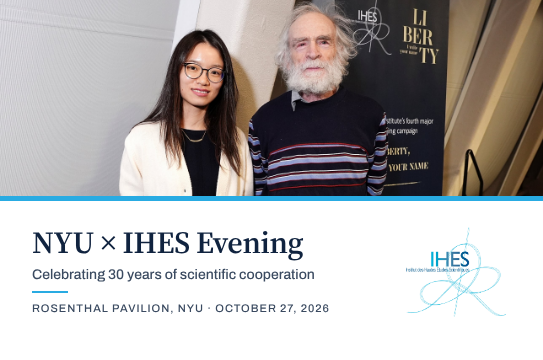
Dinner Celebrating 30 Years of Scientific Cooperation Between IHES and NYU
On Tuesday, October 27, 2026, Friends of IHES brought together its friends and supporters for a dinner at the Rosenthal Pavilion at New York University to celebrate 30 years of scientific cooperation between IHES and NYU, in the presence of Linda Mills, President of NYU, and Marilyn Simons, Chair of Friends of IHES.
Interview with Christophe Soulé, CNRS Emeritus Research Director at IHES and member of the French Academy of Sciences, conducted in May 2025 by Pierre Pansu, Professor of Mathematics Emeritus at Université Paris-Saclay.
Nous utilisons les cookies pour améliorer votre expérience sur notre site Web. En parcourant ce site, vous acceptez notre utilisation des cookies.
We use cookies to enhance your experience on our website. By browsing this site, you agree to our use of cookies.
This website uses cookies to improve your experience while you navigate through the website. Out of these, the cookies that are categorized as necessary are stored on your browser as they are essential for the working of basic functionalities of the website. We also use third-party cookies that help us analyze and understand how you use this website. These cookies will be stored in your browser only with your consent. You also have the option to opt-out of these cookies. But opting out of some of these cookies may affect your browsing experience.



 Arthur Parzygnat is a mathematician whose main research domains are Applied Category Theory, Mathematical Physcics and quantum information. He has been a postdoctoral researcher at IHES for a year and a half and is part of the

 Katie Vokes is a mathematician whose main research domains are Geometric Group Theory and Low-Dimensional Topology. She has been a postdoctoral researcher for almost two years and is part of the

 Veronica Fantini is a mathematician whose main research domains are Geometry and Mathematical Physics. She is visiting the Institute for 4 months.


 Leonhard Euler is an 18th century Swiss mathematician and physicist. He made important discoveries in fields as varied as infinitesimal calculus and graph theory. He is considered one of the greatest and most prolific mathematicians of all time.
 The unpublished documents that were presented at the exhibition, as well as a selection of the historical archived documents of IHES, were digitised with the support of Diagonale Paris-Saclay.