Day in Honor of Yvonne Choquet-Bruhat’s 100th Birthday
December 2023 marks Yvonne Choquet-Bruhat's 100th birthday. For this special occasion, IHES organizes a day in her honor on December 8, 2023.
December 2023 marks Yvonne Choquet-Bruhat’s 100th birthday. For this special occasion, IHES organizes a day in her honor on December 8, 2023.
Yvonne Choquet-Bruhat’s work has had a long-lasting impact on the field of mathematical relativity starting with her seminal 1952 paper on the local well-posedness of Einstein equations. Her numerous contributions, both to constraint equations and to the evolution problem in general relativity, have deeply influenced several generations of researchers. This special day in her honor will be the occasion to present some of the latest developments in the field.
Celebration of the Centenary of Louis Michel’s Birth (1923-1999)
This year 2023 marks the centenary of the birth of Louis Michel, the first Professor of Theoretical Physics at the IHES. On this occasion, Thibault Damour and Slava Rychkov organize a one-day commemoration on May 15, 2023, at IHES.
The year 2023 marks the centenary of the birth of Louis Michel, the first Professor of Theoretical Physics at IHES. On this occasion, Thibault Damour and Slava Rychkov organize a one-day commemoration on May 15, 2023, at IHES.
Several presentations will be given by lecturers linked to Louis Michel or to his work:
Jean-Pierre Bourguignon, CNRS-IHES
Henri Epstein, CNRS-IHES
Denis Gratias, CNRS-Institut de Recherche de Chimie Paris
Louis Michel (1923-1999),
Permanent Professor at IHES from 1962 to 1992.
Louis Michel was the first Permanent Professor in Theoretical Physics at IHES, which he joined in 1962. His scientific work made pioneering contributions in a wide area of theoretical physics, ranging from particle physics to crystallography. At IHES, Louis Michel found an appropriate setting to develop the leitmotiv of his scientific work: to deepen the mathematical roots underlying the symmetries of the laws of nature.
For a detailed analysis of Louis Michel’s scientific work, see the website created on the occasion of his 90th birthday, and the book Symmetries in Nature: The Scientific Heritage of Louis Michel (World Scientific Series in 20th Century Physics) edited by Thibault Damour, Ivan Todorov and Boris Zhilinskii (2014).
The main themes of his research at IHES – and his main collaborators – are:
Relations between internal symmetries and relativistic invariance,
Theory of spontaneous symmetry breaking and its application to high energy physics and the Jacobi ellipsoid, with Luigi A. Radicati, then to condensed matter physics, with Maurice Kléman and Gérard Toulouse,
A general formalism for the description of the polarization of particles of any spin, with Manuel G. Doncel and Pierre Minnaert,
Mathematical crystallography and representation of crystallographic groups, with Jan Mozrzymas and Boris Zhilinskii,
New applications of symmetry to energy bands in solids, with Joshua Zak,
The geometry of Euclidean lattices, with Marjorie Senechal.
Louis Michel played a significant role in the reconstruction of French Theoretical Physics in the 1950s. The list of his students bears witness to this in a striking way: Claude Bouchiat, Claude de Calan, Manuel Doncel, Henri Epstein, Gérard Flamand, Dimitri Fotiadi, Gérard Fuchs, Jean-Loup Gervais, Pierre Minnaert, Jean Nuyts, Eduardo de Rafael, Houcheng Rouhaninejad (= Henri Roane), Roland Seneor, Paul Sorba, and Raymond Stora (last in alphabetical order but first in chronological order).
Observation of a dynamical capture of two black holes
A group of researchers connected to IHES has recently suggested that an enigmatic gravitational wave could have been generated by the dynamical capture of two heavy black holes in a dense stellar environment.
A group of researchers, some of whom are connected to IHES, has recently suggested that an enigmatic gravitational wave event, different from the ones observed so far, could have been generated by the dynamical capture of two heavy black holes in a dense stellar environment.
The team includes Alessandro Nagar, former holder of the Chair of Cosmology and Astrophysics, as well as former visiting researchers Sebastiano Bernuzzi, Piero Rettegno, Rossella Gamba, Simone Albanesi, and Gregorio Carullo. The gravitational wave signal they have been working on is GW190521, which was detected by the LIGO and Virgo observatories in 2019.
The idea came from a very sophisticated data analysis carried out under the lead of Prof. Sebastiano Bernuzzi (FSU Jena) and Dr. Alessandro Nagar (INFN Torino). Their respective groups developed a general-relativistic framework for highly eccentric black hole mergers and performed an in-depth analysis of the observational data.
No dynamical capture models had ever been employed in gravitational wave data analysis before, meaning that the analysis required extreme care and considerable computational power.
Alessandro Nagar held the Chair of Cosmology and Astrophysics at IHES and was at the Institute between 2007 and 2016. He has been a frequent visitor to IHES ever since.
Simone Albanesi, Sebastiano Bernuzzi, Gregorio Carullo, Rossella Gamba , Alessandro Nagar, and Piero Rettegno visited IHES in 2022 and have collaborated with Thibault Damour, permanent professor at IHES, who participated in some of the discussions that led to these results. Some of these visits were funded thanks to the support of the Balzan Prize Foundation, thus contributing to train a new generation of physicists in GW astronomy, in the full spirit of the Balzan Prize.
IHES warmly congratulates the group on these important results!
The spacetime curvature around merger moment obtained via numerical relativity simulations.
[1] Gamba, R., Breschi, M., Carullo, G. et al. GW190521 as a dynamical capture of two nonspinning black holes. Nat Astron (2022). https://doi.org/10.1038/s41550-022-01813-w
Publication of the last results of the MICROSCOPE mission
The last results of the MICROSCOPE mission confirm the equivalence principle with an unprecedented precision.
The last results of the MICROSCOPE mission (MICROSatellite à trainée Compensée pour l’Observation du Principe d’Équivalence) were published on September 14, 2022 and confirm the equivalence principle with an unprecedented precision of 10-15. This result confirms once again the theory of General Relativity proposed by Albert Einstein.
Launched in 2016, a century after the publication of Einstein’s theory, the MICROSCOPE mission aims to test the equivalence principle between inertia and gravitation, a fundamental pillar of General Relativity, postulating that all bodies fall in the same way in the vacuum.
The violation of the equivalence principle is predicted by some unification theories between gravitation and quantum physics. In particular, a weak but non-zero violation of the equivalence principle by the dilaton in string theory has been predicted by recent work studying the mechanism of cosmological attraction [1,2] – hence the importance of testing the equivalence principle with high precision.
The mission was designed by the Office National d’Etudes et de Recherches Aérospatiales (ONERA), in collaboration with the Observatoire de la Cote d’Azur (OCA), the CNES (Centre National d’Etudes Spatiales) and the ZARM (Bremen, Germany). Thibault Damour, a permanent professor at IHES and one of the world’s leading experts on gravitation, is a Member of the Microscope Science Working Group and was one of its initiators.
MICROSCOPE uses very advanced technologies to compare the free fall acceleration of two bodies of different compositions, one made of platinum, the other of titanium. The whole thing takes place aboard a satellite that orbited the Earth from April 2016 until October 2018, making 1,642 revolutions and thus traveling 73 million km, equivalent to half the Earth-Sun distance.
Preliminary results were published in 2017 – this was already a confirmation of the equivalence principle with unparalleled accuracy that allowed the mission’s co-investigators and project leaders to win the 2019 Grand Prix Servant of the French Academy of Sciences.
The analysis of the data collected during two and a half years by the ONERA and OCA scientific teams, with the contribution of CNES and the collaboration of European laboratories, was published on September 14, 2022 in two prestigious journals: Physical Review Letters, and Classical and Quantum Gravity. These latest results push the limits of the accuracy of the equivalence principle test even further.
With its results, MICROSCOPE provides important constraints on new theories of gravitation at a level of precision that researchers expect to remain unmatched for a long time.
“Damour Fest: Adventures in Gravitation”, a conference in honor of Thibault Damour
The conference, organized by Professors Nathalie Deruelle, Alessandro Nagar, and Slava Rychkov took place at IHES from October 12 to 15, depending on health conditions.
Damour Fest
Adventures in Gravitation
To celebrate the 70th birthday of Thibault Damour, permanent professor at IHES since 1989, a “Damour Fest”, gathering friends with whom he enjoys interacting around Gravitational Physics and beyond, was held at IHES from Tuesday 12 October afternoon to Friday 15 October 2021 noon. It was organised by Nathalie Deruelle (APC, Université de Paris), Alessandro Nagar (INFN Torino) and Slava Rychkov (IHES).
The following speakers talked (a few remotely) on topics of their choice reflecting their current interest:
– Leor Barack, University of Southampton
– Sebastiano Bernuzzi, University of Jena
– Lydia Bieri, Michigan University
– Luc Blanchet, IAP, Paris
– Alessandra Buonanno, AEI, MPI, Potsdam – Sophie De Buyl, Vrije Universiteit Brussel
– Stanley Deser, Brandeis University
– Marc Henneaux, Collège de France & ULB Bruxelles
– Bala Iyer, ICTS, TIFR, Bangalore
– Piotr Jaranowski, University of Białystok
– Sergiu Klainerman, Princeton University
– Michael Kramer, MPI, Bonn
– Juan Maldacena, IAS, Princeton
– Viatcheslav Mukhanov, Ludwig Maximilian University, Munich
– Hermann Nicolai, AEI, MPI, Potsdam
– Adam Pound, University of Southampton
– Giuseppe Policastro, ENS Paris
– Alexander Polyakov, Princeton University
– Manuel Rodrigues, ONERA, Université Paris-Saclay
– Remo Ruffini, ICRA, Rome
– David Shoemaker, MIT
– Sergey Solodukhin, University of Tours
– Alexei Starobinski, Landau Institute, Moscow
– Gabriele Veneziano, CERN & Collège de France
– Alex Vilenkin, Tufts University
– Edward Witten, IAS, Princeton
To apply, get more information about the schedule, and be informed of the latest actions, visit the conference web page.
The conference was held in a blended form, with talks given on-site at IHES and others remotely through Zoom. All the talks could be followed either online or on-site (subject to availability).
Covid-19 regulations: for those who will attend in person, masks will be mandatory and we will ask them to provide a health pass upon their arrival.
Find all the videos of the Damour Fest:
Thibault Damour is awarded the 2021 Balzan Prize
Thibault Damour and Alessandra Buonanno have received the 2021 Balzan Prize in the field of “Gravity: Physical and Astrophysical Aspects”, awarded by the International Balzan Prize Foundation.
The prize acknowledges “their leadership in the prediction of the gravitational wave signals produced when compact objects like neutron stars and black holes spiral together and eventually merge. Their work was instrumental in the detection of gravitational waves, providing an extremely accurate confirmation of General Relativity as the theory of gravitation, and allowing the LIGO and Virgo detector complex to promote a type of astronomy which uses gravitational waves as new, powerful messengers of the universe.” – the Foundation explained in a press release on September 13.
Every year, the Foundation awards four Balzan Prizes, two in the category “Literature, Moral Sciences and the Arts”, and two in “the Physical, Mathematical and Natural Sciences and Medicine”. The awards are given to scholars, artists and scientists who have achieved international recognition in their field. Since 2001, the Balzan Foundation asks that prize winners use half of the prize to finance research projects carried out by young scholars or scientists.
This is already the third prize that Thibault Damour and Alessandra Buonanno have received this year, together with the Galileo Galilei Medal and the Dirac Medal, highlighting the importance of their theoretical work in the detection of gravitational waves.
IHES congratulates them on this prestigious recognition and is proud of being the birthplace of their collaboration started at the end of the 1990s, when Prof. Buonanno was a postdoctoral researcher at IHES.
Thibault Damour is awarded the 2021 Dirac Medal
Professor Thibault Damour is one of the four recipients of this year’s Dirac Medal, together with Alessandra Buonanno, Frans Pretorius, and Saul Teukolsky.
Professor Thibault Damour is one of the four recipients of this year’s Dirac Medal, together with Alessandra Buonanno (Max Planck Institute for Gravitational Physics), Frans Pretorius (Princeton University), and Saul Teukolsky (Caltech & Cornell University).
The prize acknowledges the four physicists’ theoretical contributions “establishing the predicted properties of gravitational waves in the curvature of spacetime produced when stars or black holes spiral together and merge”. Their work has been key to the detection of gravitational waves by the LIGO and Virgo collaborations since the gravitational signal produced by a collision of binary black holes was detected for the first time in 2015.
The Dirac Medal is awarded every year by ICTP, the Abdus Salam International Centre for Theoretical Physics, to scientists who have made significant contributions to theoretical physics.
Earlier this year Thibault Damour, Alessandra Buonanno and Frans Pretorius were awarded the 2021 Galileo Galilei Medal by the Italian Istituto Nazionale di Fisica Nucleare.
IHES warmly congratulates Prof. Damour and his colleagues on this prestigious award, which is yet another recognition of the importance of their theoretical work.
Thibault Damour awarded the 2021 Galileo Galilei Medal
Thibault Damour, permanent professor at IHES since 1989, is one of the three recipients of the Galileo Galilei Medal, together with physicists Alessandra Buonanno and Frans Pretorius.
Thibault Damour, permanent professor at IHES since 1989, is one of the three recipients of the Galileo Galilei Medal, together with physicists Alessandra Buonanno and Frans Pretorius “for the fundamental understanding of sources of gravitational radiation by complementary analytic and numerical techniques, enabling predictions that have been confirmed by gravitational wave observations and are now key tools in this new branch of astronomy”.
The prize thus recognizes the importance of the three researchers’ theoretical and numerical studies describing the behavior of coalescing black holes, that have been instrumental to the analysis of experimental data obtained by the gravitational wave detectors LIGO and by the Virgo Collaboration.
Prof. Buonanno, who is now the director of the “Astrophysical and Cosmological Relativity” Department at the Max Planck Institute for Gravitational Physics in Potsdam, was a post-doctoral researcher at IHES, when she worked with Prof. Damour to develop a new analytical model for binary black holes in 1998.
“Our model predicted that the spiraling process releases an enormous amount of gravitational radiation and provided the first analytical estimate of the full gravitational wave emitted during the last orbits and the coalescence of the two black holes,” explains Prof. Damour.
Prof. Pretorius, professor of physics at Princeton University and director of the Princeton Gravity Initiative, got interested in binary black holes in 2005 and came up with a first numerical solution to describe what happens when two black holes collide.
“The theoretical studies of Buonanno, Damour and Pretorius were fundamental for the start of a new era of gravitational astronomy and I am sure they will give even further prestige to the Galileo Galilei Medal,” explains Stefania De Curtis, the Director of the Galileo Galilei Institute in Arcetri, Italy, which together with the Italian National Institute for Nuclear Physics (INFN) and the University of Florence, participates in awarding the Prize. The Galileo Galilei Medal is awarded every two years to researchers who have made outstanding and seminal contributions to the advancement of research in theoretical physics. The Prize was created in 2019 and its first recipient is physicist Juan Martin Maldacena, member of the Institute for Advanced Study, Princeton.
After such a special year, IHES intends to emphasize through its greeting card the importance of exchanges, transmission and dissemination of knowledge.
For researchers, moments of sharing, both formal and informal, are essential. However, in 2020, it has been a real challenge to find the means and formats to preserve a scientific dialogue and the quality of the links with collaborators and colleagues.
This greeting card therefore aims to pay tribute to the researchers who, throughout the world, have adapted, tested new tools and explored alternative approaches, always with a view to maintaining and fostering their exchanges, to facilitate the blossoming and circulation of ideas that will lead to tomorrow’s discoveries and advances.
The Institute’s scientists who wished to do so – permanent and associate professors, invited researchers, postdoctoral and doctoral students – have thus chosen an equation that had a particular meaning for them. Those equations appear on the greetings card, alongside a famous Euler formula, often presented as one of the most beautiful equations in mathematics. You will find below a short presentation of the scientists who participated, as well as their explanations of their choice of equation.
Equation chosen by Thibault Damour, permanent professor at IHES since 1989
Thibault Damour is a theoretical physicist whose main research domains are General Relativity and Cosmology. His work was notably fundamental in the detection of the gravitational waves in 2015.
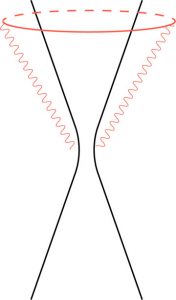
This equation concerns the scattering angle between two classical point masses (for example two black holes) interacting gravitationally according to Einstein’s theory. It says that when we add the effect of gravitational damping on the scattering angle, the result admits a high energy limit (HE) which coincides with the angle obtained with the so-called “eikonal” quantum approximation.
This physical process is illustrated in the figure on the right, which is a space-time diagram showing the collision (at a distance) of two black holes producing gravitational waves.”
Equation chosen by Arthur Parzygnat, postdoctoral researcher
Arthur Parzygnat is a mathematician whose main research domains are Applied Category Theory, Mathematical Physcics and quantum information. He has been a postdoctoral researcher at IHES for a year and a half and is part of the ERC QUASIFT led by Vasily Pestun.
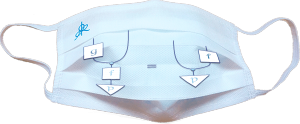
“This equation is called “Bayes’ rule/theorem,” though it is more common to see it written as P(A|B)P(B)=P(B|A)P(A). It is used to make inferences on outcomes based on evidence, such as diagnosing illnesses, it is the foundation of many machine learning algorithms, and some believe it drives how intelligent beings make decisions. The diagram drawn here is a recent categorical reformulation of Bayes’ rule, which does not rely on its probabilistic interpretation. Such a viewpoint allows one to use the more abstract concept as a definition (as opposed to a theorem) in a completely new context, where an equation such as P(A|B)P(B)=P(B|A)P(A) might not make any sense, but the diagram does. Considering how ubiquitous Bayes’ rule has been, it is very possible that we have only scratched the surface with its applications. What new insight can such a reformulation teach us? Where can it be utilized, and how can we interpret it?”
Equation chosen by Katie Vokes, postdoctoral researcher
Katie Vokes is a mathematician whose main research domains are Geometric Group Theory and Low-Dimensional Topology. She has been a postdoctoral researcher for almost two years and is part of the Huawei Young Talents Programme since October 2020.
“This equation is the statement of the Gauss–Bonnet theorem for a surface M without boundary. This is a beautiful and fundamental result in differential geometry which relates the integral of the curvature K of M to the Euler characteristic χ(M) = 2 − 2 genus(M). The Gauss–Bonnet formula encodes the answers to so many basic questions that we might have while thinking about surfaces. Why must any two hyperbolic surfaces (constant curvature K ≡ −1) of genus 5 have the same area? And why can’t we make a genus 2 surface out of a flat piece of paper without introducing singular non-manifold points? “
Equation chosen by Emmanuel Ullmo, Director of IHES
Emmanuel Ullmo is a mathematician whose research domain is Algebraic and Arithmetic Geometry.
“Let E be a (modular) elliptic curve defined over Q, the field of rational numbers. In the early 80’s, two mathematicians, Bryan Birch and Peter Swinnerton-Dyer, proposed this formula where r denotes the algebraic rank of E, which is assumed to be equal to the analytic rank of E, and X(E/Q) is also assumed to be finite.
Open for more than forty years, the conjecture has only been demonstrated in special cases. And widely recognized as one of the most difficult and deepest mathematical problems still open at the beginning of the 21st century. “
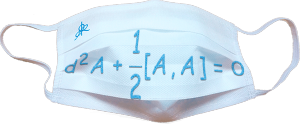
Equation chosen by Veronica Fantini, invited researcher, SISSA (Italy)
Veronica Fantini is a mathematician whose main research domains are Geometry and Mathematical Physics. She is visiting the Institute for 4 months.
“I choose the Maurer-Cartan equation d² A+½[A,A]=0, because depending on the contest and on the point of view it describes different objects. As the Maurer-Cartan equation has different interpretations, let’s look optimistically to 2021 even in this difficult time. “
Equation chosen by Robert C. Penner, René Thom Chair holder and IHES major donor
Robert C. Penner is a mathematician who is also interested in physics and biology. His main research domains are moduli spaces and their applications to physics and biology. His current work is providing important insights for the development of vaccines against Covid and other viral diseases. Robert Penner has been a regular visitor to the Institute for many years and has been the René Thom Chair holder since 2014.
“I think it is a really cool equation, with a pretty collection of symbols!
This formula expresses the Maurer-Cartan form ξ of the Lie algebra I have built for the topological group of orientation-preserving homeomorphisms of the circle, which I have been studying for 30 years. In other terms, it is the universal generalization of the Eisenstein form E2 (z) dz in hyperbolic what are sometimes called Penner coordinates λA . I am just now finishing a paper with Igor Frenkel where this formula figures prominently as a universal automorphic form intended to capture the Monster.“
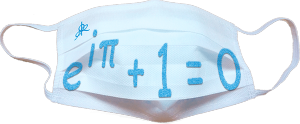
Euler’s Identity
Leonhard Euler is an 18th century Swiss mathematician and physicist. He made important discoveries in fields as varied as infinitesimal calculus and graph theory. He is considered one of the greatest and most prolific mathematicians of all time.
“Euler’s identity was voted “most beautiful mathematical formula of all time” in 1988 by a college of mathematicians.
It has the particularity of linking together the five great constants of mathematics: 0, 1, pi, e and i and according to Cédric Villani, “it is the unlikely combination of these five constants that makes this equation beautiful”.
Indeed, these constants have nothing in common a priori. Over the centuries, they have appeared in the great history of mathematics in very different contexts, to solve problems that at first sight had nothing in common.
It also presents elementary operations: multiplication, addition and equality.
It combines arithmetic, geometry, algebra and analysis in an extraordinarily condensed statement. »
Three of Thibault Damour’s publications highlighted in Physical Review D
Physical Review D has recently highlighted three of Thibault Damour’s publications where the dynamics of binary black-holes is calculated with unprecedented accuracy by using novel theoretical methods developed with his collaborators.
Physical Review D has recently highlighted three of Thibault Damour’s publications where the dynamics of binary black-holes is calculated with unprecedented accuracy by using novel theoretical methods recently developed by him and his collaborators. Their work might be crucial to interpret gravitational wave signals coming from upgraded detectors whose activity will start in 2022.
Two of these papers were the result of a fruitful collaboration with Donato Bini and Andrea Geralico (Italian National Research Council). Much of their interactions took place at IHES, where Donato Bini has been a frequent visiting professor since 2011.
An article by Jan Steinhoff and Justin Vines (Max Planck Institute for Gravitational Physics) provides an overview of Prof. Damour and his collaborators’ work and describes the scope and impact of the three highlighted publications.
“Thibault Damour from the Institute of Advanced Scientific Studies (IHES) in France and colleagues have sparked unanticipated progress in theoretical gravitational-wave predictions [1–3]. Their latest work shows that there exists a computational shortcut for the generic scattering problem by considering a special limit where one black hole weighs much less than the other.”
Gravitational waves from binary neutron stars detected
IHES congratulates the LIGO/Virgo project team which announced, on October 16th, the first observation of a gravitational wave signal from the merging of a system of two neutron stars.
The observation of gravitational waves from binary neutron stars opens the way to new science.
IHES congratulates the LIGO/Virgo project team which announced, on October 16th, the first observation of a gravitational wave signal from the merging of a system of two neutron stars. The detection was jointly made on August 17th by the two LIGO interferometers, located in the US, and by Virgo, a third Franco-Italian interferometer that joined the network on August 1st. This was the strongest, closest and most precisely localized gravitational wave signal detected so far and it was accompanied by electromagnetic signals in all wavelengths. It is the first time that such an event is seen both in gravitational and electromagnetic waves, thus marking the start of multi-messenger astronomy.
A gravitational wave signal from Binary Neutron Stars
Five gravitational wave signals were observed since September 2015. Four of them originated from the coalescence of Binary Black Holes. The LIGO-Virgo network has now observed the gravitational signal generated by binary neutron stars, as they spiraled together before colliding. Neutron stars are small but extremely dense objects, essentially constituted of neutrons. The ~100s long gravitational wave signal allowed for the measurements of the masses, thereby establishing the nature of the two colliding objects. Two seconds after the end of the gravitational wave signal a gamma-rays burst, lasting only a few seconds, was observed. This prompt electromagnetic emission was followed, 11 hours later, by an optical signal of the kilonova type. It is the first time that such a multi-messenger observation is made.
Many relevant theoretical results obtained at IHES IHES is particularly pleased to note that some of the theoretical research started or undertaken here contributed to the discovery made by the LIGO/Virgo team. On the one hand, the development of the Multipolar Post-Minkowskian Method (L. Blanchet, T. Damour, B. R. Iyer) has led to the analytical description of the gravitational wave signal during the inspiral phase, which was used to extract physical parameters from the noisy raw data. On the other hand, the Effective One Body (EOB) method (A. Buonanno, T. Damour, 2000) was extended to account for the effect of the tidal deformability of the two neutron stars, which becomes increasingly important as the two objects get closer (T. Damour, A. Nagar 2009; S. Bernuzzi, A. Nagar, T. Dietrich, T. Damour, 2015). This tidal extension of the EOB model might allow, in the near future, to extract precise quantitative information about the equation of state of nuclear matter (T. Damour, A. Nagar, L. Villain, 2012).
IHES particularly congratulates Alessandro Nagar (Raymond And Beverly Sackler Visiting Chair at IHES), now a member of the Virgo collaboration, for being one of the authors of the discovery paper (PRL 119, 16 October 2017).
And also
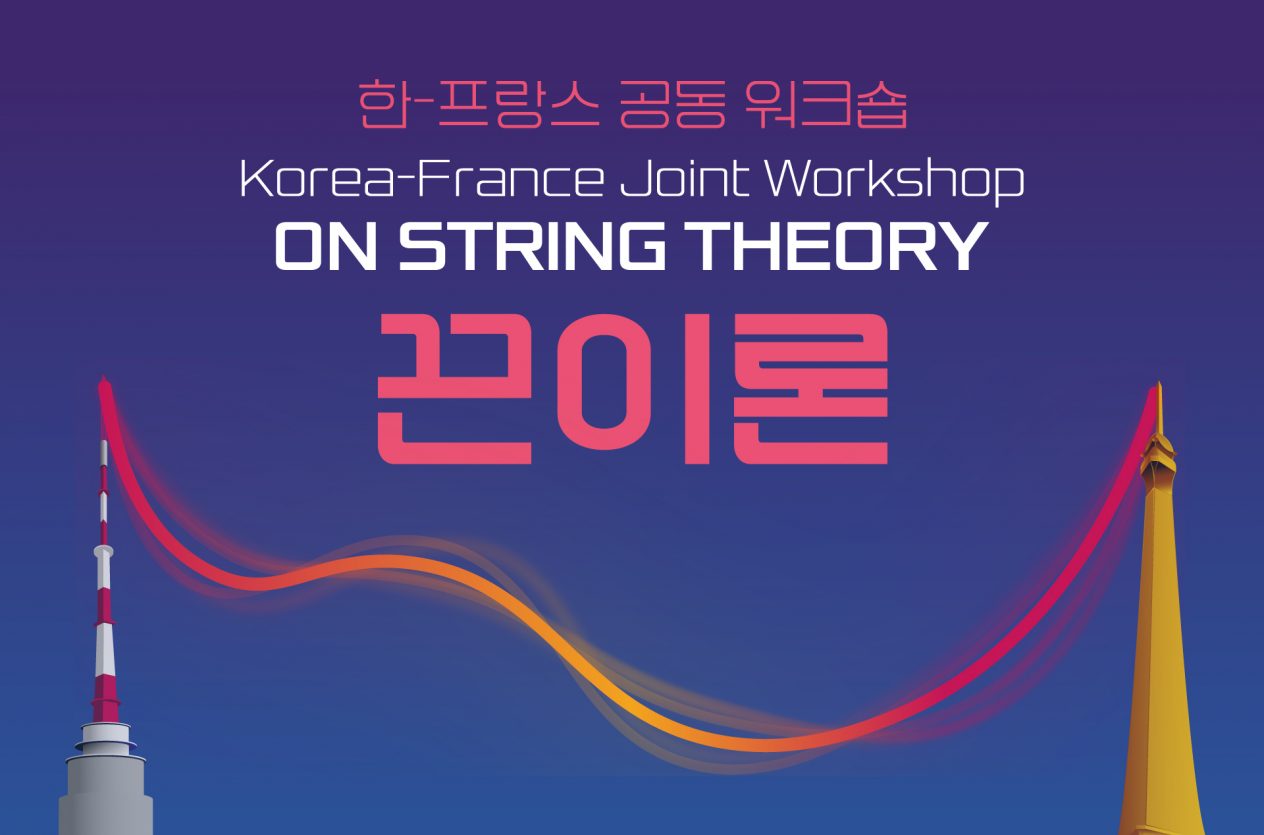
Korea-France Joint Workshop on String Theory
From September 15 to 18, Piljin Yi (KIAS), Sangmin Lee (KIAS), Sungjay Lee (KIAS), Ruben Minasian (IPhT, CEA Saclay), Julio Parra Martinez (IHES) and Eric Perlmutter (IPhT, CEA Saclay) will organize a Korean-French Workshop on String Theory.
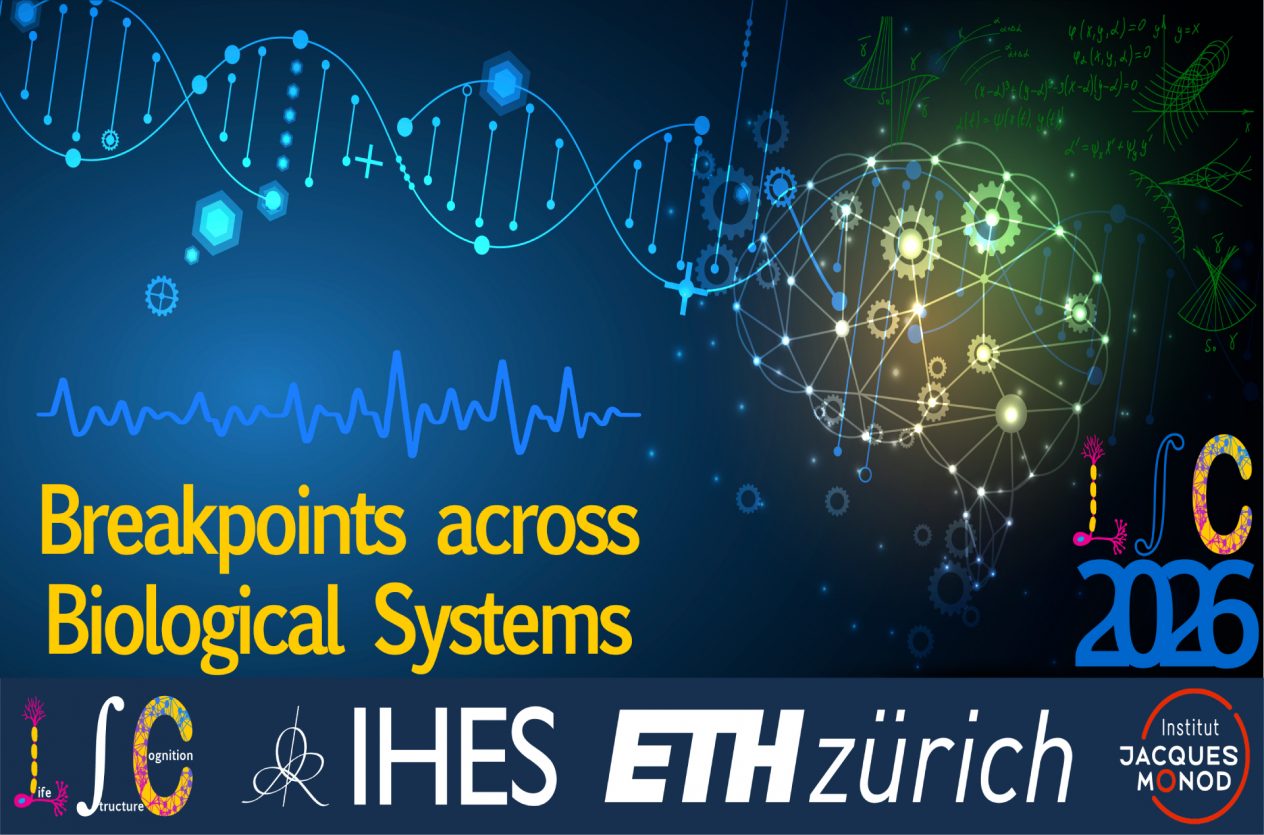
Life, Structure and Cognition (LSC) 2026: Breakpoints across Biological Systems
LSC, pour Life, Structure, and Cognition (Vie, Structure et Cognition) is an initiative with the aim of learning about and exploring the modalities for cooperative progress between Biology and Artificial Intelligence. June 22-25 for the 2026 LSC.
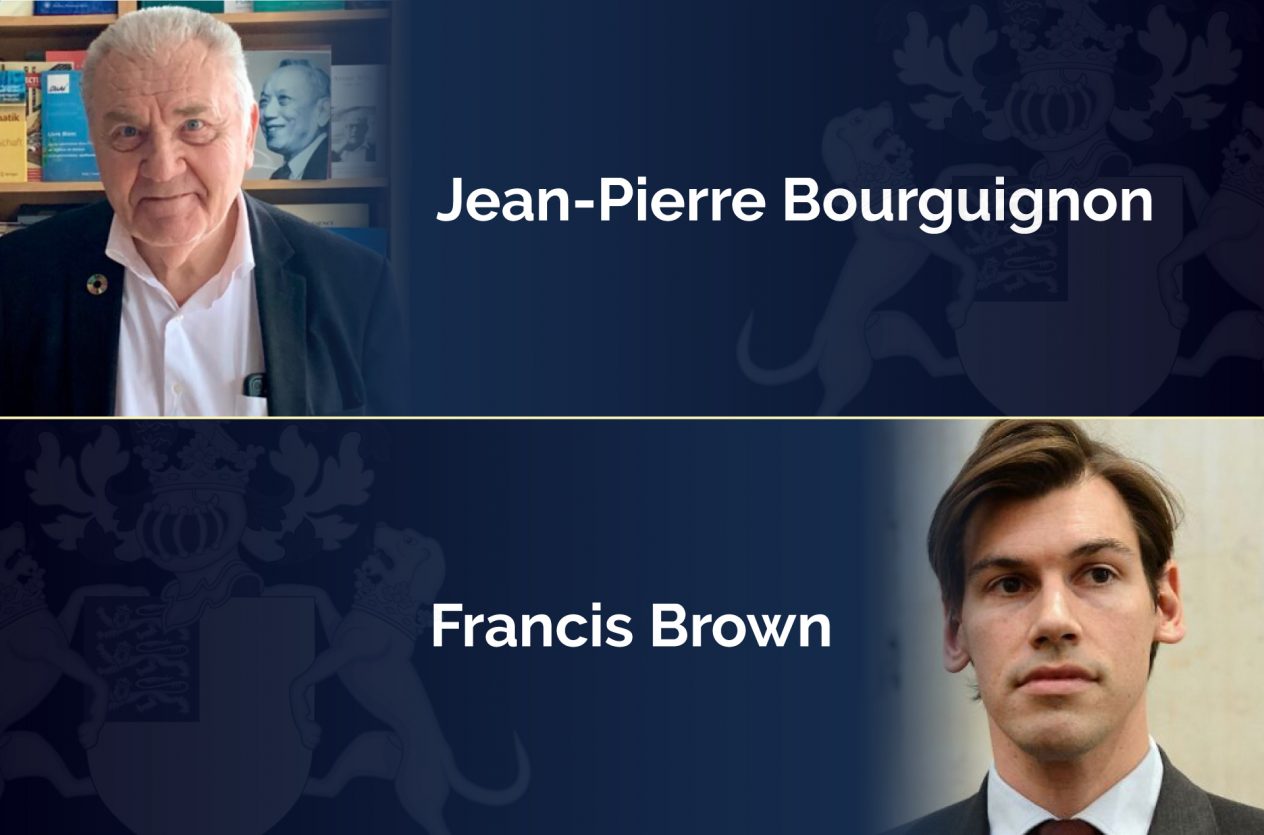
Jean-Pierre Bourguignon and Francis Brown elected Fellows of The Royal Society
IHES is proud to share that Jean-Pierre Bourguignon, former Director of IHES, and Francis Brown, former CNRS Researcher at IHES, have been elected Fellows of The Royal Society.
Nous utilisons les cookies pour améliorer votre expérience sur notre site Web. En parcourant ce site, vous acceptez notre utilisation des cookies.
We use cookies to enhance your experience on our website. By browsing this site, you agree to our use of cookies.
This website uses cookies to improve your experience while you navigate through the website. Out of these, the cookies that are categorized as necessary are stored on your browser as they are essential for the working of basic functionalities of the website. We also use third-party cookies that help us analyze and understand how you use this website. These cookies will be stored in your browser only with your consent. You also have the option to opt-out of these cookies. But opting out of some of these cookies may affect your browsing experience.

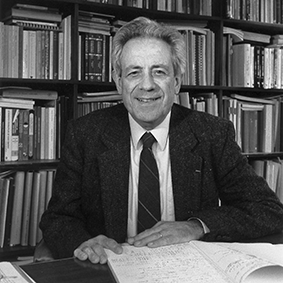 Louis Michel was the first Permanent Professor in Theoretical Physics at IHES, which he joined in 1962. His scientific work made pioneering contributions in a wide area of theoretical physics, ranging from particle physics to crystallography. At IHES, Louis Michel found an appropriate setting to develop the leitmotiv of his scientific work: to deepen the mathematical roots underlying the symmetries of the laws of nature.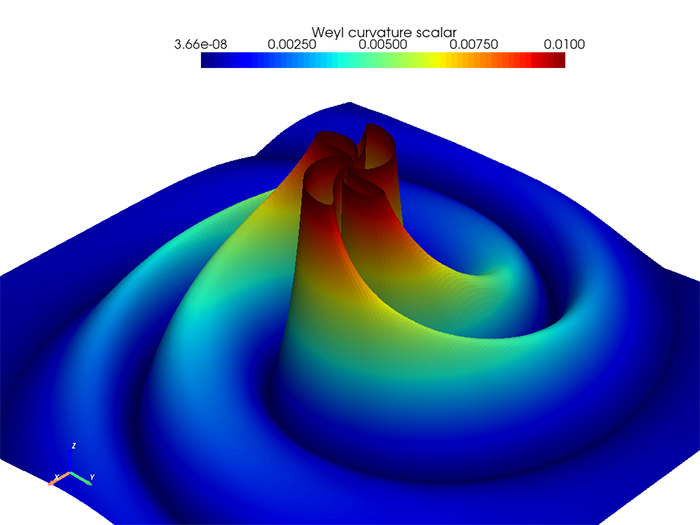


 Arthur Parzygnat is a mathematician whose main research domains are Applied Category Theory, Mathematical Physcics and quantum information. He has been a postdoctoral researcher at IHES for a year and a half and is part of the
 Katie Vokes is a mathematician whose main research domains are Geometric Group Theory and Low-Dimensional Topology. She has been a postdoctoral researcher for almost two years and is part of the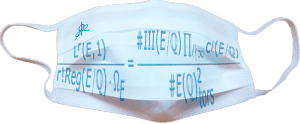

 Veronica Fantini is a mathematician whose main research domains are Geometry and Mathematical Physics. She is visiting the Institute for 4 months.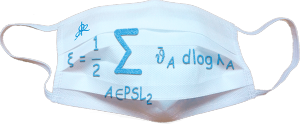

 Leonhard Euler is an 18th century Swiss mathematician and physicist. He made important discoveries in fields as varied as infinitesimal calculus and graph theory. He is considered one of the greatest and most prolific mathematicians of all time.